

financial wellness
More Americans Joining Workforce, But Many Are Unable to Find Living-Wage Jobs

Last Updated on September 19, 2025 by Daily News Staff
WASHINGTON, Sept. 15, 2022 /PRNewswire/ — The American workforce expanded from July to August, but many of those workers found they were unable to secure Living-Wage Jobs, according to an analysis by the Ludwig Institute for Shared Economic Prosperity (LISEP).
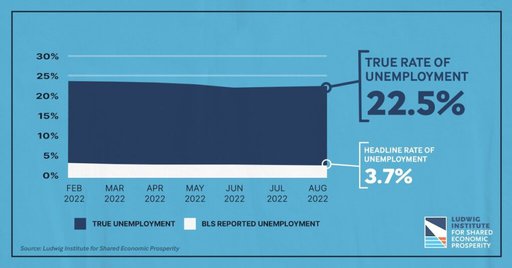
In its monthly True Rate of Unemployment (TRU) for August, LISEP reported that 22.5% of American workers are now classified as “functionally unemployed,” defined as the jobless, plus those seeking but unable to secure full-time employment, even if they want to work full-time and/or cannot earn above the poverty line after adjusting for inflation. This is an increase of 0.2 percentage points over the July TRU.
TRU’s sister metric, TRU Out of the Population (TRU OOP) – a measure of those who are functionally unemployed out of the entire population, not just active workforce participants – remained unchanged, which, when coupled with a rising TRU, indicates more workers are joining or returning to the labor force.
“It is a net positive that previously discouraged workers are rejoining the workforce, but unfortunately, their return to the workforce is, in many cases, not a return to full-time, living-wage employment,” said LISEP founder and chair Gene Ludwig. “The challenge for policymakers is to continue to encourage positive growth in employment opportunities, but do so in a manner that provides for growth in living-wage jobs for every American who wants one.”
Demographically, Black workers saw the biggest jump in TRU, increasing by 0.6 percentage points, from 25.8% to 26.4%. This, with the Black TRU OOP climbing by 0.7 percentage points, indicates that a larger percentage of Black workers are classified as functionally unemployed. Hispanic workers saw no change in the TRU, holding steady at 26.3%, with White workers tracking the overall TRU and increasing by 0.2 percentage points, to 20.7%. Male TRU increased a full percentage point, from 17.5% to 18.5%, while women dropped a half percentage point, from 27.5% to 27.0%.
Living-wage job opportunities continue to be an issue for workers with only a high school diploma, with the TRU for this group jumping 2.5 percentage points, from 24.5% to 27.0%. Likewise, those without a high school degree saw their TRU increase, from 47.3% to 47.6%. TRU for workers with some college (but no college degree) dropped, from 25.6% to 23.7%, but an analysis of the TRU OOP for this group indicates the decline is likely due to discouraged workers in this cohort leaving the workforce.
“We know the cost of living continues to be an issue for low- and middle-income Americans, as inflation continues to erode the ability of these workers to maintain even a basic standard of living. So in that respect, I’m somewhat relieved there wasn’t a bigger increase in the overall TRU,” Ludwig said. “But at the same time, we are witnessing an alarming decline in the opportunities for some minority workers to earn a living wage, which is undoubtedly a reason for concern. The bottom line: we can do better.”
About TRU
LISEP issued the white paper “Measuring Better: Development of ‘True Rate of Unemployment’ Data as the Basis for Social and Economic Policy” upon announcing the new statistical measure in October 2020. The paper and methodology can be viewed here. LISEP issues TRU one to two weeks following the release of the BLS unemployment report, which occurs on the first Friday of each month. The TRU rate and supporting data are available on the LISEP website at https://www.lisep.org/tru.
About LISEP
The Ludwig Institute for Shared Economic Prosperity (LISEP) was created in 2019 by Ludwig and his wife, Dr. Carol Ludwig. The mission of LISEP is to improve the economic well-being of middle- and lower-income Americans through research and education. LISEP’s original economic research includes new indicators for unemployment, earnings, and cost of living. These metrics aim to provide policymakers and the public with a more transparent view of the economic situation of all Americans, particularly low- and middle-income households, compared with misleading headline statistics.
About Gene Ludwig
In addition to his role as LISEP chair, Gene Ludwig is founder of the Promontory family of companies and Canapi LLC, a financial technology venture fund. He is the founder and CEO of Ludwig Regulatory Group (LRG), which advises financial firms on critical matters. Ludwig is the former vice chairman and senior control officer of Bankers Trust New York Corp. and served as the U.S. Comptroller of the Currency from 1993 to 1998. He is also author of the book The Vanishing American Dream, which investigates the economic challenges facing low- and middle-income Americans. On Twitter: @geneludwig.
SOURCE Ludwig Institute for Shared Economic Prosperity





Consumer Corner
5 Hidden Ways to Save on Home Insurance Costs
Lowering Home Insurance Costs? Many home improvements offer an added bonus of unlocking insurance discounts, but these savings opportunities can easily fly under the radar when you aren’t actively on the lookout for them.

5 Hidden Ways to Save on Home Insurance Costs
(Feature Impact) When you’re planning home improvements, you’re often thinking about improving the comfort, safety, aesthetic or value of your home. Many changes and renovations have the added bonus of unlocking insurance discounts, but these savings opportunities can easily fly under the radar when you aren’t actively on the lookout for them.
“Homeowners tend to think about their insurance when they buy the house or when they have a claim, but a lot can change in between,” said Larry Anderson, director of underwriting operations at Mercury Insurance. “Something as simple as reviewing your policy with your agent once a year can help make sure your coverage still reflects your home today and identify improvements or other factors that may qualify you for additional savings.”
The experts at Mercury Insurance, a multiple-line insurance carrier emphasizing competitive rates and excellent customer service, encourage homeowners to consider these five ways to save on home insurance costs.
Updating Older Parts of the Home
As a home ages, it’s wise to look at what parts and systems may be deteriorating and need upgrades for modernity or safety reasons. Replacing older electrical, plumbing or other major systems can protect your home from emergencies and loss risks. Depending on the state you live in, your specific policy and the improvements you made, it can also qualify your property for an updated-home insurance discount.
Keep records of major improvements – including receipts, work permits and information about when the work was completed – and plan to discuss the upgrades during your next insurance review.
 Adding Protective Technology
Beyond replacing the batteries in your smoke detectors, you can outfit your home with a variety of protective devices that make a difference to insurers. Consider options like monitored burglar and fire alarms, smart water sensors and automatic water shutoff systems designed to detect problems before they become major losses. Remember, while security upgrades can make your home less risky to insure, they won’t save you money if your insurer doesn’t know you’ve installed them.
Improving Resilience to Damage
If you live in an area prone to extreme weather or other hazards, resilience upgrades could both safeguard your home and access insurance savings. Depending on your location, qualifying improvements could include a stronger roof, wildfire mitigation measures or flood defense options. Local insurance agents can provide more specific guidance on ways to make your home less vulnerable to damage – or whether you’re eligible for discounts because of work you’ve already completed.
Qualifying for Community Programs
Even if you haven’t personally made renovations to your home, certain changes in your community could help you save on insurance. That could include local wildfire mitigation measures, membership in a qualifying homeowners association or other neighborhood characteristics that affect coverage options, but specific programs vary by location.
Reviewing Insurance Products and Discounts
Whether something significant has changed in your home or community or not, it’s always valuable to review your insurance coverage on a regular basis. For instance, there may be new products or discounts that simply didn’t exist when you originally purchased your policy. Beyond savings considerations alone, ask your agent questions to make sure your coverage still reflects your circumstances and goals.
“Finding savings is always welcome, but the bigger goal of a policy review is making sure your insurance keeps pace with your life and your home,” Anderson said. “A house isn’t static. We improve it, maintain it and protect it in new ways over time. Your insurance should keep up with those changes.”
For more information on homeowner coverage and discount eligibility, visit MercuryInsurance.com.
Questions to Consider During Your Annual Insurance Checkup
An annual insurance review is an opportunity to look for savings and update coverage. Use these questions as a jumping-off point for discussions with your agent:
- What has changed about my home?
- What has changed about my property or community?
- Have my circumstances changed?
- Are discounts available today that weren’t when I purchased my policy?
- Does my coverage still reflect what it would cost to repair or rebuild my home today?
Photos courtesy of Shuttersotck

SOURCE:
📰 Enjoying STM Daily News? Join the conversation!
💬 Leave a comment, share your thoughts, and subscribe to our newsletter for the latest stories, updates, and “News You Can Use This Moment!” delivered to your inbox.
Stay connected with STM Daily News!
Health and Life Insurance
Lessons in Life Insurance: 4 Reasons Getting It May Be Easier Than You Think
Life is the most valuable thing you have – and like all valuable things, it should be insured. Even thinking about life insurance can be stressful, so it’s one of those things that’s easy to put off and tell yourself you’ll do another day. Consider these four ways to make getting life insurance simpler than you thought.

Lessons in Life Insurance: 4 Reasons Getting It May Be Easier Than You Think
(Feature Impact) Life is the most valuable thing you have – and like all valuable things, it should be insured. Even thinking about life insurance can be stressful, so it’s one of those things that’s easy to put off and tell yourself you’ll do another day.
If that’s how you feel, you aren’t alone. According to the 2026 Life Happens Life Insurance Survey, nearly half (46%) of U.S. adults have getting life insurance on their to-do list but plan to deal with it later or not at all. Confusion, procrastination and cost concerns are among the main reasons people kick this can down the road, according to 45% of respondents.
Yet the survey also uncovered an interesting disconnect: 69% of Americans said they personally know someone who had life insurance or whose family used a life insurance policy, most often a parent or parent figure (33%), but still haven’t made getting coverage a priority.
“Life insurance isn’t unfamiliar to most Americans,” Life Happens Executive Director Brian Steiner said. “The challenge is turning that awareness into action. People may think life insurance is something they can deal with later, but waiting can leave the people they love financially vulnerable. Getting started doesn’t have to be complicated, and professional guidance can help you find protection that fits your needs and budget.”
Consider these four ways to make getting life insurance simpler than you thought.
Watch this video to learn more
1. Find a policy that’s a fit.
Roughly 4 in 10 survey respondents reported feeling overwhelmed, anxious or some combination of both about planning for life insurance, with 12% citing thinking it’ll be too expensive as a reason they’ve delayed looking into, buying or updating life insurance.
The good news: There’s a policy that’s right for your current needs. It may be term life insurance, which provides protection for a specific period of time, like to cover a mortgage or tuition for children. There’s also permanent life insurance, which offers lifelong protection, as long as you pay the premiums.
2. Take advantage of digital tools
One-quarter of respondents said they’d be more likely to look into life insurance if they learned it was easier to get than they thought, and digital tools can help make that demand a reality.
It can take as little as two minutes to find out how much you need, for example, with the life insurance needs calculator from the nonprofit Life Happens. Just answer a few simple questions to estimate the amount of life insurance coverage you may need to take care of your family.
3. It’s about protection, not perfection.
Part of the anxiety around life insurance may be the perception that it should be perfect. For more than 1 in 5 survey participants, the plan is to seriously look at it when they feel more financially stable, and another 12% simply said they’ll do it when they’re older.
However, life insurance doesn’t have to check all the boxes for every stage of your life – you can find what works for your family right now then adjust as things change over time.
4. Professional help is available.
Perhaps the biggest hurdle to tackling life insurance is the feeling that you’re in it alone. Overall, 55% of respondents said if they learned life insurance may be easier to get than they expected, they’d be more likely to start the process.
With professional help only a few clicks away, you can rest assured you’re on the path to a life insurance fit that’s right for you by visiting findapro.lifehappens.org.
Photo courtesy of Shutterstock

SOURCE:

(Feature Impact) Every year, approximately 200,000 service men and women transition from military life to corporate America. Finding the right civilian career is a transition, but it’s an opportunity to leverage military leadership and mission-driven talent.
Traditional hiring processes often focus on conventional resumes, but forward-thinking organizations recognize military experience as a competitive advantage in today’s workforce. The resilience, integrity and adaptability of America’s veterans and military families make them uniquely positioned to drive growth and innovation in their communities.
“Veterans bring unmatched discipline, adaptability and a results-driven mindset that directly translates to high-impact corporate careers,” said Drew Matheson, senior director at Capital One’s Commercial Bank and retired U.S. Army infantry officer. “While military experience doesn’t always fit perfectly on a traditional paper resume, employers like Capital One who know how to decode these unique leadership skills are able to unlock an incredible pipeline of proven performers.”
To help transitioning service members successfully navigate this career pivot, military community leaders at Capital One offer these five essential tips for service members entering the civilian workforce: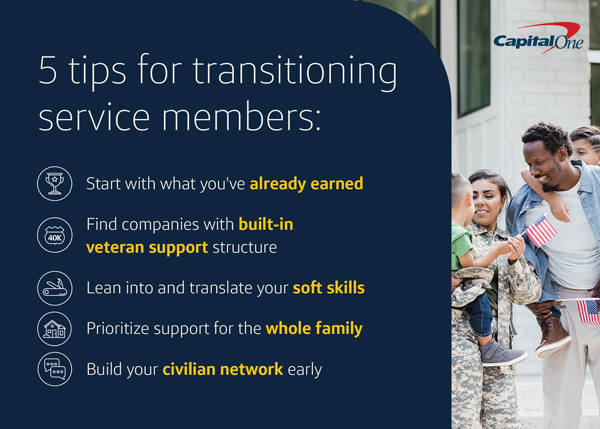
Start With What You’ve Already Earned
Opportunity starts with preparation. Beyond the well-known Post-9/11 GI Bill, which can cover tuition, housing and books, transitioning service members can look into vocational rehab or the SkillBridge program, which allows them to do civilian internships during the last 180 days of service. Many employers also offer internal tuition reimbursement programs. Taking the time to proactively map out these benefits ensures you aren’t leaving valuable opportunities or money on the table.
Find Employers with Veteran Support Structures
With almost half of veterans leaving their first post-military job within a year, according to research published by the Institute for Veterans and Military Families and VetAdvisor, finding the right culture and community is key to a successful transition. Look for employers with active veteran networks and dedicated mentorship.
For example, Capital One’s Salute Business Resource Group serves as a thriving internal community of more than 6,000 members, offering peer support, year-round professional development and mentorship for veterans, reservists and military spouses. Additionally, partner organizations like Hiring Our Heroes provide career workshops, fellowships and job fairs to ensure you’re employment-ready from day one.
Lean Into and Translate Your Soft Skills
Veterans bring a distinct competitive advantage to the applicant pool. You should confidently lean into the cross-functional “soft skills” learned in the line of duty such as risk management, crisis resolution and building trust under high-pressure scenarios.
The trick is translating these capabilities out of military jargon on your resume. Swap military terms like “NCOIC” for “Operations Manager” or “commanded” for “directed.” To make this easier, look for military-friendly employers that employ dedicated military recruiters who specialize in decoding military resumes to align skills with the right roles.
Prioritize Support for the Whole Family
Military service is a family commitment, and the transition out of uniform affects everyone. Military spouses often face unique career hurdles, including frequent relocations and employment gaps. When evaluating employers, look for companies that offer holistic benefits and flexible structures.
For example, Capital One, recognized by “U.S. Veterans Magazine” as a Top Veteran Employer and Top Military Spouse Employer, actively supports military spouses and families through dedicated spouse hiring initiatives and internal support mechanisms. Furthermore, look for organizations that support continued military training and active-duty leave, ensuring military associates never have to choose between their service and their careers.
Build Your Civilian Network Early
In the military, your network is built in. In the civilian world, you have to cultivate it. Long before your terminal leave begins, connect with veterans who work at companies you admire. Reach out for brief, 15-minute informational interviews to learn about their transition journeys rather than simply asking for a job. With more than 70% of civilian jobs filled through networking, according to estimates from Career Horizons, making organic connections early is a powerful tool for getting your foot in the door.
To find additional resources and learn more about how to support the hiring of veterans and military spouses, visit CapitalOneCareers.com/Military.
Photo courtesy of Shutterstock

SOURCE:





