

unknown
How extraterrestrial tales of aliens gain traction
The narrative explores humanity’s intrigue with extraterrestrial entities, juxtaposing evolutionary processes with claims of alien interventions, ultimately emphasizing the need for scientific evidence over fantastical stories. Aliens!

Last Updated on March 18, 2026 by Daily News Staff
Ester Lázaro Lázaro, Centro de Astrobiología (INTA-CSIC)
One night, upon returning to the cave that his tribe calls home, the monkey-humanoid Moon-Watcher finds a strange crystal object, a kind of monolith that fascinates him at first, but then quickly loses his interest when he discovers that it is not edible. Soon after, the true purpose of the monolith is revealed to be none other than penetrating the minds of our ancestors to induce new abilities that, over time, will cause the development of an intelligence capable of creating new technology.
Many readers will recognise this scene from the novel 2001, A Space Odyssey, by Arthur C. Clarke, and the film of the same name, directed by Stanley Kubrick. It almost goes without saying that the crystal monolith in question is the work of an extraterrestrial civilisation that observes life on other planets and “experiments” on them to encourage the development of intelligence in as many parts of the cosmos as possible.
Seeking simple answers to complex questions
Understanding how we, as a species, came to be intelligent is one of the great enigmas of evolutionary study. Small mutations, followed by a process of natural selection to choose the most advantageous, seems too slow a process for structures as complex as the human nervous system or brain to emerge. It is this very complexity that allows millions of neurons to communicate with each other, resulting in the emergence of qualities such as the ability to respond voluntarily to environmental stimuli, or to ask questions about the very nature of humankind and the universe.
Nowadays, we know that there are evolutionary mechanisms that have lead to great leaps in terms of complexity, but that does not stop people from turning to non-human forces – Gods, extraterrestrials, spiritual energies – to explain things that are difficult to comprehend.
This has always been the case, in all human cultures. A classic example would be attributing atmospheric events – thunder, lightning, floods – to the wrath of God. These ideas came about before humans had ever left the ground, so it is no surprise that we turned our eyes even higher – to extraterrestrials – to explain other phenomena that we could only observe once travelling at high altitudes became part of our daily lives.
The allure of the unknown
The possibility that we might have been visited by beings from other worlds has always fascinated us. The element of mystery, of the unknown, only makes it more interesting.
Any phenomenon is made all the more enticing when it seems it is being covered up or hidden for secretive reasons. The attractiveness of conspiracies often leads people towards ideas which have no scientific basis, such as the belief that the Earth is flat, that humans never set foot on the Moon, or that vaccines can control our behaviour.
Even though these ideas have repeatedly been shown to be untrue, their rapid dissemination through social media, using simple, blunt language that appeals to emotion over logic, makes them very powerful weapons.
The supposed “proof” of alien visits to our planet ranges from specific Bible passages to ancient stone carvings portraying creatures or objects that may appear to be aliens or spacecraft. The latter often take the form of flying saucers.
However, we cannot forget that humans have always created imaginary creatures that resemble them and attributed them with magical powers. When imagining Gods, humans have given them a human appearance, and almost always imagined them as living in the sky.
When we look at these representations through modern eyes, we associate them with extraterrestrial beings or structures, when in fact they could be referring to a range of different things.
When unproven stories become larger than life
Recently, in the United States Congress, UFOs (currently known as UAPs: “Unidentified Anomalous Phenomena”) are back in the limelight. This is because a former air force intelligence official has made claims that the Pentagon is in possession of remains of extraterrestrial craft and “non-human biological matter”. The claims have been backed up by the testimony of a retired navy commander and a former navy pilot.
What we can be certain of is that the more we explore our skies, the more likely it is that we will encounter phenomena that we cannot explain. However, this does not mean that they are extraterrestrial. Past experience has shown us that most of these events can be attributed to optical illusions, spy or weather balloons, space junk, or even satellites that we ourselves have made.
In Spain, UFOs were a hot topic between the 1960s and the 1980s. In this era, everyone knew someone who was convinced that they had seen a UFO. This even reached the point where an exoplanet, called Ummo, was made up. It was populated by a more advanced civilisation than ours who made contact with people on Earth. In the letters these aliens supposedly sent, the ‘Ummites’ explained concepts such as genetics and cell structure.
The truth is that nowadays, reading some of these letters can be quite amusing. The story of the planet of Ummo was ultimately proved to be a monumental hoax, a fact later admitted by its own creator.
The Ummo hoax was even linked to the creation of a paedophile ring, which should make us reflect on the harmful consequences that the spread of fabricated news stories can have.
Can we deny the possibility that intelligent alien civilisations exist?
The answer, of course, is no. The universe is immense, and it is more than likely that circumstances similar to those which led to the appearance of life on Earth have been repeated on other planets. But there is a huge distance (literally and figuratively) between acknowledging the existence of these creatures and considering the possibility that they might have visited us.
Exoplanets, also known as extrasolar planets, are extremely far away, and we are limited by the speed of light which, as proven by Einstein, is the maximum possible speed at which anything can travel. Therefore, the journey to even a “nearby” exoplanet would take thousands of years. Maybe a civilisation more advanced than ours could find a way to do it faster, but not to the point of it being something easy or commonplace.
In any case, if the remains of alien life or spacecraft are stored away somewhere, why are they not being shown to us? Scientists would jump at the chance to analyse this organic matter to find out how it is structured, how it metabolises energy, or what molecules it uses to store genetic information.
Until there is proof, this is not a question of science, but rather, of stories. Stories can be very entertaining, but these kinds of stories do not help us to build a more accurate or helpful view of the world.
Ester Lázaro Lázaro, Investigadora Científica de los Organismos Públicos de Investigación. Especializada en evolución de virus, Centro de Astrobiología (INTA-CSIC)
This article is republished from The Conversation under a Creative Commons license. Read the original article.
The science section of our news blog STM Daily News provides readers with captivating and up-to-date information on the latest scientific discoveries, breakthroughs, and innovations across various fields. We offer engaging and accessible content, ensuring that readers with different levels of scientific knowledge can stay informed. Whether it’s exploring advancements in medicine, astronomy, technology, or environmental sciences, our science section strives to shed light on the intriguing world of scientific exploration and its profound impact on our daily lives. From thought-provoking articles to informative interviews with experts in the field, STM Daily News Science offers a harmonious blend of factual reporting, analysis, and exploration, making it a go-to source for science enthusiasts and curious minds alike. https://stmdailynews.com/category/science/


unknown
Pentagon Releases Second Batch of UFO Files: New Videos, Testimony, and Unexplained Encounters
The Pentagon has released a second batch of UFO and UAP files, including military videos, witness testimony, Apollo mission records, and unexplained aerial encounters.

Last Updated on May 30, 2026 by Rod Washington
Public fascination with UFOs and UAPs continues to grow after the Pentagon released a second batch of declassified files tied to unexplained aerial phenomena. The new release expands upon the first wave of disclosures issued earlier this month and includes additional military videos, eyewitness testimony, audio recordings, and historical government documents.
While officials continue to stress that there is no confirmed evidence of extraterrestrial life, the latest tranche of files has intensified debate surrounding unexplained sightings involving military personnel, radar systems, and infrared tracking technology.
What Was Included in the Second Release?
The second batch was published through the government’s Presidential Unsealing and Reporting System for UAP Encounters (PURSUE).
According to the Pentagon, the latest release includes:
- More than 220 additional files
- Over 40 newly released videos
- Dozens of audio recordings
- Intelligence reports
- First-hand accounts from military and civilian witnesses
The Pentagon says these cases remain unresolved because investigators lacked sufficient data to make definitive conclusions. Officials also stated that additional releases are expected in the coming weeks.
New Military Videos Draw Attention
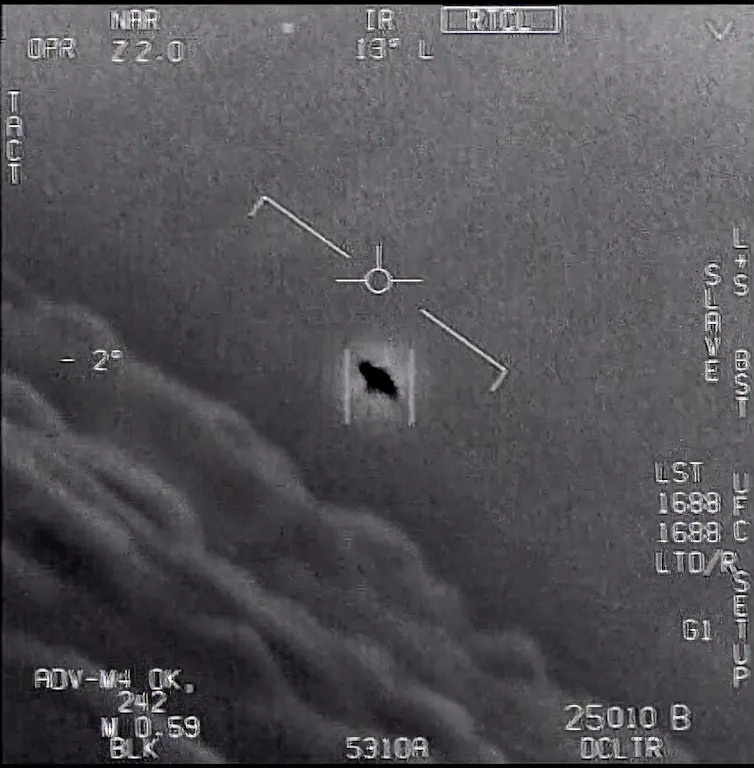
Among the most discussed materials are infrared military videos showing unusual formations and unidentified objects moving across restricted airspace.
One widely discussed video reportedly shows four unidentified objects flying in formation near Iran in 2022, captured using U.S. military infrared systems.
Another newly released report describes “orange orbs” that allegedly maneuvered near military aircraft during a mission connected to a sensitive government facility. Witnesses claimed the objects:
- Changed formation rapidly
- Approached aircraft at close range
- Appeared to pursue fighter jets before disappearing
According to one intelligence officer’s testimony, personnel were left “virtually speechless” following the encounter.
Apollo Mission Audio and Historical Records
The release also contains historical NASA-era materials involving Apollo missions and Cold War-era sightings.
One document includes audio from the Apollo 12 mission in which astronauts discussed mysterious “streaks of light” seen during their journey. NASA previously suggested the phenomenon may have been caused by internal visual effects experienced in spaceflight conditions.
The second release also includes reports from Sandia, New Mexico, where military personnel documented more than 200 sightings involving green fireballs, discs, and glowing objects between 1948 and 1950.
Pentagon Response Remains Cautious
Despite the excitement surrounding the files, the Pentagon maintains its position that:
- There is no verified evidence of extraterrestrial technology
- Many cases may eventually receive conventional explanations
Investigators say possible explanations can include:
- Drones
- Atmospheric phenomena
- Classified technology
- Sensor anomalies
- Insufficient data
Officials emphasized that unresolved does not automatically mean extraterrestrial.
Public Reaction and Skepticism
Reaction to the latest disclosure has been mixed.
Some UFO researchers believe the releases represent unprecedented government transparency and could encourage deeper scientific investigation. Others argue that many videos remain blurry, incomplete, or lacking critical technical context needed for meaningful analysis.
Skeptics also note that some materials in the first release had already circulated publicly for years, while others may involve ordinary objects captured under unusual conditions.
Still, public interest remains intense because the U.S. government is now openly acknowledging that some military encounters cannot currently be explained with available evidence.
Why the UAP Story Continues to Grow
The modern UAP discussion has evolved far beyond traditional UFO folklore.
Today the issue is increasingly viewed as:
- A national security concern
- An aviation safety issue
- A scientific mystery requiring improved data collection
Organizations now involved include:
- NASA
- All-domain Anomaly Resolution Office (AARO)
- Intelligence agencies
- Congressional oversight committees
The Pentagon has stated that additional batches of declassified files will continue to be released on a rolling basis as records are reviewed and approved for public disclosure.
The Bottom Line
The second release of Pentagon UAP files does not confirm alien visitation or extraterrestrial spacecraft. However, it does represent one of the most extensive public disclosures of unexplained aerial incident records in modern history.
Whether future investigations reveal advanced technology, misidentified phenomena, or something entirely unexpected, the UAP debate is no longer confined to the fringes of popular culture. It has become an ongoing subject of government transparency, scientific curiosity, and public fascination.
Related External Links
Stay updated with the latest UAP and breaking news coverage at STM Daily News.

unknown
Why U.S. Universities Still Avoid UAP Research Despite Growing Government Disclosure
As government disclosure around UAPs expands, universities still lag behind. This article examines academic stigma, funding gaps and the case for UAP research as a legitimate field of study.
Darrell Evans, Purdue University
Why U.S. Universities Still Avoid UAP Research Despite Growing Government Disclosure
President Donald Trump directed the Pentagon and other federal agencies to begin releasing government files related to UFOs and unidentified anomalous phenomena – called UAP – in February 2026, following years of pressure from Congress, military whistleblowers and the public.
Congress formally mandated UAP investigations through the National Defense Authorization Act in December 2022. The Pentagon’s official UAP investigative body, the All-domain Anomaly Resolution Office, AARO, now carries a caseload exceeding 2,000 reports dating back to 1945. Defense Secretary Pete Hegseth confirmed this figure earlier this year.
The cases were submitted by military personnel, pilots and government employees describing aerial objects that could not be explained as known aircraft, drones or weather phenomena. Governments in Japan, France, Brazil and Canada also have their own formal UAP investigation programs.
Yet modern research universities remain almost entirely absent from this conversation. No major university has established a dedicated UAP research center. No federal science agency offers competitive grants for UAP inquiry. No doctoral programs train researchers in UAP methodology. The gap between what governments openly acknowledge and what universities are willing to study is, at this point, difficult to explain on purely intellectual grounds.
I have navigated this gap while conducting my own UAP research. My work developing the temporal aerospace correlation tool, a standardized framework for correlating civilian UAP sighting reports with documented rocket launch activity from Cape Canaveral, is currently under peer review at Limina: The Journal of UAP Studies.
Designing that framework meant making methodological decisions without community standards, without institutional funding and without the professional infrastructure many researchers in established fields take for granted. What is missing is not interest or data – it is the shared scaffolding that turns isolated curiosity into cumulative science.
Stigma is measurable
The most rigorous evidence for the gap between faculty interest in UAP and faculty willingness to study it comes from peer-reviewed studies by Marissa Yingling, Charlton Yingling and Bethany Bell, published in the scholarly journal Humanities and Social Sciences Communications.
Across 14 disciplines at 144 major U.S. research universities, 1,460 faculty responded to their 2023 national survey. Most surveyed believed UAP research was important. Curiosity outweighed skepticism in every discipline that was part of the study. Nearly one-fifth had personally observed something aerial they could not identify. Yet fewer than 1% had ever conducted UAP-related research.
The gap was not explained by intellectual dismissal, but it was in part explained by fear. Researchers were not primarily deterred by intellectual skepticism because they doubted the topic’s merits. Instead, they feared they might lose funding, face ridicule from colleagues or find their careers quietly derailed. Faculty reported being told to “be careful.”
A 2024 follow-up study found that roughly 28% said they might vote against a colleague’s tenure case for conducting UAP research, even when they personally believed the topic warranted study.
Historian and philosopher of science Thomas Kuhn argued that scientific communities suppress anomalous questions not because those questions are unanswerable, but because they fall outside the boundaries the community has collectively decided are worth investigating.
Sociologist Thomas Gieryn called this suppression “boundary work,” referring to the active process by which scientists police what counts as legitimate science.
For UAP researchers, the data and tools to study the phenomenon exist. What may not exist is social permission to use them without professional consequence.
Creating an academic discipline
Academic disciplines do not emerge spontaneously. They require dedicated journals, agreed-upon methods, graduate programs and professional societies.
The history of cognitive neuroscience demonstrates how disciplines emerge. Before the 1980s, researchers at the intersection of neuroscience and cognitive psychology faced resistance from both parent disciplines.
These fields achieved mainstream acceptance only after targeted funding from the Alfred P. Sloan Foundation, new brain-imaging tools and the gradual formation of academic programs that created career pathways for researchers. Researchers at the nexus of these fields did not wait for central questions to be resolved. They built infrastructure, and the infrastructure made progress possible.
UAP studies as a discipline is developing some of these elements, but largely outside universities. The Society for UAP Studies, a nonprofit of scholars and researchers, operates Limina as a double-blind, peer-reviewed journal and has convened international symposia drawing researchers from physics, philosophy of science and the social sciences. But a nonprofit scholarly society without tenured faculty does not constitute a discipline.
To turn UAP studies into a recognized academic field would require three things.
First, funding. The Yingling studies found that competitive research grants would do more to unlock faculty participation than any other single factor. Without grants, researchers cannot hire students to assist them, maintain instruments or sustain the multiyear projects that produce meaningful results.
Second, shared methodological standards – these would entail agreed-upon procedures for collecting, recording and evaluating UAP reports – would mean findings from one research group can be compared and built upon by others.
Third, institutions could publicly affirm that they will evaluate appropriately rigorous UAP scholarship on its scientific merits during tenure reviews. Several universities have already done this for gun violence research and psychedelic-assisted therapy studies.
These are not isolated examples. Research into near-death experiences and adverse childhood experiences followed similar trajectories, moving from being a professional liability to mainstream legitimacy after the removal of institutional barriers.
The international comparison
This gap in UAP scholarship is unique to the United States. France’s GEIPAN, a dedicated investigation unit within its national space agency, has operated since 1977. It has publicly archived approximately 5,300 French UAP cases, of which about 2% to 3% remain unexplained after rigorous analysis.
In 2020, Japan formalized UAP reporting protocols for its Self-Defense Forces, the branch of the Japanese military responsible for national defense. By June 2024, more than 80 lawmakers had formed a parliamentary UAP investigation group that by May 2025 had formally proposed a dedicated UAP research office to the defense minister. Canada launched its own multiagency UAP investigation survey in 2023.
None of these actions has produced a corresponding response from American research universities. Universities provide independent, peer-reviewed analyses that government programs structurally cannot.
The University of Würzburg in Germany became the first Western university to officially recognize UAP as a legitimate object of academic research in 2022, when it formally added UAP investigation to its research canon. Researchers at Stockholm University and the Nordic Institute for Theoretical Physics in Sweden have been actively publishing peer-reviewed UAP research since 2017, most recently in Scientific Reports in October 2025.
Congress has passed legislation, the Pentagon is reporting on its investigations, and the president has directed federal agencies to begin releasing records. So the question no longer is whether governments take UAP seriously – it is whether universities will follow, and which ones will get there first.
Darrell Evans, Professor of Environmental Science and Sustainability, Purdue University
This article is republished from The Conversation under a Creative Commons license. Read the original article.
Dive into “The Knowledge,” where curiosity meets clarity. This playlist, in collaboration with STMDailyNews.com, is designed for viewers who value historical accuracy and insightful learning. Our short videos, ranging from 30 seconds to a minute and a half, make complex subjects easy to grasp in no time. Covering everything from historical events to contemporary processes and entertainment, “The Knowledge” bridges the past with the present. In a world where information is abundant yet often misused, our series aims to guide you through the noise, preserving vital knowledge and truths that shape our lives today. Perfect for curious minds eager to discover the ‘why’ and ‘how’ of everything around us. Subscribe and join in as we explore the facts that matter. https://stmdailynews.com/the-knowledge/


Unlikely Collaborators is bringing astrophysicist Dr. Lisa Kaltenegger to Santa Monica for a conversation centered on one of science’s most enduring questions: Are we alone in the universe? The event, part of the organization’s Spark Salon series, took place on March 17 at 7:00 p.m. PT and was offered both in person and via livestream.
Kaltenegger, founding director of the Carl Sagan Institute at Cornell University and a professor of astronomy, is widely recognized for her work on habitable exoplanets and the search for detectable signs of life beyond Earth. Her talk focused not only on the science of planet hunting, but also on the assumptions people bring to questions about life, habitability, and reality itself.

According to the event announcement, the discussion examined how scientists interpret data from distant worlds and asked broader questions about what counts as life, what makes a planet habitable, and how human perspective can shape discovery. The program also highlighted how the search for life beyond Earth can challenge long-held ideas about what is normal, possible, and even alive.
The evening included a reception, the main program, and a book signing. In-person guests also received a complimentary copy of Kaltenegger’s book, Alien Earths: The New Science for Planet Hunting in the Cosmos.
Unlikely Collaborators, founded by Elizabeth R. Koch, describes itself as a nonprofit focused on helping people better understand themselves and the world through its Perception Box framework. The Spark Salon series regularly brings together researchers, artists, and thought leaders for conversations designed to challenge perspective and encourage reflection.
Related Links
- Unlikely Collaborators official website
- Event details: Are We Alone in the Universe?
- Dr. Lisa Kaltenegger’s book: Alien Earths: The New Science for Planet Hunting in the Cosmos
- Cornell profile: Dr. Lisa Kaltenegger
Source
Dive into “The Knowledge,” where curiosity meets clarity. This playlist, in collaboration with STMDailyNews.com, is designed for viewers who value historical accuracy and insightful learning. Our short videos, ranging from 30 seconds to a minute and a half, make complex subjects easy to grasp in no time. Covering everything from historical events to contemporary processes and entertainment, “The Knowledge” bridges the past with the present. In a world where information is abundant yet often misused, our series aims to guide you through the noise, preserving vital knowledge and truths that shape our lives today. Perfect for curious minds eager to discover the ‘why’ and ‘how’ of everything around us. Subscribe and join in as we explore the facts that matter. https://stmdailynews.com/the-knowledge/





