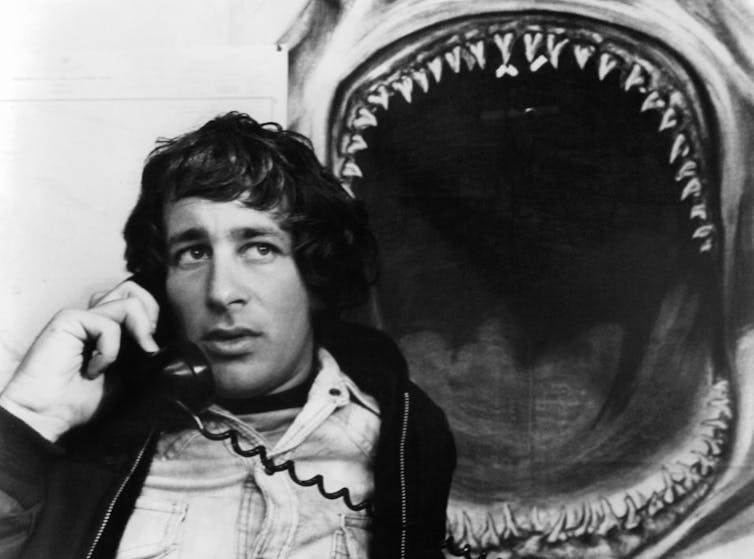
Many film historians see ‘Jaws’ as the first true summer blockbuster. Steve Kagan/Getty ImagesJared Bahir Browsh, University of Colorado Boulder “Da, duh.” Two simple notes – E and F – have become synonymous with tension, fear and sharks, representing the primal dread of being stalked by a predator. And they largely have “Jaws” to thank. Fifty years ago, Steven Spielberg’s blockbuster film – along with its spooky score composed by John Williams – convinced generations of swimmers to think twice before going in the water. As a scholar of media history and popular culture, I decided to take a deeper dive into the staying power of these two notes and learned about how they’re influenced by 19th-century classical music, Mickey Mouse and Alfred Hitchcock.
The first summer blockbuster
In 1964, fisherman Frank Mundus killed a 4,500-pound great white shark off Long Island. After hearing the story, freelance journalist Peter Benchley began pitching a novel based on three men’s attempt to capture a man-eating shark, basing the character of Quint off of Mundus. Doubleday commissioned Benchley to write the novel, and in 1973, Universal Studios producers Richard D. Zanuck and David Brown purchased the film rights to the novel before it was published. The 26-year-old Spielberg was signed on to be the director. Tapping into both mythical and real fears regarding great white sharks – including an infamous set of shark attacks along the Jersey Shore in 1916 – Benchley’s 1974 novel became a bestseller. The book was a key part of Universal’s marketing campaign, which began several months before the film’s release. Starting in the fall of 1974, Zanuck, Brown and Benchley appeared on a number of radio and television programs to simultaneously promote the release of the paperback edition of the novel and the upcoming film. The marketing also included a national television advertising campaign that featured emerging composer Williams’ two-note theme. The plan was for a summer release, which, at the time, was reserved for films with less than stellar reviews.TV ads promoting the film featured John Williams’ two-note theme. Films at the time typically were released market by market, preceded by local reviews. However, Universal’s decision to release the film in hundreds of theaters across the country on June 20, 1975, led to huge up-front profits, sparking a 14-week run as the No. 1 film in the U.S. Many consider “Jaws” the first true summer blockbuster. It catapulted Spielberg to fame and kicked off the director’s long collaboration with Williams, who would go on to earn the second-highest number of Academy Award nominations in history – 54 – behind only Walt Disney’s 59.
The film’s beating heart
Though it’s now considered one of the greatest scores in film history, when Williams proposed the two-note theme, Spielberg initially thought it was a joke. But Williams had been inspired by 19th and 20th century composers, including Claude Debussy, Igor Stravinsky and especially Antonin Dvorak’s Symphony No. 9, “From the New World.” In the “Jaws” theme, you can hear echoes of the end of Dvorak’s symphony, as well as the sounds of another character-driven musical piece, Sergei Prokofiev’s “Peter and the Wolf.” “Peter and the Wolf” and the score from “Jaws” are both prime examples of leitmotifs, or a musical piece that represents a place or character. The varying pace of the ostinato – a musical motif that repeats itself – elicits intensifying degrees of emotion and fear. This became more integral as Spielberg and the technical team struggled with the malfunctioning pneumatic sharks that they’d nicknamed “Bruce,” after Spielberg’s lawyer. As a result, the shark does not appear until the 81-minute mark of the 124-minute film. But its presence is felt through Williams’ theme, which some music scholars have theorized evoke the shark’s heartbeat.Mechanical issues with ‘Bruce,’ the mechanical shark, during filming forced Steven Spielberg to rely more on mood and atmosphere.Screen Archives/Moviepix via Getty Images
Sounds to manipulate emotions
Williams also has Disney to thank for revolutionizing character-driven music in film. The two don’t just share a brimming trophy case. They also understood how music can heighten emotion and magnify action for audiences. Although his career started in the silent film era, Disney became a titan of film, and later media, by leveraging sound to establish one of the greatest stars in media history, Mickey Mouse. When Disney saw “The Jazz Singer” in 1927, he knew that sound would be the future of film. On Nov. 18, 1928, “Steamboat Willie” premiered at Universal’s Colony Theater in New York City as Disney’s first animated film to incorporate synchronized sound. Unlike previous attempts to bring sound to film by having record players concurrently play or deploying live musicians to perform in the theater, Disney used technology that recorded sound directly on the film reel. It wasn’t the first animated film with synchronized sound, but it was a technical improvement to previous attempts at it, and “Steamboat Willie” became an international hit, launching Mickey’s – and Disney’s – career. The use of music or sound to match the rhythm of the characters on screen became known as “Mickey Mousing.” “King Kong” in 1933 would deftly deploy Mickey Mousing in a live action film, with music mimicking the giant gorilla’s movements. For example, in one scene, Kong carries away Ann Darrow, who’s played by actress Fay Wray. Composer Max Steiner uses lighter tones to convey Kong’s curiosity as he holds Ann, followed by ominous, faster, tones as Ann escapes and Kong chases after her. In doing so, Steiner encourages viewers to both fear and connect with the beast throughout the film, helping them suspend disbelief and enter a world of fantasy. Mickey Mousing declined in popularity after World War II. Many filmmakers saw it as juvenile and too simplistic for the evolving and advancing film industry.
When less is more
In spite of this criticism, the technique was still used to score some iconic scenes, like the playing of violins in the shower as Marion Crane is stabbed in Alfred Hitchcock’s “Psycho.” Spielberg idolized Hitchcock. A young Spielberg was even kicked off the Universal lot after sneaking on to watch the production of Hitchcock’s 1966 film “Torn Curtain.” Although Hitchcock and Spielberg never met, “Jaws” clearly exhibits the influence of Hitchcock, the “Master of Suspense.” And maybe that’s why Spielberg initially overcame his doubts about using something so simple to represent tension in the thriller.Steven Spielberg was just 26 years old when he signed on to direct ‘Jaws.’Universal/Getty Images The use of the two-note motif helped overcome the production issues Spielberg faced directing the first feature length movie to be filmed on the ocean. The malfunctioning animatronic shark forced Spielberg to leverage Williams’ minimalist theme to represent the shark’s ominous presence in spite of the limited appearances by the eponymous predatory star. As Williams continued his legendary career, he would deploy a similar sonic motif for certain “Star Wars” characters. Each time Darth Vader appeared, the “Imperial March” was played to set the tone for the leader of the dark side. As movie budgets creep closer to a half-billion dollars, the “Jaws” theme – and the way those two notes manipulate tension – is a reminder that in film, sometimes less can be more. Jared Bahir Browsh, Assistant Teaching Professor of Critical Sports Studies, University of Colorado Boulder This article is republished from The Conversation under a Creative Commons license. Read the original article.
Veteran actor T.K. Carter, best known for his roles in The Thing and the popular 1980s television series Punky Brewster, has died at the age of 69.
Authorities confirmed Carter was found unresponsive at his home in Duarte, California. No foul play is suspected, and an official cause of death has not yet been released.
A Career Spanning Decades
Born Thomas Kent Carter, T.K. Carter built a career in film and television that spanned more than four decades. He became a cult favorite portraying Nauls in John Carpenter’s 1982 horror classic The Thing, a film that continues to influence the genre today.
Television audiences widely remember Carter for his role as Mike Fulton on Punky Brewster, where his comedic timing and grounded performances helped make the show a lasting favorite of the era.
Film and Television Legacy
In addition to his best-known roles, Carter appeared in films such as Runaway Train, Ski Patrol, and Space Jam. His television work included guest appearances on a wide range of series throughout the 1980s, 1990s, and beyond.
Known within the industry as a reliable and versatile performer, Carter often brought authenticity and warmth to supporting roles that left a lasting impression, even in brief appearances.
Remembering T.K. Carter
As news of his passing spreads, fans and colleagues alike are reflecting on T.K. Carter’s contributions to film and television. While he may not have always been the leading name on the marquee, his work helped shape stories that continue to be watched and appreciated by new generations.
T.K. Carter is remembered for his enduring performances, professional dedication, and the quiet but meaningful legacy he leaves behind.
Stay with STM Daily News for updates to this developing story and more independent coverage of entertainment, history, and culture. Visit www.stmdailynews.com for the latest.
Pat Finn: Remembering the Familiar Face Who Made Us Laugh
Pat Finn, the familiar face from The Middle, Seinfeld, Friends, and Toyota commercials, has passed away at 60. We remember his career, legacy, and lasting impact.
Pat Finn: Remembering the Familiar Face Who Made Us Laugh
Many people may not have known his name right away, but they knew his face. Pat Finn was one of those rare actors who quietly became part of America’s shared television experience—popping up in beloved sitcoms, memorable commercials, and scene-stealing guest roles for more than three decades.
In December 2025, Finn passed away at the age of 60 after a battle with bladder cancer, leaving behind a body of work that continues to resonate with audiences who grew up watching network television’s golden era of sitcoms.
A Career Built on Consistency and Craft
Pat Finn wasn’t a headline-chasing star. Instead, he was the definition of a working actor—someone whose talent and reliability kept him in steady demand across generations of television.
He appeared in some of the most recognizable shows in TV history, including Seinfeld, Friends, Murphy Brown, 3rd Rock from the Sun, That ’70s Show, The King of Queens, Curb Your Enthusiasm, and The Goldbergs. To many fans, he was especially memorable as Bill Norwood, the occasionally awkward and often hilarious boss on ABC’s long-running sitcom The Middle.
These weren’t flashy roles—but they were essential ones. Finn had a gift for grounding comedy in reality, playing characters who felt like people you actually knew: coworkers, neighbors, or that guy you’d see at the store every week.
From Chicago Improv to National Screens
Born in Evanston, Illinois, Pat Finn came out of Chicago’s legendary improv scene, training and performing with The Second City and the iO Theater. That background gave him sharp comedic instincts and impeccable timing—skills that translated effortlessly to television.
He was also a contemporary and friend of Chris Farley, and like many performers from that era, Finn carried the Chicago improv tradition of generosity, collaboration, and humility throughout his career.
The Toyota Commercials—and Being “That Guy”
In later years, a new generation came to recognize Finn from Toyota commercials, particularly regional dealership ads. Once again, he became “that guy” everyone recognized but couldn’t quite place—a testament to just how deeply embedded he was in pop culture.
Commercial work is often overlooked, but Finn approached it with the same professionalism and charm as his television roles, making even short appearances feel authentic and memorable.
A Teacher, Mentor, and Family Man
Beyond acting, Pat Finn was also a teacher and mentor, sharing his experience with aspiring performers and encouraging young actors to respect the craft rather than chase fame.
Advertisement
He was married to his wife, Donna, for more than three decades, and together they raised three children. In tributes following his passing, family and colleagues alike emphasized not just his talent, but his kindness, humor, and generosity.
A Quiet Legacy That Lasts
Pat Finn’s passing is a reminder that television history isn’t shaped only by superstars. It’s built by dependable, talented performers who show up, deliver, and elevate every project they touch.
If you’ve ever laughed at a scene and later realized, “Hey, I’ve seen that guy before,” there’s a good chance it was Pat Finn.
His work lives on—in reruns, streaming libraries, commercials, and the memories of audiences who didn’t always know his name, but never forgot his presence.
Rest in peace, Pat Finn. And thank you for the laughs.
Looking for an entertainment experience that transcends the ordinary? Look no further than STM Daily News Blog’s vibrant Entertainment section. Immerse yourself in the captivating world of indie films, streaming and podcasts, movie reviews, music, expos, venues, and theme and amusement parks. Discover hidden cinematic gems, binge-worthy series and addictive podcasts, gain insights into the latest releases with our movie reviews, explore the latest trends in music, dive into the vibrant atmosphere of expos, and embark on thrilling adventures in breathtaking venues and theme parks. Join us at STM Entertainment and let your entertainment journey begin! https://stmdailynews.com/category/entertainment/
The Viral Backlash: How a Chef, a TikTok Influencer, and One Moment Changed a San Francisco Restaurant
TikTok Influencer vs Chef: A viral TikTok confrontation between Chef Luke Sung and a food influencer led to backlash, a restaurant closure, and a major rebrand in San Francisco.
The Viral Backlash: How a Chef, a TikTok Influencer, and One Moment Changed a San Francisco Restaurant
In mid-2025, a San Francisco restaurant found itself at the center of a viral controversy—not because of its food, but because of an interaction between a well-known chef and a TikTok food influencer. The incident sparked a broader conversation about power, professionalism, and the growing influence of social media in the hospitality industry.
What Happened at Kis Cafe
The incident involved Chef Luke Sung, a respected name in the Bay Area culinary scene, and a TikTok micro-influencer known online as @itskarlabb. The influencer had been invited to Kis Cafe for a planned promotional collaboration. According to the influencer, during her visit the chef questioned her follower count—around 15,000 at the time—and allegedly implied that her audience was not the “type of people” who would dine at his restaurant. She later described the exchange as humiliating and dismissive. After leaving the restaurant, she shared her experience in a TikTok video. The post quickly went viral, gaining millions of views and triggering a wave of online backlash.
The Internet Reacts
Although the influencer initially did not name the restaurant or the chef, internet users quickly identified Kis Cafe. The restaurant’s review pages were flooded with criticism, and the incident became a flashpoint in online discussions about elitism, influencer culture, and accountability. Within days, Kis Cafe issued a public apology and announced that Luke Sung was no longer affiliated with the restaurant in any capacity.
Chef Luke Sung Responds
Chef Sung later released a public apology, acknowledging that his behavior was condescending and inappropriate. He stated that there were no excuses for the way he treated the influencer and accepted responsibility for the incident. The apology, however, did little to slow the momentum of public reaction.
The Restaurant Closes — and Reopens
Not long after the controversy, Kis Cafe announced it would close. In the months that followed, the space reopened under a new name, Bosque, with new leadership and no involvement from Sung. The rebrand was seen as a clear attempt to move forward and distance the business from the viral episode.
The Influencer Effect
Meanwhile, the influencer at the center of the controversy saw her follower count surge dramatically, growing from a modest audience into hundreds of thousands of followers almost overnight. The incident highlighted the real-world impact that even “micro-influencers” can have—and how a single moment, captured and shared, can reshape careers and businesses.
Why This Story Matters
This controversy underscored a major cultural shift: social media is no longer separate from real-world industries like dining and hospitality. Online platforms can amplify personal experiences into powerful narratives with lasting consequences. As of early 2026, the restaurant operates under a new identity, the chef has stepped away from the project entirely, and the influencer continues to grow her platform. The episode remains a cautionary tale about professionalism, respect, and the power of digital voices. Get The Knowledge. More stories like this are available at STM Daily News.
Dive into “The Knowledge,” where curiosity meets clarity. This playlist, in collaboration with STMDailyNews.com, is designed for viewers who value historical accuracy and insightful learning. Our short videos, ranging from 30 seconds to a minute and a half, make complex subjects easy to grasp in no time. Covering everything from historical events to contemporary processes and entertainment, “The Knowledge” bridges the past with the present. In a world where information is abundant yet often misused, our series aims to guide you through the noise, preserving vital knowledge and truths that shape our lives today. Perfect for curious minds eager to discover the ‘why’ and ‘how’ of everything around us. Subscribe and join in as we explore the facts that matter. https://stmdailynews.com/the-knowledge/
Hal Machina is a passionate writer, blogger, and self-proclaimed journalist who explores the intersection of science, tech, and futurism. Join him on a journey into innovative ideas and groundbreaking discoveries!


