
How bigotry crushed the dreams of an all-Black Little League team
Chris Lamb, Indiana University John Rivers, John Bailey, David Middleton, Leroy Major and Buck Godfrey – all teammates from the 1955 Cannon Street YMCA Little League All-Star team – left Charleston, South Carolina, on a bus on Aug. 18, 2025. After a stop at the Baseball Hall of Fame in Cooperstown, New York, for a couple days – where their story is included in an exhibit on Black baseball that opened in 2024 – they’ll head to Williamsport, Pennsylvania. There, they’ll be recognized before the Little League World Series championship game on August 24, 2025 – 70 years after the players, then 11 and 12 years old, watched the championship game from the bleachers, wondering why they weren’t on the field living out their own dreams instead of watching other boys live out theirs. When the Cannon Street team registered for a baseball tournament in Charleston in July 1955, it put the team and the forces of integration on a collision course with segregation, bigotry and the Southern way of life. White teams refused to take the field with the Cannon Street team, who represented the first Black Little League in South Carolina. The team won two tournaments by forfeit. They were supposed to then go to a regional tournament in Rome, Georgia, where, if they won, they’d advance to the Little League World Series. But Little League officials ruled the team ineligible for the regional tournament because it had advanced by winning on forfeit and not on the field, as the rules stipulated.
A 4-team Black league is born
The Civil Rights Movement is often told in terms of court decisions, bus boycotts and racist demagogues. It’s rarely told from the point of view of children, who suffered in ways that left physical and emotional scars. When I was a journalism professor at the College of Charleston, I learned how the presence of a single Black all-star team was enough to cause one of the biggest crises in Little League history. In 2022, I wrote the book “Stolen Dreams: The 1955 Cannon Street All-Stars and Little League Baseball’s Civil War.” The team’s story begins in 1953. Robert Morrison, president of the Cannon Street YMCA, petitioned Little League Baseball to create a league for Black teams, and Little League Baseball granted the charter. Dozens of Black 11- and 12-year-old boys were selected for the four-team league before the 1954 season. They played on a diamond of grass and gravel at Harmon Field in Charleston, a city with a long history of racial strife. In 1861, the Civil War began in Charleston harbor, where hundreds of thousands of slaves had been brought to the U.S. from the 1600s to the 1800s. The field also wasn’t far from Emanuel AME church, where nine Black parishioners were murdered during a prayer meeting in 2015. Little League Baseball barred first-year leagues from the postseason tournaments. At some point during the 1955 season, the best players were selected for the league’s All-Star team. Cannon Street YMCA officials then registered the team for the Charleston city tournament, which included all-star teams from the city’s all-white leagues. Little League Baseball officially prohibited racial discrimination. But in South Carolina, racial discrimination was still legal.
Dixie fights back
The U.S. Supreme Court had ruled a year earlier that segregation in schools was unconstitutional in the landmark Brown v. Board of Education decision, paving the way for racial integration. Few states resisted integration as fiercely as South Carolina, and no politician fought harder against racial equality than the state’s junior U.S. senator, Strom Thurmond. So when the Cannon Street YMCA All-Stars registered for Charleston’s citywide tournament in July 1955, all the white teams withdrew. The Cannon Street team won by forfeit and advanced to the state tournament. Danny Jones, the state’s director of Little League Baseball, petitioned the organization to create a segregated state tournament. Little League Baseball’s president, Peter McGovern, denied Jones’ request. He said that any team that refused to play the Cannon Street team would be banned from the organization. Thurmond let it be known to Jones that an integrated tournament could not be permitted. In the end, Jones urged all the white teams to withdraw from the state tournament. He then resigned from Little League Baseball, created the Little Boys League and wrote the league’s charter, which prohibited Black players.The official logo for Dixie Youth Baseball, which was originally established as an all-white league.Dixie Youth Baseball The Little Boys League – which was rebranded as Dixie Youth Baseball – soon replaced Little League in other Southern states; within six years, there were 390 such leagues spanning most of the former Confederacy. It would be decades before Little League Baseball returned to South Carolina. Having won the South Carolina tournament by forfeit, the Cannon Street YMCA All-Stars prepared for the regional tournament in Rome, Georgia, where the state’s governor, Marvin Griffin, objected to integration. If youth baseball could be integrated, so, too, could schools, swimming pools and municipal parks, he said.
Let them play!
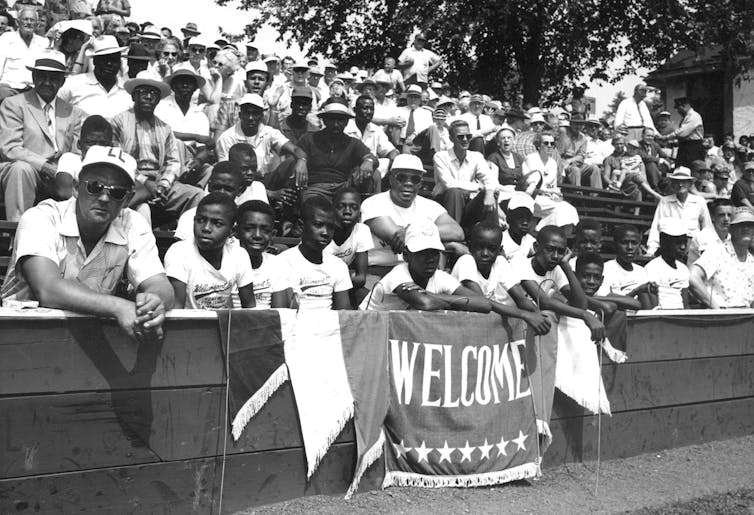
Little League rules said that teams could advance only by playing and winning, so the Cannon Street’s state championship was ruled invalid because it had come by forfeit. McGovern decided against making an exception for the Cannon Street YMCA All-Stars. Most white-owned newspapers, whether in the South or North, had long stayed silent on the topic of racial discrimination. But the story of the Cannon Street All-Stars broke through. Editors and reporters may have wanted to avoid the topic of racism, but boys being denied the opportunity to play in a baseball tournament was too objectionable to ignore. On July 31, 1955, New York Daily News columnist Dick Young asked Brooklyn Dodgers star Jackie Robinson, who had broken Major League Baseball’s color barrier eight years earlier, about the white teams that had quit the tournament rather than play against a Black team. “How stupid can they be?” Robinson said. “I had to laugh when I read the story.” Perhaps pressured by criticism, McGovern, Little League’s president, invited the team to be Little League’s guests for the championship game. So the team boarded a bus for Williamsport. They arrived the night before the championship game, which pitted Morrisville, Pennsylvania, against Delaware Township, New Jersey, an integrated team. The Cannon Street YMCA All-Stars and their coaches were introduced before the game, and the players recall hearing a loud voice from the bleachers. “Let them play!” it boomed. Others in the crowd joined in, the players said. “Let them play! Let them play!” John Rivers, who played second base for the team, told me he can still “hear it now.” After their brief moment on the field, the Cannon Street All-Stars returned to their seats and watched other boys live out their dreams. A photograph of the team in the stands reveals the disappointment on their faces.The Cannon Street All-Stars watch from the stands at the 1955 Little League World Series in Williamsport, Pa.1955 Cannon Street All-Stars/Facebook On the following day – Aug. 28, 1955 – the team boarded its bus to return to Charleston. It was the same date that Emmett Till, not much older than the players on the team, was brutally murdered in Money, Mississippi, for reportedly whistling at a white woman. The boys and girls who play in the 2025 tournament will forever remember the experience. The surviving members of the Cannon Street All-Stars, who are all in their early 80s, never forgot what they were denied. Rivers, who went on to become a successful architect, says this is the moral of their story. “It’s a tragedy to take dreams away from a youngster,” Rivers told The Washington Post in 2022. “I knew it then. I know it now, and I’ve seen to it that no one takes dreams away from me again.” Now there are some on the political right who want to bury America’s ugly racial history. America has never fully reckoned with slavery or the decades of segregation, Rivers recently told me. “It just decided to move on from that ugly period in its history without any kind of therapy,” he said. “And now they are trying to sweep it all under the rug again.” Portions of this article first appeared in an article published on Aug. 19, 2016.Chris Lamb, Professor of Journalism, Indiana University This article is republished from The Conversation under a Creative Commons license. Read the original article.
Senior Assist Day Marks Four Years of Supporting Seniors in South Phoenix
Senior Assist Day celebrates four years of serving seniors at Tanner Gardens in South Phoenix, led by Assistory Outreach Services and founder Jon Taylor.
Senior Assist Day Marks Four Years of Supporting Seniors in South Phoenix
PHOENIX, AZ — Senior Assist Day reached a meaningful milestone this year, marking four years of service to seniors living at Tanner Gardens in South Phoenix. Hosted by Assistory Outreach Services, the annual event continues to provide dignity, connection, and practical support to an often-overlooked population.
A Personal Beginning
The origins of Senior Assist Day are deeply personal for Assistory Outreach Services founder and CEO Jon Taylor.
“The origin of me going to Tanner Gardens was when I was with the 100 Black Men of Phoenix. We used to do a luncheon for seniors around December.”
That early connection took on new meaning as Taylor’s mother began showing signs of dementia, inspiring him to create an event rooted in empathy and care.
“I got a great feeling from being around those senior citizens. Senior Assist Day is roughly based on my mother.”
An Event That Continues to Grow
What began as a small gathering has grown into a full community experience. Seniors now enjoy catered meals, live music, personal care services, and gifts tailored to their needs. This year’s event included authentic Mexican food, live holiday music, haircuts provided by AJ’s Barbershop, and the donation of new shoes — a moment that stood out for many attendees.
“Seeing the excitement and how they were reacting to the new shoes was incredible,” Taylor said.
Beyond a Single Day
Senior Assist Day also helps build trust between Assistory Outreach Services and the residents of Tanner Gardens, opening the door to additional programs throughout the year. Through initiatives like the Digital Access Program for Seniors (DAPs), the organization helps seniors develop basic phone and computer skills, empowering them to stay connected and informed.
Challenges and Purpose
Keeping the event going year after year requires dedication and resources. Taylor personally raises funds and helps purchase gifts for more than 130 residents annually. Despite the challenges, his motivation remains strong.
“I do feel as though this is my ministry. I’m providing services, and I’m being fulfilled at the same time.”
Looking Ahead
Looking to the future, Taylor envisions Senior Assist Day becoming an all-day celebration, offering expanded services, entertainment, and meals — all focused exclusively on the residents of Tanner Gardens. As the event enters its fifth year, Senior Assist Day stands as a testament to what consistent community engagement and compassion can achieve. About Assistory Outreach ServicesAssistory Outreach Services is a community-based nonprofit organization dedicated to empowering seniors, low-income residents, and individuals experiencing homelessness. Assistory helps senior citizens embrace technology by teaching basic cell phone and computer skills, using a formula rooted in education, love, and patience to remove fear and build confidence. In addition to senior programming, the organization focuses on serving low-income and homeless populations by providing food boxes, holiday meals, and homeless care packages known as Assist Packs. This year, Assistory Outreach Services is expanding its impact by partnering with other nonprofits and religious organizations to coordinate food distribution through its community food pantry. Coverage by STM Daily News.
STM Daily News is a multifaceted podcast that explores a wide range of topics, from life and consumer issues to the latest in food and beverage trends. Our discussions dive into the realms of science, covering everything from space and Earth to nature, artificial intelligence, and astronomy. We also celebrate the amateur sports scene, highlighting local athletes and events, including our special segment on senior Pickleball, where we report on the latest happenings in this exciting community. With our diverse content, STM Daily News aims to inform, entertain, and engage listeners, providing a comprehensive look at the issues that matter most in our daily lives. https://stories-this-moment.castos.com/
Rod: A creative force, blending words, images, and flavors. Blogger, writer, filmmaker, and photographer. Cooking enthusiast with a sci-fi vision. Passionate about his upcoming series and dedicated to TNC Network. Partnered with Rebecca Washington for a shared journey of love and art.
Brigitte Bardot defined the modern woman and defied social norms
Ben McCann, University of Adelaide Brigitte Bardot’s death, at the age of 91, brings to a close one of the most extraordinary careers in post-war French cultural life. Best known as an actress, she was also a singer, a fashion icon, an animal rights activist and a symbol of France’s sexual liberation. Famous enough to be known by her initials, B.B. symbolised a certain vision of French femininity – rebellious and sensual, yet vulnerable. Her impact on beauty standards and French national identity was profound. At her peak, she rivalled Marilyn Monroe in global fame and recognition. Simone de Beauvoir, France’s leading feminist writer, famously wrote in 1959 that Bardot “appears as a force of nature, dangerous so long as she remains untamed”.
A star is born
Bardot was born in 1934 to a well-off Parisian family. Raised in a strict Catholic household, she studied ballet at the Conservatoire de Paris with hopes of becoming a professional dancer.Brigitte Bardot, pictured here in 1946, studied ballet as a child.Roger Viollet via Getty Images Her striking looks led her to modelling. By 14, she was appearing in Elle magazine, catching the eye of director Roger Vadim, whom she married in 1952. She began acting in the early 1950s and her appearance as Juliette in Vadim’s And God Created Woman (Et Dieu… créa la femme, 1956) put her on the map. Bardot was instantly catapulted to international stardom. Vadim presented his wife as the ultimate expression of youthful, erotic freedom that both shocked and captivated French audiences. Watching this relatively tame film today, it’s difficult to imagine just how taboo-breaking Bardot’s performance was. But in sleepy Catholic, conservative 1950s France, it set new norms for on-screen sexuality. The film became a global phenomenon. Critics loved it, but censors and religious groups grew nervous.
An 60s icon
Bardot’s lack of formal training as an actress paradoxically became part of her appeal: she adopted a spontaneous acting approach, as much physical as verbal. She was stunning in Contempt (Le Mépris, 1963), Jean-Luc Godard’s masterpiece about a crumbling marriage. Godard used her beauty and fame both as spectacle and critique. The film’s most famous sequence was a 31-minute conversation between Bardot and her co-star Michel Piccoli. Bardot was never better. In Henri-Georges Clouzot’s intense courtroom drama The Truth (La Vérité, 1960), she showcased her dramatic range playing a young woman on trial for the murder of her lover.Bardot in a poster for The Truth, 1960.LMPC via Getty Images In 1965, she co-starred with Jeanne Moreau in Louis Malle’s Long Live Maria (Viva Maria), a rare female buddy film that blended comedy and political satire. Bardot’s anarchic energy remains a dazzling feat. A Very Private Affair (Vie privée, 1962) saw her portray a woman consumed by fame and chased by the media. The plotline was eerily predictive of Bardot’s own future. She popularised fashion trends like the choucroute hairstyle and ballet flats. The Bardot neckline – off-the-shoulder tops and dresses – was named after her. She even wore pink gingham at her 1959 wedding.
Allure and provocation
Bardot’s star appeal lay in her contradictions. She appeared simultaneously natural and provocative, spontaneous and calculated. Her dishevelled glamour and effortless sexuality helped construct the archetype of the modern “sex kitten”. She famously said “it is better to be unfaithful than to be faithful without wanting to be”. Throwing off the shackles of bourgeois morality, Bardot epitomised a commitment to emotional and sexual freedom. Her turbulent love life was a case in point. She was married four times, with dozens of stormy relationships and extra-marital affairs along the way. Forever immortalised as a free-spirited ingénue, Bardot was a muse for filmmakers, artists and musicians, from Andy Warhol to Serge Gainsbourg. Later on, Kate Moss, Amy Winehouse and Elle Fanning mentioned Bardot as an inspiration. Famously, Bardot never succumbed to cosmetic surgery. As she once noted:
Women should embrace ageing because, at the end of the day, it’s much more beautiful to have a grandmother with white hair who looks like an elderly lady than to have a grandmother who’s bleached, dyed, and […] who looks much older but also really unhappy.
Life after the movies
Bardot retired from acting in 1973, aged only 39, citing disillusionment with fame. “It suffocated and destroyed me”, she said, about the film industry. She shifted her attention to animal rights, founding the Brigitte Bardot Foundation in 1986. She became an uncompromising, vocal activist, campaigning against animal cruelty, fur farming, whaling and bullfighting. But Bardot courted controversy from the mid-1990s for her far-right political views, remarks about Islam and immigration and repeated convictions for inciting racial hatred. She publicly defended disgraced actor Gérard Depardieu and pushed back on the #MeToo movement in France. Such statements damaged her reputation, especially outside France, and created a troubling image: the once-liberating sex symbol now associated with nationalist conservatism. While she never identified as a feminist, her unapologetic autonomy, early retirement and outspoken views led some to re-evaluate her as a figure of proto-feminist rebellion. France gradually began to turn against Bardot, bothered by her outspoken views. But some applauded her couldn’t-care-less attitude and unwillingness to play by the rules. Ultimately, by rejecting fame on her own terms, she parlayed her 50s free-spiritedness into a bold stand against conformity and societal norms. Late in life, she told Danièle Thompson, the writer-director of the 2023 mini-series about her career, “I don’t understand why the whole world is still talking about me”. The answer is simple – Bardot continues to fascinate us, flaws and all. Ben McCann, Associate Professor of French Studies, University of Adelaide This article is republished from The Conversation under a Creative Commons license. Read the original article.
PG&E Donates $1 Million to Local Food Banks to Help Feed Families
PG&E donates $1 million to local food banks across Northern and Central California—equivalent to about 3 million meals—supporting 38 food banks serving 47 counties.
Just in time for the holidays, Pacific Gas and Electric Company (PG&E) announced a $1 million donation to local food banks across Northern and Central California—support aimed at meeting a surge in demand as more families and seniors struggle to put food on the table. According to PG&E, the contribution is expected to provide the equivalent of roughly 3 million meals and will support 38 food banks serving 47 counties within PG&E’s service territory.
A third major food-bank contribution since September
The $1 million gift marks the third food-bank-focused contribution since September from PG&E or The PG&E Corporation Foundation (the PG&E Foundation). Combined, those efforts bring PG&E’s total community food support in 2025 to $2.37 million. PG&E emphasized that the funding for these charitable contributions comes from PG&E shareholders—not customers.
Food banks facing record-breaking demand
Food banks across California are reporting pressure levels not seen since the pandemic. Officials with the California Association of Food Banks say demand has reached record highs, driven in part by an unexpected surge during the federal government shutdown this fall. “California food banks experienced an unexpected surge with the [federal government] shutdown this fall. So, we reached out for help on their behalf and PG&E responded,” said Stacia Levenfeld, Chief Executive Officer of the California Association of Food Banks. “Their $1 million gift to food banks throughout Northern and Central California will have a meaningful impact on the lives of millions of people this holiday season and help food banks continue their critical work in our communities.” PG&E leaders framed the donation as an extension of a longstanding partnership with food bank networks. “We are grateful to help local food banks fulfill their mission during this time of increasing demand, especially as more families and seniors are struggling through the holiday season,” said Carla Peterman, Executive Vice President, Corporate Affairs, PG&E Corporation and Chair of The PG&E Corporation Foundation Board. “Our longstanding partnership with the California Association of Food Banks supports the safety net that is our local food banks.”
Where the 2025 food support has gone
PG&E outlined additional contributions made earlier in the year:
September: The PG&E Foundation awarded $1.12 million to support local food banks, tribal food banks, and senior meal programs.
November: The PG&E Foundation donated $250,000 to the California Association of Food Banks’ Emergency Response Fund.
Equity-focused grant distribution
The California Association of Food Banks notes that while California produces nearly half of the nation’s fruits and vegetables, more than one in five residents still don’t know where their next meal will come from. Food insecurity rates are even higher in many communities of color. PG&E said grant amounts awarded to local organizations will account for county poverty and unemployment levels, using a formula from the California Department of Social Services. The goal: promote equity by directing more support to counties with higher need.
About the PG&E Corporation Foundation and PG&E
The PG&E Corporation Foundation is an independent 501(c)(3) nonprofit organization, separate from PG&E and sponsored by PG&E Corporation. PG&E is a combined natural gas and electric utility serving more than 16 million people across 70,000 square miles in Northern and Central California. More information is available at pge.com and pge.com/news.
Why this matters
As food banks brace for sustained demand beyond the holiday season, large-scale donations like PG&E’s can help stabilize local supply—especially when distributed with an equity lens that targets the counties facing the steepest economic pressures. For families, seniors, and individuals navigating rising costs, the impact is immediate: more meals available now, and stronger community support systems heading into the new year. Community links: