Connect with us

opinion

How ‘South Park’ could help Democrats win back the young voters the party lost to Trump

Published

on

South Park
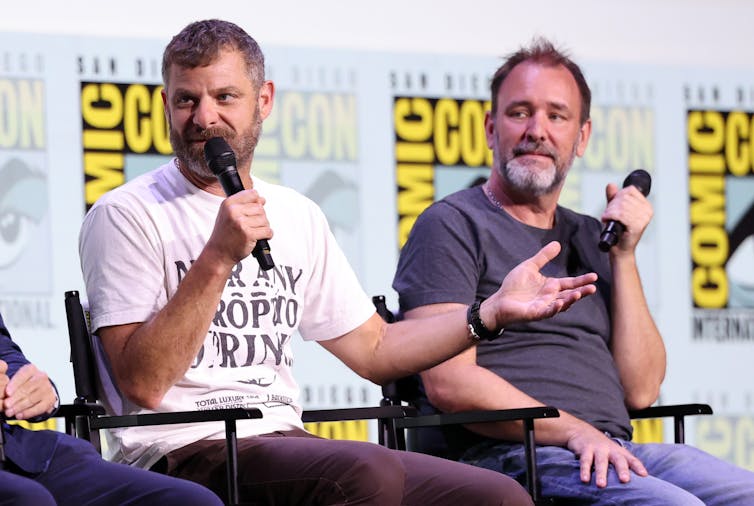
‘South Park’ creators Matt Stone and Trey Parker appear at Comic-Con 2025 in San Diego on July 24, 2025. Amy Sussman/Getty Images

How ‘South Park’ could help Democrats win back the young voters the party lost to Trump

Nick Marx, Colorado State University The Season 27 premiere of “South Park” in July 2025 began like so many of the show’s episodes: Resident bigot Eric Cartman is pissed off. He directs his ire at the Trump administration, which had recently pulled federal funding for NPR, because he enjoyed hearing liberals “whine about stuff.” In other words, Cartman is irate that Trump has stolen his hateful, vindictive shtick. As the episode goes on, other South Park residents join Cartman in rallying against Donald Trump. In the show’s infamously over-the-top style, the president is depicted as thin-skinned, deceitful – and, well, sexually ill-equipped. The episode ends with a surreal, graphic deepfake scene of a totally nude Donald Trump stumbling around a desert. The White House immediately blasted “South Park” as irrelevant and “desperate for attention.” The ratings tell a different story. The season premiere scored 6 million viewers across Comedy Central and Paramount+, with even more tuning in two weeks later for the follow-up. Each ensuing episode has further skewered Trump and his administration. “South Park” has long targeted ineffectual authority figures with ripped-from-the-headlines timeliness, which is made possible by its weekly production schedule. Whereas most animated television shows require months of production lead time, series co-creators Trey Parker and Matt Stone need just a week or two to write, voice and animate an entire episode. While the ever-churning news cycle has made it more difficult to hold those in power accountable, the cartoon’s timely satire still galvanizes viewer attention. This makes it uniquely suited to channel rage toward Trump and other political leaders – and, perhaps, influence an audience that has recently proved elusive to Democrats.

A history of poking the powerful

The appeal of “South Park” doesn’t necessarily lie in partisan attacks on Republicans. Its politics have always been all over the map, with both liberals and conservatives railing against the show at various points. The 2006 episode “ManBearPig” ridiculed former Democratic Vice President Al Gore’s climate activism. In 2014, liberal critics decried an episode titled “Mr. Garrison’s Fancy New Vagina” for deploying transphobic tropes. And “The Pandemic Special,” which aired in 2020, mocked the restrictive vaccine policies promoted by progressives. Meanwhile, conservative watchdog groups such as the Parents Television and Media Council have long targeted “South Park” for its allegedly harmful influence on children. The none-too-subtly titled 1999 movie “South Park: Bigger, Longer & Uncut” satirized these efforts: Throughout the movie, Kyle’s mom, Sheila, tries to censor the graphic children’s cartoon characters Terrance and Phillip. That movie also marks one of the earliest appearances of the Iraqi despot Saddam Hussein. It portrays him as a crazed, lecherous supervillain hellbent on taking over the world alongside his gay lover, Satan.
Former Iraqi dictator Saddam Hussein has been a recurring character on ‘South Park.’
The current “South Park” season has animated Trump with the same cutout, stop-motion style as it did with Hussein, implying direct parallels between their dictatorial desires. Behind the scenes, Trump has reportedly been “seething” over the depiction. In the 2006 two-part episode “Cartoon Wars,” Parker and Stone warred with Comedy Central over the right to show an animated depiction of the Muslim prophet Muhammad. The network rejected the idea after political violence followed in the wake of a Danish newspaper’s publication of a cartoon featuring Muhammad. Eventually, censored animations of Muhammad aired with disclaimers from Comedy Central, but only after Parker and Stone’s refusal to address the issue before broadcast. The cartoon continues to relish poking its corporate benefactors. The current season premiered hours after Trump’s Federal Communications Commission approved a merger for the show’s parent company, Paramount. The administration delayed the transaction in order to settle its lawsuit against the Paramount-owned news show “60 Minutes,” which Trump had accused of favorably editing an interview with former Vice President Kamala Harris while she was running as the Democratic nominee for president. That same day also saw the announcement of a new US$1.5 billion deal keeping “South Park” at Paramount. Parker and Stone’s skewering of Trump sends a message to Paramount in the wake of the “60 Minutes” settlement and the cancellation of “The Late Show with Stephen Colbert”: Let politics dictate your content at your own risk.

A person dressed up as a bunny stands behind an older man who's saluting while wearing a blue suit and red tie.
‘South Park’ has sought to take President Trump down a notch. Mandel Ngan/AFP via Getty Images

Reaching the right voters

As the Democratic Party’s establishment struggles to appeal to young, internet-savvy, male voters – look no further than party strategists’ attempts to find “a liberal Joe Rogan” – “South Park” is garnering record viewership with young audiences. The rest of the season, meanwhile, has provided a timely, steady drumbeat of Trump mockery. The second episode of the current season calls out the Trump administration’s illegal ICE raids. The next episode lampoons Trump’s affinity for lavish gifts and compliments. In it, tech CEOs and world leaders obsequiously note that Trump “does not have a small penis.” The fourth episode depicts him as a negligent and emotionally abusive lover to Satan, further connecting him to the show’s previous portrayals of Saddam Hussein.
Satan is depicted as President Trump’s lover in Season 27 of ‘South Park.’
Despite its penchant for outrageous and, at times, scattershot satire, “South Park” has an important lesson to teach Trump’s political opponents. The appeal of both Trump and “South Park” to many young men is not in the positive ideas they offer, but in the way they both humiliate their opponents. I research comedy on the right, and I’ve written about how right-wing humor has long thrived on “owning the libs.” Now, “South Park” is owning Trump, and with each new lurid reveal in the Jeffrey Epstein saga, it will have plenty of fodder as the season progresses. Simply calling attention to Trump’s hypocrisies and corruption – long the forte of media figures such as Jon Stewart, John Oliver and the hosts of the podcast “Pod Save America” – becomes white noise after a while. But actually animating the sitting president with a micropenis? Making a mockery of the self-serving business deals of the “dealmaker in chief” and his spineless corporate cronies? Well, those things won’t win an election on their own. But they inadvertently could help Democrats lure back some of the young men who drifted to Trump in 2024. Nick Marx, Professor of Film and Media Studies, Colorado State University This article is republished from The Conversation under a Creative Commons license. Read the original article.

Discover more from Daily News

Subscribe to get the latest posts sent to your email.

Continue Reading
Advertisement Sports Research

Blog

The Empty Promise: Lynwood’s Lost Downtown Dream

In the 1970s, Lynwood, CA, dreamed of a downtown mall anchored by Montgomery Ward. Decades later, the empty lots told a story of ambition, delay, and renewal.

Published

on

In the 1970s, Lynwood, CA, dreamed of a downtown mall anchored by Montgomery Ward. Decades later, the empty lots told a story of ambition, delay, and renewal.

Artistic Image: R Washington and AI

In the early 1970s, Lynwood, California, dreamed big.

City leaders envisioned a new, modern downtown — a sprawling shopping and auto mall that would bring jobs, shoppers, and a sense of pride back to this small but growing city in the southeast corner of Los Angeles County. At the heart of the plan stood a gleaming new Montgomery Ward department store, which opened around 1973 and promised to anchor a larger commercial center that never fully came.

But for those of us who grew up in Lynwood during that time, the promise never quite materialized.

Instead, we remember acres of empty lots, chain-link fences, and faded “Coming Soon” signs that sat for decades — silent witnesses to a dream deferred.

The Vision That Stalled

In 1973, Lynwood’s Redevelopment Agency launched what it called Project Area A — an ambitious plan to clear and rebuild much of the city’s downtown core. Small businesses and homes were bought out, land was assembled, and the city floated bonds to support new construction.

For a brief moment, it looked as if the plan might work. Montgomery Ward opened its doors, serving as a retail beacon for the area. Yet the rest of the mall — the shops, restaurants, and auto dealerships — never came.

By the mid-1970s, much of downtown had been bulldozed, but little replaced it. And by the time Ward closed its Lynwood location in 1986, the vast lots surrounding it had become symbols of frustration and unfulfilled potential.

What Happened?

Some longtime residents whispered about corruption or backroom deals — the kind of speculation that grows when visible progress stalls.

But newspaper archives and redevelopment records tell a more complex story.

Lynwood’s plans collided with a series of hard realities:

The construction of the Century Freeway (I-105) disrupted neighborhoods and depressed land values. Environmental cleanup and ownership disputes slowed development. Economic shifts in retail — as malls in nearby Downey, South Gate, and Paramount attracted anchor stores — drained the local market. And later, political infighting among city officials made sustained redevelopment almost impossible.

Advertisement
Get More From A Face Cleanser And Spa-like Massage

To this day, there’s no public record of proven corruption directly tied to the 1970s mall plan. What did exist was a tangle of bureaucracy, economic change, and missed opportunity — a perfect storm that left Lynwood’s heart half-built and half-forgotten.

Growing Up Among the Vacant Lots

For those of us who were kids in Lynwood during that era, the story is more personal.

We remember the sight of the Montgomery Ward building — modern and hopeful at first, then shuttered and fading by the mid-1980s.

We remember riding bikes past the empty dirt fields that were supposed to become shopping plazas. And we remember the quiet frustration of adults who had believed the city’s promises.

Those empty blocks became our playgrounds — but they also became symbols of the gap between what Lynwood was and what it wanted to be.

A New Chapter: Plaza México and Beyond

By the late 1990s and early 2000s, the dream finally resurfaced in a new form.

Developers transformed the long-idle site into Plaza México, a vibrant commercial and cultural hub that celebrates Mexican and Latin American heritage.

It took nearly 30 years for Lynwood’s downtown to come alive again.

The result is beautiful — but it’s also bittersweet for those who remember how long the land sat empty, and how many local businesses and residents were displaced in pursuit of a dream that took a generation to fulfill.

Advertisement
Get More From A Face Cleanser And Spa-like Massage

Looking Back

The story of Lynwood’s lost mall isn’t just about urban planning.

It’s about hope, change, and resilience. It’s about how a community tried to reinvent itself — and how the children who grew up watching that effort still carry its memory.

Sometimes, when I drive through that stretch of Imperial Highway and Long Beach Boulevard, I still imagine what might have been: the bustling mall that never was, and the voices of a neighborhood caught between ambition and uncertainty.

📚 Further Reading

  • Montgomery Ward will close its Lynwood store. (Jan 3 1986) — Los Angeles Times. 

    Read it here

  • Montgomery Ward Won’t Confirm Deal: Lynwood Council Says Retailer to Stay Open. (Jan 16 1986) — Los Angeles Times. 

    Read it here

  • “Las Plazas of South LA” — academic paper by J.N. Leal (2012), discussing retail and redevelopment challenges in the region including Lynwood. 

    Read the PDF

  • Proposed Lynwood Development Draws Support and Criticism. (2007) — Los Angeles Sentinel. 

    Read it here

  • Wikipedia page: Lynwood, California — overview of the city including mention of Plaza México redevelopment. 

    Read it here

Dive into “The Knowledge,” where curiosity meets clarity. This playlist, in collaboration with STMDailyNews.com, is designed for viewers who value historical accuracy and insightful learning. Our short videos, ranging from 30 seconds to a minute and a half, make complex subjects easy to grasp in no time. Covering everything from historical events to contemporary processes and entertainment, “The Knowledge” bridges the past with the present. In a world where information is abundant yet often misused, our series aims to guide you through the noise, preserving vital knowledge and truths that shape our lives today. Perfect for curious minds eager to discover the ‘why’ and ‘how’ of everything around us. Subscribe and join in as we explore the facts that matter.  https://stmdailynews.com/the-knowledge/


Advertisement
Get More From A Face Cleanser And Spa-like Massage
View recent photos

Unlock fun facts & lost history—get The Knowledge in your inbox!

We don’t spam! Read our privacy policy for more info.


Discover more from Daily News

Subscribe to get the latest posts sent to your email.

Continue Reading

Entertainment

The dystopian Pottersville in ‘It’s a Wonderful Life’ is starting to feel less like fiction

A fresh look at It’s a Wonderful Life through the film’s darkest detour—Pottersville—and why its greed, corruption, and desensitization to cruelty feels uncomfortably familiar in America today.

Published

on

file 20251209 56 ruqe19.png?ixlib=rb 4.1
To many Americans, George Bailey’s dystopian nightmare is disquietingly familiar. Paramount

The dystopian Pottersville in ‘It’s a Wonderful Life’ is starting to feel less like fiction

Nora Gilbert, University of North Texas Along with millions of others, I’ll soon be taking 2 hours and 10 minutes out of my busy holiday schedule to sit down and watch a movie I’ve seen countless times before: Frank Capra’sIt’s a Wonderful Life,” which tells the story of a man’s existential crisis one Christmas Eve in the fictional town of Bedford Falls. There are lots of reasons why this eight-decade-old film still resonates, from its nostalgic pleasures to its cultural critiques. But when I watch it this year, the sequence where Bedford Falls transforms into the dark and dystopian “Pottersville” will resonate the most. In the film, protagonist George Bailey, who’s played by Jimmy Stewart, is on the brink of suicide. He seems to have achieved the hallmarks of the American dream: He’s taken over his father’s loan business, married the love of his life and fathered four excessively adorable children. But George feels stifled and beaten down. His Uncle Billy has misplaced US$8,000 of the company’s money, and the town’s resident tyrant, Mr. Potter, is using the mishap to try to ruin George, who’s his last remaining business competitor. An angel named Clarence is tasked with pulling George back from the brink. To stop him from attempting suicide, Clarence decides to show George what life would have been like if he’d never been born. In this alternate reality, Bedford Falls is called Pottersville, a place Mr. Potter runs as a ruthless banker and slumlord.
Movie still of young man walking through a dark, snowy town and passing by a bright sign reading 'Pottersville.'
Pottersville, the dark, dystopian version of Bedford Falls, is a place characterized by vice and moral decay. Paramount
Having previously written about “It’s a Wonderful Life” in my book on literary and film censorship, I can’t help but see parallels between Pottersville and the U.S. today. Think about it: In Pottersville, one man hoards all the financial profits and political power. In Pottersville, greed, corruption and cynicism reign supreme. In Pottersville, hard-working immigrants like Giuseppe Martini who were able to build a life and run a business in Bedford Falls have vanished. In Pottersville, homeless addicts like Mr. Gower and nonconformist “pixies” like Clarence are scorned and ostracized, then booted out of the local watering hole. In Pottersville, cops arrest people like Violet Bick while they’re at work and haul them away, kicking and screaming.
Black-and-white movie still of a young women being dragged away by the police as a worried young man looks on.
Violet Bick gets dragged away by the Pottersville police as George looks on. Paramount
But what horrifies George the most about Pottersville is how desensitized the people living in it seem to be to its harshness and cruelty – how they treat him like he’s the crazy, deranged one for wanting and expecting things to be different and better. This is what the current political moment feels like to me. There are days when the latest headlines feel so jarringly unprecedented that I find myself thinking, “Can this be happening? Can this be real?” If you think these comparisons are a bit of a stretch, consider when “It’s a Wonderful Life” was made, and the frame of mind Capra was in when he made it.

Frank Capra, anti-fascist

In 1946, Capra was just returning to Hollywood filmmaking after serving for four years in the U.S. Army, where the Office of War Information had tasked him with producing a series of documentary films about World War II and the lead-up to it. Even though Capra hadn’t been on the front lines, he’d been immersed in the sounds and images of war for years on end, and he had become acutely familiar with Germany, Italy and Japan’s respective rises to fascism.
Young man posing and smiling while wearing a military uniform.
Frank Capra served in the U.S. Army during World War II. Keystone/Hulton Archive via Getty Images
When deciding on his first postwar film, Capra recalled in his autobiography that he specifically “knew one thing – it would not be about war.” Instead, he chose to adapt a short story by Philip Van Doren Stern, “The Greatest Gift,” that Stern had originally sent to friends and family as a Christmas card in 1943. Stern’s story is certainly not about war. But it’s not exactly about Christmas, either. As Stern writes in his opening lines:
“The little town straggling up the hill was bright with colored Christmas lights. But George Pratt did not see them. He was leaning over the railing of the iron bridge, staring down moodily at the black water.”
The protagonist contemplates suicide because he’s “sick of everything” in the small-town “mudhole” he’s stuck in – until, that is, a “strange little man” gives him the chance to see what life would be like if he’d never been born. It was Capra and his team of screenwriters who added the sinister Henry F. Potter to Stern’s short, simple tale. The Potter subplot encapsulates the film’s most trenchant, still-resonant themes: the unfairness of socioeconomic injustices; the pervasiveness of corporate and political corruption; the threat of monopolized power; the need for affordable housing. These themes had, of course, run through many of Capra’s prewar films as well: “Mr. Deeds Goes to Town,” “You Can’t Take It with You,” “Meet John Doe” and “Mr. Smith Goes to Washington,” the last of which also starred Jimmy Stewart. But they take on a different kind of weight in “It’s a Wonderful Life” – a weight that’s especially visible on the weathered face of Stewart, who himself had just returned from a harrowing four-year tour of duty as a bomber pilot in Europe. The idealistic vigor with which Stewart had fought crooked politicians and oligarchs as Mr. Smith is replaced by the bitterness, exhaustion, frustration and desperation with which he battles against Mr. Potter as George Bailey.
Black-and-white movie still of a distraught man with snow on his jacket.
George Bailey feels helpless in the face of corruption and cruelty. Paramount

Life after Pottersville

By the time George has begged and pleaded his way out of Pottersville, the lost $8,000 is no longer top of mind. He’s mainly just relieved to find Bedford Falls as he had left it, warts and all. And yet, the Bedford Falls that George returns to isn’t quite the same as the one he left behind. In this Bedford Falls, the community rallies together to figure out a way to recoup George’s missing money. Their pre-digital version of a GoFundMe page saves George from what he’d feared most: bankruptcy, scandal and prison. And even though his wife, Mary, tries to attribute this sudden wave of collectivist, activist energy to some sort of divine intervention – “George, it’s a miracle; it’s a miracle!” – Uncle Billy points out that it really came about through more earthly organizing means: “Mary did it, George; Mary did it! She told some people you were in trouble, and they scattered all over town collecting money!”
A group of smiling people dump a large basket of cash on a desk.
The residents of Bedford Falls come together to save George from financial ruin. Paramount
But the question of whether George actually wins his battle against Potter is a murky one. While the typical Capra protagonist triumphs by defeating vice and exposing subterfuge, George never even realizes that Potter is the one who got hold of his money and tried to ruin his life. Potter is never held accountable for his crimes. On the other hand, George is able to learn, from his time in Pottersville, what a crucial role he plays in his community. George’s victory over Potter, then, lies not in some grand final act of retribution, but in the incremental ways he has stood up to Potter throughout his life: not capitulating to Potter’s bullying or intimidation tactics; speaking truth to power; and running a community-centered business rather than one guided by greed and exploitation. In recent months, there have been similar acts of protest, large and small, in the form of rallies, boycotts, immigrant aid efforts, subscription cancellations, food bank donations and more. That doesn’t mean the U.S. has made it out of Pottersville, however. Each day, more head-spinning headlines appear, whether they’re about masked agents terrorizing immigrant communities, the dismantling of anti-corruption oversights, the consolidation of executive power or the naked display of political grift. Zuzu’s petals are still missing. Clarence still hasn’t gotten his wings. But this holiday season, I’m hoping it will feel helpfully cathartic to go with George Bailey, for the umpteenth time, through the dark abyss of his dystopian nightmare – and come out with him, stronger and wiser, on the other side. Nora Gilbert, Professor of Literary and Film Studies, University of North Texas This article is republished from The Conversation under a Creative Commons license. Read the original article.
Dreambreaker: A Pickleball Story — A Closer Look at the Documentary and Its Uncredited Voice
Link: https://stmdailynews.com/dreambreaker-a-pickleball-story-a-closer-look-at-the-documentary-and-its-uncredited-voice/

Discover more from Daily News

Subscribe to get the latest posts sent to your email.

Continue Reading

pets

Why I Never Gave My Small Dog Rawhide Chews: A Pet Parent’s Perspective

As a small dog owner, I learned the hard way why rawhide chews are risky — especially for aggressive chewers like my Jack Russell–Chihuahua mix, Luna. Here’s what I discovered and why we chose safer alternatives.

Published

on

Last Updated on January 1, 2026 by Daily News Staff

As a small dog owner, I learned the hard way why rawhide chews are risky — especially for aggressive chewers like my Jack Russell–Chihuahua mix, Luna. Here’s what I discovered and why we chose safer alternatives.

Dog chew bone

Why I Never Gave Luna Rawhide Chews — A Small Dog Owner’s Story

When we brought home our tiny but mighty pup, Luna — a Jack Russell–Chihuahua mix — we knew she loved to chew. In the past, I had given rawhide chews to larger dogs in our family, but thanks to my wife’s research and my own digging into the facts, we never gave rawhide to Luna. And here’s why. At first, rawhide chews seem harmless — they’re marketed as natural and long-lasting. But as I started reading more from trusted sources, it became clear rawhide treats can pose serious risks, especially for small dogs and aggressive chewers like Luna.
As a small dog owner, I learned the hard way why rawhide chews are risky — especially for aggressive chewers like my Jack Russell–Chihuahua mix, Luna. Here’s what I discovered and why we chose safer alternatives.

Luna smile for the camera – Image Credit: RW

Rawhide Isn’t Easy to Digest

Rawhide is made from animal hides that are chemically treated and dried. Dogs’ digestive systems simply aren’t equipped to break it down efficiently, which can lead to chunks getting stuck in the stomach or intestines. In some cases, these obstructions require emergency surgery. Veterinarians warn about choking and digestive blockages with rawhide chews. [oai_citation:0‡Veterinary Care at Your Fingertips](https://www.petscare.com/news/faq/do-vets-recommend-rawhide-for-dogs?utm_source=chatgpt.com)

Choking and Blockage Risks Are Very Real

As puppies chew rawhide, it softens and can break into large, protective chunks that are easy to swallow whole. These pieces can become lodged in a dog’s throat, leading to choking, or travel into the gut and create dangerous blockages. The American Kennel Club explains that strong chewers can break off large pieces that are especially risky for small breeds. [oai_citation:1‡American Kennel Club](https://www.akc.org/expert-advice/health/are-rawhide-chews-dangerous-for-dog/?utm_source=chatgpt.com)

Chemical Processing and Contamination Concerns

Rawhide is often treated with harsh chemicals like bleach or hydrogen peroxide during processing. These substances might not be fully removed and can irritate a dog’s stomach or cause other health problems. There’s also a documented risk of bacterial contamination with pathogens like Salmonella or E. coli. Research highlights these chemical and contamination concerns. [oai_citation:2‡Veterinary Care at Your Fingertips](https://www.petscare.com/news/post/why-rawhide-bad-dogs-dangers?utm_source=chatgpt.com)

What We Do Instead

Instead of rawhide, we give Luna safer, digestible chews like bully sticks and rubber chew toys. These alternatives satisfy her chewing instincts without the same level of risk. When choosing any chew, we always supervise her — especially because she’s such an aggressive chewer. If you’re a small-dog owner like me, it’s worth reconsidering rawhide chews. With safer options available and documented risks associated with rawhide, I’m glad we made the switch for Luna before any issues arose.
Paddletek Group Launches: What the New Multi-Brand Merger Means for Performance Pickleball
Link: https://stmdailynews.com/paddletek-group-launches-what-the-new-multi-brand-merger-means-for-performance-pickleball/

Discover more from Daily News

Subscribe to get the latest posts sent to your email.

Continue Reading

Trending