Connect with us

Entertainment

Some ‘Star Wars’ stories have already become reality

Published

on

Star Wars Stories
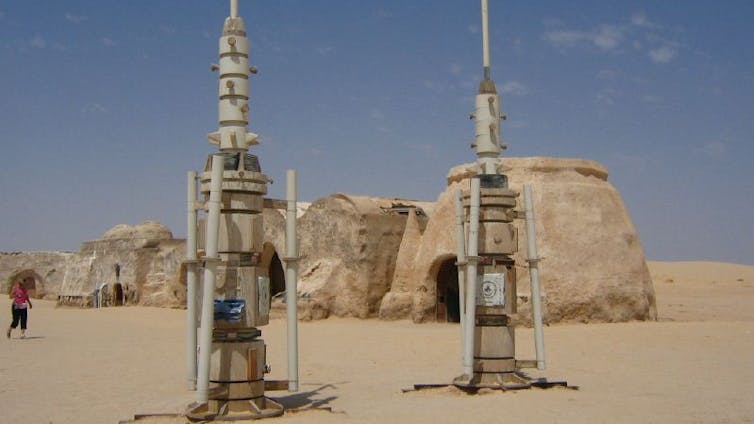
Tatooine’s moisture farming equipment stands in the desert of Tunisia, where parts of the ‘Star Wars’ movie series were filmed. Véronique Debord-Lazaro via Flickr, CC BY-SA
Daniel B. Oerther, Missouri University of Science and Technology and William Schonberg, Missouri University of Science and Technology Just 48 short years ago, movie director George Lucas used the phrase “A long time ago in a galaxy far, far away” as the opening to the first “Star Wars” movie, later labeled “Episode IV: A New Hope.” But at least four important aspects of the “Star Wars” saga are much closer – both in time and space – than Lucas was letting on. One, the ability to add blue food coloring to milk, was possible even at the time the first film came out. But in 2024, “Star Wars”-themed blue milk became periodically available in grocery stores. And we, an environmental health engineer and a civil engineer, know there are at least three more elements of these ancient, distant Lucas stories that might seem like science fiction but are, in fact, science reality.

Moisture farming

In that first movie, “Episode IV,” Luke Skywalker’s Uncle Owen was a farmer on the planet of Tatooine. He farmed water from air in the middle of a desert. It might sound impossible, but it’s exactly what experts discussed at the second International Atmospheric Water Harvesting Summit hosted by Arizona State University in March 2025. Each day, a human needs to consume about the equivalent of 0.8 gallons of water (3 liters). With more than 8 billion people living on the planet, that means engineers need to produce nearly 2.6 trillion gallons (10 trillion liters) of clean drinking water every year. Taken globally, rainfall would be enough, but it’s distributed very unevenly – including landing in the oceans, where it immediately becomes too salty to drink safely. Deserts, which cover about one-fifth of the Earth’s land area, are home to about 1 billion people. Researchers at places such as Berkeley have developed solar-powered systems that can produce clean drinking water from thin air. In general, they use a material that traps water molecules from the air within its structure and then use sunlight to condense that water out of the material and into drinkable liquid. But there is still a ways to go before they are ready for commercial distribution and available to help large numbers of people.
Researchers can harvest water from air in the desert, in a process powered only by the Sun.

Space debris

When the second Death Star was destroyed in “Return of the Jedi,” it made a huge mess, as you would expect when blowing to smithereens an object at least 87 miles across (140 kilometers). But the movie’s mythology helpfully explains a hyperspace wormhole briefly opened, scattering much of the falling debris across the galaxy. As best as anyone can tell, a hyperspace wormhole has never appeared near Earth. And even if such a thing existed or happened, humans might not have the technology to chuck all our trash in there anyway. So we’re left with a whole lot of stuff all around us, including in space. According to the website Orbiting Now, in late April 2025 there were just over 12,000 active satellites orbiting the planet. All in all, the United States and other space-faring nations are trying to keep track of nearly 50,000 objects orbiting Earth. And there are millions of fragments of space debris too small to be observed or tracked. Just as on Earth’s roads, space vehicles crash into each other if traffic gets too congested. But unlike the debris that falls to the road after an Earth crash, all the bits and pieces that break off in a space crash fly away at speeds of several thousand miles per hour (10,000 to 30,000 kph) and can then hit other satellites or spacecraft that cross their paths. This accumulation of space debris is creating an increasing problem. With more satellites and spacecraft heading to orbit, and more stuff up there moving around that might hit them, space travel is becoming more like flying the Millennium Falcon through an asteroid field every day. Engineers at NASA, the European Space Agency and other space programs are exploring a variety of technologies – including a net, a harpoon and a laser – to remove the more dangerous pieces of space junk and clean up the space environment.
Dodging obstacles in space is no picnic.

The Force itself

To most Earth audiences, the Force was a mysterious energy field created by life that binds the galaxy together. That is until 1999, when “Episode I: The Phantom Menace” revealed that the Force came from midi-chlorians, a microscopic, sentient life form that lives within every living cell. To biologists, midi-chlorians sound suspiciously similar to mitochondria, the powerhouse of our cells. The current working hypothesis is that mitochondria emerged from bacteria that lived within cells of other living things. And mitochondria can communicate with other life forms, including bacteria. There are many different kinds of mitochondria, and medical professionals are learning how to transplant mitochondria from one cell to another just like they transplant organs from one person’s body to another. Maybe one day a transplant procedure could help people find the light side of the Force and turn away from the dark side. May the Fourth – and the Force – be with you.The Conversation Daniel B. Oerther, Professor of Environmental Health Engineering, Missouri University of Science and Technology and William Schonberg, Professor of Civil Engineering, Missouri University of Science and Technology This article is republished from The Conversation under a Creative Commons license. Read the original article.

Discover more from Daily News

Subscribe to get the latest posts sent to your email.

Continue Reading
Advertisement Sports Research

actors & performers

T.K. Carter, The Thing and Punky Brewster Actor, Dies at 69

Actor T.K. Carter, known for The Thing and Punky Brewster, has died at age 69. A look at his career and lasting legacy in film and television.

Published

on

Actor T.K. Carter at a public appearance, known for roles in The Thing and Punky Brewster

T.K. Carter in Punky Brewster (1984) Image: IMDB

Veteran actor T.K. Carter, best known for his roles in The Thing and the popular 1980s television series Punky Brewster, has died at the age of 69.

Authorities confirmed Carter was found unresponsive at his home in Duarte, California. No foul play is suspected, and an official cause of death has not yet been released.

A Career Spanning Decades

Born Thomas Kent Carter, T.K. Carter built a career in film and television that spanned more than four decades. He became a cult favorite portraying Nauls in John Carpenter’s 1982 horror classic The Thing, a film that continues to influence the genre today.

Television audiences widely remember Carter for his role as Mike Fulton on Punky Brewster, where his comedic timing and grounded performances helped make the show a lasting favorite of the era.

Film and Television Legacy

In addition to his best-known roles, Carter appeared in films such as Runaway Train, Ski Patrol, and Space Jam. His television work included guest appearances on a wide range of series throughout the 1980s, 1990s, and beyond.

Known within the industry as a reliable and versatile performer, Carter often brought authenticity and warmth to supporting roles that left a lasting impression, even in brief appearances.

Remembering T.K. Carter

As news of his passing spreads, fans and colleagues alike are reflecting on T.K. Carter’s contributions to film and television. While he may not have always been the leading name on the marquee, his work helped shape stories that continue to be watched and appreciated by new generations.

T.K. Carter is remembered for his enduring performances, professional dedication, and the quiet but meaningful legacy he leaves behind.

Related Coverage

Stay with STM Daily News for updates to this developing story and more independent coverage of entertainment, history, and culture. Visit www.stmdailynews.com for the latest.


Discover more from Daily News

Subscribe to get the latest posts sent to your email.

Continue Reading

actors & performers

Pat Finn: Remembering the Familiar Face Who Made Us Laugh

Pat Finn, the familiar face from The Middle, Seinfeld, Friends, and Toyota commercials, has passed away at 60. We remember his career, legacy, and lasting impact.

Published

on

Pat Finn: Remembering the Familiar Face Who Made Us Laugh

Many people may not have known his name right away, but they knew his face. Pat Finn was one of those rare actors who quietly became part of America’s shared television experience—popping up in beloved sitcoms, memorable commercials, and scene-stealing guest roles for more than three decades.

In December 2025, Finn passed away at the age of 60 after a battle with bladder cancer, leaving behind a body of work that continues to resonate with audiences who grew up watching network television’s golden era of sitcoms.

A Career Built on Consistency and Craft


Pat Finn wasn’t a headline-chasing star. Instead, he was the definition of a working actor—someone whose talent and reliability kept him in steady demand across generations of television.

He appeared in some of the most recognizable shows in TV history, including Seinfeld, Friends, Murphy Brown, 3rd Rock from the Sun, That ’70s Show, The King of Queens, Curb Your Enthusiasm, and The Goldbergs. To many fans, he was especially memorable as Bill Norwood, the occasionally awkward and often hilarious boss on ABC’s long-running sitcom The Middle.

These weren’t flashy roles—but they were essential ones. Finn had a gift for grounding comedy in reality, playing characters who felt like people you actually knew: coworkers, neighbors, or that guy you’d see at the store every week.

From Chicago Improv to National Screens

Born in Evanston, Illinois, Pat Finn came out of Chicago’s legendary improv scene, training and performing with The Second City and the iO Theater. That background gave him sharp comedic instincts and impeccable timing—skills that translated effortlessly to television.

He was also a contemporary and friend of Chris Farley, and like many performers from that era, Finn carried the Chicago improv tradition of generosity, collaboration, and humility throughout his career.

The Toyota Commercials—and Being “That Guy”

In later years, a new generation came to recognize Finn from Toyota commercials, particularly regional dealership ads. Once again, he became “that guy” everyone recognized but couldn’t quite place—a testament to just how deeply embedded he was in pop culture.

Commercial work is often overlooked, but Finn approached it with the same professionalism and charm as his television roles, making even short appearances feel authentic and memorable.

A Teacher, Mentor, and Family Man

Beyond acting, Pat Finn was also a teacher and mentor, sharing his experience with aspiring performers and encouraging young actors to respect the craft rather than chase fame.

Advertisement
Get More From A Face Cleanser And Spa-like Massage

He was married to his wife, Donna, for more than three decades, and together they raised three children. In tributes following his passing, family and colleagues alike emphasized not just his talent, but his kindness, humor, and generosity.

A Quiet Legacy That Lasts

Pat Finn’s passing is a reminder that television history isn’t shaped only by superstars. It’s built by dependable, talented performers who show up, deliver, and elevate every project they touch.

If you’ve ever laughed at a scene and later realized, “Hey, I’ve seen that guy before,” there’s a good chance it was Pat Finn.

His work lives on—in reruns, streaming libraries, commercials, and the memories of audiences who didn’t always know his name, but never forgot his presence.

Rest in peace, Pat Finn. And thank you for the laughs.

Related Coverage

  Pat Finn, the familiar face from The Middle, Seinfeld, Friends, and Toyota commercials, has passed away at 60. We remember his career, legacy, and lasting impact.

Looking for an entertainment experience that transcends the ordinary? Look no further than STM Daily News Blog’s vibrant Entertainment section. Immerse yourself in the captivating world of indie films, streaming and podcasts, movie reviews, music, expos, venues, and theme and amusement parks. Discover hidden cinematic gems, binge-worthy series and addictive podcasts, gain insights into the latest releases with our movie reviews, explore the latest trends in music, dive into the vibrant atmosphere of expos, and embark on thrilling adventures in breathtaking venues and theme parks. Join us at STM Entertainment and let your entertainment journey begin! https://stmdailynews.com/category/entertainment/

and let your entertainment journey begin!


Discover more from Daily News

Subscribe to get the latest posts sent to your email.

Continue Reading

social media

The Viral Backlash: How a Chef, a TikTok Influencer, and One Moment Changed a San Francisco Restaurant

TikTok Influencer vs Chef: A viral TikTok confrontation between Chef Luke Sung and a food influencer led to backlash, a restaurant closure, and a major rebrand in San Francisco.

Published

on

new york city circa 2021 finder scrolling tik tok video sharing social networking serv SBI 349948744

The Viral Backlash: How a Chef, a TikTok Influencer, and One Moment Changed a San Francisco Restaurant

In mid-2025, a San Francisco restaurant found itself at the center of a viral controversy—not because of its food, but because of an interaction between a well-known chef and a TikTok food influencer. The incident sparked a broader conversation about power, professionalism, and the growing influence of social media in the hospitality industry.

What Happened at Kis Cafe

The incident involved Chef Luke Sung, a respected name in the Bay Area culinary scene, and a TikTok micro-influencer known online as @itskarlabb. The influencer had been invited to Kis Cafe for a planned promotional collaboration. According to the influencer, during her visit the chef questioned her follower count—around 15,000 at the time—and allegedly implied that her audience was not the “type of people” who would dine at his restaurant. She later described the exchange as humiliating and dismissive. After leaving the restaurant, she shared her experience in a TikTok video. The post quickly went viral, gaining millions of views and triggering a wave of online backlash.

The Internet Reacts

Although the influencer initially did not name the restaurant or the chef, internet users quickly identified Kis Cafe. The restaurant’s review pages were flooded with criticism, and the incident became a flashpoint in online discussions about elitism, influencer culture, and accountability. Within days, Kis Cafe issued a public apology and announced that Luke Sung was no longer affiliated with the restaurant in any capacity.

Chef Luke Sung Responds

Chef Sung later released a public apology, acknowledging that his behavior was condescending and inappropriate. He stated that there were no excuses for the way he treated the influencer and accepted responsibility for the incident. The apology, however, did little to slow the momentum of public reaction.

The Restaurant Closes — and Reopens

Not long after the controversy, Kis Cafe announced it would close. In the months that followed, the space reopened under a new name, Bosque, with new leadership and no involvement from Sung. The rebrand was seen as a clear attempt to move forward and distance the business from the viral episode.

The Influencer Effect

Meanwhile, the influencer at the center of the controversy saw her follower count surge dramatically, growing from a modest audience into hundreds of thousands of followers almost overnight. The incident highlighted the real-world impact that even “micro-influencers” can have—and how a single moment, captured and shared, can reshape careers and businesses.

Why This Story Matters

This controversy underscored a major cultural shift: social media is no longer separate from real-world industries like dining and hospitality. Online platforms can amplify personal experiences into powerful narratives with lasting consequences. As of early 2026, the restaurant operates under a new identity, the chef has stepped away from the project entirely, and the influencer continues to grow her platform. The episode remains a cautionary tale about professionalism, respect, and the power of digital voices. Get The Knowledge. More stories like this are available at STM Daily News.

Dive into “The Knowledge,” where curiosity meets clarity. This playlist, in collaboration with STMDailyNews.com, is designed for viewers who value historical accuracy and insightful learning. Our short videos, ranging from 30 seconds to a minute and a half, make complex subjects easy to grasp in no time. Covering everything from historical events to contemporary processes and entertainment, “The Knowledge” bridges the past with the present. In a world where information is abundant yet often misused, our series aims to guide you through the noise, preserving vital knowledge and truths that shape our lives today. Perfect for curious minds eager to discover the ‘why’ and ‘how’ of everything around us. Subscribe and join in as we explore the facts that matter.  https://stmdailynews.com/the-knowledge/

Authors

  • IMG 0366

    Hal Machina is a passionate writer, blogger, and self-proclaimed journalist who explores the intersection of science, tech, and futurism. Join him on a journey into innovative ideas and groundbreaking discoveries!

    View all posts journalist

Discover more from Daily News

Subscribe to get the latest posts sent to your email.

Continue Reading

Trending


