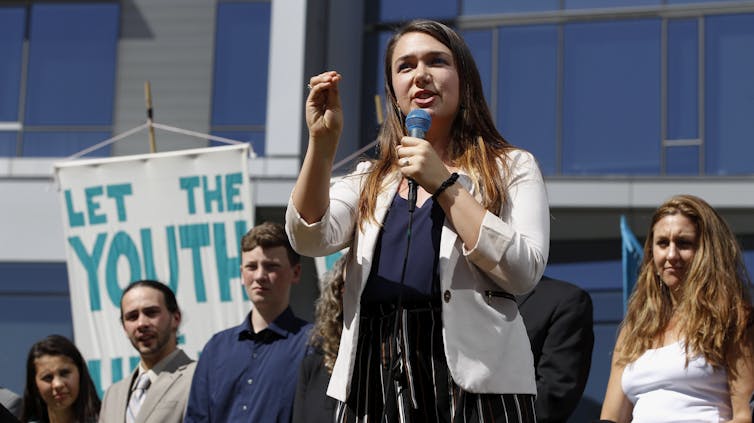
Kelsey Juliana, a lead plaintiff in a federal lawsuit over responsibility for climate change, speaks at a 2019 rally in Oregon. AP Photo/Steve DipaolaHannah Wiseman, Penn State The U.S. Supreme Court in March 2025 ended a decade-old lawsuit filed by a group of children who sought to hold the federal government responsible for some of the consequences of climate change. But just two months earlier, the justices allowed a similar suit from the city and county of Honolulu, Hawaii, to continue against oil and gas companies. Evidence shows that fossil fuel companies, electric utilities and the federal government have known about climate change, its dangers and its human causes for at least 50 years. But the steps taken by fossil fuel companies, utilities and governments, including the U.S. government, have not been enough to meet international climate targets. So local and state governments and citizens have asked the courts to force companies and public agencies to act. Their results have varied, with limited victories to date. But the cases keep coming.
In response to this federal executive seesaw of climate action, some legal claims use a court-based, or common law, approach to address climate concerns. For instance, in Connecticut v. American Electric Power, filed in 2004, nine states asked a federal judge to order power plants to reduce their emissions. The states said those emissions contributed to global warming, which they argued met the federal common law definition of a “public nuisance.” That case ended when the U.S. Supreme Court ruled in 2011 that the existence of a statute – the federal Clean Air Act – meant common law did not apply. Other plaintiffs have tried to use the “public nuisance” claim or a related common-law claim of “trespass” to force large power plants or oil and gas producers to pay climate-related damages. But in those cases, too, courts found that the Clean Air Act overrode the common-law grounds for those claims. With those case outcomes, many plaintiffs have shifted their strategies, focusing more on state courts and seeking to hold the fossil fuel industry responsible for allegedly deceiving the public about the causes and effects of climate change.Three examples of petroleum industry advertisements a lawsuit alleges are misleading about the causes of climate change.State of Maine v. BP, Chevron, ExxonMobil, Shell, Sunoco and American Petroleum Insititute
Examining deception
In many cases, state and local governments are arguing that the fossil fuel industry knew about the dangers of climate change and deceived the public about them, and that the industry exaggerated the extent of its investments in energy that doesn’t emit carbon. Rather than directly asking courts to order reduced carbon emissions, these cases tend to seek damages that will help governments cover the costs associated with climate change, such as construction of cooling centers and repair of roads damaged by increased precipitation. In legal terms, the lawsuits are saying oil and gas companies violated consumer-protection laws and committed common-law civil violations such as negligence. For instance, the city of Chicago alleges that major petroleum giants – along with the industry trade association the American Petroleum Institute – had “abundant knowledge” of the public harms of fossil fuels yet “actively campaigned” to hide that information and deceive consumers. Many other complaints by states and local governments make similar allegations. Another lawsuit, from the state of Maine, lists and provides photographs of a litany of internal industry documents showing industry knowledge of the threat of climate change. That lawsuit also cites a 1977 memo from an Exxon employee to Exxon executives, which stated that “current scientific opinion overwhelmingly favors attributing atmospheric carbon dioxide increase to fossil fuel consumption,” and a 1979 internal Exxon memo about the buildup of carbon dioxide emissions, which warned that “(t)he potential problem is great and urgent.” These complaints also show organizations supported by fossil fuel companies published ads as far back as the 1990s, with titles such as “Apocalypse No” and “Who told you the earth was warming … Chicken Little?” Some of these ads – part of a broader campaign – were funded by a group called the Information Council for the Environment, supported by coal producers and electric utilities. Courts have dismissed some of these complaints, finding that federal laws overrule the principles those suits are based on. But many are still winding their way through the courts. In 2023 the Supreme Court of Hawaii found that federal laws do not prevent climate claims based on state common law. In January 2025 the U.S. Supreme Court allowed the case to continue.Lead claimant Rikki Held, then 22, confers with lawyers before the beginning of a 2023 Montana trial about young people’s rights in a time of climate change.William Campbell/Getty Images
Other approaches
Still other litigation approaches argue that governments inadequately reviewed the effects of greenhouse gas emissions, or even supported or subsidized those emissions caused by private industry. Those lawsuits – some of which were filed by children, with help from their parents or legal guardians – claim the governments’ actions violated people’s constitutional rights. For instance, children in the Juliana v. United States case, first filed in 2015, said 50 years of petroleum-supporting actions by presidents and various federal agencies had violated their fundamental “right to a climate system capable of sustaining human life.” The 9th U.S. Circuit Court of Appeals ruled that their claim was a “political question” – meant for Congress, not the courts. The U.S. Supreme Court declined to reconsider that ruling in March 2025. But children in Montana found more success. The Montana Constitution requires state officials and all residents to “maintain and improve a clean and healthful environment … for present and future generations.” In 2024 the Montana Supreme Court determined that this provision “includes a stable climate system that sustains human lives and liberties.” The Montana Supreme Court also reviewed a state law banning officials from considering greenhouse gas emissions of projects approved by the state. The court found that the ban violated the state constitution, too. Since then, the Montana Supreme Court has specifically required state officials to review the climate effects of a project for which permits were challenged. Concerned people and groups continue to file climate-related lawsuits across the country and around the world. They are seeing mixed results, but as the cases continue and more are filed, they are drawing attention to potential corporate and government wrongdoing, as well as the human costs of climate change. And they are inspiring shareholders and citizens to demand more accurate information and action from fossil fuel companies and electric utilities.Hannah Wiseman, Professor of Law, Penn State This article is republished from The Conversation under a Creative Commons license. Read the original article.
Metro Board to Consider Locally Preferred Alternative for Sepulveda Transit Corridor Project
Metro Board will consider Modified Alternative 5 as the Locally Preferred Alternative for the Sepulveda Transit Corridor Project on January 22, 2026, a major step toward improving transit between the San Fernando Valley and LA’s Westside.
On Thursday, January 22, 2026, at 10:00 AM, the Metro Board will consider selecting a Locally Preferred Alternative (LPA) for the Sepulveda Transit Corridor Project. This milestone could significantly improve mobility options between the San Fernando Valley and the of Los Angeles.
Proposed Alternative
After a technical evaluation and reviewing more than 8,000 public comments from the Draft Environmental Impact Report (Draft EIR) period, Metro staff has proposed Modified Alternative 5 as the LPA. This underground heavy rail line would run between the Van Nuys Metrolink Station and the E Line Expo/Sepulveda Station with a key connection to the G Line at Van Nuys Boulevard.
Modified Alternative 5 combines the benefits of Alternative 5—high ridership, frequent service, and shorter station construction sites—while avoiding geographic challenges in the Santa Monica Mountains. It also incorporates connectivity advantages from Alternative 6 along Van Nuys Boulevard, reducing the overall project length and anticipated costs, and increasing direct connections to Metro’s growing transit network.
Next Steps
If approved, Metro would advance project development for the LPA, including:
Evaluating phasing and the Public/Private Partnership (P3) delivery model
Identifying value engineering opportunities
Refining designs to allow G Line connection at Van Nuys Boulevard
Continuing environmental review and community outreach
Public Participation
Residents, businesses, and institutions are encouraged to provide feedback:
Attend in person: Sign up on the tablets in the Metro Headquarters lobby before 9:45 AM.
Email comments:BoardClerk@metro.net (comments received before 5 PM on January 21, 2026, will be sent to the full Board)
The Sepulveda Transit Corridor Project will connect the San Fernando Valley to the Westside, addressing the natural barrier of the Santa Monica Mountains and relieving congestion on the I-405. It will provide a fast, safe, and reliable alternative to the freeway and strengthen LA’s regional transit network.
Disclaimer: Station locations and construction timelines are subject to change. Project availability may vary. Public input is encouraged before final decisions are made.
Continuing Coverage: STM Daily News will continue to follow developments surrounding the Sepulveda Transit Corridor Project, including Metro Board decisions, environmental review updates, community input opportunities, and the project’s long-term impact on transportation across Los Angeles.
For the latest updates, in-depth reporting, and transportation-focused coverage, visit STM Daily News.
Why can’t I wiggle my toes one at a time, like my fingers?
why can’t I wiggle my toes? Ever wondered why you can’t wiggle your toes one at a time like your fingers? Learn how evolution, muscles, and your brain all play a part in making fingers more independent than toes—and why that’s key for walking and balance.
Why can’t I wiggle my toes individually, like I can with my fingers? – Vincent, age 15, Arlington, Virginia
One of my favorite activities is going to the zoo where I live in Knoxville when it first opens and the animals are most active. On one recent weekend, I headed to the chimpanzees first. Their breakfast was still scattered around their enclosure for them to find. Ripley, one of the male chimpanzees, quickly gathered up some fruits and vegetables, sometimes using his feet almost like hands. After he ate, he used his feet to grab the fire hoses hanging around the enclosure and even held pieces of straw and other toys in his toes. I found myself feeling a bit envious. Why can’t people use our feet like this, quickly and easily grasping things with our toes just as easily as we do with our fingers? I’m a biological anthropologist who studies the biomechanics of the modern human foot and ankle, using mechanical principles of movement to understand how forces affect the shape of our bodies and how humans have changed over time. Your muscles, brain and how human feet evolved all play a part in why you can’t wiggle individual toes one by one.Chimpanzee hands and feet do similar jobs.Manoj Shah/Stone via Getty Images
Comparing humans to a close relative
Humans are primates, which means we belong to the same group of animals that includes apes like Riley the chimp. In fact, chimpanzees are our closest genetic relatives, sharing almost 98.8% of our DNA. Evolution is part of the answer to why chimpanzees have such dexterous toes while ours seem much more clumsy. Our very ancient ancestors probably moved around the way chimpanzees do, using both their arms and legs. But over time our lineage started walking on two legs. Human feet needed to change to help us stay balanced and to support our bodies as we walk upright. It became less important for our toes to move individually than to keep us from toppling over as we moved through the world in this new way.Feet adapted so we could walk and balance on just two legs.Karina Mansfield/Moment via Getty Images Human hands became more important for things such as using tools, one of the hallmark skills of human beings. Over time, our fingers became better at moving on their own. People use their hands to do lots of things, such as drawing, texting or playing a musical instrument. Even typing this article is possible only because my fingers can make small, careful and controlled movements. People’s feet and hands evolved for different purposes.
Muscles that move your fingers or toes
Evolution brought these differences about by physically adapting our muscles, bones and tendons to better support walking and balance. Hands and feet have similar anatomy; both have five fingers or toes that are moved by muscles and tendons. The human foot contains 29 muscles that all work to help you walk and stay balanced when you stand. In comparison, a hand has 34 muscles. Most of the muscles of your foot let you point your toes down, like when you stand on tiptoes, or lift them up, like when you walk on your heels. These muscles also help feet roll slightly inward or outward, which lets you keep your balance on uneven ground. All these movements work together to help you walk and run safely. The big toe on each foot is special because it helps push your body forward when you walk and has extra muscles just for its movement. The other four toes don’t have their own separate muscles. A few main muscles in the bottom of your foot and in your calf move all four toes at once. Because they share muscles, those toes can wiggle, but not very independently like your fingers can. The calf muscles also have long tendons that reach into the foot; they’re better at keeping you steady and helping you walk than at making tiny, precise movements.Your hand is capable of delicate movements thanks to the muscles and ligaments that control its bones.Henry Gray, ‘Anatomy of the Human Body’/Wikimedia Commons, CC BY In contrast, six main muscle groups help move each finger. The fingers share these muscles, which sit mostly in the forearm and connect to the fingers by tendons. The thumb and pinky have extra muscles that let you grip and hold objects more easily. All of these muscles are specialized to allow careful, controlled movements, such as writing. So, yes, I have more muscles dedicated to moving my fingers, but that is not the only reason I can’t wiggle my toes one by one.
Divvying up brain power
You also need to look inside your brain to understand why toes and fingers work differently. Part of your brain called the motor cortex tells your body how to move. It’s made of cells called neurons that act like tiny messengers, sending signals to the rest of your body. Your motor cortex devotes many more neurons to controlling your fingers than your toes, so it can send much more detailed instructions to your fingers. Because of the way your motor cortex is organized, it takes more “brain power,” meaning more signals and more activity, to move your fingers than your toes.The motor cortex of your brain sends orders to move parts of your body.Kateryna Kon/Science Photo Library via Getty Images Even though you can’t grab things with your feet like Ripley the chimp can, you can understand why.Hello, curious kids! Do you have a question you’d like an expert to answer? Ask an adult to send your question to CuriousKidsUS@theconversation.com. Please tell us your name, age and the city where you live.And since curiosity has no age limit – adults, let us know what you’re wondering, too. We won’t be able to answer every question, but we will do our best.Steven Lautzenheiser, Assistant Professor of Biological Anthropology, University of Tennessee This article is republished from The Conversation under a Creative Commons license. Read the original article.
Why do people get headaches? – Evie V., age 10, Corpus Christi, Texas
Whether sharp and stabbing or dull and throbbing, a headache can ruin your day. But your brain doesn’t actually feel pain. So what is going on when it feels like your head is in a vise or about to explode? I am a child neurologist – that is, a doctor who specializes in diseases of the brain in kids. Most of my patients are kids and adolescents who are struggling with headaches. Head pain is complicated, and there is still a lot to learn about what causes it and how it can be treated. But researchers know there are a few key players that take part in generating pain.
What are headaches?
Nerves communicate information like pain through electrical signals between the body and the brain. While the brain itself doesn’t have any nerve sensors to feel pain, blood vessels in the head and structures that protect and surround the brain do sense pain. When these tissues detect injury or damage, they release chemicals that trigger transmission of electrical signals through nerves to tell the brain the head is hurting. The brain will also use nerves to signal the body to respond to pain with symptoms like feeling tired, teary eyes, runny nose, upset stomach and discomfort in bright or loud environments. It’s not clear why humans evolved to feel these symptoms, but some scientists theorize that this can lead to healthier lifestyle choices to decrease the chance of future headache attacks.Weather changes are one of the most commonly reported migraine triggers. Danielle Wilhour, a neurologist and headache specialist at University of Colorado Anschutz Medical Campus, explains why shifts in weather can bring on migraines — and what you can do to ease the pain.
What causes headaches?
Often, headaches are a sign that the body is under some kind of stress. That stress triggers chemical and physical changes to the nerves and blood vessels around your brain, head and neck that can cause headaches. Many types of stresses can cause headaches, including an infection, allergies, hormone changes during puberty and menstrual cycles, not getting enough sleep, not drinking enough water, skipping meals or drinking too much caffeine or alcohol. Sometimes, headaches happen with emotional stress, like feeling anxious or depressed. Even pressure in your sinuses due to changes in the weather can cause your head to hurt. One in 11 kids have had a type of severe headache called a migraine. They feel like a pulsing and pounding pain in your head and come with other symptoms, including nausea or being sensitive to lights and sounds. During a migraine, it can be hard to do everyday activities because they can make the pain worse. It is also very common to feel unwell or irritable before the head pain starts and after the pain is gone.Migraines and chronic headaches can be debilitating.Viktoriya Skorikova/Moment via Getty Images Migraines occur when the nerves and other structures used in signaling and interpreting pain aren’t working properly, leading to pain and discomfort from stimulation that wouldn’t normally provoke this. There are many environmental and genetic factors that contribute to this dysfunction. Some people are born with a higher risk of developing migraines. Most people with migraines have someone in their family who also experiences them.
What can treat and prevent headaches?
Identifying what type of headache you’re experiencing is crucial to making sure it is treated properly. Because migraines can be severe, they’re the type of headache that most often leads to doctor’s visits for both kids and adults. There are several ways to reduce your chances of having headaches, such as drinking plenty of water and limiting caffeine. Eating, sleeping and exercising regularly are other ways you can help prevent headaches.Sleep deprivation can worsen headaches.DjelicS/iStock via Getty Images Plus While painkillers like ibuprofen are often enough to relieve a headache, prescription medications are sometimes necessary to make head pain more bearable. Some medications can also help control or prevent headache episodes. Physical therapy to exercise the body or behavioral therapy to work on the mind can also help you manage headache pain. There are even electronic devices to treat headaches by stimulating different parts of the nervous system. It is important to talk with a doctor about headaches, especially if it’s a new problem or you experience a change in how they usually feel. Sometimes, brain imaging or blood tests are needed to rule out another health issue. Recognizing a headache problem early will help your doctor get started on helping you figure out the best way to treat it.Hello, curious kids! Do you have a question you’d like an expert to answer? Ask an adult to send your question to CuriousKidsUS@theconversation.com. Please tell us your name, age and the city where you live.And since curiosity has no age limit – adults, let us know what you’re wondering, too. We won’t be able to answer every question, but we will do our best.Katherine Cobb-Pitstick, Assistant Professor of Child Neurology, University of Pittsburgh This article is republished from The Conversation under a Creative Commons license. Read the original article.