

News
Unity and Support: Baltimore’s Response to the Key Bridge Collapse
“Baltimore’s Orioles and Ravens unite, donating $10M to Key Bridge Fund after tragic collapse. Community stands strong in the face of adversity.”

Last Updated on April 7, 2024 by Rod Washington
In a display of unity and generosity, Baltimore’s major league franchises, the Orioles and the Ravens, have joined forces to donate $10 million towards the recovery efforts following the tragic collapse of the Francis Scott Key Bridge on March 26. The donation will be channeled through the Baltimore Community Foundation’s “Maryland Tough Baltimore Strong Key Bridge Fund,” aiming to provide financial assistance to the families of victims, port workers, first responders, and others impacted by this devastating event.
New Orioles owner, David M. Rubenstein, emphasized the city’s resilience in the face of adversity, noting that the donation reflects a commitment to supporting those who play pivotal roles in maintaining the city’s operations. Ravens owner, Steve Bisciotti, expressed heartfelt condolences to the victims and their families, acknowledging the bravery and dedication of the first responders involved in the rescue efforts.
The collapse, triggered by a container ship losing control and striking a pier, resulted in the tragic loss of six construction workers with two individuals fortunate to be rescued from the river. This catastrophe has undoubtedly shaken the community, but the response from the Orioles, Ravens, and the wider Baltimore community speaks volumes about their solidarity and determination to stand together during times of crisis.
As the city mourns the lives lost and works towards recovery, the support from these sports franchises serves as a beacon of hope and solidarity. The resilience and strength displayed by Baltimore and Maryland in the wake of this tragedy are a testament to the unwavering spirit of its people. Through collaboration and compassion, the community is coming together to heal and rebuild, showcasing the true essence of unity in the face of adversity.
About the Key Bridge Collapse
Key Bridge collapsed on March 26, 2024, at 01:27 EDT (05:27 UTC) due to a collision with a Singapore-registered container ship named MV Dali. The ship lost power and hit the southwest supporting pier of the main truss section. The National Transportation Safety Board (NTSB) reported that the bridge was built before the use of redundant support structures, which are now commonly used in modern bridges. The NTSB stated that these structures would have prevented the collapse.
During sonar exploration, it was discovered that several vehicles were submerged underwater, and two individuals were rescued alive from the river. Maryland Governor Wes Moore declared a state of emergency, acknowledging that the situation could have been much worse. However, the actions of the ship’s crew, who sent a distress signal, and the workers on the bridge, who prevented other vehicles from crossing the bridge moments before the collapse, helped to save many lives. Following the incident, insurers are expected to face multi-billion dollar losses due to damages, business disruptions, and liability claims.
An eight-worker repair crew was working on a bridge when a collision occurred. It is believed that the crew members are the only victims of the disaster. During the search and rescue operation, two of the victims were found inside a red pickup truck, submerged under 25 feet of Patapsco River water, near the mid-span of the collapsed bridge. Due to the unfavorable water conditions, further search operations have been suspended. (Wikipedia)
https://en.wikipedia.org/wiki/Francis_Scott_Key_Bridge_(Baltimore)


News
Entertain with Ease Using Fresh Fall Flavors
Fresh Fall Flavors: When seasonal celebrations start to fill up your calendar as you host friends and family, an appetizer that is delicious, yet simple, quickly moves from a new addition at the table to a tried-and-true shareable that guests look forward to year after year. This Baked Feta with Roasted California Grapes recipe delivers warm and rich flavors while being incredibly easy to prepare in a rush.


Entertain with Ease Using Fresh Fall Flavors
(Feature Impact) When seasonal celebrations start to fill up your calendar as you host friends and family, an appetizer that is delicious, yet simple, quickly moves from a new addition at the table to a tried-and-true shareable that guests look forward to year after year.
This Baked Feta with Roasted California Grapes recipe delivers warm and rich flavors while being incredibly easy to prepare in a rush. Juicy Grapes from California are roasted to deepen their sweet flavor then served over baked feta for a bite that is sweet, tangy and comforting.
Don’t forget: Grapes make an excellent healthy and fresh snack any time during the fall season, whether you need an after-school pick-me-up, a break between meetings or a quick on-the-go breakfast.
Fall into more flavorful recipe ideas at GrapesFromCalifornia.com.
Watch video to see how to make this recipe!

Baked Feta with Roasted California Grapes
Servings: 6
- 1 1/2 cups red and black seedless Grapes from California
- 1 tablespoon olive oil, plus additional for drizzling, divided
- 1-2 teaspoons balsamic vinegar
- 1 pound block feta
- 1-2 tablespoons fresh thyme
- 1 teaspoon dried oregano
- red pepper flakes, to taste
- crusty bread slices
- Heat oven to 400 F.
- In medium bowl, toss grapes with 1 tablespoon olive oil and balsamic vinegar to coat then place on baking tray. Roast 10-15 minutes, or until grapes just begin to soften. Remove from oven and let rest in pan 5 minutes.
- Slice block of feta into two thick slices and place in baking dish. Sprinkle with thyme, oregano and red pepper flakes, to taste, and drizzle with olive oil. Top with roasted grapes. Bake about 10 minutes, or until cheese has softened. Serve with crusty bread slices.

SOURCE:
California Table Grape Commission
For more recipe ideas, visit “FOOD & DRINK!“


(Feature Impact) Every year, approximately 200,000 service men and women transition from military life to corporate America. Finding the right civilian career is a transition, but it’s an opportunity to leverage military leadership and mission-driven talent.
Traditional hiring processes often focus on conventional resumes, but forward-thinking organizations recognize military experience as a competitive advantage in today’s workforce. The resilience, integrity and adaptability of America’s veterans and military families make them uniquely positioned to drive growth and innovation in their communities.
“Veterans bring unmatched discipline, adaptability and a results-driven mindset that directly translates to high-impact corporate careers,” said Drew Matheson, senior director at Capital One’s Commercial Bank and retired U.S. Army infantry officer. “While military experience doesn’t always fit perfectly on a traditional paper resume, employers like Capital One who know how to decode these unique leadership skills are able to unlock an incredible pipeline of proven performers.”
To help transitioning service members successfully navigate this career pivot, military community leaders at Capital One offer these five essential tips for service members entering the civilian workforce: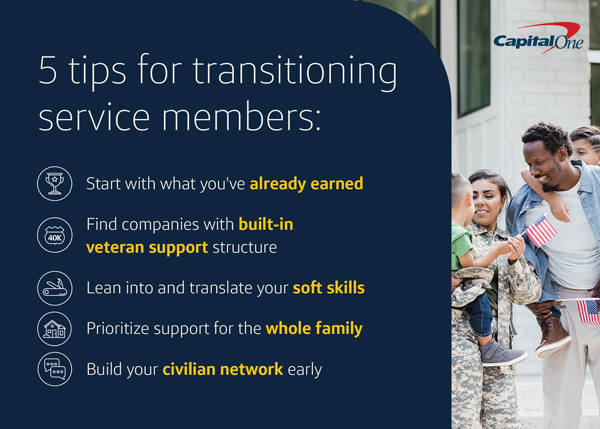
Start With What You’ve Already Earned
Opportunity starts with preparation. Beyond the well-known Post-9/11 GI Bill, which can cover tuition, housing and books, transitioning service members can look into vocational rehab or the SkillBridge program, which allows them to do civilian internships during the last 180 days of service. Many employers also offer internal tuition reimbursement programs. Taking the time to proactively map out these benefits ensures you aren’t leaving valuable opportunities or money on the table.
Find Employers with Veteran Support Structures
With almost half of veterans leaving their first post-military job within a year, according to research published by the Institute for Veterans and Military Families and VetAdvisor, finding the right culture and community is key to a successful transition. Look for employers with active veteran networks and dedicated mentorship.
For example, Capital One’s Salute Business Resource Group serves as a thriving internal community of more than 6,000 members, offering peer support, year-round professional development and mentorship for veterans, reservists and military spouses. Additionally, partner organizations like Hiring Our Heroes provide career workshops, fellowships and job fairs to ensure you’re employment-ready from day one.
Lean Into and Translate Your Soft Skills
Veterans bring a distinct competitive advantage to the applicant pool. You should confidently lean into the cross-functional “soft skills” learned in the line of duty such as risk management, crisis resolution and building trust under high-pressure scenarios.
The trick is translating these capabilities out of military jargon on your resume. Swap military terms like “NCOIC” for “Operations Manager” or “commanded” for “directed.” To make this easier, look for military-friendly employers that employ dedicated military recruiters who specialize in decoding military resumes to align skills with the right roles.
Prioritize Support for the Whole Family
Military service is a family commitment, and the transition out of uniform affects everyone. Military spouses often face unique career hurdles, including frequent relocations and employment gaps. When evaluating employers, look for companies that offer holistic benefits and flexible structures.
For example, Capital One, recognized by “U.S. Veterans Magazine” as a Top Veteran Employer and Top Military Spouse Employer, actively supports military spouses and families through dedicated spouse hiring initiatives and internal support mechanisms. Furthermore, look for organizations that support continued military training and active-duty leave, ensuring military associates never have to choose between their service and their careers.
Build Your Civilian Network Early
In the military, your network is built in. In the civilian world, you have to cultivate it. Long before your terminal leave begins, connect with veterans who work at companies you admire. Reach out for brief, 15-minute informational interviews to learn about their transition journeys rather than simply asking for a job. With more than 70% of civilian jobs filled through networking, according to estimates from Career Horizons, making organic connections early is a powerful tool for getting your foot in the door.
To find additional resources and learn more about how to support the hiring of veterans and military spouses, visit CapitalOneCareers.com/Military.
Photo courtesy of Shutterstock

SOURCE:
health and wellness
Zepbound Linked to Lower Healthcare Costs in Adults 55+ With Obesity, Real-World Study Suggests

A new real-world study of adults over age 55 with overweight or obesity found that sustained use of Zepbound (tirzepatide) for weight management was associated with lower healthcare costs over time compared with similar adults who were not treated. Eli Lilly and Company said the findings were driven in part by lower rates of hospital admissions and emergency department visits, and were published in Diabetes, Obesity and Metabolism.
What the study found
According to Lilly, researchers estimated healthcare cost differences over time (excluding the cost of Zepbound itself) using two established analytic methods. Across both approaches, monthly healthcare costs were lower, on average, among older adults who stayed on Zepbound.
Key estimates reported in the release include:
- At six months: costs were up to 15% lower (up to $181 per patient, per month).
- At 12 months: the estimated difference widened to as much as $607 per patient, per month, reflecting up to 38% lower costs than those not treated (estimates varied by model).
In the primary analysis, adults over 55 treated with Zepbound had lower rates of hospital admissions and emergency department visits across every follow-up period, along with numerically higher rates of routine outpatient and office visitsa pattern the company said was consistent with greater engagement in routine care.
Why Medicare is part of the conversation
Lilly said the cost findings may be relevant for older adults, including those in Medicares GLP-1 Bridge program. The company noted that beginning at six months, estimated healthcare savings nearly covered the programs monthly treatment cost of $195 per patient, per month, and by 12 months the estimated savings exceeded the reported monthly treatment cost.
Its important to note the release also emphasizes a limitation: claims data do not capture Zepbounds net price, and the study excluded the cost of Zepbound from total treatment costs. That means the reported differences reflect potential savings elsewhere in care that could offset treatment costs, not the full net cost impact.
Who was included in the analysis
The retrospective observational cohort study used Komodos Healthcare Map, a database of de-identified claims data from more than 330 million individuals enrolled in U.S. healthcare plans. The analysis included 15,843 adults over age 55 (mean age 64.5) with obesity or overweight plus at least one obesity-related complication who initiated Zepbound between November 2023 and September 2025. Each Zepbound user was matched 1:1 with a control participant who met the same eligibility criteria but did not initiate GLP-1 or GIP/GLP-1 receptor agonist medication.
What Zepbound is
Zepbound (tirzepatide) is a dual GIP and GLP-1 receptor agonist indicated for adults with obesity, or some adults with overweight who also have at least one weight-related medical problem, to lose weight and keep it off. Lilly also noted Zepbound is FDA-approved to treat adults with moderate-to-severe obstructive sleep apnea and obesity, and should be used alongside a reduced-calorie diet and increased physical activity.
Safety summary (high level)
The release includes an indications and safety summary with warnings. Among other risks, Lilly notes Zepbound carries a warning about thyroid tumors, including thyroid cancer, and may cause serious side effects such as severe stomach problems, dehydration leading to kidney problems, gallbladder problems, pancreatitis, serious allergic reactions, and low blood sugar (especially when used with certain diabetes medicines). Patients should talk with a healthcare provider about risks and whether the medication is appropriate for them.
Related Links
- Zepbound (official product site): https://zepbound.lilly.com/
- Lilly newsroom: https://www.lilly.com/news
- Journal page (publisher hub): https://dom-pubs.onlinelibrary.wiley.com/journal/14631326
- Medicare (official): https://www.medicare.gov/
- FDA MedWatch (side effect reporting): https://www.fda.gov/medwatch
Source
- PRNewswire / Eli Lilly and Company press release (Aug. 26, 2026): Zepbound linked to lower healthcare costs in adults over age 55 with obesity according to a real-world study
💪 Your health journey starts here! Explore the latest health news, fitness tips, wellness trends, and healthy living advice. Share your thoughts in the comments and subscribe to the STM Daily News newsletter to stay informed and inspired every day.





