

Movies
40 years ago, the first AIDS movies forced Americans to confront a disease they didn’t want to see

40 years ago, the first AIDS movies forced Americans to confront a disease they didn’t want to see
Scott Malia, College of the Holy Cross
First it was referred to as a “mysterious illness.” Later it was called “gay cancer,” “gay plague” and “GRID,” an acronym for gay-related immune deficiency. Most egregiously, some called it “4H disease” – shorthand for “homosexuals, heroin addicts, hemophiliacs and Haitians,” the populations most afflicted in the early days.
While these names were ultimately replaced by AIDS – and later, after the virus was identified, by HIV – they reflected two key realities about AIDS at the time: a lack of understanding about the disease and its strong association with gay men.
Although the first report in the mainstream press about AIDS appeared in 1981, the first movies to explore the disease wouldn’t come for four more years.
When the feature film “Buddies” and the television film “An Early Frost” premiered 40 years ago, in the fall of 1985, AIDS had belatedly been breaking into the public consciousness.
Earlier that year, the first off-Broadway plays about AIDS opened: “As Is” by William Hoffman and “The Normal Heart” by writer and activist Larry Kramer. That summer, actor Rock Hudson disclosed that he had AIDS, becoming the first major celebrity to do so. Hudson, who died in October 1985, was a friend of President Ronald Reagan and Nancy Reagan. Reagan, who had been noticeably silent on the subject of the disease, would go on to make his first – albeit brief – public remarks about AIDS in September 1985.
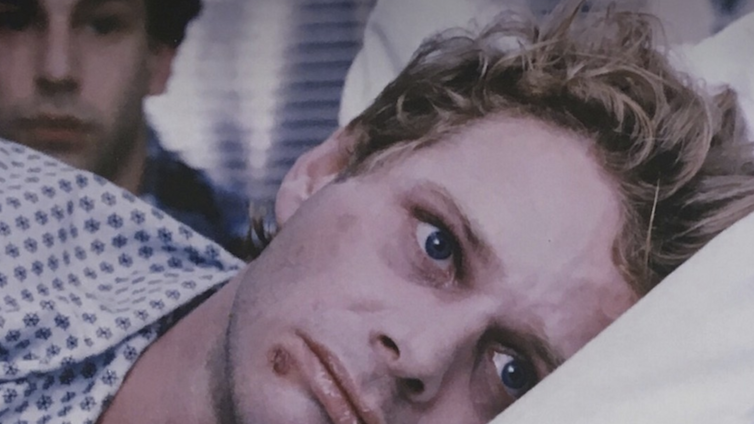
Five days before Reagan’s speech, “Buddies,” an independent film made for US$27,000 and shot in nine days, premiered at the Castro Theatre in San Francisco on Sept. 12, 1985.
A film on the front lines
If you haven’t heard of “Buddies,” that’s not surprising; the film mostly played art houses and festivals before disappearing.
Its filmmaker, Arthur J. Bressan Jr., was best known for his gay pornographic films, although he’d also made documentaries such as “Gay USA.” “Buddies” would go on to reach a wider audience thanks to a 2018 video release by Vinegar Syndrome, a distribution company that focuses on restoring cult cinema, exploitation films and other obscure titles.
It was inspired by the real-life buddies program at the Gay Men’s Health Crisis, an organization Kramer co-founded. At the time, many people dying of the disease had been rejected by family and friends, so a buddy might be the only person who visited a terminal AIDS patient.
The film feels like a play, in that most of the movie takes place in a single room and features just two characters: a naive young gay man named David and a young AIDS patient named Robert. Over the course of the film, the characters open up about their lives and their fears about the growing epidemic. It also includes a sex scene – something other early AIDS films completely avoided – in which David and Robert engage in safer sex.
AIDS packaged for the masses
The remarkably frank and intimate approach to the epidemic in “Buddies” contrasts sharply to the television film “An Early Frost,” which premiered on NBC on Nov. 11, 1985.
The film’s protagonist is a successful Chicago lawyer named Michael who hasn’t come out to his family, much to the distress of his long-term partner, Peter. When Michael finds out he has AIDS, he’s forced to come out to his parents, both as gay and as having AIDS.
Much of the film deals with Michael’s self-acceptance and his attempts to mend his relationships. Yet the production of “An Early Frost” was fraught with concerns about depicting both homosexuality and AIDS. Unlike David and Robert, Michael and Peter show no physical affection – they barely touch each other. https://www.youtube.com/embed/a0vizM1_tiI?wmode=transparent&start=0 A promotional clip for ‘An Early Frost,’ which drew 34 million viewers when it premiered on NBC.
Knowledge of AIDS was still evolving – a test for HIV was approved in March 1985 – so screenwriters and life partners Daniel Lipman and Ron Cowen went through 13 revisions of the script. The real-life fears and misconceptions about how AIDS could and could not be transmitted were central to the storyline, adding extra pressure to be accurate in the face of evolving understanding of the virus.
Despite losing NBC $500,000 in advertisers, “An Early Frost” drew 34 million viewers and was showered with Emmy nominations the following year.
A quilt of stories emerges
“Buddies” and “An Early Frost” opened up AIDS and HIV as subject matters for film and television.
They begat two lanes of HIV storytelling that continue to this day.
The first is an approach geared to mainstream audiences that tends to avoid controversial issues such as sex or religion and instead focuses on characters who grapple with both the illness and the stigma of the virus.
The second is an indie approach that’s often more confrontational, irreverent and angry at the injustice and indifference AIDS patients faced.
The former approach is seen in 1993’s “Philadelphia,” which earned Tom Hanks his first Oscar. The critically and commercially successful film shares a number of story points with “An Early Frost”: Hanks’ character, a big-city lawyer, finds out he is HIV positive and must confront bias head-on. HIV also features prominently in later films such as “Precious” (2009) and “Dallas Buyers Club” (2013), both of which, like “Philadelphia,” became awards darlings.
The edgier, more critical approach can be seen in the New Queer Cinema movement of the 1990s, a film movement that developed as a response to the epidemic. Gregg Araki’s “The Living End” (1992) is a key film in the movment: It tells the story of two HIV-positive men who become pseudo-vigilantes in the wake of their diagnoses. https://www.youtube.com/embed/7mvDLTMUtQQ?wmode=transparent&start=0 In ‘The Living End,’ the HIV-positive protagonists go on a hedonistic rampage to take out their anger at the world.
Somewhere in between is “Longtime Companion” (1990), which was the first film about AIDS to receive a wide release and tracks the impact of the epidemic on a fictional group of gay men throughout the 1980s. The film was written by gay playwright and screenwriter Craig Lucas and directed by Norman Rene, who died of AIDS six years after the film’s release.
Studios still leery
In many ways, television is where the real breakthroughs have happened and continue to happen.
The first television episode to deal with AIDS appeared on the medical drama “St. Elsewhere” in 1983; AIDS was also the subject of episodes in the sitcoms “Mr. Belvedere,” “The Golden Girls” and “Designing Women.” “Killing All the Right People” was the title of the latter’s special episode – a phrase the show’s writer and co-creator Linda Bloodworth-Thomason heard while her mother was being treated for AIDS.
More recently, producer Ryan Murphy has made a cottage industry of representations of queer people, particularly those with HIV. His stage revivals of “The Normal Heart” and Mart Crowley’s 1968 play “The Boys in the Band” were later adapted into films for television and streaming. He also produced “Pose,” a three-season series about drag ball culture in the 1980s that stars queer characters of color, several of whom are HIV positive.
Yet for all of these strides, representations of HIV in film are still hard to come by. In fact, out of the 256 films released by major distributors in 2024, the number of HIV-postive characters amounted to … zero.
Perhaps movie studios are less willing to risk even a character with HIV given the drop in movie theater attendance in the age of streaming.
If you think it’s an exaggeration to suggest that people might not want to be seen going to the theater to watch a film about characters with HIV, the results of a 2021 GLAAD survey may surprise you.
It found that the stigma around HIV is still very high, particularly for HIV-positive people working in schools and hospitals. One-third of respondents were unaware that medication is available to prevent the transmission of HIV. More than half didn’t know that HIV-positive people can reach undetectable status and not transmit the virus to others.
Another important finding from the survey: Only about half of the nonqueer respondents had seen a TV show or film about someone with HIV.
This reflects both the progress made since “Buddies” and “An Early Frost” and also why these films still matter today. They were released at a time when there was almost no cultural representation of HIV, and misinformation and disinformation were rampant. There have been so many advances, in both the treatment of HIV and its visibility in popular culture. That visibility still matters, because there’s still much more than can be done to end the stigma.
Scott Malia, Associate Professor of Theatre, College of the Holy Cross
This article is republished from The Conversation under a Creative Commons license. Read the original article.


The next round of Street Fighter is heading to the big screen. Paramount Pictures and Legendary Pictures will release the new live-action movie exclusively in theaters on October 16, 2026, bringing Capcom’s video game characters into a story built around rivalries, a dangerous tournament, and a conspiracy lurking behind the competition.
Directed by Kitao Sakurai, the film features Andrew Koji as Ryu, Noah Centineo as Ken Masters, and Callina Liang as Chun-Li, alongside an ensemble that includes Jason Momoa, Curtis “50 Cent” Jackson, and wrestling stars Roman Reigns and Cody Rhodes.
Ryu and Ken Face a Fight Beyond the Arena
Set in 1993, the movie finds Ryu and Ken estranged when Chun-Li draws them back into combat for the next World Warrior Tournament. What initially looks like a chance to test their fighting skills becomes something much more dangerous.
According to the studio’s synopsis, a deadly conspiracy puts the two fighters on a collision course, forcing them to confront both each other and unresolved struggles from their past. That setup gives the film a personal conflict to explore alongside its tournament action.
For viewers who remember gathering around an arcade cabinet, the 1993 setting offers a nostalgic hook. The studio is also promising familiar signature moves, including Hadoukens and roundhouse kicks, as the game’s combat makes the jump to live action.
A Cast Packed With Familiar Fighters
Beyond its central trio, the announced lineup brings together actors, comedians, musicians, wrestlers, and martial artists. Among the character pairings:
- Joe “Roman Reigns” Anoai as Akuma
- David Dastmalchian as M. Bison
- Cody Rhodes as Guile
- Vidyut Jammwal as Dhalsim
- Orville Peck as Vega
- Olivier Richters as Zangief
- Hirooki Goto as E. Honda
- Mel Jarnson as Cammy
- Curtis “50 Cent” Jackson as Balrog
- Jason Momoa as Blanka
The cast also includes Andrew Schulz as Dan Hibiki, Eric André as Don Sauvage, Rayna Vallandingham as Juli, Kyle Mooney as Marvin, and Alexander Volkanovski as Joe.
With so many characters sharing the screen, one question will be how the movie balances the wider roster with Ryu and Ken’s central story. The announced cast gives longtime fans plenty of familiar names to watch for.
Who Is Behind the Movie?
Paramount Pictures and Legendary Pictures present Street Fighter in association with Capcom. The Legendary Pictures production is based on the Capcom video game, with a story by Dalan Musson and Gary Dauberman and a screenplay by T.J. Fixman and Kitao Sakurai.
Producers include Mary Parent, Cale Boyter, Jason Momoa, Takayuki Nakayama, and Stefan Makhoul. The supplied production announcement notes that credits are subject to change.
Release Date and Rating
Street Fighter opens only in theaters October 16, 2026. The film is rated PG-13 for violence/action, bloody images, strong language, sexual references, partial nudity, and brief smoking, according to the supplied studio announcement.
Fans can visit Paramount’s official Street Fighter page for the trailer and film information, and follow #StreetFighterMovie for promotional updates.
Which fighter are you most excited to see in live action? Share your pick in the comments, and visit STM Daily News for more Entertainment coverage and newsletter updates.
Source: Supplied Paramount Pictures/Legendary Pictures production announcement; release date, synopsis, and selected credits checked against Paramount’s official film page. This article is a preview, not a review.

Entertainment
M&M’S Brews Up ‘Practical Magic 2’ Movie Night Hype With Limited-Edition Amas Veritas Spell & Snack Packs


M&M’S is leaning hard into spooky-season nostalgia ahead of Practical Magic 2, teaming up with Warner Bros. Pictures on a limited-edition release designed for Halloween movie nights. The brand announced the M&M’S Amas Veritas Spell & Snack Pack, a collectible add-on built around the iconic “Amas Veritas” love charm from the original 1998 film—timed to the sequel’s theatrical release date: September 10, 2026 (in theaters only).
The pack features custom-designed M&M’S candies printed with eight whimsical symbols inspired by the original spell, plus an “extended verse” of four new symbols that the company says hint at mysteries in the sequel. The drop is positioned as part fan-service, part snackable merch—something you bring to a watch party, but also something collectors will want to grab before it disappears.
Availability is limited and online-only. The Spell & Snack Pack is offered exclusively atMMS.com/Practical-Magic as a gift with purchase when fans buy an M&M’S Milk Chocolate Fun Size Sharing Bag, while supplies last. In a nod to the film’s midnight vibe, there are two timed drops at 12:00 a.m. ET: September 3, 2026 and September 14, 2026.
To push the nostalgia even further, M&M’S is also partnering with actress Camilla Belle—who played young Sally Owens in the original film—to recreate her spell scene with an M&M’S twist in social content on Instagram and TikTok. For Halloween hosting, the brand also flagged seasonal staples rolling out nationwide, including its Fun Size Halloween Variety Pack and Halloween Blend options in both Milk Chocolate and Peanut.
Source
- PRNewswire / Mars, Incorporated press release (Sept. 2, 2026): “M&M’S® Brews Up Movie Night Magic This Halloween Season With Limited-Edition ‘Amas Veritas’ Spell & Snack Packs…”
Related links
- Limited-edition pack page: https://www.mms.com/Practical-Magic
- Mars, Incorporated: https://www.mars.com/
- M&M’S (main site): https://www.mms.com/
- Warner Bros. Pictures: https://www.warnerbros.com/
🎬🍿 Lights, camera, entertainment! From must-see movies and TV to music, celebrities, events, and the latest pop culture buzz, STM Daily News keeps you in the know. 💬 Join the conversation, share your take in the comments, and 📬 subscribe to our newsletter so you never miss the next big story!

Entertainment
Danica McKellar and Matthew Marsden Star in The Greatest Christmas Gift for Great American Pure Flix

Great American Media is kicking off the holiday season early with a new Great American Christmas Original. The company announced The Greatest Christmas Gift, starring Danica McKellar and Matthew Marsden, will make its World Premiere streaming first on Great American Pure Flix, before also airing on Great American Family and GFAM+. The title joins Great American Media’s sixth annual Great American Christmas slate—its signature seasonal programming block built around faith, family, and classic Christmas storytelling.
In the film, McKellar plays Emma Harper, a gifted music teacher preparing for a Christmas wedding to her fiancé Caleb Bennett (Marsden). But just as the couple is planning what should be a joyful small-town celebration, an unexpected setback threatens the future they’ve carefully built. As Christmas approaches, the story leans into a familiar but resonant holiday theme: the most meaningful gifts aren’t the ones wrapped under the tree, but the ones revealed through steadfast faith, selfless love, and a community that shows up when it matters most.
Bill Abbott, President and CEO of Great American Media, highlighted why McKellar remains a cornerstone of the network’s holiday brand, saying audiences trust her films to leave them “encouraged, uplifted, and inspired.” Abbott added that pairing McKellar with Marsden in The Greatest Christmas Gift reflects the company’s commitment to stories where “faith, family, and hope are at the center,” reinforcing Great American Media’s identity as a major entertainment player focused on faith-forward programming. The film is written by Summer Israel Johnson.
The Greatest Christmas Gift is positioned as another comfort-watch entry for viewers who want their holiday movies warm, sincere, and rooted in community—exactly the lane Great American Christmas has been building year after year. Keep an eye out for premiere-date details as Great American Pure Flix rolls out its holiday lineup.
Source (primary)
- PRNewswire / Great American Media press release (Aug. 20, 2026) — “Danica McKellar and Matthew Marsden to Star in The Greatest Christmas Gift…”
Related links
- Great American Pure Flix (streaming service): https://www.pureflix.com/
- Great American Family (network): https://www.greatamericanfamily.com/
- Great American Media (corporate / brand info): https://www.greatamericanmedia.com/
Related talent links
- Danica McKellar (IMDb): https://www.imdb.com/name/nm0001528/
- Matthew Marsden (IMDb): https://www.imdb.com/name/nm0551128/
🎬 Stay in the spotlight with STM Daily News Entertainment! Catch the latest movies, TV, music, celebrity news, events, and pop culture stories. Explore more, share your thoughts in the comments, and subscribe to our newsletter so you never miss what’s happening in entertainment.





