Connect with us

The Knowledge

Even before they can read, young children are visualizing letters and other objects with the same strategies adults use

Published

on

young children are visualizing letters and other objects
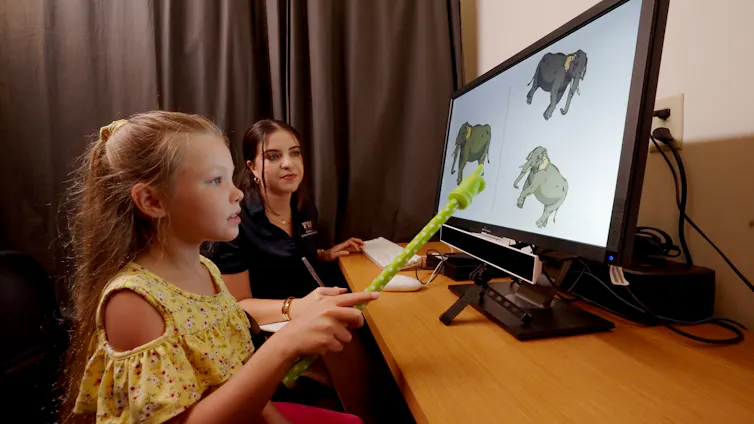
A student looks at different images, as eye-tracking technology monitors how she is visualizing the objects.
Chris Necuze/FIU, CC BY

Even before they can read, young children are visualizing letters and other objects with the same strategies adults use

Shannon Pruden, Florida International University and Karinna Rodriguez, Florida International University

What do puzzles, gymnastics, writing and using maps all have in common?

They all rely on people’s ability to visualize objects as they spin, flip or turn in space, without physically moving them. This is a spatial skill that developmental psychologists call mental rotation.

Whether a person is navigating a new city or doing a cartwheel, they must use mental rotation skills to move shapes or objects in their mind and make sense of where their bodies are going and what surrounds them.

When children play with puzzles, building blocks or pattern games, they are also practicing mental rotation.

Over time, these skills support learning in math, science and reading. This can look like visualizing pulley systems in physics or seeing the differences between similar-looking letters such as b and d, which young children often confuse.

Strong mental rotation skills also lay the foundation for doing well in school and developing interest in careers in science, technology, engineering and math.

Most preschool-age children are not yet learning to read – but it turns out they are still using some of these same spatial reasoning skills as they think about the world around them.

We are scholars of, developmental science and were curious to find out how children as young as 3 years old mentally rotate objects.

While there is research on the age at which children can mentally rotate objects, less is understood about how children are solving mental rotation problems. We found in our research, conducted from 2022 to 2023, that young children are using the same problem-solving strategies as adults when they solve a mental rotation task.

Children think visually, just like adults

We used eye-tracking technology to understand how a sample of 148 children, all between 3 and 7 years old, solved different mental rotation problems. Eye-trackers use harmless infrared light to capture eye movements. This technology lets us observe how children solve these problems in real time.

Advertisement
Get More From A Face Cleanser And Spa-like Massage

As part of our study, we showed each child a large picture of items such as a fire truck, as well as two smaller pictures of the same truck, one placed above the other and positioned slightly differently.

Children were asked to say which small picture on the right matched the large one on the left. In this example, the correct answer is the top picture, because that top fire truck can be rotated to match the large fire truck. The bottom fire truck was a mirrored image, and no matter how much you rotate it, it will never match the large fire truck.

file 20250925 64 xywaer.png?ixlib=rb 4.1
Children looked at pictures of fire trucks as part of a research study to assess how they manipulated the object in their heads.
Karinna Rodriguez

While the children thought about their response, the eye-tracker, mounted right below the computer screen, recorded their eye movements.

By looking at where and for how long children looked at each image, we figured out what kind of strategy they were using.

Some children focused on fewer parts of the object and spent less time studying its details. This suggests they used a holistic strategy, meaning they took in the whole image at once, instead of breaking it into pieces. These children mentally rotated the entire object to solve the task.

Other children focused on parts of the object and spent more time studying its details. This suggests they broke the image down into pieces instead of visualizing the image as a whole, known as a piecemeal strategy. Our findings support prior work showing that children generally use these two visual approaches to solve mental rotation problems.

This study helped us learn where children look while solving puzzles and identify how they solve these problems – without ever having to ask the child, who might be too young to explain, about their process.

Children were more likely to turn the whole image instead of breaking it down into pieces, a pattern of problem solving adults typically also use. This means that even very young children are already thinking about how objects move and turn in space in ways that are more advanced than expected.
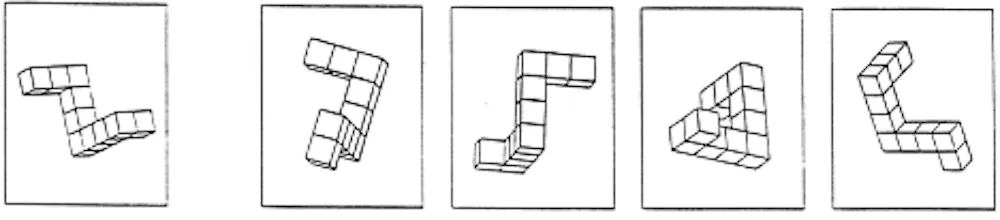
White blocks are seen in different configurations in a drawing.
An example of a mental rotation task that can show how people are visually moving objects in their minds.
Angie Mackewn, CC BY

Supporting children’s visual skills

Knowing how young children mentally rotate objects may help researchers, teachers and parents understand why some children struggle with learning to read.

Children who break an image down into pieces, instead of visualizing it as a whole, to solve mental rotation problems may be the very same children who struggle with discriminating similar-looking letters such as p and q and may later be diagnosed with dyslexia.

Parents can play an important role in building their child’s mental rotation skills. Parents can help children by offering them opportunities to practice rotating real objects with toys such as three-dimensional puzzles or building blocks. Tangrams – flat, colorful puzzles that come in different shapes – can be used to practice breaking down shapes of animals into pieces. Parents can encourage their child to look for shapes that match parts of the animal or object they are building.

Nov. 8 is International STEM Day, a celebration of all things science, technology, engineering and mathematics.

Advertisement
Get More From A Face Cleanser And Spa-like Massage

Research like ours provides valuable guidance for designing early STEM activities and educational tools. By directly observing children’s problem solving in real time, we can develop better ways for educators and toy makers to support strong spatial thinking from an early age. To celebrate, we encourage people to engage in activities that test their spatial skills, such as ditching the GPS for the day or playing a game of Tetris.

Mental rotation is a powerful skill that helps us understand and interact with the surrounding physical world. From solving puzzles to reading maps, mental rotation plays a role in many everyday activities. Building mental rotation abilities can improve children’s performance in subjects such as reading, math and science and may inspire future careers in STEM fields.

Shannon Pruden, Professor of psychology, Florida International University and Karinna Rodriguez, PhD candidate in psychology, Florida International University

This article is republished from The Conversation under a Creative Commons license. Read the original article.

Dive into “The Knowledge,” where curiosity meets clarity. This playlist, in collaboration with STMDailyNews.com, is designed for viewers who value historical accuracy and insightful learning. Our short videos, ranging from 30 seconds to a minute and a half, make complex subjects easy to grasp in no time. Covering everything from historical events to contemporary processes and entertainment, “The Knowledge” bridges the past with the present. In a world where information is abundant yet often misused, our series aims to guide you through the noise, preserving vital knowledge and truths that shape our lives today. Perfect for curious minds eager to discover the ‘why’ and ‘how’ of everything around us. Subscribe and join in as we explore the facts that matter.  https://stmdailynews.com/the-knowledge/

Continue Reading
Advertisement SodaStream USA, inc

The Knowledge

Forgotten Genius Fridays: Madison Washington and the Slave Revolt That Changed History

Discover the inspiring story of Madison Washington, the courageous freedom fighter who led the 1841 Creole revolt, securing freedom for 128 enslaved people in the most successful slave uprising in American history.

Published

on

A dramatic illustration of Madison Washington standing on the deck of the Creole at sea, rallying fellow captives during the 1841 revolt, with storm clouds and the ship sailing toward freedom in the Bahamas.

When people think of heroic figures who fought against slavery, names like Harriet Tubman, Frederick Douglass, and Sojourner Truth often come to mind. Yet one remarkable man remains largely absent from history books despite leading the most successful slave revolt in American history.

His name was Madison Washington.

His courage aboard the brig Creole in 1841 transformed the lives of more than one hundred enslaved people and became a powerful symbol of the fight for freedom.

Born Into Slavery

Madison Washington was born into slavery in Virginia during the early 19th century. Like millions of enslaved African Americans, he endured the brutality and injustice of a system that denied him even the most basic human rights.

Determined to be free, Washington escaped slavery in 1839 and reached Canada with help from the Underground Railroad.

Freedom, however, came with heartbreak.

His wife remained enslaved in Virginia, and Washington made the extraordinary decision to risk everything by returning to rescue her.

Instead, he was captured and imprisoned.

The Voyage Aboard the Creole

In November 1841, Washington and 134 other enslaved people were forced aboard the American slave ship Creole. The vessel was headed from Virginia to New Orleans, where many of the captives would likely be sold to plantations across the Deep South.

Washington refused to accept that fate.

On November 7, he and several fellow captives launched a carefully planned revolt. During the struggle, one slave trader was killed, while much of the crew was subdued.

Advertisement
Get More From A Face Cleanser And Spa-like Massage

Rather than continue to New Orleans, Washington ordered the crew to sail to Nassau in the Bahamas.

Freedom in the Bahamas

The decision proved historic.

Great Britain had abolished slavery throughout most of its empire years earlier, and when the Creole arrived in Nassau, British authorities refused American demands to return the enslaved passengers as property.

Instead, 128 formerly enslaved people were granted their freedom.

The Creole revolt became the most successful slave uprising in United States history.

International Consequences

The incident sparked a diplomatic dispute between the United States and Great Britain that lasted for years.

Southern slaveholders demanded compensation for what they viewed as lost property, while abolitionists celebrated Madison Washington as a courageous freedom fighter who challenged one of history’s greatest injustices.

The event also strengthened arguments against slavery by demonstrating that people held in bondage would continue to resist oppression whenever opportunities arose.

Frederick Douglass Honors a Hero

Madison Washington’s bravery inspired one of America’s greatest abolitionists.

Frederick Douglass based his 1853 novella, The Heroic Slave, on Washington’s remarkable story. The work became one of the earliest pieces of African American fiction centered on a real historical figure and introduced many readers to Washington’s extraordinary leadership.

Advertisement
Get More From A Face Cleanser And Spa-like Massage

Although historical records about Washington’s later life remain scarce, his legacy lived on through Douglass’s writing and through the generations of freedom seekers who followed.

Why Madison Washington Matters Today

Madison Washington reminds us that history is filled with individuals whose contributions have been overlooked despite changing the course of events.

His story is about more than a shipboard revolt.

It is about courage in the face of impossible odds.

It is about sacrificing personal safety for loved ones.

And it is about the universal desire for freedom.

As we continue to uncover stories that have too often been left untold, Madison Washington deserves recognition alongside the great heroes of American history.

His determination helped secure freedom for more than one hundred people—and his legacy continues to inspire those who believe that justice is always worth fighting for.


Forgotten Genius Fridays

Every Friday, STM Daily News shines a light on remarkable people whose contributions have shaped our world but whose stories deserve greater recognition. Join us as we rediscover the innovators, pioneers, leaders, and trailblazers history should never forget.

What other forgotten heroes should we feature next? Share your suggestions in the comments, and don’t forget to subscribe to the STM Daily News newsletter for more inspiring stories delivered straight to your inbox.

Advertisement
Get More From A Face Cleanser And Spa-like Massage

Related External Links

For readers interested in learning more about Madison Washington, the Creole revolt, and the broader history of slavery and abolition, these trusted resources provide additional historical context:

Note: External links are provided for educational and informational purposes. STM Daily News is not responsible for the content or policies of third-party websites.

🧠 Discover the remarkable innovators, inventors, and trailblazers who helped shape our world but rarely receive the recognition they deserve. Share your thoughts in the comments and subscribe to the STM Daily News newsletter to catch every new Forgotten Genius Friday feature and more inspiring stories delivered to your inbox.

Continue Reading

Forgotten Genius Fridays

Katherine Johnson: The Human Computer Who Helped America Reach the Moon

Discover how Katherine Johnson’s mathematical genius helped NASA send astronauts into space and to the Moon. Learn why she remains one of America’s most inspiring scientific pioneers.

Published

on

Forgotten Genius Friday | The Knowledge | STM Daily News

Discover how Katherine Johnson's mathematical genius helped NASA send astronauts into space and to the Moon. Learn why she remains one of America's most inspiring scientific pioneers.

When the United States raced to explore space during the 1950s and 1960s, rockets and astronauts often captured the headlines. Behind every successful mission, however, was a team of brilliant mathematicians and engineers whose calculations made spaceflight possible. Among them was Katherine Johnson, an extraordinary mathematician whose work helped America reach orbit, the Moon, and beyond.

Although her contributions remained largely unknown for decades, Katherine Johnson’s remarkable career transformed the U.S. space program and inspired generations of scientists, engineers, and mathematicians.

A Gift for Mathematics

Katherine Coleman Goble Johnson was born on August 26, 1918, in White Sulphur Springs, West Virginia. From an early age, her exceptional talent for mathematics was evident. She skipped several grades, graduated from high school at just 14 years old, and earned degrees in mathematics and French from West Virginia State College by the age of 18.

At a time when educational and career opportunities for African American women were limited, Johnson’s determination and love of mathematics helped her overcome barriers that stood in the way of many aspiring scientists.

Joining America’s Space Program

In 1953, Johnson joined the National Advisory Committee for Aeronautics (NACA), the agency that would later become NASA.

She worked in the segregated West Area Computing Unit, where African American women served as “human computers,” performing complex mathematical calculations by hand. Their work was essential to aircraft research and, later, the nation’s ambitious efforts in human spaceflight.

Johnson’s exceptional analytical skills quickly earned the respect of engineers and mission planners. Rather than simply solving equations, she asked questions, challenged assumptions, and helped develop solutions to problems that had never been encountered before.

The Woman John Glenn Trusted

One of Katherine Johnson’s most famous moments came in 1962 before astronaut John Glenn became the first American to orbit Earth.

NASA had begun using electronic computers to calculate flight trajectories, but Glenn wanted one final verification before launch. According to NASA’s historical accounts, he requested that Katherine Johnson personally check the computer’s calculations.

“If she says they’re good,” Glenn reportedly said, “then I’m ready to go.”

Advertisement
Get More From A Face Cleanser And Spa-like Massage

Johnson confirmed the numbers, and Glenn successfully completed three orbits around Earth, marking a major milestone in the Space Race.

Helping America Reach the Moon

Katherine Johnson’s contributions did not end with Project Mercury.

She calculated trajectories for the Apollo program, helping engineers plan missions that ultimately carried astronauts to the Moon and safely back to Earth. Her work also supported the Space Shuttle program and early concepts for future space exploration.

Her calculations contributed to some of the most significant achievements in aerospace history, demonstrating the critical role mathematics plays in exploration and discovery.

Recognition Long Overdue

For much of her career, Katherine Johnson worked behind the scenes, receiving little public recognition. That changed in later years as historians and researchers began highlighting the contributions of the women who helped build America’s space program.

In 2015, President Barack Obama awarded Katherine Johnson the Presidential Medal of Freedom, the nation’s highest civilian honor.

A year later, her story reached millions through the acclaimed film Hidden Figures, which introduced audiences around the world to Johnson and her colleagues Dorothy Vaughan and Mary Jackson.

The movie helped shine a long-overdue spotlight on the women whose brilliance helped change history.

A Legacy That Continues to Inspire

Katherine Johnson passed away on February 24, 2020, at the age of 101, leaving behind a legacy of excellence, perseverance, and intellectual curiosity.

Her work reminds us that history is often shaped not only by those who step into the spotlight but also by those working quietly behind the scenes to solve impossible problems.

Advertisement
Get More From A Face Cleanser And Spa-like Massage

Today, students pursuing careers in science, technology, engineering, and mathematics continue to draw inspiration from her life and achievements. Her story demonstrates that talent, determination, and curiosity can overcome even the greatest obstacles.

As NASA prepares for a new era of lunar exploration and future missions to Mars, Katherine Johnson’s legacy remains woven into the history of every successful journey beyond our planet.

Why We Remember

Forgotten Genius Friday celebrates innovators whose achievements deserve greater recognition. Katherine Johnson’s extraordinary mathematical talent helped make space exploration possible, proving that one brilliant mind can help change the course of history.

Her calculations guided astronauts through some of humanity’s greatest adventures—and her legacy continues to inspire the explorers of tomorrow.

Related Links

🧠 Discover the remarkable innovators, inventors, and trailblazers who helped shape our world but rarely receive the recognition they deserve. Share your thoughts in the comments and subscribe to the STM Daily News newsletter to catch every new Forgotten Genius Friday feature and more inspiring stories delivered to your inbox.

Continue Reading

News

Joby Aviation and Toyota kick off manufacturing alliance to scale electric air taxi production

Joby Aviation and Toyota launch a joint venture to improve productivity, quality, and cost as they prepare to scale electric air taxi production.

Published

on

Joby Aviation and Toyota Motor Corporation have launched the initial phase of a strategic manufacturing alliance aimed at accelerating commercial production of electric air taxis—an early step the companies say is designed to make “air mobility for all” a practical, everyday reality.

Announced June 30, 2026, the partnership formalizes a new joint venture that will combine Joby’s electric aviation development with Toyota’s production systems and operational expertise. The near-term focus: building the groundwork for commercial production while pushing improvements in productivity, quality, and cost—key factors as the industry moves from prototypes to scaled manufacturing.

Joby Aviation and Toyota launch a joint venture to improve productivity, quality, and cost as they prepare to scale electric air taxi production.
Joby Aviation and Toyota Motor Corporation Launch Initial Phase of a Strategic Manufacturing Alliance to Realize Air Mobility for All

What the joint venture is designed to do

According to the companies, the alliance will initially concentrate on:

  • Establishing the foundation for commercial production capability
  • Advancing manufacturing excellence with an emphasis on productivity, quality, and cost
  • Supporting expansion of Joby’s production capacity as it works toward aircraft certification and prepares for anticipated demand

The announcement positions Toyota’s manufacturing playbook—known globally for lean production and continuous improvement—as a lever to help Joby move from development into repeatable, high-quality output at scale.

Why it matters: eVTOLs need scale, not just flight tests

Electric vertical take-off and landing (eVTOL) aircraft have become one of the most closely watched bets in next-generation transportation, but the path to viable air taxi services depends on more than successful test flights. Certification timelines, supply chain readiness, and the ability to produce aircraft consistently (and affordably) are often what separates promising technology from commercial reality.

By forming a joint venture focused on manufacturing readiness, Joby and Toyota are signaling that the next competitive frontier is industrialization—how quickly and reliably eVTOL aircraft can be built to meet safety standards and market demand.

Related Links for Further reading

  1. Joby Aviation (official): https://www.jobyaviation.com
  2. Joby Investor Relations / News (official updates & filings): https://ir.jobyaviation.com
  3. Toyota Newsroom (official): https://www.toyotanewsroom.com
  4. Toyota Global (corporate overview): https://global.toyota/en
  5. FAA Advanced Air Mobility / Air Taxis (context): https://www.faa.gov/air-taxis

What executives are saying

Joby founder and CEO JoeBen Bevirt emphasized the long-running relationship between the companies, calling the joint venture a reflection of shared confidence in the opportunity ahead.

“Toyota has been by Joby’s side for nearly a decade, providing invaluable guidance and support as we built the foundation for manufacturing our aircraft,” Bevirt said. “Together, we share a vision of making aerial mobility an everyday reality.”

Toyota Motor Corporation Chairman Akio Toyoda framed air mobility as an extension of the company’s broader mission.

“Since our founding, we’ve been guided by the philosophy of providing mobility for all,” Toyoda said, adding that Toyota views air mobility as “a natural extension of that philosophy—from the ground into the sky.”

About the companies

Joby Aviation (NYSE: JOBY) is a California-based transportation company developing an all-electric eVTOL air taxi. The company intends to operate its own air taxi service in cities worldwide and sell aircraft to other operators and partners.

Toyota (NYSE: TM) has operated in North America for nearly 70 years and says it is focused on sustainable, next-generation mobility through Toyota and Lexus brands. Toyota reports nearly 64,000 employees in North America, 14 manufacturing plants, and more than 1,800 dealerships. The company also noted that its North Carolina plant began assembling automotive batteries for electrified vehicles in 2025.

Advertisement
Get More From A Face Cleanser And Spa-like Massage

What to watch for next

For readers tracking the air taxi sector, the next milestones will likely center on:

  • Details on how the joint venture will be structured operationally
  • Updates on Joby’s certification progress and production ramp timelines
  • Signs of how manufacturing improvements translate into cost reductions and throughput
  • Additional agreements or expanded collaboration as the alliance progresses

While the companies highlighted expected benefits, they also noted the usual forward-looking risks—such as regulatory certification timelines, market conditions, and the ability to finalize additional agreements.

Source: Toyota Motor North America / PRNewswire (June 30, 2026)

📰 Enjoying STM Daily News? Join the conversation!

💬 Leave a comment, share your thoughts, and subscribe to our newsletter for the latest stories, updates, and “News You Can Use This Moment!” delivered to your inbox.

Stay connected with STM Daily News!

Continue Reading

Trending


