

Family
5 Tips to Get Your Home Ready for Holiday Hosting
Get your home guest-ready with these 5 holiday hosting tips. From decluttering to creating cozy spaces, prepare for stress-free entertaining this season.

Last Updated on December 19, 2025 by Daily News Staff

5 Tips to Get Your Home Ready for Holiday Hosting
(Family Features) Whether you’re planning a cozy dinner with friends or a full-blown holiday gathering, preparing your home for guests doesn’t have to be stressful. With a little organization and a few simple steps, you can create a space that feels warm and welcoming, allowing you to focus on what really matters: spending time together.
Declutter and Deep Clean
Start by refreshing high-traffic areas, including the living room, kitchen and bathrooms. Clear off counters and coffee tables, dust surfaces, vacuum carpet, mop tile or hardwood and wipe down glass or mirrors.
Tidy Up the Kitchen
The kitchen is the heart of many gatherings, meaning it’s important to clear both refrigerator and counter space to make room for food, drinks and serving dishes. Before guests arrive, ensure your oven, microwave, dishwasher, garbage disposal, coffee maker and other appliances are working properly. Don’t forget to stock essentials like paper plates, silverware, napkins, ice and paper towels so you’re not scrambling later.
Refresh Guest Spaces
If visitors will be staying overnight, prep sleeping areas by changing the sheets, fluffing the pillows and stocking extra blankets. Thoughtful touches like fresh towels, water bottles and a charging station can make guests feel at home.
Create a Functional Flow
Think about how guests will move through your home. Designate areas for food, drinks, games and mingling, arranging furniture to encourage conversation. If you’re expecting a large crowd, add extra seating options.
Add Seasonal Touches
For seasonal warmth, swap out throw pillows, add greenery and candles or hang a wreath or other decorations. Scattering cozy blankets and simmering a pot of cinnamon and citrus on the stove can also help create a warm, inviting atmosphere.
Visit eLivingtoday.com for more tips and guidance to get your home ready to welcome guests.
Photo courtesy of Shutterstock
SOURCE:
eLivingtoday.com
Welcome to the Consumer Corner section of STM Daily News, your ultimate destination for savvy shopping and informed decision-making! Dive into a treasure trove of insights and reviews covering everything from the hottest toys that spark joy in your little ones to the latest electronic gadgets that simplify your life. Explore our comprehensive guides on stylish home furnishings, discover smart tips for buying a home or enhancing your living space with creative improvement ideas, and get the lowdown on the best cars through our detailed auto reviews. Whether you’re making a major purchase or simply seeking inspiration, the Consumer Corner is here to empower you every step of the way—unlock the keys to becoming a smarter consumer today!








financial wellness
Life insurance is on the to-do list. Right under cleaning out the garage.
No matter how you define “adulting,” getting life insurance tends to be one part of the to-do list that keeps getting set on a procrastination loop. New survey data backs that up: there are plenty of other tasks adults would rather focus on first.

(Sheeka Sanahori) Being an adult comes with a never-ending list of responsibilities: Cook dinner. Scrub the bathroom. File taxes. The tasks grow even longer when sharing a household with a partner, building a family, or taking care of others. No matter how you define “adulting,” getting life insurance tends to be one part of the to-do list that keeps getting set on a procrastination loop.
New survey data backs that up: there are plenty of other tasks adults would rather focus on first.
The Adulting Task Americans Keep Avoiding
According to the 2026 Life Happens Life Insurance Survey, a financial literacy nonprofit organization, 39% of U.S. adults would rather clean out their email inbox than figure out their life insurance needs. Another 31% would rather clean out the garage or basement. One in five U.S. adults would be willing to sit on hold with customer service for three hours before life insurance planning. Even though many adults have it somewhere on their list, nearly half (46%) say they’ll either deal with it later or not at all.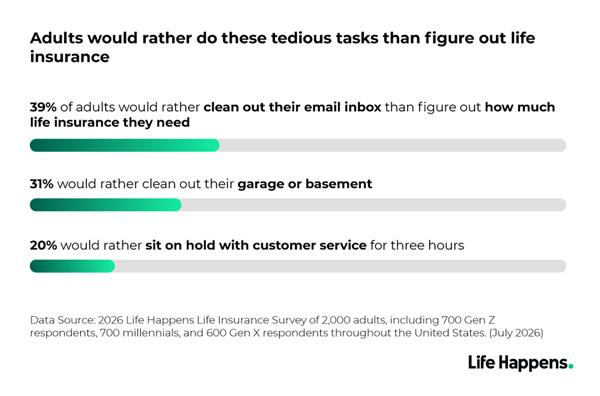
They Know It Matters
Nearly a third of adults have already figured out a life insurance plan, and they feel good about their decision. Others are feeling more conflicted: 14% have a policy, but they’re not sure if they have enough. Another 12% say they either don’t know where to start or they think it’ll be too expensive.
It’s no wonder people are putting it off: Navigating a new-to-them form of financial planning can come with a lot of complicated emotions. Four in 10 feel either overwhelmed, anxious, or some combination of both. Sixteen percent of U.S. adults feel guilty for putting it off, but when the outcome is more procrastination, that feeling lingers.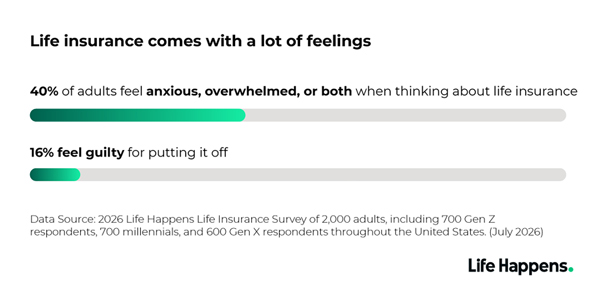
Why Later Keeps Winning
If you’ve ever faced an important decision without having enough information to make an informed choice, you know how stressful it can be. While the generations have different takes on making major decisions with a gut feeling or “pure vibes,” most of the time, people want to feel like they’re making an informed choice. Forty-five percent of U.S. adults say cost concerns, confusion or procrastination are the main reasons they have delayed or would delay looking into life insurance. For more than one in five, the plan is to seriously look at it when they feel more financially stable. For 12%, they say they’ll do it when they’re older.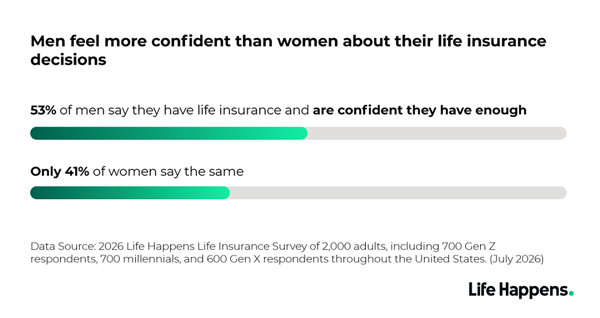
Men tend to feel more confident about their life insurance decisions to date; 53% of men vs. 41% of women feel confident their family would be financially protected.
The First Step Feels Bigger Than It Is
Learning more about life insurance, how it’s priced and how it works could help get many consumers out of their procrastination loop. A quarter of people say they’d make a decision if they learned it was easier to get than they previously thought. Thirty percent would make the purchase if they learned it was more affordable than they believed it to be. Others need an experienced professional to talk to or an online calculator tool to give them guidance.
Methodology: Life Happens commissioned Atomik Research to conduct an online survey of 2,000 adults, including 700 Gen Z respondents, 700 millennials, and 600 Gen X respondents throughout the United States. The margin of error for the overall sample is +/- 2 percentage points and +/- 4 percentage points for each generational sample, with a confidence level of 95 percent. Fieldwork took place between July 14 and July 20, 2026. Atomik Research, part of 4media group, is a creative market research agency.
Photo courtesy of Shutterstock (couple using computer)

SOURCE:
Community
Zum Begins 2026–27 School Year With Expanded Student Transportation Network
Zum is launching the 2026–27 school year with expanded school bus operations in Fresno, Los Angeles and other communities, bringing real-time tracking and modern transportation technology to students and families.

New partnerships in Fresno and Kansas join ongoing operations in Omaha, St. Louis, Santa Barbara and Los Angeles
As millions of students return to classrooms, transportation company Zūm is beginning the 2026–27 school year with new district partnerships, expanded technology deployments and thousands of drivers preparing for what the company calls “the most important commute in America.”
The Redwood City, California-based student mobility company announced that its teams have completed months of driver training, route validation and operational planning ahead of the new academic year.
“There is nothing quite like the first day of school at Zum,” founder and CEO Ritu Narayan said in the company’s announcement. “You see drivers arriving before sunrise, teams making final preparations and buses rolling out of yards across the country—all united around one purpose: getting students safely and reliably to school.”
New buses roll out in Fresno
One of Zūm’s largest new launches is in California’s Fresno Unified School District. According to the company, 168 buses were placed into service just two weeks after its local team moved into a new transportation yard.
The district is also introducing the Zūm Parent App, which allows families to track buses in real time, receive arrival alerts, view scheduled rides and receive notifications when a child boards or exits a bus. Registered students will receive bus cards connected to the transportation system, according to Fresno Unified.
The rollout is part of a broader change in how Fresno Unified manages student transportation. Routes and stops will continue to be evaluated using registration information, actual ridership and family feedback, the district says. Beginning September 28, registered students will generally be required to show a bus pass before boarding. Fresno Unified’s transportation page provides registration instructions and assistance for families.
Technology comes to LAUSD’s in-house fleet
In Los Angeles, Zūm says its CMX technology has been deployed across the Los Angeles Unified School District’s internally operated bus fleet.
The platform is designed to connect routing, dispatch, drivers, schools, transportation officials and families through one operating system. Its tools include real-time vehicle visibility, route planning, operational coordination and family communications.
Rather than replacing the district’s in-house drivers, the Los Angeles deployment focuses on providing the technology used to coordinate district-operated buses.
New partnership in Kansas
Zūm also began a new partnership with the Shawnee Mission School District in Kansas. District leaders, drivers, monitors and school employees marked the start of the program with a launch celebration.
The company said Shawnee Mission’s transition is intended to give the district a more modern and technology-supported approach to student transportation.
Meanwhile, Zūm is returning for a third school year in Omaha and Santa Barbara. Its St. Louis operation is entering its second year.
Drivers remain at the center
Although technology plays a growing role in school transportation, Zūm emphasized that drivers remain essential to the daily experience of students and their families.
“Back to school is when months of preparation come to life,” said Liz Sanchez, Zūm’s executive vice president of student mobility. “Our teams spend months hiring and training drivers, validating routes and working alongside our district partners to prepare.”
Drivers often serve as the first school-related adults students see in the morning and the last they see before returning home. Their work can also determine whether students arrive safely and on time—especially in communities where families have limited transportation choices.
A changing school-bus experience
School transportation has traditionally depended on separate systems for scheduling, dispatching, vehicle tracking and communicating with parents. Zūm CMX is designed to bring those functions together and give school districts a clearer view of their daily operations.
For families, the most visible change may be access to real-time bus locations and arrival notifications. These tools can reduce some of the uncertainty associated with late buses, route changes and missed pickups.
Zūm reports that its technology and transportation services now support more than 6,500 schools across 19 states. As the company expands, the 2026–27 school year will test how effectively its technology, drivers and district partnerships can translate into dependable daily service.
For students, however, the goal remains straightforward: a safe ride to school, a reliable trip home and one less obstacle between them and their education.
This article is based primarily on information provided in an August 21, 2026, Zūm press release. Statements about the company’s national reach, fleet deployments and technology are attributed to Zūm unless independently noted.
Source: Zūm official website
Related links:
- Fresno Unified: Zūm Parent App
- Fresno Unified: New Transportation Model
- Fresno Unified: Bus Routes
- Fresno Unified: Back-to-School Resources
📰 Enjoying STM Daily News? Join the conversation!
💬 Leave a comment, share your thoughts, and subscribe to our newsletter for the latest stories, updates, and “News You Can Use This Moment!” delivered to your inbox.
Stay connected with STM Daily News!

Community
ABCs for School Zone Safety: Tips for Drivers, Pedestrians and Bicyclists
School Zone Safety: A new school year means there’s more traffic around school campuses. Between dropoffs and pickups, children riding bicycles, walking to school and all the shuttling between sports practices and other extracurricular activities, this season is a reminder to make every trip to and from school a safe one.
ABCs for School Zone Safety: Tips for Drivers, Pedestrians and Bicyclists
(Feature Impact) A new school year means there’s more traffic around school campuses. Between dropoffs and pickups, children riding bicycles, walking to school and all the shuttling between sports practices and other extracurricular activities, this season is a reminder to make every trip to and from school a safe one.
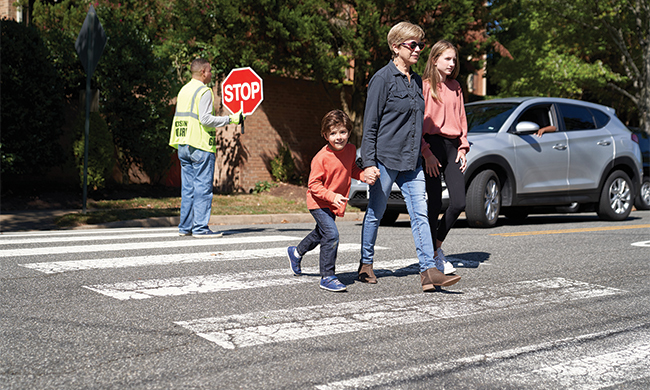
To make sure no parent worries about their child getting to school safely, the California Office of Traffic Safety (OTS) and Caltrans are encouraging drivers, pedestrians and bicyclists to remember their “ABCs” on every trip: stay Alert for Bicyclists and watch for and yield to Children crossing the street.
With students in school and traffic patterns changing, consider these tips so students arrive to and from class safely:
Drivers
Because children outside of vehicles do not have the same protections as drivers and passengers, drivers have an outsized role to protect people walking, biking and rolling.
- Take your time and be patient.
- Always follow the speed limit.
- Use extra caution at crosswalks and intersections, especially if you notice children nearby.
- Don’t drive distracted – even a quick glance at your phone can have tragic consequences.
- Never drive while impaired.
- Adjust your driving to the conditions and use extra caution in rain, fog and darkness.
- If you see a bicyclist ahead, wait until it’s safe to pass and give them at least 3 feet of space when you do.
Pedestrians
Pedestrians have an important role in their own safety, particularly in school zones and crosswalks where children and other people may be present.
- Use sidewalks when available. If there are no sidewalks, walk facing traffic so you can see drivers and they can see you.
- Avoid crossing outside of crosswalks. If there is a signalized crosswalk or marked crosswalk, use it.
- Before crossing the street, look both ways. If there are any stopped or turning cars, try to make eye contact with the drivers before crossing so you know they see you.
- If you’re walking after dark or when visibility is poor, make yourself visible by wearing something bright or reflective and shining a light.
- Stay alert – don’t wear headphones or use your phone while crossing the street or walking across a busy road.
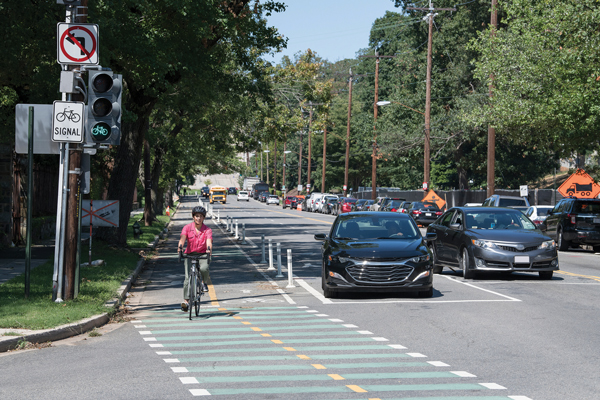 Bicyclists
Bicyclists can help protect themselves by staying alert and visible, especially in areas where traffic, pedestrians and young students may be present.
- When possible, plan your route along bike paths or roads with dedicated bike lanes away from vehicle traffic.
- Equip your bicycle with lights and reflectors to be more visible to drivers and pedestrians.
- Wear a properly fitted helmet and bright clothing.
- Learn cyclist hand signals to communicate when you’re turning, slowing or stopping.
- Stay aware of drivers and always yield to pedestrians.
To learn more and join the movement, visit GoSafelyCA.org.
E-Bike Safety Tips
With more young people using e-bikes than ever before, it’s important that riders and their parents or guardians understand the risks involved and make smart, safe choices.
Since e-bikes can travel at faster speeds than traditional bicycles, they pose greater risk for serious injury or death in the event of a crash. Class 1 and 2 e-bikes can both travel at up to 20 mph unassisted, while Class 3 e-bikes can go as fast as 28 mph unassisted.
E-bike rules vary based on the top unassisted speed, but parents and guardians should follow these tips for e-bikes:
- Many local ordinances and state laws restrict e-bike use for minors or require special licensing.
- Helmets are required for riders under age 18 for Class 1-2 e-bikes and all riders on Class 3 e-bikes, regardless of age.
- You must be 16 years or older to ride a Class 3 e-bike.
- Never ride e-bikes that don’t have pedals as they could be considered e-motos and not legally permitted on roads.
- Ride in bike lanes or on legal paths, avoiding roads with traffic when possible.
- Be as predictable as possible and use caution when making turns, crossing streets or riding in conditions with poor visibility.
E-bike rules may vary by state and regionally. Contact local law enforcement regarding local laws.

SOURCE:
📰 Enjoying STM Daily News? Join the conversation!
💬 Leave a comment, share your thoughts, and subscribe to our newsletter for the latest stories, updates, and “News You Can Use This Moment!” delivered to your inbox.
Stay connected with STM Daily News!





