Connect with us

Food

How Pecans Became a Holiday Staple: 8,000 Years of American Pecan History

Pecan History? Discover the 8,000-year history of pecans—America’s only native major nut crop. Learn how pecans evolved from wild, overlooked trees to a beloved holiday staple found in pies, pralines, and more.

Published

on

Last Updated on December 18, 2025 by Daily News Staff

How Pecans Became a Holiday Staple: 8,000 Years of American Pecan History
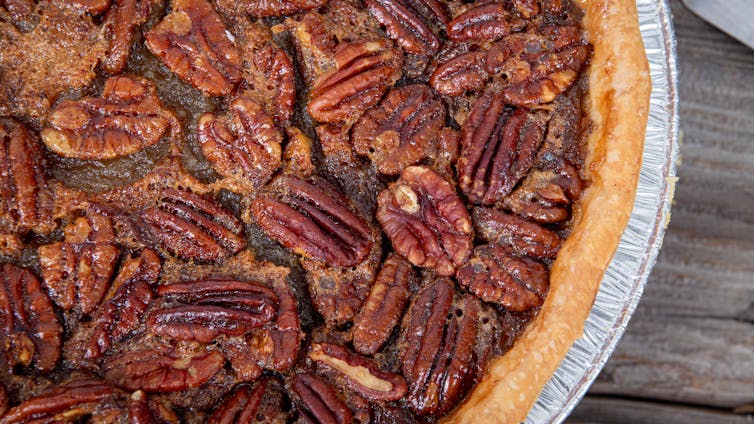
Pecan pie is a popular holiday treat in the United States.
Julie Deshaies/iStock via Getty Images

How Pecans Became a Holiday Staple: 8,000 Years of American Pecan History

Shelley Mitchell, Oklahoma State University

Pecans have a storied history in the United States. Today, American trees produce hundreds of million of pounds of pecans – 80% of the world’s pecan crop. Most of that crop stays here. Pecans are used to produce pecan milk, butter and oil, but many of the nuts end up in pecan pies.

Throughout history, pecans have been overlooked, poached, cultivated and improved. As they have spread throughout the United States, they have been eaten raw and in recipes. Pecans have grown more popular over the decades, and you will probably encounter them in some form this holiday season.

I’m an extension specialist in Oklahoma, a state consistently ranked fifth in pecan production, behind Georgia, New Mexico, Arizona and Texas. I’ll admit that I am not a fan of the taste of pecans, which leaves more for the squirrels, crows and enthusiastic pecan lovers.

The spread of pecans

The pecan is a nut related to the hickory. Actually, though we call them nuts, pecans are actually a type of fruit called a drupe. Drupes have pits, like the peach and cherry.

Three green, oval-shaped pods on the branch of a tree
Three pecan fruits, which ripen and split open to release pecan nuts, clustered on a pecan tree.
IAISI/Moment via Getty Images

The pecan nuts that look like little brown footballs are actually the seed that starts inside the pecan fruit – until the fruit ripens and splits open to release the pecan. They are usually the size of your thumb, and you may need a nutcracker to open them. You can eat them raw or as part of a cooked dish.

The pecan derives its name from the Algonquin “pakani,” which means “a nut too hard to crack by hand.” Rich in fat and easy to transport, pecans traveled with Native Americans throughout what is now the southern United States. They were used for food, medicine and trade as early as 8,000 years ago.

A map of the US with parts of Texas, Louisiana, Oklahoma, Arkansas and Missouri highlighted in green.
Pecans are native to the southern United States.
Elbert L. Little Jr. of the U.S. Department of Agriculture, Forest Service

Pecans are native to the southern United States, and while they had previously spread along travel and trade routes, the first documented purposeful planting of a pecan tree was in New York in 1722. Three years later, George Washington’s estate, Mount Vernon, had some planted pecans. Washington loved pecans, and Revolutionary War soldiers said he was constantly eating them.

Meanwhile, no one needed to plant pecans in the South, since they naturally grew along riverbanks and in groves. Pecan trees are alternate bearing: They will have a very large crop one year, followed by one or two very small crops. But because they naturally produced a harvest with no input from farmers, people did not need to actively cultivate them. Locals would harvest nuts for themselves but otherwise ignored the self-sufficient trees.

It wasn’t until the late 1800s that people in the pecan’s native range realized the pecan’s potential worth for income and trade. Harvesting pecans became competitive, and young boys would climb onto precarious tree branches. One girl was lifted by a hot air balloon so she could beat on the upper branches of trees and let them fall to collectors below. Pecan poaching was a problem in natural groves on private property.

Pecan cultivation begins

Even with so obvious a demand, cultivated orchards in the South were still rare into the 1900s. Pecan trees don’t produce nuts for several years after planting, so their future quality is unknown.

Two lines of trees
An orchard of pecan trees.
Jon Frederick/iStock via Getty Images

To guarantee quality nuts, farmers began using a technique called grafting; they’d join branches from quality trees to another pecan tree’s trunk. The first attempt at grafting pecans was in 1822, but the attempts weren’t very successful.

Grafting pecans became popular after an enslaved man named Antoine who lived on a Louisiana plantation successfully produced large pecans with tender shells by grafting, around 1846. His pecans became the first widely available improved pecan variety.

Advertisement
Get More From A Face Cleanser And Spa-like Massage
A cut tree trunk with two smaller, thiner shoots (from a different type of tree) protruding from it.
Grafting is a technique that involves connecting the branch of one tree to the trunk of another.
Orest Lyzhechka/iStock via Getty Images

The variety was named Centennial because it was introduced to the public 30 years later at the Philadelphia Centennial Expedition in 1876, alongside the telephone, Heinz ketchup and the right arm of the Statue of Liberty.

This technique also sped up the production process. To keep pecan quality up and produce consistent annual harvests, today’s pecan growers shake the trees while the nuts are still growing, until about half of the pecans fall off. This reduces the number of nuts so that the tree can put more energy into fewer pecans, which leads to better quality. Shaking also evens out the yield, so that the alternate-bearing characteristic doesn’t create a boom-bust cycle.

US pecan consumption

The French brought praline dessert with them when they immigrated to Louisiana in the early 1700s. A praline is a flat, creamy candy made with nuts, sugar, butter and cream. Their original recipe used almonds, but at the time, the only nut available in America was the pecan, so pecan pralines were born.

Two clusters of nuts and creamy butter on a plate.
Pralines were originally a French dessert, but Americans began making them with pecans.
Jupiterimages/The Image Bank via Getty Images

During the Civil War and world wars, Americans consumed pecans in large quantities because they were a protein-packed alternative when meat was expensive and scarce. One cup of pecan halves has about 9 grams of protein.

After the wars, pecan demand declined, resulting in millions of excess pounds at harvest. One effort to increase demand was a national pecan recipe contest in 1924. Over 21,000 submissions came from over 5,000 cooks, with 800 of them published in a book.

Pecan consumption went up with the inclusion of pecans in commercially prepared foods and the start of the mail-order industry in the 1870s, as pecans can be shipped and stored at room temperature. That characteristic also put them on some Apollo missions. Small amounts of pecans contain many vitamins and minerals. They became commonplace in cereals, which touted their health benefits.

In 1938, the federal government published the pamphlet Nuts and How to Use Them, which touted pecans’ nutritional value and came with recipes. Food writers suggested using pecans as shortening because they are composed mostly of fat.

The government even put a price ceiling on pecans to encourage consumption, but consumers weren’t buying them. The government ended up buying the surplus pecans and integrating them into the National School Lunch Program.

A machine with an arm attached to a tree, and a wheeled cab on the ground.
Today, pecan producers use machines called tree shakers to shake pecans out of the trees.
Christine_Kohler/iStock via Getty Images

While you are sitting around the Thanksgiving table this year, you can discuss one of the biggest controversies in the pecan industry: Are they PEE-cans or puh-KAHNS?

Editor’s note: This article was updated to include the amount of protein in a cup of pecans.

Shelley Mitchell, Senior Extension Specialist in Horticulture and Landscape Architecture, Oklahoma State University

This article is republished from The Conversation under a Creative Commons license. Read the original article.

Food and Drink

Advertisement
Get More From A Face Cleanser And Spa-like Massage

Link: https://stmdailynews.com/food-and-drink/

HUNGRY FOR MORE?

Discover a feast for your senses with our Food & Drink Blog, a tantalizing part of STM Daily News. Get the latest articles, recipes, and foodie news delivered straight to your inbox. Satisfaction guaranteed!

SIGN UP TO RECEIVE THE LATEST RECIPES & FOODIE NEWS, PLUS SOME EXCLUSIVE GOODIES!

We don’t spam! Read our privacy policy for more info.

Food and Drink

Discover more from Daily News

Subscribe to get the latest posts sent to your email.

Continue Reading
Advertisement Sports Research
Click to comment

Leave a Reply

Your email address will not be published. Required fields are marked *

Food

What Are Comfort Foods—and Why Do We Crave Them?

Comfort foods go beyond taste—they offer emotional reassurance, cultural identity, and nostalgia. Learn why we crave them and how they connect us.

Published

on

Comfort foods go beyond taste—they offer emotional reassurance, cultural identity, and nostalgia. Learn why we crave them and how they connect us.

What Are Comfort Foods—and Why Do We Crave Them?

Food & Beverage | The Knowledge Comfort foods are more than just meals—they are emotional touchstones. From a bowl of chicken noodle soup to a plate of mac and cheese, comfort foods provide familiarity, warmth, and reassurance during moments of stress, illness, or nostalgia. While comfort foods vary by culture and personal experience, their purpose is universal: they make us feel grounded, safe, and connected.

What Defines Comfort Food?

Although comfort foods differ from person to person, they often share common characteristics:
  • Familiar and nostalgic – Foods tied to childhood or family traditions
  • Warm and filling – Soups, casseroles, stews, and baked dishes
  • Emotionally satisfying – Comforting beyond physical hunger
  • Rich in carbohydrates or fats – Which can influence mood-regulating chemicals in the brain
These foods are rarely chosen for convenience alone—they’re chosen because they feel like home.

The Science Behind Comfort Foods

There is real science behind why comfort foods make us feel better. Carbohydrate-rich foods can increase the production of serotonin, a neurotransmitter that helps regulate mood and promote a sense of calm. Warm foods also play a role. Studies suggest that warmth can enhance feelings of safety and emotional comfort, which may explain why soups, stews, and hot meals are commonly craved during stressful times or colder seasons. In short, comfort foods don’t just satisfy hunger—they support emotional well-being.

Comfort Foods Are Cultural

Every culture has its own version of comfort food, shaped by tradition, availability, and shared history:
  • United States: Mac and cheese, meatloaf, mashed potatoes
  • Mexico: Tamales, pozole
  • Italy: Pasta, lasagna
  • Japan: Ramen, curry rice
  • India: Dal with rice
What makes these foods comforting isn’t the recipe—it’s the memory and meaning attached to them.

Why We Turn to Comfort Foods

People often crave comfort foods during moments of emotional or physical vulnerability, including:
  • Stress or anxiety
  • Illness or fatigue
  • Homesickness
  • Major life changes
  • Celebrations and family gatherings
In uncertain moments, familiar flavors help restore a sense of normalcy and emotional balance.

More Than a Meal

Comfort food isn’t about indulgence or nutrition alone—it’s about connection. These dishes link us to people, places, and moments that shaped us. That’s why comfort foods endure across generations, cultures, and changing trends. Comfort food doesn’t just feed the body. It feeds the moment.

Related Reading

Get The Knowledge—only on STM Daily News.

Discover more from Daily News

Subscribe to get the latest posts sent to your email.

Continue Reading

social media

The Viral Backlash: How a Chef, a TikTok Influencer, and One Moment Changed a San Francisco Restaurant

TikTok Influencer vs Chef: A viral TikTok confrontation between Chef Luke Sung and a food influencer led to backlash, a restaurant closure, and a major rebrand in San Francisco.

Published

on

new york city circa 2021 finder scrolling tik tok video sharing social networking serv SBI 349948744

The Viral Backlash: How a Chef, a TikTok Influencer, and One Moment Changed a San Francisco Restaurant

In mid-2025, a San Francisco restaurant found itself at the center of a viral controversy—not because of its food, but because of an interaction between a well-known chef and a TikTok food influencer. The incident sparked a broader conversation about power, professionalism, and the growing influence of social media in the hospitality industry.

What Happened at Kis Cafe

The incident involved Chef Luke Sung, a respected name in the Bay Area culinary scene, and a TikTok micro-influencer known online as @itskarlabb. The influencer had been invited to Kis Cafe for a planned promotional collaboration. According to the influencer, during her visit the chef questioned her follower count—around 15,000 at the time—and allegedly implied that her audience was not the “type of people” who would dine at his restaurant. She later described the exchange as humiliating and dismissive. After leaving the restaurant, she shared her experience in a TikTok video. The post quickly went viral, gaining millions of views and triggering a wave of online backlash.

The Internet Reacts

Although the influencer initially did not name the restaurant or the chef, internet users quickly identified Kis Cafe. The restaurant’s review pages were flooded with criticism, and the incident became a flashpoint in online discussions about elitism, influencer culture, and accountability. Within days, Kis Cafe issued a public apology and announced that Luke Sung was no longer affiliated with the restaurant in any capacity.

Chef Luke Sung Responds

Chef Sung later released a public apology, acknowledging that his behavior was condescending and inappropriate. He stated that there were no excuses for the way he treated the influencer and accepted responsibility for the incident. The apology, however, did little to slow the momentum of public reaction.

The Restaurant Closes — and Reopens

Not long after the controversy, Kis Cafe announced it would close. In the months that followed, the space reopened under a new name, Bosque, with new leadership and no involvement from Sung. The rebrand was seen as a clear attempt to move forward and distance the business from the viral episode.

The Influencer Effect

Meanwhile, the influencer at the center of the controversy saw her follower count surge dramatically, growing from a modest audience into hundreds of thousands of followers almost overnight. The incident highlighted the real-world impact that even “micro-influencers” can have—and how a single moment, captured and shared, can reshape careers and businesses.

Why This Story Matters

This controversy underscored a major cultural shift: social media is no longer separate from real-world industries like dining and hospitality. Online platforms can amplify personal experiences into powerful narratives with lasting consequences. As of early 2026, the restaurant operates under a new identity, the chef has stepped away from the project entirely, and the influencer continues to grow her platform. The episode remains a cautionary tale about professionalism, respect, and the power of digital voices. Get The Knowledge. More stories like this are available at STM Daily News.

Dive into “The Knowledge,” where curiosity meets clarity. This playlist, in collaboration with STMDailyNews.com, is designed for viewers who value historical accuracy and insightful learning. Our short videos, ranging from 30 seconds to a minute and a half, make complex subjects easy to grasp in no time. Covering everything from historical events to contemporary processes and entertainment, “The Knowledge” bridges the past with the present. In a world where information is abundant yet often misused, our series aims to guide you through the noise, preserving vital knowledge and truths that shape our lives today. Perfect for curious minds eager to discover the ‘why’ and ‘how’ of everything around us. Subscribe and join in as we explore the facts that matter.  https://stmdailynews.com/the-knowledge/

Authors

  • IMG 0366

    Hal Machina is a passionate writer, blogger, and self-proclaimed journalist who explores the intersection of science, tech, and futurism. Join him on a journey into innovative ideas and groundbreaking discoveries!

    View all posts journalist

Discover more from Daily News

Subscribe to get the latest posts sent to your email.

Continue Reading

Food and Beverage

JonnyPops Launches Refreshing New “No Sugar Added with Electrolytes” Mini Frozen Pops

JonnyPops is launching No Sugar Added with Electrolytes mini frozen pops—an organic, dye-free treat with hydration support—coming April 2026.

Published

on

JonnyPops is launching No Sugar Added with Electrolytes mini frozen pops—an organic, dye-free treat with hydration support—coming April 2026.

JonnyPops Launches Refreshing New “No Sugar Added with Electrolytes” Mini Frozen Pops.

JonnyPops Launches Refreshing New “No Sugar Added with Electrolytes” Mini Frozen Pops

A better-for-you frozen treat meets hydration support in a grab-and-go mini format. If you’ve ever reached for something cold after a workout, a long day outside, or when you’re just not feeling 100%, you’re not alone — and JonnyPops says its fans have been telling that story for a while. The Minnesota-based frozen treat brand announced it’s expanding its No Sugar Added Minis lineup with a new option designed to be both refreshing and functional: JonnyPops “No Sugar Added with Electrolytes” mini frozen pops.

Fans asked for hydration-friendly pops — JonnyPops listened

According to the company, the new product was inspired by emails and social media comments from customers who were already using JonnyPops as a simple way to cool down and feel a little more hydrated. JonnyPops says consumers shared stories about playing sports in the heat, spending time outdoors, or recovering from an illness — and how a frozen treat with hydration support would be the perfect pop for those moments. That feedback led the brand to add electrolytes to its popular No Sugar Added Minis.

What’s inside the new minis

JonnyPops says the new “No Sugar Added with Electrolytes” minis are built around the same standards fans expect from the brand, including:
  • Organic ingredients
  • No artificial dyes
  • No added sugar
  • Electrolytes for hydration support
  • Layered flavors designed for a fun, refreshing bite
“Consumers often share with us how JonnyPops is part of their everyday moments,” said Erik Brust, Co-Founder of JonnyPops. “We hope that these new frozen pops will be loved by our fans and enjoyed in all moments that need a refreshing treat.”

When you can find them

JonnyPops says the new minis are expected to hit stores in April 2026. For updates on availability and additional product news, visit www.jonnypops.com and follow JonnyPops on social media.

About JonnyPops

JonnyPops’ tagline is “A Better Pop for a Better World!™” and the company says its mission is to make “delicious, magical products” while helping make the world a kinder place. The brand notes its pops are free from artificial dyes, made in a peanut-free facility, and include a kind deed printed on every pop stick. JonnyPops was founded in a St. Olaf College dorm room and sold its first pops at Twin Cities farmers’ markets and local cafes in 2012. Today, the company employs 200+ people, produces its frozen pops in-house, and is sold through major retailers across all 50 states. Learn more at jonnypops.com or follow @jonnypops on Instagram.

Media contact

JonnyPops@dkcnews.com

At our core, we at STM Daily News, strive to keep you informed and inspired with the freshest content on all things food and beverage. From mouthwatering recipes to intriguing articles, we’re here to satisfy your appetite for culinary knowledge.

Visit our Food & Drink section to get the latest on Foodie News and recipes, offering a delightful blend of culinary inspiration and gastronomic trends to elevate your dining experience. https://stmdailynews.com/food-and-drink/

Authors


Discover more from Daily News

Subscribe to get the latest posts sent to your email.

Continue Reading

Trending