

News
Broncos ‘Private’ Stadium Plan: How Tax Breaks and Infrastructure Can Still Cost the Public Millions
Broncos ‘Private’ Stadium Plan: In September 2025, the Denver Broncos announced plans for a new privately financed stadium. However, scrutiny arises as public funds often subsidize these projects, obscuring true financing sources. This raises concerns about the long-term financial impact on taxpayers, who may shoulder broader costs beyond construction, including infrastructure and social ramifications.

Geoffrey Propheter, University of Colorado Denver
Broncos say their new stadium will be ‘privately financed,’ but ‘private’ often still means hundreds of millions in public resources
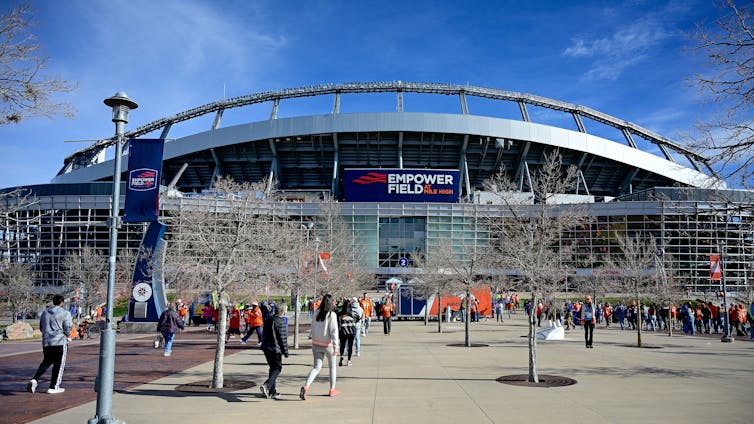
The Denver Broncos announced in early September 2025 their plan to build a privately financed football stadium. The proposal received a lot of attention and praise.
Across the five major sports leagues in the U.S. – the NBA, NHL, NFL, MLB and MLS – only 20% of facilities are privately owned.
I’ve studied the intersection of state and local public finance and pro sports for two decades. This experience has led me to approach claims of private financing with suspicion.
Private dollars are often masked as public dollars in these arrangements. https://www.youtube.com/embed/zwv34Lpo0ec?wmode=transparent&start=0 A Fox31 Denver news report aired in November 2025 about the Broncos’ plans for a new stadium.
Private vs public dollars
In theory, what counts as private or public dollars is uncontroversial. Dollars are public when government has a legal claim over them – otherwise, they are private.
The public versus private dollar distinction matters when accounting for who is contributing how much to a sports facility. When public dollars are allowed to count as private dollars, a project proposal looks more enticing than it is, in fact.
For instance, lawmakers regularly allow team owners to count public dollars as private dollars. The Sacramento City Council agreed to let the NBA’s Sacramento Kings count their property tax payments for the city-owned arena as private contributions to the overall cost of financing the arena. But property taxes are public dollars that in other instances go toward public services like schools and road repairs.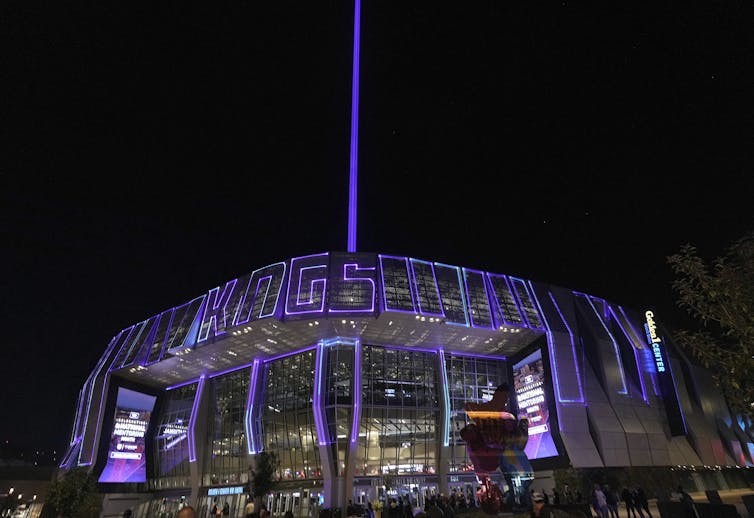
Team owners building private facilities also typically receive public dollars through tax breaks, which is government spending in disguise. Property tax exemptions, sales and use tax exemptions on materials and machinery, and income tax credits are common forms of government givebacks to sports team owners.
I’ve estimated that property tax exemptions alone, among facilities in the five major leagues, have cost state and local governments US$20 billion cumulatively over the life of teams’ leases, 42% of which would have gone to K-12 education.
Rental payments spent on facilities are not private dollars
Many facilities and their infrastructure are funded through public debt secured in part by team rental payments. Lawmakers, media and consultants often view projects secured by rents as privately financed, in part or whole.
However, rental income in exchange for use or operation of public property should not be counted as private dollars.
Here’s a thought experiment. Suppose state lawmakers allocated the rent paid for use of campground sites in a state park to pay for new campground bathrooms. Are the bathrooms privately funded?
The flaw in concluding “yes” arises from a failure to appreciate that lawmakers, through policy, create legal claims over certain dollars. All dollars start as private dollars, but through the tax system, lawmakers transfer ownership of some dollars to the public.
It is the government landlord’s choice, a policy decision, to spend the rental income on the rented property, a choice available to them only if they own the rental income in the first place.
Yet lawmakers regularly allow teams, both professional and minor league, to count rental payments as private contributions. This accounting makes sports subsidies look less generous than they actually are.
Looking beyond construction
Facilities not only need to be constructed but also operated, maintained and eventually upgraded. Roads, sewer lines, overpasses, game-day security and emergency response and public policies to mitigate gentrification caused by a facility are all common taxpayer-funded touchpoints. In addition, facilities have preconstruction costs such as land acquisition, soil remediation and site preparation, as well as later costs such as demolition and remediation for the land’s next use.
Focusing on privately financed construction and ignoring all other aspects of a project’s development and operation is misleading, potentially contributing to lawmakers making inefficient and expensive policy decisions.
By way of example, the Council of the District of Columbia approved a subsidy agreement last year with the NFL’s Commanders. The stadium would be financed, constructed and operated by the team owner, who would pay $1 in rent per year and remit no property taxes. In exchange for financing the stadium privately, the owner receives exclusive development rights to 20 acres of land adjacent to the stadium for the next 90 years.
The stadium is expected to cost the owner $2.5 billion, with the city contributing $1.3 billion for infrastructure.
But the city also gives up market rental income between $6 billion and $25 billion,depending on future land appreciation rates, that it could make on the 20 acres.
In other words, the rent discount alone means the city gives up revenue equal to multiple stadiums in exchange for the Commanders providing one. It is as if the council has a Lamborghini, traded it straight up for a Honda Civic, and then praised themselves for their negotiation acumen that resulted in a “free” Civic.
The Broncos’ proposed stadium
As of January 2026, Denver taxpayers know only that the Broncos stadium construction will be privately financed and that public dollars will be spent on some infrastructure.
Being enamored with such a proposal is similar to being offered a $1 billion yacht at a 75% discount. In my experience, there are two types of public officials: one will want to spend $250 million to save $750 million, while the other will ask whether $250 million for a yacht is an appropriate use of taxpayer resources given existing needs elsewhere.
My hope is that lawmakers better appreciate the many ways government participation in sports facility development, including privately financed ones, imposes serious risks and costs for current and future taxpayers. What is the expected total cost of the stadium project over its life? How much of the life cost would public resources cover? Could public resources generate greater benefits in an alternative use? How much will it cost to mitigate or compensate those affected by a project’s expected negative side effects, such as gentrification, congestion, pollution and crime?
Read more of our stories about Colorado.
Geoffrey Propheter, Associate Professor, School of Public Affairs, University of Colorado Denver
This article is republished from The Conversation under a Creative Commons license. Read the original article.

Forgotten Genius Fridays
The Tuskegee Airmen: The Red Tails Who Fought Two Wars
The Tuskegee Airmen were far more than the legendary Red Tail fighter pilots. Thousands of pilots, mechanics, instructors and support personnel challenged segregation while helping fight World War II—and their achievements helped change the U.S. military.

A Forgotten Genius Special | STM Daily News
They were training to fight America’s enemies overseas while confronting discrimination in the country they had volunteered to defend. The Red Tails.
They became known as the Tuskegee Airmen.
Their story is often reduced to an image of Black fighter pilots flying red-tailed P-51 Mustangs over Europe during World War II. But the real story was much larger.
The Tuskegee Airmen included pilots, mechanics, instructors, navigators, bombardiers, radio operators, parachute riggers, medical personnel, meteorologists, cooks, clerks, control-tower personnel and many others who helped make military aviation possible.
The National Park Service describes more than 16,000 people as participants in the broader Tuskegee experience.
Together, they helped challenge one of the most persistent prejudices in the American military: the racist assumption that Black Americans lacked the intelligence, discipline or ability required to become successful military aviators.
They proved otherwise.
An Experiment Built on a False Assumption
In January 1941, Secretary of War Henry L. Stimson authorized the formation of a Black pursuit squadron.
The 99th Pursuit Squadron, later redesignated the 99th Fighter Squadron, was activated in March 1941.
Because the American military remained segregated, Black aviators weren’t simply incorporated into existing flying units. A separate training program was established around Tuskegee, Alabama.
Flight training took place at Moton Field, while Tuskegee Army Air Field provided advanced military flight training.
What military officials regarded as an experiment would ultimately help demonstrate that the restrictions placed upon Black aviators had nothing to do with their abilities.
More Than Pilots
The name “Tuskegee Airmen” can be misleading if we imagine only the men sitting inside fighter cockpits.
Aircraft don’t fly because of pilots alone.
They require mechanics.
Fuel crews.
Radio operators.
Meteorologists.
Armorers.
Dispatchers.
Parachute riggers.
Medical personnel.
Instructors.
Navigators.
Engineers.
Control-tower operators.
Administrative personnel.
And many others.
Women were part of the Tuskegee experience as well. According to the National Park Service, women worked as mechanics, control-tower operators, aircraft fuselage technicians, gate guards, secretaries and clerks. Three permanent female parachute riggers helped train hundreds of cadets in the proper packing and maintenance of parachutes.
The Tuskegee story was therefore not simply the story of several hundred pilots.
It was the story of an entire aviation community.
Taking the Fight Overseas
The 99th Fighter Squadron deployed overseas in 1943.
Flying Curtiss P-40 Warhawks, its pilots entered combat in the Mediterranean theater, operating from North Africa and later Sicily and Italy.
The Tuskegee program continued expanding.
Three additional Black fighter squadrons—the 100th, 301st and 302nd—became part of the 332nd Fighter Group.
And the man who would eventually command them had already experienced another form of racial isolation.
His name was Benjamin O. Davis Jr.
The son of America’s first Black Army general had graduated from West Point in 1936 after fellow cadets subjected him to years of deliberate social isolation.
Now Davis was leading Black American fighter pilots into combat.
The Red Tails
The 332nd eventually transitioned to the aircraft that became most closely associated with the Tuskegee Airmen:
The North American P-51 Mustang.
The tails of the group’s aircraft were painted red to identify the unit.
The distinctive markings helped produce one of the most famous nicknames in American military aviation:
The Red Tails.
Operating primarily from Italy, the 332nd escorted heavy bombers deep into enemy territory while also attacking ground targets.
Escort duty was extraordinarily important.
American bombers flying deep into enemy territory were vulnerable to German fighters. Escort pilots had to remain close enough to protect the bombers while simultaneously watching for enemy aircraft.
The Tuskegee Airmen developed an impressive record performing that mission.
The Legend — and the Reality
One claim became particularly famous after the war:
The Tuskegee Airmen never lost a bomber they escorted to enemy fighters.
It is an inspiring story.
It also isn’t completely accurate.
Research by Air Force historian Daniel Haulman using wartime mission reports found that 27 bombers being escorted by the 332nd Fighter Group were shot down by enemy aircraft.
Those losses occurred during seven of the group’s 179 bomber escort missions for the Fifteenth Air Force.
But correcting the legend doesn’t diminish their accomplishment.
In fact, the documented record remains impressive.
Research comparing the 332nd with other P-51 fighter groups in the Fifteenth Air Force found that the Tuskegee Airmen lost substantially fewer escorted bombers to enemy aircraft than the other groups examined.
The truth doesn’t weaken their story.
The truth makes their achievement real.
Fighting Two Wars
The enemy wasn’t confined to the skies over Europe.
Black servicemen returned from missions defending democracy overseas while still confronting segregation at American military installations and throughout American society.
This contradiction became part of the broader Double V campaign during World War II—the call for victory against fascism abroad and racial discrimination at home.
Tuskegee personnel repeatedly challenged discriminatory military policies.
One of the most significant confrontations occurred in 1945 at Freeman Field, Indiana, when Black officers protested restrictions that prevented them from using an officers’ club reserved for white officers.
Their resistance became known as the Freeman Field Mutiny.
The confrontation demonstrated that the Tuskegee story wasn’t simply about proving Black Americans could fly airplanes.
It was also about demanding the rights that should accompany wearing the same uniform.
Changing More Than Aviation
The Tuskegee Airmen didn’t single-handedly desegregate the United States military.
But their performance undermined one of the principal arguments used to justify segregation—that Black servicemen could not perform highly technical or demanding military assignments as effectively as white servicemen.
Three years after the Tuskegee flying program began sending pilots into combat, President Harry S. Truman issued Executive Order 9981 on July 26, 1948, establishing a federal policy of equality of treatment and opportunity in the armed services regardless of race, color, religion or national origin.
Military integration would take additional years to implement.
But the old assumptions had become increasingly difficult to defend.
A Legacy Larger Than the Red Tails
The Tuskegee Airmen eventually became symbols of perseverance, military excellence and the long struggle to expand opportunity within America’s armed forces.
In 2007, the Tuskegee Airmen collectively received the Congressional Gold Medal in recognition of their service.
Yet perhaps the best way to understand their achievement is not through mythology.
They didn’t need a perfect combat record to make history.
They trained in a system created because many officials doubted Black Americans could become military aviators.
They went into combat.
They flew.
They fought.
They protected bomber formations.
They maintained aircraft.
They trained pilots.
And thousands of people behind the scenes made those missions possible.
They demonstrated through performance what segregation had attempted to deny.
And among the men leading them was the son of America’s first Black Army general.
His name was Benjamin O. Davis Jr.
His journey had taken him from isolation at West Point to the cockpit of a military aircraft and command of the 332nd Fighter Group.
But his story was far from finished.
Next Friday on Forgotten Genius Fridays: Benjamin O. Davis Jr. — From West Point Isolation to Four-Star General.
Forgotten Genius Fridays is an STM Daily News series exploring innovators, pioneers and historical figures whose achievements deserve a larger place in our collective memory.
Sources & Related Links
National Park Service — Tuskegee Airmen History & Culture documents the broad definition of the Tuskegee Airmen and the many ground and support occupations involved.
Air Force Historical Support Division — Tuskegee Airmen provides an excellent military chronology of the 99th Fighter Squadron and 332nd Fighter Group.
National Park Service — Tuskegee Airmen National Historic Site is especially useful for Moton Field, training and the Red Tails.
National Park Service — And There Were Women provides material for an often-overlooked part of the story: women who participated in the Tuskegee experience.
Congress authorized a Congressional Gold Medal for the Tuskegee Airmen collectively, recognizing their military record and its role in inspiring reform in the armed forces; the presentation ceremony took place in 2007.
Explore more fascinating stories, videos, and articles on The Knowledge at STM Daily News!
Entertainment
Mattel Adventure Park and VAI Resort: What’s the Latest in Glendale?
Mattel Adventure Park and VAI Resort still have no announced opening date. VAI says construction continues and expects to share more about the park in late 2026.

GLENDALE, Ariz. — The wait continues for Mattel Adventure Park and VAI Resort near State Farm Stadium. Both remain under development, and neither has announced an opening date.
There has, however, been a change in how the park is being described. In August, Axios Phoenix reported that Epic Resort Destinations, the park’s original developer, appears to be out of the Glendale project. Asked about Epic’s involvement, a VAI spokesperson told Axios that VAI is the park’s owner and operator, but did not directly answer whether Epic still has any role. Another VAI spokesperson said the park and resort are now considered part of the same project and that construction continues on both.
VAI also told Axios it is redefining the park’s guest experience and creative vision and expects to share more in the fourth quarter of 2026. That is a promise of a project update, not an opening announcement.
The VAI Resort FAQ currently says it will announce an opening date approximately nine months in advance. Mattel Adventure Park’s Glendale page continues to promote planned attractions, including the Barbie Beach House and two Hot Wheels roller coasters, without listing an opening date.
For families hoping to visit, the practical answer is that there is still no date to put on the calendar. The next meaningful development to watch is VAI’s promised fourth-quarter update: it may clarify the park’s plans, but visitors will need an official opening announcement before they can plan a trip.
Source links: VAI Resort FAQ · Mattel Adventure Park Glendale page · Axios Phoenix’s August report
🎬🍿 Lights, camera, entertainment! From must-see movies and TV to music, celebrities, events, and the latest pop culture buzz, STM Daily News keeps you in the know. 💬 Join the conversation, share your take in the comments, and 📬 subscribe to our newsletter so you never miss the next big story!
The Long Track Back
LA Metro Locks In Vermont BRT Funding as World Cup Results Point Toward 2028
Metro’s World Cup service carried 212,865 passenger trips across eight matches. Its after-action report points to strong demand while identifying bus lanes, shuttle frequency, parking prices, and shade as priorities for future major events.
Last Updated on September 21, 2026 by Daily News Staff
A fully funded rapid-bus project and more than 212,000 World Cup shuttle trips offer two revealing signs of how Los Angeles is preparing for the 2028 Olympic and Paralympic Games.
LA Metro has reached a major funding milestone for one of its most important bus projects while releasing new evidence that transit can move a significant share of spectators during major international events.
A newly issued Metro report confirms that the Federal Transit Administration executed a $149.9 million Small Starts grant agreement for the Vermont Transit Corridor Bus Rapid Transit project on September 2, 2026. Metro now describes the proposed $413.8 million life-of-project budget as fully funded through federal, state and local sources.
Separately, Metro’s official review of the 2026 FIFA World Cup found that its special bus network carried 212,865 passenger trips during eight matches in Inglewood—approximately 20 percent of total match attendance.
Together, the developments show Metro moving from planning toward delivery: building permanent improvements for one of Los Angeles County’s busiest bus corridors while applying lessons from the World Cup to the much larger transportation challenge awaiting the region in 2028.
Vermont Avenue BRT moves closer to construction
The Vermont Transit Corridor would create a 12.4-mile, all-day bus rapid transit route between Sunset Boulevard and 120th Street. It would connect with the B, C, D and E rail lines and include 26 enhanced stations at 13 locations.
Metro’s existing Vermont Avenue service carries approximately 38,000 weekday boardings but operates through some of the region’s most congested streets. The BRT project would add dedicated side-running bus lanes, upgraded stations, improved lighting, transit-signal priority, real-time arrival information and pedestrian-safety improvements.
Metro estimates that the project could attract approximately 12,000 additional daily riders while improving the speed and reliability of every bus operating through the corridor.
The funding package includes:
- $149.9 million from the FTA Small Starts program
- $106.34 million from the federal Congestion Mitigation and Air Quality program
- $81.06 million from California’s SB 1 Local Partnership Program
- $44.49 million in Proposition C funding
- $25 million from Measure M
- $5 million from the state Transit and Intercity Rail Capital Program
- $2 million in federal Community Project Funding
Metro anticipates authorizing and executing additional early-work packages beginning in the fourth quarter of 2026. Major construction is expected to begin in fall 2026, with passenger service targeted for June 2028—just weeks before the Olympic Games begin in Los Angeles.
That is a more precise schedule than earlier project information, which described construction as beginning in late 2026 or early 2027 and service starting generally in time for the Games.
The $413.8 million life-of-project budget still requires final Metro Board approval. The federal grant agreement, however, removes a major financial uncertainty and gives Metro a clearer path toward construction.
World Cup transit carried one in five spectators
Metro’s World Cup after-action report provides the most complete picture yet of how the agency performed during its first major test ahead of 2028.
Metro deployed 300 buses over 15 special routes connecting SoFi Stadium with rail stations, transit hubs and temporary park-and-ride locations across Los Angeles and Orange counties. The service carried 212,865 passenger trips over eight matches, including 31,536 trips on the busiest match day.
According to Metro, the operation recorded no missed trips caused by mechanical problems, no traffic incidents and no safety incidents. The agency reported 100 percent fleet availability.
Customer surveys were also favorable. Metro said 91 percent of special-shuttle riders were satisfied with the service, while 93 percent indicated they would likely use a similar direct-service option during the 2028 Games. Perceived safety received a 96 percent satisfaction rating.
Contactless payment played a significant role. Approximately 72 percent of World Cup shuttle riders paid directly with a contactless credit or debit card—a systemwide feature Metro launched shortly before the tournament.
The operation was not without lessons. Riders and participating agencies identified several areas needing improvement, including dedicated bus lanes, more frequent shuttles, lower park-and-ride prices, additional shade, better group-payment options and more seating for passengers with accessibility needs.
Those concerns become more consequential when looking toward 2028. The Olympics and Paralympics will last longer than the World Cup, involve substantially more events and disperse spectators across venues throughout the region. An operation that succeeded for eight matches must therefore be expanded without disrupting everyday bus and rail riders.
A glimpse of Metro’s 2028 strategy
The Vermont BRT and World Cup results represent different sides of the same challenge.
The BRT project is a permanent investment intended to improve everyday mobility in East Hollywood, Koreatown, Exposition Park, South Los Angeles, West Athens and Westmont. Its Olympic value is important, but its lasting value will be measured by whether buses become faster and more dependable for the thousands of residents who already use the corridor.
The World Cup service, meanwhile, demonstrates that direct event shuttles can persuade a meaningful share of spectators to leave their cars behind. It also reveals the extraordinary staffing, equipment, coordination and street priority required to make those services work.
Metro has now shown that the model can succeed at World Cup scale. The next test is whether the agency can complete projects such as the Vermont BRT on schedule and turn a successful temporary operation into a repeatable regional system for 2028—and beyond.
Primary sources
- LA Metro: Vermont Transit Corridor BRT life-of-project budget report
- Federal Transit Administration: Vermont Avenue BRT project profile
- LA Metro: 2026 FIFA World Cup debrief
The Long Track Back examines the projects, decisions and turning points reshaping public transportation across Los Angeles County.
The Long Track Back follows the history and future of Los Angeles transit—from the lines the region lost to the rail and bus projects reshaping how people move today. Explore the decisions, construction milestones, and ridership trends behind LA’s changing network.
Update (September 22, 2026): Metro’s separate 2028 Games mobility report explains what happens next with the World Cup lessons. Metro is using its observations and rider surveys to refine Olympic transit plans, but says it needs funding certainty by the end of 2026 to keep major preparations on schedule. The report does not announce a change to the World Cup ridership figures cited above. (File #: 2026-0617)





