

Entertainment
30 years after ‘Reasonable Doubt,’ Jay‑Z’s career embodies hip‑hop’s biggest contradictions
Share article
Print article
“Reasonable Doubt” was not the first rap album I ever owned. But Jay-Z’s debut was the first hip-hop album I bought with my own money.

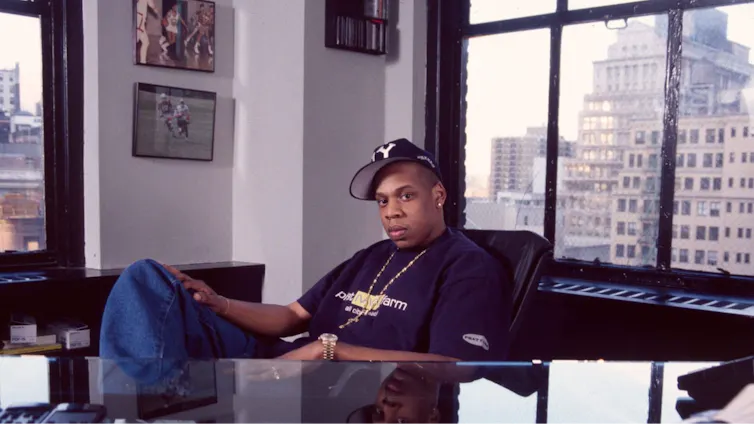
30 years after ‘Reasonable Doubt,’ Jay‑Z’s career embodies hip‑hop’s biggest contradictions
Jabari M. Evans, University of South Carolina
“Reasonable Doubt” was not the first rap album I ever owned. But Jay-Z’s debut was the first hip-hop album I bought with my own money. More importantly, it was the first one I studied as a young writer who aspired to become a rapper, a dream that eventually came true.
Jay-Z sounded cool in a way that resembled a jazz musician more than a conventional rap star. He rapped with a quiet calm that also conveyed supreme confidence. His lyrics were layered, skillful and unorthodox.
Yes, the tracks often revolved around drug dealing. But the hustlers who populated “Reasonable Doubt” weren’t degenerates. They were refined and astute thinkers. And unlike other gangsta rappers, there was a moral quandary at the heart of his storytelling. In tracks like “D’Evils,” Jay-Z’s narrator turns crime, aspiration and paranoia into meditations on capitalism and the psychic cost of wealth:
We used to fight for building blocks
Now we fight for blocks with buildings that make a killing
The closest of friends when we first started
But grew apart as the money grew, and soon grew black-hearted
And later:
My soul is possessed by D’Evils in the form of diamonds and Lexuses
The cinematic complexity displayed in its tracks helps explain why “Reasonable Doubt” was inducted into the Grammy Hall of Fame, and why it still matters 30 years later.
But the album also launched the career of a rapper whose own trajectory has come to mirror hip-hop’s own transformation.
In 1996, hip-hop was still fighting for legitimacy. Three decades later, it had been folded into the mainstream. Kendrick Lamar can win a Pulitzer Prize, Nas can have an endowed fellowship at Harvard University, and Jay-Z, who once couldn’t get signed to a label, can create a label of his own and become a billionaire business mogul.
Is it even possible for hip-hop to be seen as countercultural in 2026? And what happens when hip-hop’s most successful outsider becomes central to the very institutions he once seemed to challenge?
From moral panic to corporate behemoth
When “Reasonable Doubt” was released, hip-hop was both ascendant and under siege.
In February 1996, Tupac Shakur came out with “All Eyez on Me,” which became one of the bestselling rap albums of all time; seven months later, he was shot and killed. His friend-turned-rival, The Notorious B.I.G., was shot and killed in a drive-by shooting the following year. The media often cast these high-profile deaths as proof that rap music was inseparable from street violence, and the moral panic around hip-hop’s influence on young listeners only intensified.
How times have changed. Today, hip-hop powers advertising campaigns, luxury branding and streaming platforms. According to Nielsen, rap surpassed rock music as the most popular music genre in the U.S. in 2018. Today, it accounts for roughly 1-in-4 on-demand audio streams.
Jay-Z has played an outsized role in that transformation.
Since 1998, he’s won 25 Grammys for his own music. In that time, he’s also built a business empire. There’s his talent agency, Roc Nation; his streaming platform, TIDAL; his venture capital firm, Marcy Venture Partners; and his luxury alcohol brands, Armand de Brignac and D’Ussé. Through Roc Nation, he’s also a strategic partner with the NFL, advising the football league on its entertainment programming.
Forbes currently pegs his net worth at US$2.8 billion.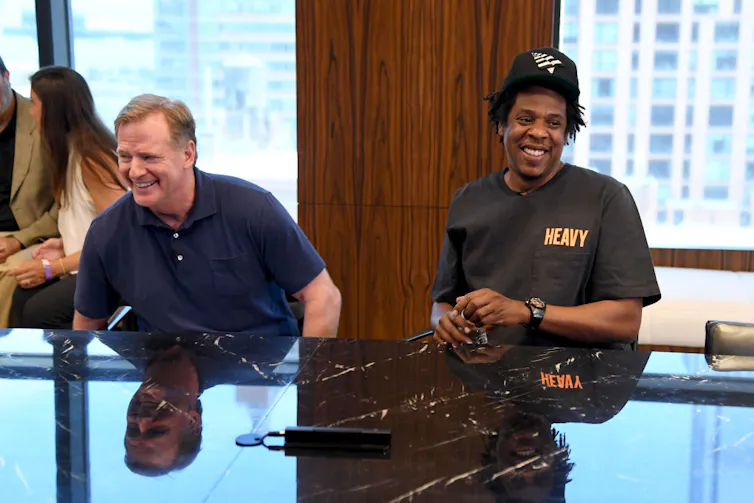
Confronted on capitalism
In April 2026, GQ published a long interview with Jay-Z.
This was a big deal: Jay-Z hadn’t interacted with the media like this since 2017, when he was promoting his 13th solo album, “4:44.”
How would one of hip-hop’s elder statesmen reflect on his career and his many successes?
In the interview, Jay-Z didn’t present his riches as a complicated outcome of capitalism’s contradictions. Instead, he talked about his wealth as if it were something his critics had failed to understand. When asked about the belief that there’s something inherently suspect about accumulating so much money, he pushed back:
“It’s almost like a cop-out. You get to demonize this group of folks without fixing the actual system that exists […] Your morality defines who you are. Your morality is not defined by a dollar amount.”
As for the notion that his career trajectory was somehow hypocritical:
“The only thing I heard coming up was the American dream. You could make it, if you pull yourself up by the bootstraps. I heard that my entire life – until we started being successful. Then it was like: You’re selling out because you’re making money.”
He then went on to insist that being handsomely paid is not some sort of betrayal to hip-hop, art or his community.
“I make art first and then I make sure that I’m compensated for my art. … That [capitalist] structure exists; I just see the world for what it is, not for what I want it to be. I’m a realist.”
To me, Jay-Z certainly sounded persuasive. He also sounded defensive. I think that’s because hip-hop has long been haunted by the idea that wealth compromises credibility, even as the tracks have always contained aspirational themes of luxury and entrepreneurship.
Don’t hate the player, hate the game
For my generation, Jay-Z sold aspiration in addition to albums.
I wore Rocawear denim suits in high school with a kind of conviction that now feels almost funny to admit. In college, drinking Belvedere vodka, which appeared in many a Jay-Z track in the early 2000s, felt like a rite of passage.
That’s because Jay made luxury seem urbane, sophisticated and distinctly Black. Even later in life, when I’d smoke Cohiba cigars, drink D’USSÉ or read about art collecting, I felt like I was living inside a script he had helped write.
Looking back, I can see that much of my admiration for him was cloaked in materialism. Now, I think about the work of political scientist Cedric Robinson, who wrote extensively about what he called “racial capitalism.”
He argued that capitalism has always been structured through race. It does not merely tolerate racial hierarchy; it depends on it. That means Black wealth – even spectacular Black wealth – does not automatically equal Black liberation. One Black billionaire can be held up as evidence of progress, while the broader system that continues to produce Black inequality remains intact.
In other words, if Jay-Z’s ascent becomes shorthand for Black progress, then the critique of the system that continues to oppress those at the margins starts to fade. The culture begins to confuse exceptional mobility with collective freedom.
At the same time, I don’t think Jay-Z can be simply understood as a sellout. Communication scholar A.J. Escoffery has written a lot about what he calls “reparative media.” Essentially, he calls for media institutions to do more than offer tokens of representation to marginalized communities. Media companies need to be built or owned by those communities.
Jay-Z’s defenders will sometimes describe him along these lines – as a Robin Hood-like figure who has taken capital from historically white-owned institutions and redirected some of it toward Black communities or Black entrepreneurs. Even if those gestures remain, at heart, capitalist – like his investments in cannabis brands – he’ll often use his positioning and clout to fund minority-owned businesses.
In the GQ interview, the rapper seemed to acknowledge the compromises he felt compelled to make, and he spoke of the limits Black artists face in industries they do not own:
“[There’s] nowhere you’re going to go that Black people control distribution and control media. At some point you’re going to have to partner with somebody.”
In that, Jay-Z highlights what hip-hop continues to grapple with. The genre no longer has to prove it belongs in the mainstream. But it has to figure out what it means to survive without being fully absorbed by it.
Jabari M. Evans, Assistant Professor of Race and Media, School of Journalism and Mass Communications, University of South Carolina
This article is republished from The Conversation under a Creative Commons license. Read the original article.
📰 Enjoying STM Daily News? Join the conversation!
💬 Leave a comment, share your thoughts, and subscribe to our newsletter for the latest stories, updates, and “News You Can Use This Moment!” delivered to your inbox.
Stay connected with STM Daily News!


Entertainment
Mattel Adventure Park and VAI Resort: What’s the Latest in Glendale?
Mattel Adventure Park and VAI Resort still have no announced opening date. VAI says construction continues and expects to share more about the park in late 2026.


GLENDALE, Ariz. — The wait continues for Mattel Adventure Park and VAI Resort near State Farm Stadium. Both remain under development, and neither has announced an opening date.
There has, however, been a change in how the park is being described. In August, Axios Phoenix reported that Epic Resort Destinations, the park’s original developer, appears to be out of the Glendale project. Asked about Epic’s involvement, a VAI spokesperson told Axios that VAI is the park’s owner and operator, but did not directly answer whether Epic still has any role. Another VAI spokesperson said the park and resort are now considered part of the same project and that construction continues on both.
VAI also told Axios it is redefining the park’s guest experience and creative vision and expects to share more in the fourth quarter of 2026. That is a promise of a project update, not an opening announcement.
The VAI Resort FAQ currently says it will announce an opening date approximately nine months in advance. Mattel Adventure Park’s Glendale page continues to promote planned attractions, including the Barbie Beach House and two Hot Wheels roller coasters, without listing an opening date.
For families hoping to visit, the practical answer is that there is still no date to put on the calendar. The next meaningful development to watch is VAI’s promised fourth-quarter update: it may clarify the park’s plans, but visitors will need an official opening announcement before they can plan a trip.
Source links: VAI Resort FAQ · Mattel Adventure Park Glendale page · Axios Phoenix’s August report
🎬🍿 Lights, camera, entertainment! From must-see movies and TV to music, celebrities, events, and the latest pop culture buzz, STM Daily News keeps you in the know. 💬 Join the conversation, share your take in the comments, and 📬 subscribe to our newsletter so you never miss the next big story!
Entertainment
Apple Music Super Bowl LX Halftime Show Starring Bad Bunny Wins 7 Emmys, Sets New Record

Executive produced by Roc Nation and JAY-Z, the show becomes the most-awarded halftime production in Emmy history.
The Apple Music Super Bowl LX Halftime Show starring Bad Bunny took home seven Emmy Awards at the 78th Emmy Awards, making it the most-awarded Super Bowl halftime show in Emmy history, according to Roc Nation. The live spectacle—executive produced by Roc Nation and JAY-Z—won across major production categories, underscoring how the halftime stage has evolved into a full-scale, awards-caliber live television event.
The record-setting wins included Outstanding Variety Special (Live), Outstanding Music Direction, Outstanding Directing for a Variety Special, Outstanding Choreography for Variety or Reality Programming, Outstanding Sound Mixing for a Variety Series or Special, Outstanding Lighting Design/Lighting Direction for a Special, and Outstanding Technical Direction and Camerawork for a Special. Roc Nation also noted the show set a global viewership record, pulling 4.157 billion views in 24 hours across global broadcast, YouTube, and social platforms.
Beyond the trophies and viewership numbers, the halftime show leaned into big-name star power with special guest performers Lady Gaga and Ricky Martin, plus additional appearances from Karol G, Cardi B, Jessica Alba, Pedro Pascal, Young Miko, and others. The sweep signals not just a win for the artists on stage, but for the behind-the-scenes creative teams turning the halftime show into one of the most technically ambitious live productions on television.
What to watch for: With Emmy recognition now firmly in the conversation, expect future halftime shows to push even harder on cinematic staging, choreography, and broadcast innovation—because the bar (and the awards) just got higher.
Source: Roc Nation (PRNewswire), Sept. 6, 2026
Link to original press release: https://prnmedia.prnewswire.com/news-releases/the-apple-music-super-bowl-lx-halftime-starring-bad-bunny–executive-produced-by-roc-nation–jay-z-wins-seven-emmys-302870842.html
📰 Enjoying STM Daily News? Join the conversation!
💬 Leave a comment, share your thoughts, and subscribe to our newsletter for the latest stories, updates, and “News You Can Use This Moment!” delivered to your inbox.
Stay connected with STM Daily News!
Last Updated on September 17, 2026 by Daily News Staff
HOLLYWOOD, Calif. — Paramount’s century-long connection to Hollywood could be facing one of its biggest challenges yet, as the entertainment giant reportedly prepares for the possibility of moving major operations out of California amid an escalating legal battle over its proposed acquisition of Warner Bros. Discovery.
Paramount has informed the offices of Los Angeles Mayor Karen Bass and California Attorney General Rob Bonta that it is prepared to formally announce plans to leave California, according to reporting Wednesday from TheWrap. Paramount has not formally announced a relocation, and a company spokesperson declined to comment to the publication.
The potential move centers on Paramount Skydance’s proposed approximately $110 billion acquisition of Warner Bros. Discovery, a deal being challenged on antitrust grounds by California and a coalition of 11 other states, along with a separate challenge from the Writers Guild of America. California Attorney General Rob Bonta argues that combining the two entertainment companies could reduce competition, potentially leading to higher prices and fewer choices for consumers.
A court agreement currently prevents Paramount and Warner Bros. Discovery from completing the merger until June 1, 2027, or until after a court decision on the states’ claims, whichever comes first. The antitrust case is scheduled for trial in March 2027.
Paramount’s Hollywood Future
At the center of the controversy is Paramount’s historic studio complex at 5555 Melrose Avenue in Hollywood, one of the entertainment industry’s most recognizable properties.
The Los Angeles Times reported that Paramount CEO David Ellison has told associates that he would prefer to remain in Los Angeles. However, Paramount’s board has reportedly approved a contingency plan that could move the company’s headquarters out of Hollywood, and Ellison has indicated that the company is prepared to sell its historic studio properties and relocate operations if the merger remains stalled.
Tennessee, Texas and Georgia have emerged in reports as potential destinations should Paramount ultimately decide to relocate.
The financial pressure is significant. Beginning October 1, Paramount faces a roughly $7 million-per-day additional payment obligation tied to delays in completing the Warner Bros. Discovery transaction. Paramount has asked the federal court to require the states and the Writers Guild of America to post a $1.88 billion bond to cover potential costs associated with the delay.
What’s at Stake for Los Angeles?
A Paramount departure could extend far beyond the loss of a famous Hollywood address.
An economic analysis cited by TheWrap estimates that a large-scale Paramount departure could put as many as 57,980 full-time jobs, $21.2 billion in annual economic output and approximately $1.17 billion in state and local tax revenue at risk. Those figures represent an economic-impact scenario rather than a prediction that all of those losses would necessarily occur.
There are competing concerns about the merger itself. Los Angeles County analysis has estimated that completing the Paramount-Warner Bros. combination could also eliminate thousands of entertainment and related jobs because of consolidation. Opponents of the merger, including entertainment unions, have raised concerns about reduced competition and employment, while supporters argue that reaching a settlement could help prevent Paramount from moving operations out of California.
Mayor Bass has said she remains focused on protecting Los Angeles entertainment jobs and keeping Hollywood’s entertainment industry centered in the city. Bonta’s office, meanwhile, has maintained that California will continue enforcing its antitrust laws while remaining open to good-faith discussions. There is still an opportunity for the dispute to be resolved before Paramount makes a final decision about its California operations. Paramount Skydance and representatives for California Attorney General Rob Bonta are scheduled to participate in court-ordered settlement talks on October 14 and 15. The discussions could potentially resolve the antitrust dispute and clear a path for Paramount’s proposed Warner Bros. Discovery acquisition. For now, Paramount has made no official announcement that it is leaving California. The company declined to comment on reports Wednesday that it was preparing to announce a departure. That leaves the future of Paramount’s Hollywood operations — including its historic Melrose Avenue studio — uncertain as the legal and financial pressure surrounding the merger continues to build. Settlement Talks Scheduled
For now, the gates at Paramount remain firmly planted on Melrose Avenue.
Settlement Talks Scheduled
There is still an opportunity for the dispute to be resolved before Paramount makes a final decision about its California operations.
Paramount Skydance and representatives for California Attorney General Rob Bonta are scheduled to participate in court-ordered settlement talks on October 14 and 15. The discussions could potentially resolve the antitrust dispute and clear a path for Paramount’s proposed Warner Bros. Discovery acquisition.
For now, Paramount has made no official announcement that it is leaving California. The company declined to comment on reports Wednesday that it was preparing to announce a departure.
That leaves the future of Paramount’s Hollywood operations — including its historic Melrose Avenue studio — uncertain as the legal and financial pressure surrounding the merger continues to build.uilding around the Warner Bros. Discovery deal, the question of whether one of Hollywood’s most historic studios will continue calling California home has moved from speculation to a potentially consequential decision for Los Angeles and its entertainment industry.
STM Daily News will continue monitoring the Paramount-Warner Bros. Discovery dispute and what it could mean for Hollywood, entertainment workers and the future of film and television production in California.
Source and Related Reading
- California Attorney General — Agreement Halting Paramount/Warner Bros. Merger — Primary source explaining the states’ antitrust challenge and agreement delaying completion of the merger.
- Los Angeles Times — Paramount and Bonta Ordered Into Settlement Talks — Reports the October 14–15 settlement meetings and current state of the dispute.
- Los Angeles Times — Paramount’s Possible Hollywood Exit — Detailed reporting on the relocation contingency, potential destinations and implications for Los Angeles.
- Reuters — DOJ Backs Bond Demand in Paramount-Warner Fight — Covers the $1.88 billion bond dispute, $7 million daily fee and March trial.
- TheWrap — Paramount Preps California Exit — Reports the latest developments surrounding Paramount’s potential departure.





