

News
Listening for the right radio signals could be an effective way to track small drones
Unidentified drone sightings near sensitive U.S. locations raise public concern. Challenges exist in tracking these drones, necessitating better detection methods and potential regulatory changes for airspace management.

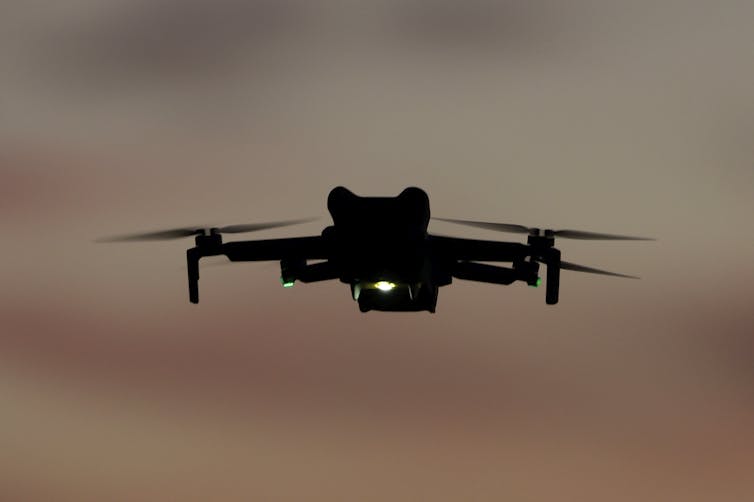
Iain Boyd, University of Colorado Boulder
The recent spate of unidentified drone sightings in the U.S., including some near sensitive locations such as airports and military installations, has caused significant public concern.
Some of this recent increase in activity may be related to a September 2023 change in U.S. Federal Aviation Administration regulations that now allow drone operators to fly at night. But most of the sightings are likely airplanes or helicopters rather than drones.
The inability of the U.S. government to definitively identify the aircraft in the recent incidents, however, has some people wondering, why can’t they?
I am an engineer who studies defense systems. I see radio frequency sensors as a promising approach to detecting, tracking and identifying drones, not least because drone detectors based on the technology are already available. But I also see challenges to using the detectors to comprehensively spot drones flying over American communities.
How drones are controlled
Operators communicate with drones from a distance using radio frequency signals. Radio frequency signals are widely used in everyday life such as in garage door openers, car key fobs and, of course, radios. Because the radio spectrum is used for so many different purposes, it is carefully regulated by the Federal Communications Commission.
Drone communications are only allowed in narrow bands around specific frequencies such as at 5 gigahertz. Each make and model of a drone uses unique communication protocols coded within the radio frequency signals to interpret instructions from an operator and to send data back to them. In this way, a drone pilot can instruct the drone to execute a flight maneuver, and the drone can inform the pilot where it is and how fast it is flying.
Identifying drones by radio signals
Radio frequency sensors can listen in to the well-known drone frequencies to detect communication protocols that are specific to each particular drone model. In a sense, these radio frequency signals represent a unique fingerprint of each type of drone.
In the best-case scenario, authorities can use the radio frequency signals to determine the drone’s location, range, speed and flight direction. These radio frequency devices are called passive sensors because they simply listen out for and receive signals without taking any active steps. The typical range limit for detecting signals is about 3 miles (4.8 kilometers) from the source.
These sensors do not represent advanced technology, and they are readily available. So, why haven’t authorities made wider use of them? https://www.youtube.com/embed/9yFzdpEqQCs?wmode=transparent&start=0 Drones were all the buzz in the Northeast at the end of 2024.
Challenges to using radio frequency sensors
While the monitoring of radio frequency signals is a promising approach to detecting and identifying drones, there are several challenges to doing so.
First, it’s only possible for a sensor to obtain detailed information on drones that the sensor knows the communication protocols for. Getting sensors that can detect a wide range of drones will require coordination between all drone manufacturers and some central registration entity.
In the absence of information that makes it possible to decode the radio frequency signals, all that can be inferred about a drone is a rough idea of its location and direction. This situation can be improved by deploying multiple sensors and coordinating their information.
Second, the detection approach works best in “quiet” radio frequency environments where there are no buildings, machinery or people. It’s not easy to confidently attribute the unique source of a radio frequency signal in urban settings and other cluttered environments. Radio frequency signals bounce off all solid surfaces, making it difficult to be sure where the original signal came from. Again, the use of multiple sensors around a particular location, and careful placement of those sensors, can help to alleviate this issue.
Third, a major part of the concern over the inability to detect and identify drones is that they may be operated by criminals or terrorists. If drone operators with malicious intent know that an area targeted for a drone operation is being monitored by radio frequency sensors, they may develop effective countermeasures. For example, they may use signal frequencies that lie outside the FCC-regulated parameters, and communication protocols that have not been registered. An even more effective countermeasure is to preprogram the flight path of a drone to completely avoid the use of any radio frequency communications between the operator and the drone.
Finally, widespread deployment of radio frequency sensors for tracking drones would be logistically complicated and financially expensive. There are likely thousands of locations in the U.S. alone that might require protection from hostile drone attacks. The cost of deploying a fully effective drone detection system would be significant.
There are other means of detecting drones, including radar systems and networks of acoustic sensors, which listen for the unique sounds drones generate. But radar systems are relatively expensive, and acoustic drone detection is a new technology.
The way forward
It was almost guaranteed that at some point the problem of unidentified drones would arise. People are operating drones more and more in regions of the airspace that have previously been very sparsely populated.
Perhaps the recent concerns over drone sightings are a wake-up call. The airspace is only going to become much more congested in the coming years as more consumers buy drones, drones are used for more commercial purposes, and air-taxis come into use. There’s only so much that drone detection technologies can do, and it might become necessary for the FAA to tighten regulation of the nation’s airspace by, for example, requiring drone operators to submit detailed flight plans.
In the meantime, don’t be too quick to assume those blinking lights you see in the night sky are drones.
Iain Boyd, Director of the Center for National Security Initiatives and Professor of Aerospace Engineering Sciences, University of Colorado Boulder
This article is republished from The Conversation under a Creative Commons license. Read the original article.


Automotive
Slate Truck Gets Real: First Experience Center Opens Ahead of Planned Deliveries
Slate Auto’s first permanent Experience Center gives consumers an up-close look at its customizable electric truck ahead of planned customer deliveries.

Slate Auto’s new Chicago location gives prospective buyers a permanent place to see the minimalist electric pickup, explore customization options and learn about demo opportunities—but it is not yet proof that customer deliveries have begun.
CHICAGO — October 20, 2026 — The Slate Truck is moving out of computer renderings and temporary roadshow stops and into a permanent retail setting. Slate Auto opened its first Experience Center on October 15 at 1053 W. Grand Avenue in Chicago, giving consumers a year-round location to get an up-close look at the company’s highly anticipated electric pickup.
The Near West Side facility occupies a former Tesla location and includes showroom, retail and garage space, along with electric-vehicle charging infrastructure. For Slate, the opening represents an important step in turning strong online interest into a more tangible buying experience as the startup works toward launching its first vehicle.
Visitors can examine the truck’s compact dimensions, deliberately simple cabin and accessory-driven design in person. The center also showcases Slate’s personalization strategy, including exterior wraps, add-on accessories and digital design tools intended to let owners configure the truck around their needs.
Slate has also promoted demonstration opportunities connected with the location, although availability may be limited or appointment-based as the company continues to prepare its fleet. Early media access included passenger rides rather than unrestricted customer test drives, so prospective visitors should confirm current availability before making a special trip.
Why the Chicago opening matters
Until now, most consumers have encountered the Slate Truck through online reservations, media coverage or temporary appearances. A permanent showroom gives buyers a chance to judge details that are difficult to evaluate on a screen, including seating position, bed access, cabin materials and the overall size of the vehicle.
That is especially important for a product built around an unconventional value proposition. Slate is promoting a basic two-seat, two-door electric truck with manual crank windows and no factory-installed infotainment screen or stereo. The company’s strategy is to keep the starting price low and let buyers add features later through accessories and conversion kits.
The physical location also gives Slate a place to explain that approach directly. Rather than presenting the truck as an unfinished vehicle, the company can demonstrate how its modular accessories, wraps and planned SUV-style conversion components are meant to expand the vehicle’s usefulness over time.
Chicago is a logical first market for that effort. The city offers access to a large Midwestern customer base and is within the broader region of Slate’s planned manufacturing operation in Warsaw, Indiana. Reusing a former Tesla store also gives the startup a space already suited to displaying and servicing electric vehicles.
The roadshow continues beyond Chicago
The Experience Center is opening as Slate expands its public demonstration schedule. The company’s events calendar lists a Boston-area demo ride event from October 21 through October 25 at The Shops at Chestnut Hill, followed by an appearance at RADwood in Alameda, California, on October 24 and a New Jersey demo ride event in Freehold from October 28 through October 31.
Slate also lists future stops in Washington, D.C., Raleigh, Atlanta, Miami and Orlando. Together, the permanent Chicago center and the traveling events suggest the company is moving into a broader customer-education phase ahead of planned deliveries.
What has—and has not—changed
The showroom opening does not change Slate’s headline pricing or range claims. The truck is still advertised with a base price of $24,950 before taxes, registration and destination charges. With the currently listed $1,450 destination fee, the entry price would be approximately $26,400 before other costs or optional equipment.
Slate also continues to advertise an estimated range of up to 205 miles. That figure remains an estimate rather than a final EPA-certified rating.
Most importantly, Slate has not publicly confirmed that regular customer production has started or that the first retail deliveries have occurred. Limited deliveries have been reported as possible before the end of December 2026, while many reservation holders may receive later delivery windows in 2027. The Chicago opening is therefore a commercialization milestone, not a manufacturing milestone.
For customers and industry observers, the next major signals will be the start of production at the Warsaw factory, final specifications and EPA range ratings, and confirmed handoffs to paying buyers.
The bottom line
Slate Auto now has a permanent place where consumers can see and evaluate its unusually simple electric truck. That makes the product feel more real and gives the company a platform to explain a customization-heavy business model that may be unfamiliar to traditional truck buyers.
Still, the biggest questions remain unanswered. Opening a showroom demonstrates progress in marketing and customer engagement; producing vehicles at scale, holding the promised price and delivering a 205-mile truck to reservation holders will determine whether Slate can convert enthusiasm into a viable automotive business.
Sources and more information
- Slate Auto events and demo schedule
- Electrek: Slate opens its first Experience Center in Chicago
- Autoblog: Slate opens its first U.S. showroom
- Slate Auto
Category: Consumer Corner / Automotive


Forgotten Genius Fridays
Octavia E. Butler: The Black Woman Who Helped Change Science Fiction
Discover how Octavia E. Butler transformed science fiction, explored Black identity, and helped shape Afrofuturism through her groundbreaking novels.
Forgotten Genius Friday | The Knowledge | STM Daily News
Octavia E. Butler: The Woman Who Reimagined the Future
When we think about science fiction, we often picture spaceships, robots, alien civilizations, and futuristic technology. But what happens when science fiction becomes a way to explore racism, inequality, human survival, and the consequences of our choices?
That is exactly what Octavia E. Butler brought to the genre.
Long before Afrofuturism became a widely recognized cultural movement, Butler was creating extraordinary stories that placed Black characters—especially Black women—at the center of imagined futures.
Her work challenged conventional ideas about who could be a hero, whose experiences mattered, and what science fiction could accomplish.
A Young Girl With a Powerful Imagination
Octavia Estelle Butler was born on June 22, 1947, in Pasadena, California.
Raised primarily by her mother and grandmother after her father’s death, Butler grew up shy and found comfort in books and storytelling.
Her mother worked as a domestic employee, and Butler sometimes accompanied her to work. Those experiences exposed her to the racial and economic inequalities that would later influence her fiction.
As a child, Butler loved science fiction, but she noticed something missing: people who looked like her.
Rather than accepting that absence, she began creating stories of her own.
She would eventually become one of the most influential writers in speculative fiction.
Breaking Barriers in Science Fiction
During the 1970s, mainstream American science fiction was largely associated with white male writers and protagonists.
Butler entered that literary world with a different perspective.
Her first published novel, Patternmaster, appeared in 1976. It introduced readers to a world shaped by extraordinary mental abilities, social hierarchies, and struggles for power.
Butler continued developing complex stories that explored humanity’s relationship with authority, identity, biology, and survival.
In 1979, she published one of her best-known novels, Kindred.
The book follows Dana, a Black woman living in 1970s California who is repeatedly transported back to a Maryland plantation before the Civil War.
Through Dana’s experiences, Butler forced readers to confront the brutality of American slavery and its continuing influence on the present.
Rather than treating history as something safely confined to the past, Kindred makes that history immediate and deeply personal.
Imagining the Future—and Warning Us About It
In 1993, Butler published Parable of the Sower, a novel set in a collapsing American society struggling with economic inequality, environmental destruction, violence, and weakened institutions.
Its central character, Lauren Olamina, is a young Black woman who develops a philosophy called Earthseed while searching for a way to survive and build a community.
The novel takes place beginning in 2024, making its imagined future particularly striking to modern readers.
Butler followed it with Parable of the Talents in 1998, continuing her examination of social instability, religious extremism, authoritarianism, and the struggle to create a better future.
Her novels were not literal predictions. They were works of speculative fiction that used recognizable social trends to ask difficult questions about where humanity might be headed.
Octavia Butler and Afrofuturism
Afrofuturism brings together African and African diasporic experiences with science fiction, technology, history, mythology, and imaginative visions of the future.
While artists such as Sun Ra and George Clinton explored cosmic identity through music, performance, and futuristic imagery, Butler used literature to investigate power, history, and humanity’s possible futures.
Her novels frequently placed Black women in situations where they had to navigate extraordinary challenges and reshape the societies around them.
Butler’s work is widely discussed within Afrofuturist scholarship, although her literary contributions also extend beyond any single cultural label.
She demonstrated that Black people did not have to remain secondary characters in someone else’s vision of the future.
They could be the architects of entirely new worlds.
Recognition and a Lasting Legacy
Butler received some of science fiction’s most significant honors, including Hugo and Nebula Awards.
In 1995, she became the first science-fiction writer to receive a MacArthur Fellowship, often called a genius grant.
Her work also included the Xenogenesis trilogy, later collected as Lilith’s Brood, which explored humanity’s encounter with an extraterrestrial species and raised questions about consent, adaptation, identity, and survival.
Butler died on February 24, 2006, at age 58.
Yet her influence has continued to grow.
Her novels are studied in classrooms, discussed by scholars, and embraced by new generations of readers and creators interested in science fiction, social justice, and Afrofuturism.
A Genius Who Made Us Think Differently About Tomorrow
Octavia E. Butler was more than a science-fiction author.
She was a visionary storyteller who understood that imagining the future also meant examining the past and questioning the present.
Her stories asked readers to consider how power operates, how communities survive, and how human beings might change.
And perhaps her greatest contribution was demonstrating that the future belongs in the imagination of everyone.
Why Octavia E. Butler Belongs in Forgotten Genius Friday
At STM Daily News, our Forgotten Genius Friday series celebrates extraordinary individuals whose ideas, innovations, and accomplishments helped shape our world, even if their stories aren’t widely known. Octavia E. Butler fits that mission perfectly. Although she received prestigious literary awards and recognition during her lifetime, her influence extends far beyond science fiction. Like the inventors, scientists, and trailblazers we’ve featured in this series, Butler challenged barriers, defied expectations, and opened doors for future generations. Through her imagination, she helped redefine who could tell stories about humanity’s future—and who could be at the center of those stories. Her inclusion in Forgotten Genius Friday reminds us that genius isn’t limited to laboratories and inventions. Sometimes, it begins with a pen, a powerful imagination, and the courage to envision a different world.
Sources and fact-checking
The Huntington Library holds Butler’s literary archive and confirms the chronology of her major novels, awards, and career. The MacArthur Foundation independently documents her 1995 fellowship.
- Official Octavia E. Butler biography
- The Huntington — Octavia E. Butler Papers
- MacArthur Foundation — Octavia Butler
- The Huntington — Telling My Stories exhibition
For more stories about overlooked innovators, writers, scientists, and visionaries who changed our world, explore The Knowledge and Forgotten Genius Friday at STM Daily News.
recipes
Cozy Up with Comforting Soups and Stews
Comforting Soups and Stews: As temperatures drop, few meals warm you from the inside out quite like Beef Stew with Rice or Hearty Rice Minestrone Soup. These comforting favorites deliver delicious flavor to the family table, and better yet, they don’t require much time in the kitchen, making them particularly practical for busy weekdays.


Cozy Up with Comforting Soups and Stews
(Feature Impact) As temperatures drop, few meals warm you from the inside out quite like a hearty bowl of soup or stew. These comforting favorites deliver delicious flavor to the family table, and better yet, they don’t require much time in the kitchen, making them particularly practical for busy weekdays.
With a few convenient staples on hand, like Minute Instant White Rice, you can prepare satisfying meals in a cinch. This rice is known for its light, fluffy texture; short, easy prep; and quick cook time.
It’s made with one simple ingredient – USA-grown rice – then precooked and dried with nothing added but convenience, making it a practical addition to this classic Beef Stew and Rice recipe. Bursting with tender beef and hearty vegetables, this filling stew offers a classic option that’s both quick and comforting, ideal for saving time after school and a day in the office as the pressure cooker does the work for you.
For another cozy meal that’s pressure-cooked to perfection, Hearty Rice Minestrone Soup brings together beans, tomatoes and spices in a rustic Italian-inspired dish. It’s pure comfort and warmth in a bowl, requiring just 30 minutes total for an approachable dinner when you’re in a pinch.
An aromatic touch is added from Minute Instant Jasmine Rice, known for its distinctive scent, perfect texture and delicious taste. Sweet and buttery, it’s fast, fragrant and flavorful to help you on your mission to make quick meals so you can spend less time cooking and more time enjoying with loved ones.
Find more comforting meal ideas by visiting MinuteRice.com.
Beef Stew with Rice
Prep time: 10 minutes
Cook time: 40 minutes
Servings: 4
- 1 tablespoon olive oil
- 1 pound beef chuck, cut into 1-inch cubes
- 1 onion, chopped
- 2 cloves garlic, minced
- 2 medium potatoes, diced
- 2 carrots, sliced
- 4 cups beef broth
- 1 teaspoon salt
- 1 teaspoon pepper
- 1 cup Minute Instant White Rice
- fresh parsley, for garnish
- In bottom of pressure cooker, heat oil over medium-high heat. Brown beef cubes on all sides. Remove and set aside.
- In same pot, add onion and garlic. Saute about 2 minutes.
- Return beef to pot. Add potatoes, carrots and beef broth. Season with salt and pepper.
- Close lid and set valve to sealing. Select pressure cook or manual and set timer for 35 minutes. Once cooking time is up, let pressure release naturally about 10 minutes then carefully switch valve to venting to release remaining pressure.
- Prepare rice according to package directions.
- Open lid, stir cooked rice into stew and adjust seasoning, if necessary. Garnish with parsley.

Hearty Rice Minestrone Soup
Prep time: 10 minutes
Cook time: 20 minutes
Servings: 8
- 2 tablespoons olive oil
- 1 carrot, chopped
- 1 stalk celery, chopped
- 1 onion, chopped
- 3 garlic cloves, minced
- 1 tablespoon finely chopped fresh thyme
- 1/2 teaspoon dried oregano
- 1/4 teaspoon salt
- 1/4 teaspoon black pepper
- 5 cups chicken broth
- 1 can (14 ounces) diced tomatoes
- 1 can (19 ounces) cannellini beans, drained and rinsed
- 4 cups chopped kale
- 1 cup Minute Jasmine Rice
- 1/3 cup finely grated Parmesan cheese
- 1/4 cup thinly sliced basil
- 1/4 teaspoon red chili flakes
- Set pressure cooker to saute setting over high heat. Heat oil. Add carrot, celery, onion, garlic, thyme, oregano, salt and pepper; cook 3-5 minutes, or until starting to soften. Stir in broth and tomatoes.
- Lock lid and move pressure valve to sealing. Select pressure cook on high 10 minutes. Once cooking is complete, manually release pressure according to manufacturer’s instructions. Carefully remove lid.
- Set pressure cooker to saute setting over high heat; bring to boil. Stir in beans and kale; cook 2 minutes, or until softened.
- Stir in rice. Set pressure cooker to warm setting. Cover and let stand 5 minutes.
- Stir in Parmesan, basil and red chili flakes.
Substitutions: Use Romano beans for cannellini beans. Make vegetarian by substituting vegetable broth for chicken broth.
SOURCE:




