Connect with us

Sports

Why is the object of golf to play as little golf as possible?

Published

on

Golf
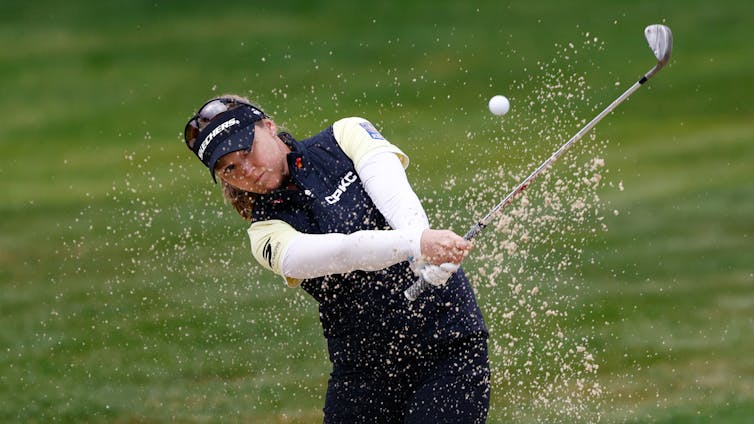
Brooke M. Henderson hits a bunker shot during a tournament in Grand Rapids, Mich., on June 12, 2025.
Michael Miller/ISI Photos via Getty Images

Why is the object of golf to play as little golf as possible?

Patrick Tutka, Purdue University

Curious Kids is a series for children of all ages. If you have a question you’d like an expert to answer, send it to CuriousKidsUS@theconversation.com.


Why is the object of golf to play the least amount of golf? – Bryleigh, age 12, Chandler, Arizona


In most sports, the team or player with the highest score wins, and fans celebrate super-high-scoring games. In golf, it’s the opposite – the lowest score is the champion. And since golf scores are the number of strokes each player needs to get around the course, the object is to do it with as few strokes as possible.

I study sport management, which includes training people to manage golf courses, help run associations that set the rules, and create scoring for golf. When I play golf, I find that it’s a great mental test. If I score poorly on one hole, how do I play the next hole? Will I let frustration cause me to play poorly and score high again, or can I recover?

Skilled players are able to manage each shot, finding the best place to hit the ball so that they leverage the strengths of their game and work with conditions (weather, wind) at the hole they are playing. This allows them to limit the score they get on the hole.

In golf every shot is a stroke, and you play each hole only once. There are no do-overs or second chances, so each move is extremely important for scoring. That’s different from a game like basketball, where you may get a rebound or a second chance to make a particular shot.

Golf originated in Scotland and dates back to the 12th century. Mary, Queen of Scots, was one of the first female players.

Par for the course

Each hole on a golf course is assigned a par score, which is the number of shots the designer believes it will take to play that hole. Almost all golf courses are made up of par 3, par 4 and par 5 shots.

On a par 3, a person is expected to take three shots to put the ball in the hole. That usually begins with a tee shot from the starting point of the hole and then two shots around or on the green area where the hole is cut. Par 4s expect two shots, covering more ground, before they get to the green area; par 5s expect three shots.

Par is designed for each hole and then added up for the course. Most golf courses have 18 holes and a par between 70 and 72.

There also are par 3 courses, where every hole is a par 3, so they can be spaced more closely and players don’t have to hit long drives. And there are short courses with fewer than 18 holes and total pars as low as 27, usually set on smaller properties.

Golfers want their score to be at par, or even lower, for each course. A decent golfer would probably shoot around 90 on an 18-hole, par 72 course. Coming in close to par lets people play together and compete against each other. Imagine that they were all trying to use as many shots as possible: They would never finish a hole, let alone a full round of the course.

Advertisement
Get More From A Face Cleanser And Spa-like Massage

Each score is given a name in comparison to par for a given hole. A score two strokes under par is called an eagle, and a score of one under par is called a birdie. When players go over par, it’s a bogey for one stroke over, a double bogey for two strokes over, and so on. There also are less-known terms, such as a snowman, which is shooting an 8 on a hole.

Every shot matters

Other sports that reward the lowest scores or the fewest attempts include darts and pool. For example, in 8-ball or 9-ball pool, the winner is the first person who sinks all of their colors and either the 8 or 9 ball into pockets with the fewest shots. Similarly, both swimming and track and field are won with low scores, although these are based on competitors’ times, not strokes or shots.

Golf requires great concentration and a good understanding of how your shot may move in the air. Players also need strategies for getting around objects in front of them on the course, such as trees, ponds and sand traps, which are also known as bunkers.

Good golfers are able to control relatively closely where their ball lands. But one of my favorite statistics is that the very best professional golfers land their ball within 10 feet of the hole just 1 in 4 times when they hit from 100 yards away.

A sense of humor helps. Baseball great Hank Aaron once said, “It took me 17 years to get 3,000 hits in baseball. It took one afternoon on the golf course.”


Hello, curious kids! Do you have a question you’d like an expert to answer? Ask an adult to send your question to CuriousKidsUS@theconversation.com. Please tell us your name, age and the city where you live.

And since curiosity has no age limit – adults, let us know what you’re wondering, too. We won’t be able to answer every question, but we will do our best.

Patrick Tutka, Clinical Associate Professor of Health and Kinesiology, Purdue University

This article is republished from The Conversation under a Creative Commons license. Read the original article.

Advertisement
Get More From A Face Cleanser And Spa-like Massage

health and wellness

“Protect Your Skin: Celebrate Sunscreen Day”

“May 27th is Sunscreen Day! Protect your skin from harmful UV rays with broad-spectrum sunscreen and sun safety practices.”

Published

on

Last Updated on May 27, 2026 by Daily News Staff

woman seated on textile applying suncsreen. Celebrate Sunscreen Day
Photo by RF._.studio on Pexels.com

Sunscreen Day is a day dedicated to promoting the importance of wearing sunscreen and protecting our skin from harmful UV rays. Observed annually on May 27th, this day serves as a reminder that sunscreen is not just for the beach or pool, but an essential part of our daily routine.

The sun emits two types of harmful UV rays: UVA and UVB. UVA rays are responsible for premature aging, such as wrinkles and age spots, while UVB rays cause sunburn and can lead to the development of skin cancer. Sunscreen works by absorbing or reflecting these rays, preventing them from penetrating the skin.

Unfortunately, many people still do not wear sunscreen or do not wear it correctly. According to the Skin Cancer Foundation, only 30% of Americans regularly use sunscreen. This is concerning, as skin cancer is the most common cancer in the United States, with over 5 million cases diagnosed each year.

To ensure that sunscreen is effective, it is important to choose a broad-spectrum sunscreen with at least SPF 30. Broad-spectrum sunscreens protect against both UVA and UVB rays, while SPF 30 provides adequate protection for most skin types. Sunscreen should be applied 15 minutes before sun exposure and reapplied every two hours, or more frequently if swimming or sweating.

It is also important to remember that sunscreen is not the only way to protect your skin from the sun. Seeking shade, wearing protective clothing, and avoiding peak sun hours (10 am to 4 pm) can also help reduce your risk of sun damage.

Sunscreen Day is a great opportunity to start incorporating sunscreen into your daily routine. Make it a habit to apply sunscreen every morning before leaving the house, and keep a bottle in your car or bag for reapplication throughout the day. Encourage your friends and family to do the same, and spread awareness about the importance of sun protection.

“Happy Sunscreen Day!”

In conclusion, sunscreen is a crucial aspect of protecting our skin from the harmful effects of the sun. By choosing a broad-spectrum sunscreen with at least SPF 30 and incorporating it into our daily routine, we can reduce our risk of skin cancer and premature aging. So let’s celebrate Sunscreen Day by making a commitment to protect our skin and encouraging others to do the same!

For more information heres a link to the Skin Cancer Foundation: https://www.skincancer.org/skin-cancer-prevention/sun-protection/sunscreen/

https://stmdailynews.com/category/lifestyle/health-and-wellness/

Advertisement
Get More From A Face Cleanser And Spa-like Massage
SLeeves SPR Newsletter

DON’T MISS A DINK

Stay up-to-date with the latest Pickleball news, and be the first to know when the newest episode of Sleeve’s Senior Pickleball Report is released on YouTube and much more.

We don’t spam! Read our privacy policy for more info.

Continue Reading

Sports

CatchCorner by Sports Illustrated Partners With CityPickle to Expand Urban Pickleball Access in NYC

CatchCorner by Sports Illustrated partners with CityPickle to expand NYC pickleball access, adding Central Park, Times Square and LIC courts to easy online booking.

Published

on

New York City’s pickleball boom is getting a little easier to navigate. CatchCorner by Sports Illustrated, a North America–wide platform for booking sports facilities, announced a strategic partnership with CityPickle that will bring several of the operator’s most recognizable NYC courts onto CatchCorner’s reservation network.

The launch includes three CityPickle locations: Wollman Rink in Central Park, the flagship facility in Times Square, and indoor courts in Long Island City. A fourth site at Brooklyn Bridge is expected to open soon, expanding the footprint even further. The idea is simple: players can discover and book court time through CatchCorner in “just a few clicks,” with real-time availability and built-in payment options.

CityPickle pickleball courts at Wollman Rink in Central Park, one of several NYC locations now bookable through CatchCorner by Sports Illustrated.
Wollman Rink in Central Park, CityPickle Location (CNW Group/CatchCorner)

Why this partnership matters

Pickleball’s growth has been fueled by accessibility, but in dense cities the biggest barrier is often logistics: finding courts, knowing what’s available, and actually locking in a time slot. By pairing CityPickle’s high-profile, high-traffic venues with CatchCorner’s booking infrastructure, the partnership aims to reduce friction for everyone from first-timers to regular players.

CatchCorner CEO Jonathan Azouri framed CityPickle as a key player in expanding access, pointing to the way the operator is repurposing iconic city spaces into “dynamic hubs for sport, community, and social connection.” CityPickle’s Director of Strategic Operations, Nate Hamowy, echoed that community-first approach, saying the company’s mission is to create a place where “everyone can enjoy the game,” and that CatchCorner’s platform helps players find and connect across sports.

The bigger trend: racquet sports go urban

The announcement also signals a broader shift in how racquet sports are being built into city life. Instead of relying solely on traditional clubs or hard-to-access public courts, operators are increasingly activating prominent locations and creating event-like environments around play. In a place like NYC—where space is scarce and demand is high—partnerships like this can be the difference between pickleball feeling like a trend and pickleball becoming a permanent part of the city’s recreation ecosystem.

What to watch for next

  • Brooklyn Bridge expansion: The upcoming fourth location could be a major demand driver, especially if it mirrors the visibility and foot traffic of the Central Park and Times Square sites.
  • More venue additions: CatchCorner’s model is built for scale. If the CityPickle rollout performs well, it could accelerate additional urban racquet-sport partnerships.
  • Community programming: The most successful city courts tend to pair bookings with leagues, clinics, and social play—expect more structured programming as these venues attract new players.

Players looking to reserve court time can do so through CatchCorner’s platform at www.catchcorner.comor via the CatchCorner app on the App Store and Google Play.

The Sports section of STM Daily News is your ultimate destination for all things sports, catering to everyday fans and dedicated enthusiasts alike. We cover a wide range of topics, from the thrill of amateur competitions to the excitement of semi-professional and professional leagues. Our content delves into physical and mental fitness, providing insights and tips that help individuals elevate their performance, whether on the field or in their personal wellness journeys. Stay informed and inspired as we explore the dynamic world of sports, celebrating both the passion of the players and the joy of the fans.

https://stmdailynews.com/sports

Continue Reading

Senior Pickleball Report

Pickleball Kingdom’s California Expansion Starts in Roseville; Sleeves SPR Has Full Details

West Coast pickleball players could see more indoor options soon as Pickleball Kingdom’s California Expansion becomes statewide. The first club opens in Roseville with 11 indoor courts.

Published

on

SACRAMENTO, Calif. — Pickleball Kingdom, which calls itself the world’s largest indoor pickleball entity, announced a landmark agreement to develop locations across California, with multi-unit franchisees Parminder and Komal Saini leading the statewide expansion.

Pickleball Kingdom’s California Expansion Begins With 11-Court Roseville Facility
Interior view of a Pickleball Kingdom club, featuring multiple professional-grade indoor courts.

Pickleball Kingdom’s California Expansion

The company said demand is rising across the Bay Area, Sacramento, Los Angeles, Orange County, San Diego County, and the Inland Empire, and that future clubs are expected to include professional-grade indoor courts, coaching and clinics for all skill levels, youth development programs, leagues and tournaments, a pro shop, and social areas.

The first California location is set to open in Roseville with grand opening activities the weekend of March 28. The club will feature 11 professional-grade indoor courts across approximately 32,900 square feet at 10251 Fairway Drive, Roseville, CA 95678.

For more context on the announcement and what the rollout could mean for California players, Sleeves Senior Pickleball Report published a full write-up here: https://sleeves-spr.com/pickleball-kingdom-announces-major-california-expansion-first-club-opens-in-roseville/Pickleball Kingdom also said it is seeking additional franchise partners in California. More information is available at https://pickleballkingdom.com/franchise/

Get the latest updates and information on the rapidly growing sport of pickleball, specifically designed for the senior community aged 50+. Check out Sleeve’s Senior Pickleball Report on YouTube to stay informed and up-to-date with the ever-changing world of pickleball. Join the community and stay ahead of the game. https://stmdailynews.com/sleeves-senior-pickleball-report/

Continue Reading

Trending

