

News
Thrive Scholars Responds to Supreme Court Ruling on Race-Conscious Admissions

Last Updated on June 28, 2024 by Daily News Staff
LOS ANGELES /PRNewswire/ — Today, the Supreme Court has ruled that colleges are no longer allowed to use race as a criterion for admissions, stripping college admissions officers of one of their most effective interventions for making their campuses the types of diverse learning institutions they know will best prepare all students for lifelong success.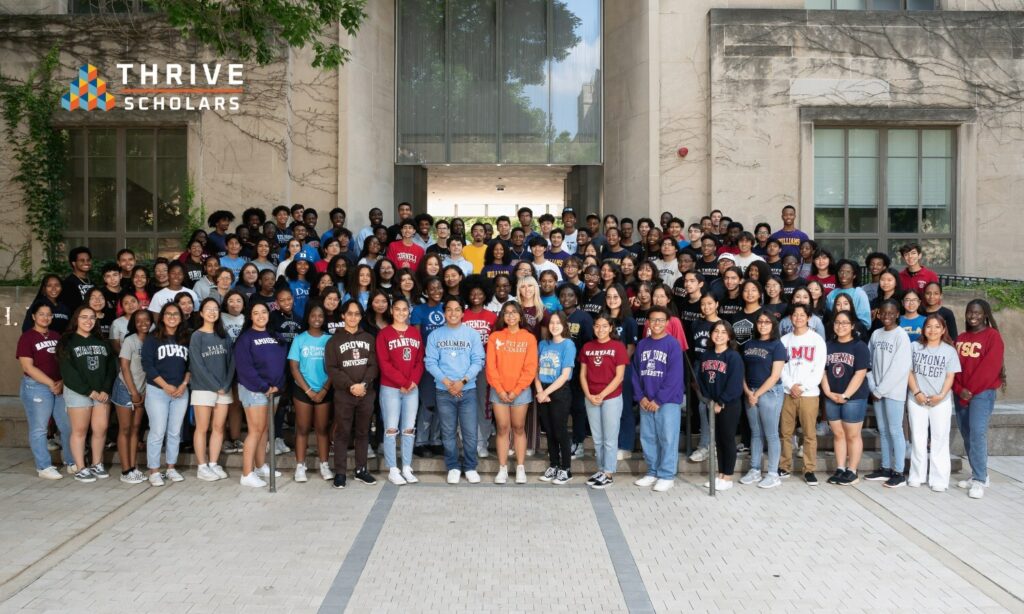
Thrive Scholars, a national nonprofit that for 20 years has supported high-achieving, underrepresented students of color get into and graduate from top colleges to help them find success in careers that lead to economic mobility, believes this decision will exacerbate diversity challenges on campus, make it harder for talented students of color to achieve their dreams, hinder their sense of belonging, and send the wrong signal to students currently on campuses across the country.
“Before I was connected with Thrive Scholars, I was limited by what I was able to see and didn’t have exposure to the opportunities that were truly out there,” said Venezia Garza, a Thrive Scholar and college student in her junior year at Princeton. “Within school, I struggled to feel a sense of belonging as the goals I had for myself of pursuing higher education were out of place and foreign to most. Attending my first Summer Academy as a Thrive Scholar completely broke down the limiting perceptions of myself and introduced me to a brilliant community of students who looked like myself and had lived through similar experiences. Summer Academy prepared me with the intellectual tools I now use to find success at Princeton.”
As Justice Sotomayor references in her dissent, one main reason colleges use race as a factor in college admissions is to address the opportunity gap – the fact that while talent is equally distributed, opportunity is not. Many under-resourced high schools serve student populations primarily comprised of students of color and do not provide them the opportunities they need to develop the credentials selective colleges are looking for in admissions. For example, more than half of the public high schools where Black and Latino students make up the majority of enrollment do not offer AP Calculus – a gateway course to many top selective colleges.
This understanding forms the foundation for Thrive Scholar’s programming. By providing the academic support and access to opportunity in high school that more privileged students take for granted to a broader, more diverse range of students, we help talented students develop the credentials, skills, and experiences top colleges are looking for.
“We start with our Summer Academy, an academically intensive program over two summers in the 11th and 12th grade where our Scholars attend a daily three-hour calculus class and a three-hour college writing course every day for six weeks each summer, taught by college professors on a college campus,” said Tyra Anderson-Montina, Chief Program Officer at Thrive Scholars. “The data on this intervention is overwhelming. Over 40 percent of our Scholars who participate in Thrive Scholars’ Summer Academy attend Ivy Plus colleges, with 85 percent attending the Top 50 schools.”
Students who participate in Thrive Scholars Summer Academy statistically go on to have a higher college GPA, are 10% more likely to graduate, and are 33% more likely to persist in STEM than students of all demographic backgrounds who attend their same top schools. The data is clear – these students have the talent and determination to succeed; they just need the same access to opportunity and skills building that others take for granted.
“While the laws may change, our values will not. At Thrive Scholars, we believe high-achieving students of color belong in higher ed institutions and diverse college campuses are important,” said Steve Stein, CEO of Thrive Scholars. “We will work with our academic partners to comply with all laws as we advance our mission in this new environment. We believe our mission is more relevant and vital now than ever before and will continue to support underserved talent in their academic and career journeys.”
About Thrive Scholars
Thrive Scholars is a national nonprofit that for 20 years has worked hard to help high-achieving, underrepresented students of color from economically disadvantaged backgrounds get into and graduate from top colleges equipped to achieve their full career potential. Thrive Scholars uses data to develop programming that translates to Scholar success through a full suite of academic preparation, mentorship, social-emotional, financial, and career counseling to close the opportunity gap.
SOURCE Thrive Scholars
The Bridge is a section of the STM Daily News Blog meant for diversity, offering real news stories about bona fide community efforts to perpetuate a greater good. The purpose of The Bridge is to connect the divides that separate us, fostering understanding and empathy among different groups. By highlighting positive initiatives and inspirational actions, The Bridge aims to create a sense of unity and shared purpose. This section brings to light stories of individuals and organizations working tirelessly to promote inclusivity, equality, and mutual respect. Through these narratives, readers are encouraged to appreciate the richness of diverse perspectives and to participate actively in building stronger, more cohesive communities.
https://stmdailynews.com/category/the-bridge





Forgotten Genius Fridays
Benjamin O. Davis Sr.: The General Who Broke the U.S. Military’s Color Barrier
Benjamin O. Davis Sr. rose from the ranks of the Buffalo Soldiers to become the first Black general in U.S. military history. His remarkable career spanned roughly 50 years and helped challenge racial barriers inside a segregated Army.

Forgotten Genius Fridays | STM Daily News
Before the Tuskegee Airmen challenged segregation in the skies over World War II, another barrier was being broken within the ranks of the United States Army.
His name was Benjamin O. Davis Sr.
On October 25, 1940, Davis was promoted to brigadier general, becoming the first African American general officer in the Regular Army and the U.S. armed forces. His promotion represented an extraordinary milestone in a military that was still officially segregated.
But Davis’s story didn’t begin with stars on his shoulders.
It began more than four decades earlier.
From Volunteer to Buffalo Soldier
Born in Washington, D.C., on July 1, 1877, Davis entered military service during the Spanish-American War in 1898, serving as a temporary first lieutenant with the 8th United States Volunteer Infantry.
After that unit was mustered out, Davis made a consequential decision. In June 1899, he enlisted as a private in the Regular Army’s 9th Cavalry Regiment.
The 9th Cavalry was one of the famed Black regiments whose soldiers became widely known as the Buffalo Soldiers.
Davis quickly advanced through the enlisted ranks, becoming a corporal and then squadron sergeant major. In February 1901, he received a commission as a second lieutenant of cavalry in the Regular Army.
His journey through the ranks had begun.
Serving an Army That Wasn’t Equal
Davis would serve his country for decades, but his career unfolded inside an institution constrained by racial segregation.
Assignments available to Black officers were limited, particularly because military practices sought to prevent Black officers from commanding white soldiers. Davis consequently spent portions of his career teaching military science at historically Black institutions, including Wilberforce University and Tuskegee Institute, and served as a military attaché in Liberia.
These assignments were important, but they also reflected the racial restrictions under which Black Army officers served.
Despite those obstacles, Davis continued advancing.
He became a lieutenant colonel in 1920 and a colonel in 1930.
Then came 1940.
A Star That Made History
On October 25, 1940, President Franklin D. Roosevelt promoted Benjamin O. Davis Sr. to brigadier general.
For the first time, a Black officer wore a general’s star in the Regular Army.
The significance extended beyond Davis himself. Black Americans had served in the nation’s armed forces from its earliest conflicts, yet the highest levels of military leadership had remained closed to them.
Davis had broken through that barrier.
Yet the military remained segregated.
Becoming a general did not make segregation disappear.
Instead, Davis would spend part of World War II confronting some of its consequences.
A General Confronts Discrimination
During World War II, Davis served with the Army’s Inspector General organization and undertook assignments involving the conditions and treatment of Black troops.
He traveled extensively, investigated problems affecting soldiers and units, and advised military leaders on matters involving Black servicemen.
His work took him overseas as well. In 1942, he was sent to the European Theater on special duty concerning issues affecting Black troops. He later served in Paris as special assistant to the commanding general of the Communications Zone.
His Distinguished Service Medal citation credited his investigations and advice with helping produce fairer solutions to problems involving soldiers and contributing to broader War Department policy.
Davis therefore occupied an unusual position.
He was simultaneously a senior officer in the United States Army and a Black American serving inside a military whose segregation policies continued to restrict people who looked like him.
Then Came His Son
There is another remarkable dimension to the Benjamin O. Davis story.
While Davis Sr. was breaking barriers within the Army, his son was preparing to break barriers in the air.
Benjamin O. Davis Jr. graduated from the United States Military Academy at West Point in 1936 after enduring years of racial isolation from fellow cadets. He would later become a military pilot and eventually command both the 99th Fighter Squadron and the 332nd Fighter Group, becoming one of the most important leaders associated with the Tuskegee Airmen.
For a period, father and son represented an extraordinary rarity within the U.S. military: two Black career officers operating at a time when opportunities for Black commissioned officers remained severely restricted.
Their stories would eventually become intertwined with one of the most important experiments in American military history.
The Tuskegee Airmen.
Fifty Years of Service
Benjamin O. Davis Sr. retired from active military service on July 14, 1948, completing approximately 50 years of service.
Less than two weeks later, on July 26, President Harry S. Truman issued Executive Order 9981, declaring a policy of equality of treatment and opportunity in the armed services regardless of race, color, religion or national origin.
The transformation of the military would take years.
But Davis had spent much of his career pushing against the barriers that made such a transformation necessary.
He died on November 26, 1970, and was buried at Arlington National Cemetery.
Among his decorations were the Distinguished Service Medal, Bronze Star Medal, France’s Croix de Guerre with Palm, and Liberia’s Order of the Star of Africa.
Why Benjamin O. Davis Sr. Matters
It would be easy to remember Benjamin O. Davis Sr. simply as the first Black general in American military history.
But his significance runs deeper.
He rose from private to general in an institution that placed substantial racial barriers in his path. He served with the Buffalo Soldiers, educated future officers, represented the United States overseas and advised military leaders about the treatment of Black troops during World War II.
And his story became the first chapter of an extraordinary father-and-son legacy.
Benjamin O. Davis Sr. broke one barrier.
His son would soon take the fight into the skies.
Next in our special series: The Tuskegee Airmen — The Red Tails Who Fought Two Wars.
Then, on the following Forgotten Genius Friday, we’ll tell the remarkable story of Benjamin O. Davis Jr.—from four years of isolation at West Point to commanding the Tuskegee Airmen and ultimately wearing four stars.
Forgotten Genius Fridays is an STM Daily News series highlighting innovators, pioneers and historical figures whose achievements deserve a larger place in our collective memory.
Sources & Related Reading
Primary source: U.S. Army Center of Military History — Benjamin O. Davis Sr. — detailed official chronology of his Army service and historic promotion.
Biography: National Museum of the United States Army — Benjamin O. Davis Sr. — particularly useful for his Buffalo Soldier service, segregation-era assignments and World War II work.
Related: National Park Service — Benjamin O. Davis Jr. — provides the bridge to the next generation and the Tuskegee Airmen.
Last Updated on September 17, 2026 by Daily News Staff
HOLLYWOOD, Calif. — Paramount’s century-long connection to Hollywood could be facing one of its biggest challenges yet, as the entertainment giant reportedly prepares for the possibility of moving major operations out of California amid an escalating legal battle over its proposed acquisition of Warner Bros. Discovery.
Paramount has informed the offices of Los Angeles Mayor Karen Bass and California Attorney General Rob Bonta that it is prepared to formally announce plans to leave California, according to reporting Wednesday from TheWrap. Paramount has not formally announced a relocation, and a company spokesperson declined to comment to the publication.
The potential move centers on Paramount Skydance’s proposed approximately $110 billion acquisition of Warner Bros. Discovery, a deal being challenged on antitrust grounds by California and a coalition of 11 other states, along with a separate challenge from the Writers Guild of America. California Attorney General Rob Bonta argues that combining the two entertainment companies could reduce competition, potentially leading to higher prices and fewer choices for consumers.
A court agreement currently prevents Paramount and Warner Bros. Discovery from completing the merger until June 1, 2027, or until after a court decision on the states’ claims, whichever comes first. The antitrust case is scheduled for trial in March 2027.
Paramount’s Hollywood Future
At the center of the controversy is Paramount’s historic studio complex at 5555 Melrose Avenue in Hollywood, one of the entertainment industry’s most recognizable properties.
The Los Angeles Times reported that Paramount CEO David Ellison has told associates that he would prefer to remain in Los Angeles. However, Paramount’s board has reportedly approved a contingency plan that could move the company’s headquarters out of Hollywood, and Ellison has indicated that the company is prepared to sell its historic studio properties and relocate operations if the merger remains stalled.
Tennessee, Texas and Georgia have emerged in reports as potential destinations should Paramount ultimately decide to relocate.
The financial pressure is significant. Beginning October 1, Paramount faces a roughly $7 million-per-day additional payment obligation tied to delays in completing the Warner Bros. Discovery transaction. Paramount has asked the federal court to require the states and the Writers Guild of America to post a $1.88 billion bond to cover potential costs associated with the delay.
What’s at Stake for Los Angeles?
A Paramount departure could extend far beyond the loss of a famous Hollywood address.
An economic analysis cited by TheWrap estimates that a large-scale Paramount departure could put as many as 57,980 full-time jobs, $21.2 billion in annual economic output and approximately $1.17 billion in state and local tax revenue at risk. Those figures represent an economic-impact scenario rather than a prediction that all of those losses would necessarily occur.
There are competing concerns about the merger itself. Los Angeles County analysis has estimated that completing the Paramount-Warner Bros. combination could also eliminate thousands of entertainment and related jobs because of consolidation. Opponents of the merger, including entertainment unions, have raised concerns about reduced competition and employment, while supporters argue that reaching a settlement could help prevent Paramount from moving operations out of California.
Mayor Bass has said she remains focused on protecting Los Angeles entertainment jobs and keeping Hollywood’s entertainment industry centered in the city. Bonta’s office, meanwhile, has maintained that California will continue enforcing its antitrust laws while remaining open to good-faith discussions. There is still an opportunity for the dispute to be resolved before Paramount makes a final decision about its California operations. Paramount Skydance and representatives for California Attorney General Rob Bonta are scheduled to participate in court-ordered settlement talks on October 14 and 15. The discussions could potentially resolve the antitrust dispute and clear a path for Paramount’s proposed Warner Bros. Discovery acquisition. For now, Paramount has made no official announcement that it is leaving California. The company declined to comment on reports Wednesday that it was preparing to announce a departure. That leaves the future of Paramount’s Hollywood operations — including its historic Melrose Avenue studio — uncertain as the legal and financial pressure surrounding the merger continues to build. Settlement Talks Scheduled
For now, the gates at Paramount remain firmly planted on Melrose Avenue.
Settlement Talks Scheduled
There is still an opportunity for the dispute to be resolved before Paramount makes a final decision about its California operations.
Paramount Skydance and representatives for California Attorney General Rob Bonta are scheduled to participate in court-ordered settlement talks on October 14 and 15. The discussions could potentially resolve the antitrust dispute and clear a path for Paramount’s proposed Warner Bros. Discovery acquisition.
For now, Paramount has made no official announcement that it is leaving California. The company declined to comment on reports Wednesday that it was preparing to announce a departure.
That leaves the future of Paramount’s Hollywood operations — including its historic Melrose Avenue studio — uncertain as the legal and financial pressure surrounding the merger continues to build.uilding around the Warner Bros. Discovery deal, the question of whether one of Hollywood’s most historic studios will continue calling California home has moved from speculation to a potentially consequential decision for Los Angeles and its entertainment industry.
STM Daily News will continue monitoring the Paramount-Warner Bros. Discovery dispute and what it could mean for Hollywood, entertainment workers and the future of film and television production in California.
Source and Related Reading
- California Attorney General — Agreement Halting Paramount/Warner Bros. Merger — Primary source explaining the states’ antitrust challenge and agreement delaying completion of the merger.
- Los Angeles Times — Paramount and Bonta Ordered Into Settlement Talks — Reports the October 14–15 settlement meetings and current state of the dispute.
- Los Angeles Times — Paramount’s Possible Hollywood Exit — Detailed reporting on the relocation contingency, potential destinations and implications for Los Angeles.
- Reuters — DOJ Backs Bond Demand in Paramount-Warner Fight — Covers the $1.88 billion bond dispute, $7 million daily fee and March trial.
- TheWrap — Paramount Preps California Exit — Reports the latest developments surrounding Paramount’s potential departure.
News
Entertain with Ease Using Fresh Fall Flavors
Fresh Fall Flavors: When seasonal celebrations start to fill up your calendar as you host friends and family, an appetizer that is delicious, yet simple, quickly moves from a new addition at the table to a tried-and-true shareable that guests look forward to year after year. This Baked Feta with Roasted California Grapes recipe delivers warm and rich flavors while being incredibly easy to prepare in a rush.

Entertain with Ease Using Fresh Fall Flavors
(Feature Impact) When seasonal celebrations start to fill up your calendar as you host friends and family, an appetizer that is delicious, yet simple, quickly moves from a new addition at the table to a tried-and-true shareable that guests look forward to year after year.
This Baked Feta with Roasted California Grapes recipe delivers warm and rich flavors while being incredibly easy to prepare in a rush. Juicy Grapes from California are roasted to deepen their sweet flavor then served over baked feta for a bite that is sweet, tangy and comforting.
Don’t forget: Grapes make an excellent healthy and fresh snack any time during the fall season, whether you need an after-school pick-me-up, a break between meetings or a quick on-the-go breakfast.
Fall into more flavorful recipe ideas at GrapesFromCalifornia.com.
Watch video to see how to make this recipe!

Baked Feta with Roasted California Grapes
Servings: 6
- 1 1/2 cups red and black seedless Grapes from California
- 1 tablespoon olive oil, plus additional for drizzling, divided
- 1-2 teaspoons balsamic vinegar
- 1 pound block feta
- 1-2 tablespoons fresh thyme
- 1 teaspoon dried oregano
- red pepper flakes, to taste
- crusty bread slices
- Heat oven to 400 F.
- In medium bowl, toss grapes with 1 tablespoon olive oil and balsamic vinegar to coat then place on baking tray. Roast 10-15 minutes, or until grapes just begin to soften. Remove from oven and let rest in pan 5 minutes.
- Slice block of feta into two thick slices and place in baking dish. Sprinkle with thyme, oregano and red pepper flakes, to taste, and drizzle with olive oil. Top with roasted grapes. Bake about 10 minutes, or until cheese has softened. Serve with crusty bread slices.

SOURCE:
California Table Grape Commission
For more recipe ideas, visit “FOOD & DRINK!“





