

Lifestyle
Add some romance to your life with GetExperience.com

Last Updated on June 26, 2024 by Daily News Staff
GetExperience.com works around the world providing the best experiences and travel activities from locals.
WILMINGTON, DE /24-7PressRelease/ — Add some romance to your life with GetExperience.com
Romantic dates are the most important part of any relationship, and it doesn’t matter if you’ve been together for two weeks or twenty years. Some people prefer a classic candlelit dinner, while others adore dates that take their breath away. Whichever option you choose, the most important thing is your mood and a loving smile. And don’t forget to put your phone away!
GetExperience.com works around the world with people of all ages, incomes, and backgrounds, and we’ve identified the most desirable dates.
Definitely, the most romantic dates are the ones that take place in nature, and especially at the sea. Our top favorite is going for a sunset sail. Imagine an endless expanse of water reflecting the rays of the setting sun, the coast of Spain or Portugal is left behind, while you and your soulmate are sitting at the stern of a snow-white yacht, holding a glass of cold champagne. Isn’t it a fairy tale? If you don’t have enough time to go out on a yacht, but you would certainly like to please your partner with a sea view, try going horseback riding on the beach.
What’s as romantic as a seaside sunset? A starry sky! Dates under a starry sky deserve special honors. It may be a picnic or camping under the stars. And if you’re lucky enough, you might enjoy a meteor shower! The most important thing is to choose a location away from big cities, such as the mountains of Greece or the Maldives. In this case, the light of the night streets will not overshadow the light of the stars.
If in your language to say “I love you” is to experience an adrenaline rush together, then leave the slow and atmospheric dates aside. Choose from crazy options in the sky — a hot air balloon ride or skydiving — or in the dirt — riding a tandem bike or riding in a horse-drawn carriage together. There are enough offers for unusual dates in Dubai.
Sometimes the desire to please the soulmate strikes in the middle of a vacation when the problems of daily life have already been forgotten, but there is still enough time to celebrate life. Use this time to try something new for which you usually don’t have enough time or energy in everyday life, for example, taking a French cooking class or learning to tango. Gastronomy lovers will enjoy dinner at a Michelin-starred restaurant or wine tasting at a famous vineyard. Italy, considered the creator of one of the tastiest cuisines in the world, is perfect for a date like this.
The date doesn’t have to consist of a single event, it may last the whole evening. Begin by seeing a performance together, and then take a limo ride to dinner. The perfect finish would be a couple’s massage.
If you believe that the simple things have the greatest meaning, invite your partner to watch the sunrise or sunset with you. Always remember that the most significant part of the date is the person you love, and the event may be chosen at GetExperience.com. Moreover, if you find yourself in a situation where the right person isn’t around, but you want to go on a date, the service will help you with this by suggesting a companion.
Let GetExperience.com bring romance into your life and find any kind of romantic experience all over the world at the best price or you can start a tender by providing your budget and getting offers from hosts!
https://stmdailynews.com/category/lifestyle


Health
Radon is the second leading cause of lung cancer. 8 in 10 US adults have never tested their home for it
Decades of public health campaigns have reinforced the connection between smoking and lung cancer, helping people understand that their choices can influence their health. Despite radon being the second-leading cause of lung cancer, many have never tested their home for it.

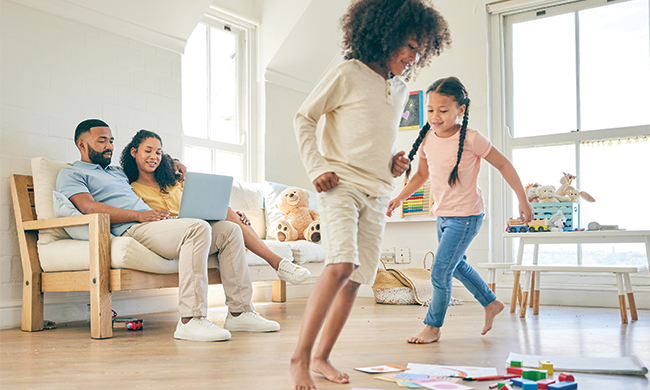
Radon is the second leading cause of lung cancer. 8 in 10 US adults have never tested their home for it
(Sheeka Sanahori) Avoid tobacco products. Eat a healthy diet. Get recommended cancer screenings. Most U.S. adults recognize these behaviors as ways to lower their cancer risk or catch cancer early. Decades of public health campaigns have reinforced the connection between smoking and lung cancer, helping people understand that their choices can influence their health.
But U.S. adults are far less likely to recognize a risk factor they can’t control through daily habits. Radon – an odorless, invisible gas that forms naturally in the ground – is the second leading cause of lung cancer, but new research from the Prevent Cancer Foundation finds that 8 in 10 U.S. adults have never tested their home for radon. The findings are based on the Foundation’s annual Early Detection Survey of more than 7,000 U.S. adults, conducted in January 2026.
With recent high-profile lung cancer cases, such as the October diagnosis of Pope Leo XIV, who is not known to have a history of smoking cigarettes, more people are paying attention to other risk factors for lung cancer, especially for people who have never smoked.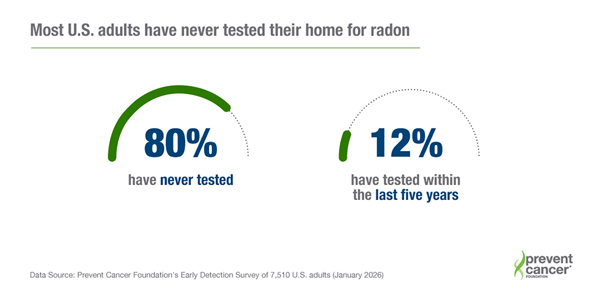
Testing for radon is last on the list
When asked about preventive behaviors, 77.5% say avoiding tobacco lowers their cancer risk. Three out of four say eating a healthy diet and getting routine cancer screenings make a difference, too. More than half also named regular exercise, limiting alcohol and protecting themselves from harmful UV rays.
Testing their home for radon ranked last on the list of preventive behaviors, with only 28% listing it as a way to reduce their cancer risk.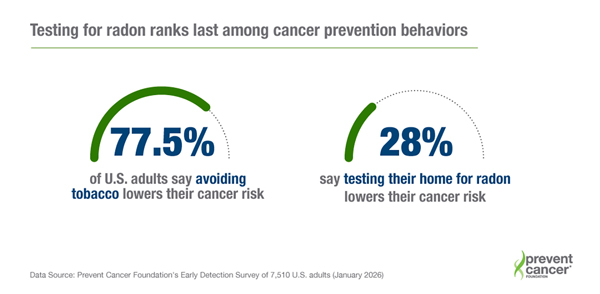
Most homes go untested in every region
Radon hasn’t reached the same level of public awareness as tobacco use, diet and exercise. U.S. adults appear to overlook an environmental risk that could be inside their own homes. Eighty percent of U.S. adults report never having their homes tested for radon, and only 12% have tested within the last five years. The U.S. Environmental Protection Agency (EPA) recommends testing every two years.
In the Northeast, about 7 in 10 people (72%) have never tested their home for radon. That percentage increases for the Midwest (79%), West (82%) and South (83%). Unlike cigarettes, radon does not produce smoke and is odorless, so a test is the only way to detect its presence.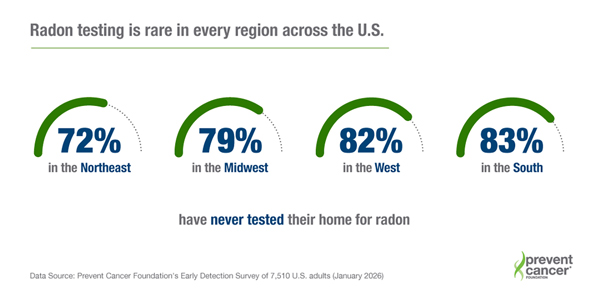
What it takes to find out
Radon can enter homes through the ground when uranium underneath decays. Once it’s inside, it gets trapped. People can live with high radon levels without knowing it, in older homes and new construction alike. Breaking ground on undisturbed land during construction can release more radon.
Renters can either test themselves or ask their landlord whether the home has been tested and request the results. Landlord requirements vary by state.
Test kits are inexpensive and available online and at home improvement stores. The EPA recommends taking action to reduce radon levels at 4 picocuries per liter (pCi/L) or higher, and notes that levels below that may still carry risk. If levels are high, a mitigation system can bring them down.
Beyond radon, the EPA and other health authorities cite avoiding tobacco and secondhand smoke as the most significant steps people can take to lower lung cancer risk, along with following screening guidelines based on personal risk factors.
Methodology
The Prevent Cancer Foundation commissioned Atomik Research to conduct the Foundation’s fourth annual Early Detection Survey of U.S. adults. The study consists of an online survey questionnaire, which includes several repeated measures from a previous year’s questionnaire and a primary data set gathered from a sample of 7,510 adults located throughout the United States. The sample consists of adults 21 years of age or older, and researchers implemented several demographic-based quotas in order to achieve sample characteristics similar to the overall U.S. population of adults 21 and older.
Researchers controlled for demographic variables such as biological sex, age group classification, race/ethnicity, parental status, geographic region, employment status and community classifications (e.g., urban or rural classification).
The margin of error of the overall sample is +/-1 percentage point with a confidence level of 95%. Fieldwork took place between Jan. 10 and Jan. 30, 2026. Atomik Research is an independent market research agency.
Percentages may not add up to 100% due to computer rounding, and/or the acceptance of multiple responses.
Photo courtesy of Shutterstock (family playing)
SOURCE:
Prevent Cancer Foundation
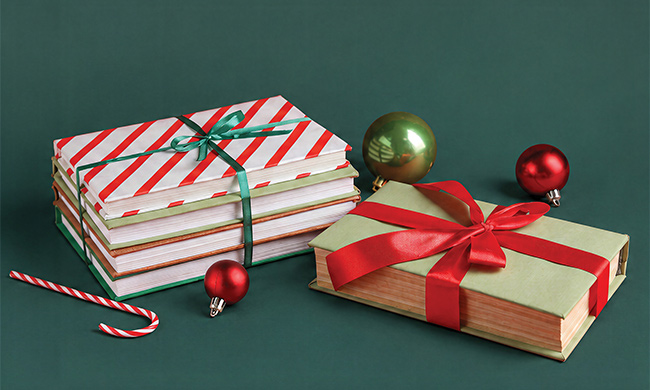
Book gifts: what readers want, what they spend and what actually gets read
(Feature Impact) What do readers want in a book gift? A title they asked for, a sign the giver was paying attention and, for many, a pre-owned copy they would welcome as much as a new one, according to an October 2026 survey commissioned by ThriftBooks.
Atomik Research surveyed 2,000 U.S. adults who read at least three books in the past 12 months. Fieldwork was conducted October 14–19, 2026. The findings below cover readers’ gift preferences, holiday book budgets and attitudes toward pre-owned books.
What are good gift ideas for a book lover?
A book the recipient has asked for is the most popular choice in the October 2026 ThriftBooks survey of 2,000 U.S. adults who read at least three books a year. Asked which book-related item they would most want to unwrap, 45% choose a book they requested, followed by a gift card at 17% and a current bestseller at 15%.
Givers favor requested titles, too. In the same survey, 51% say a book the recipient asked for is what they are most likely to give.
In a separate question, 53% say they would rather receive a single book someone selected for them, compared with 28% who prefer a gift card and 11% who would take a book chosen at random.
Books also rank highly as gifts overall: 44% of readers call a book their favorite kind of gift to receive, and another 32% rank it second.
How do you find out what book someone wants?
Ask for their reading wishlist. In the October 2026 ThriftBooks survey of 2,000 U.S. readers, 81% say they keep a list of books they want to read. That includes 59% who keep it in an app, in phone notes or on paper, and 22% who keep it in their head.
Most readers are open to sharing that list. Sixty-eight percent would share a reading wishlist with friends and family for the holidays, including 25% who already do.
A wishlist can also help avoid duplicates. Fifty-one percent of readers say the hardest part for someone shopping for them is not knowing what they have already read or own.
Is it okay to give someone a used book as a gift?
Most readers surveyed say they would be just as happy receiving a pre-owned copy of a book they want as a new one. In the October 2026 ThriftBooks survey of 2,000 U.S. readers, 70% give that answer. Another 24% say it would depend on the condition, while 4% say they would rather receive a new copy.
Readers are also willing to give pre-owned books. Twenty-four percent have already given one as a holiday gift, and 29% say they would. Another 20% would give a pre-owned book only if it looked new.
What are good stocking stuffer ideas for book lovers?
Most book gifts land in stocking stuffer price range. Among readers who plan to give books this holiday season, 58% expect to spend less than $20 per book, according to the October 2026 ThriftBooks survey. The largest group, 42%, plans to spend $10–$19 per book.
For total seasonal book spending, 30% of the full sample of 2,000 U.S. readers plan to spend $25–$49, and 25% plan to spend $50–$99.
The per-book spending figures describe readers who plan to give books; the total seasonal spending figures describe the full survey sample.
What are the best books to give as Christmas gifts?
Start with a book the recipient has asked for. In the October 2026 ThriftBooks survey of 2,000 U.S. readers, 45% choose a requested book as the book-related item they would most want to unwrap.
If you need a genre starting point, mystery and thriller is the most frequently selected choice: 38% name it as a genre they would most want to receive during the holiday season.
Horror follows at 20%, with science fiction and fantasy at about one in five. History and romance each draw 18%; biography and memoir and cooking and food each draw 13%; and classics draw 12%.
Respondents could select up to three genres. These findings identify popular genres rather than specific recommended titles; the recipient’s own interests and wishlist can help narrow the choice.
Should you give one of the best books of 2026 or an older title?
Choose based on what the recipient wants to read, whether that is a 2026 release or an older title they missed. In the October 2026 ThriftBooks survey of 2,000 U.S. readers, 45% say they have no preference between a 2026 new release and an older title, as long as it is a book they want.
Another 32% would rather receive an older title they missed, while 20% specifically want a 2026 new release.
The survey compares new releases with older titles rather than evaluating books on best-of-the-year lists. A book does not need to be newly published to be a welcome gift.
Are coffee table books a good gift?
Reading it and displaying it is the most common outcome among people who have received one. In the October 2026 ThriftBooks survey of 2,000 U.S. readers, 22% of all respondents say they both read and displayed a large illustrated or coffee table book received as a holiday gift, 20% say they mostly displayed it, and 19% say they mostly read it. Another 39% say they have never received one as a holiday gift.
Asked what they would most want someone to do with a coffee table book they gave, 41% say read and display it. Another 23% say read it, and 12% say display it.
What makes a book gift feel thoughtful?
A note written inside is the most frequently selected response in the October 2026 ThriftBooks survey of 2,000 U.S. readers. Asked what makes a book holiday gift feel most thoughtful, 32% choose a note written inside.
A title connected to something the giver and recipient discussed ranks second at nearly three in 10. An author the recipient mentioned draws 17%, followed by the next book in a series the recipient started at 11% and a special edition at 10%.
The leading responses emphasize a personal connection: a message from the giver or a book tied to a conversation.
What happens when someone receives a book they do not want to read?
Eventually reading it anyway is the most common response. In the October 2026 ThriftBooks survey of 2,000 U.S. readers, 38% say that is what usually happens to a gifted book they do not want to read.
Another 20% say they donate it, and 18% leave it on the shelf unread.
Are readers using AI to choose holiday gifts in 2026?
Some readers are turning to AI for gift ideas. In the October 2026 ThriftBooks survey of 2,000 U.S. readers, 15% say they have already used an AI tool such as ChatGPT to help choose gifts for the 2026 holiday season, and 16% say they plan to.
Another 23% say they might use AI, while 45% say they will not.
These findings describe adults who read at least three books a year, rather than U.S. holiday shoppers overall.
Are readers prioritizing screen-free gifts in 2026?
Screen-free gifts are a priority for most readers surveyed. In the October 2026 ThriftBooks survey of 2,000 U.S. readers, 44% say they are definitely prioritizing gifts that do not involve a screen for the 2026 holiday season, and 27% say they are somewhat prioritizing them.
Another 14% say they are not prioritizing screen-free gifts, while 15% are unsure.
About the research
ThriftBooks commissioned Atomik Research to conduct an online survey of 2,000 adults throughout the United States who have read at least 3 books in the past 12 months. The margin of error is +/- 2 percentage points with a confidence level of 95 percent. Fieldwork took place between October 14 and October 19, 2026.
Atomik Research, part of 4media group, is a creative market research agency.
About ThriftBooks
ThriftBooks is an online bookseller specializing in new and used books.
Photo courtesy of Shutterstock
SOURCE:
ThriftBooks
Gifts That Light the Way This Holiday Season
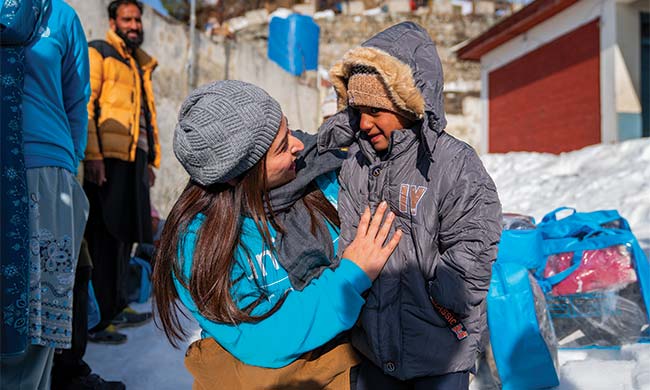
(Feature Impact) The holidays are a time for giving, whether that’s finding a thoughtful gift, sharing a meal or showing kindness to someone in need. This season, that spirit of generosity can extend far beyond your own communities to aid more than 200 million children around the world in need of humanitarian assistance. For children facing conflict, disaster and other challenges, every hour counts; a gift can mean warm clothes, lifesaving supplies, a chance to continue their education and hope for a brighter future.
The fastest response begins long before disaster strikes, wars break out, storms have names or one case becomes an outbreak. For 80 years, UNICEF has delivered at the speed of need, with supplies prepositioned and teams already on the ground with a presence in more than 90 countries and territories plus a supply network that reaches children by plane, boat, truck, motorbike, donkey and even drone.
From the world’s largest humanitarian warehouse in Copenhagen, the organization can get lifesaving essentials, such as nutrition, shelter and warm clothing, to even the world’s hardest-to-reach children and families within 72 hours of an emergency.
Every gift helps keep lifesaving supplies stocked and ready to move. Your support means when a child needs help, it’s already on the way. This holiday season, there are many ways to be part of that work.
 For example, with UNICEF Market and Inspired Gifts, it’s easy to bring education and lifesaving essentials to children around the world. This year, share the warmthby providing blankets for children, empower kids with artby sending a classroom art kit to help children heal and learn or deliver the care bundle of soap to families.
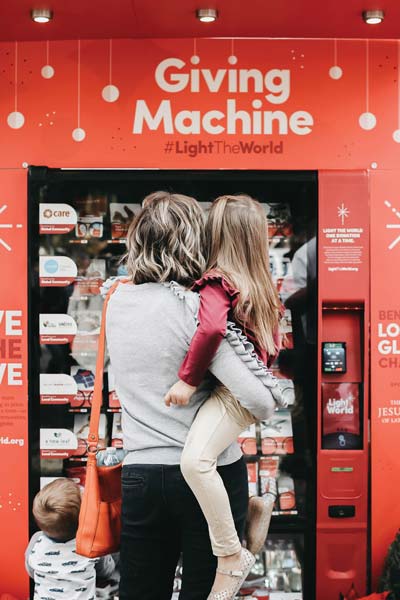
Inspired Gifts will also be featured for the ninth consecutive year in Light the World Giving Machines in cities across the country. The machines work like vending machines, but instead of snacks, passersby can purchase gifts that help children around the world, such as 100 doses of polio vaccine, 125 packets of ready-to-use therapeutic food or a school commuter bike.
You can also support quality education in Malawi through The K.I.N.D. (Kids in Need of Desks) Fund. Now in its 16th year, the fund has raised more than $55 million to remove financial barriers to education and provided more than 420,000 classroom desks and 52,000 scholarships that help girls stay in school beyond the primary level.
Whether through Inspired Gifts, a Giving Machine, a classroom desk in Malawi or a gift from a UNICEF partner, every contribution offers a meaningful way to make a difference and help build a brighter future for children around the world.
Your Marriott Bonvoy points can protect and care for children worldwide. From Dec. 1-8, the travel company will match five points for every point members donate to philanthropic partners, up to 25 million total points. Additionally, members who earn 50 or 75 qualifying nights in a calendar year are eligible to select UNICEF to benefit from their Annual Choice Benefit with a $100 donation. Learn more at giving.marriott.com.
If you’re interested in making a personal donation and your employer has a workplace giving platform, you can increase the impact of your donation by searching for your employer on the matching gifts page to see if they have a matching gift program that could double, or even triple, what your donation can do for children.
Visit unicefusa.org/giving2026 to learn more and deliver at the speed of need to children this holiday season.

SOURCE:
UNICEF





