

Science
Separating out signals recorded at the seafloor
Roger Bryant and David Fike’s research reveals that pyrite sulfur isotopes mainly reflect local conditions, shifting fundamental understanding of oceanic environmental studies.

Last Updated on November 1, 2024 by Daily News Staff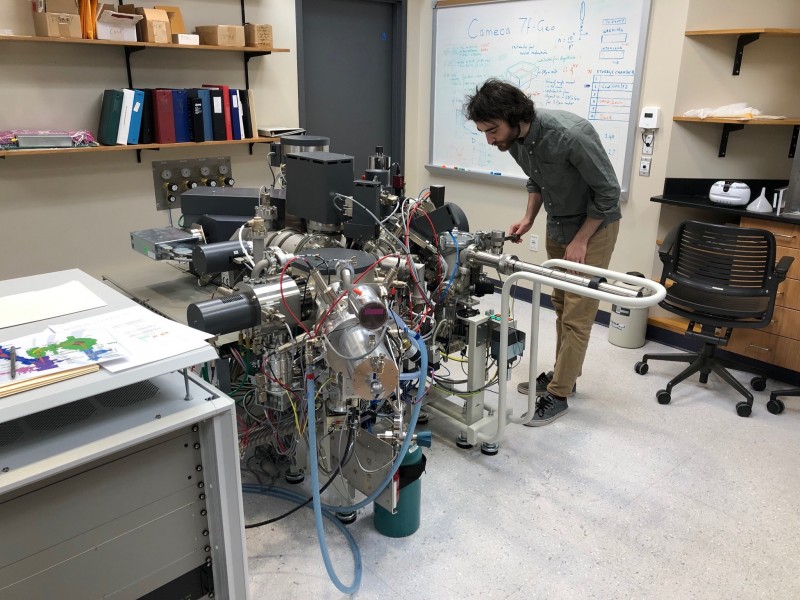
Roger Bryant studied ocean floor core samples at the Secondary Ion Mass Spectrometry (SIMS) facility at Washington University in St. Louis during his PhD studies. Bryant and David Fike have used this data to prove a discovery that will fundamentally change how scientists use pyrite sulfur isotopes to study oceanic conditions.
« Separating out signals recorded at the seafloor
Newswise — Blame it on plate tectonics. The deep ocean is never preserved, but instead is lost to time as the seafloor is subducted. Geologists are mostly left with shallower rocks from closer to the shoreline to inform their studies of Earth history.
Signals from the Sea
“We have only a good record of the deep ocean for the last ~180 million years,” said David Fike, the Glassberg/Greensfelder Distinguished University Professor of Earth, Environmental, and Planetary Sciences in Arts & Sciences at Washington University in St. Louis. “Everything else is just shallow-water deposits. So it’s really important to understand the bias that might be present when we look at shallow-water deposits.”
One of the ways that scientists like Fike use deposits from the seafloor is to reconstruct timelines of past ecological and environmental change. Researchers are keenly interested in how and when oxygen began to build up in the oceans and atmosphere, making Earth more hospitable to life as we know it.
For decades they have relied on pyrite, the iron-sulfide mineral known as “fool’s gold,” as a sensitive recorder of conditions in the marine environment where it is formed. By measuring the bulk isotopic composition of sulfur in pyrite samples — the relative abundance of sulfur atoms with slightly different mass — scientists have tried to better understand ancient microbial activity and interpret global chemical cycles.
But the outlook for pyrite is not so shiny anymore. In a pair of companion papers published Nov. 24 in the journal Science, Fike and his collaborators show that variations in pyrite sulfur isotopes may not represent the global processes that have made them such popular targets of analysis.
Instead, Fike’s research demonstrates that pyritte responds predominantly to local processes that should not be taken as representative of the whole ocean. A new microanalysis approach developed at Washington University helped the researchers to separate out signals in pyrite that reveal the relative influence of microbes and that of local climate.
For the first study, Fike worked with Roger Bryant, who completed his graduate studies at Washington University, to examine the grain-level distribution of pyrite sulfur isotope compositions in a sample of recent glacial-interglacial sediments. They developed and used a cutting-edge analytical technique with the secondary-ion mass spectrometer (SIMS) in Fike’s laboratory.
“We analyzed every individual pyrite crystal that we could find and got isotopic values for each one,” Fike said. By considering the distribution of results from individual grains, rather than the average (or bulk) results, the scientists showed that it is possible to tease apart the role of the physical properties of the depositional environment, like the sedimentation rate and the porosity of the sediments, from the microbial activity in the seabed.
“We found that even when bulk pyrite sulfur isotopes changed a lot between glacials and interglacials, the minima of our single grain pyrite distributions remained broadly constant,” Bryant said. “This told us that microbial activity did not drive the changes in bulk pyrite sulfur isotopes and refuted one of our major hypotheses.”
“Using this framework, we’re able to go in and look at the separate roles of microbes and sediments in driving the signals,” Fike said. “That to me represents a huge step forward in being able to interpret what is recorded in these signals.”
In the second paper, led by Itay Halevy of the Weizmann Institute of Science and co-authored by Fike and Bryant, the scientists developed and explored a computer model of marine sediments, complete with mathematical representations of the microorganisms that degrade organic matter and turn sulfate into sulfide and the processes that trap that sulfide in pyrite.
“We found that variations in the isotopic composition of pyrite are mostly a function of the depositional environment in which the pyrite formed,” Halevy said. The new model shows that a range of parameters of the sedimentary environment affect the balance between sulfate and sulfide consumption and resupply, and that this balance is the major determinant of the sulfur isotope composition of pyrite.
“The rate of sediment deposition on the seafloor, the proportion of organic matter in that sediment, the proportion of reactive iron particles, the density of packing of the sediment as it settles to the seafloor — all of these properties affect the isotopic composition of pyrite in ways that we can now understand,” he said.
Importantly, none of these properties of the sedimentary environment are strongly linked to the global sulfur cycle, to the oxidation state of the global ocean, or essentially any other property that researchers have traditionally used pyrite sulfur isotopes to reconstruct, the scientists said.
“The really exciting aspect of this new work is that it gives us a predictive model for how we think other pyrite records should behave,” Fike said. “For example, if we can interpret other records — and better understand that they are driven by things like local changes in sedimentation, rather than global parameters about ocean oxygen state or microbial activity — then we can try to use this data to refine our understanding of sea level change in the past.”
Source: Washington University in St. Louis
The science section of our news blog STM Daily News provides readers with captivating and up-to-date information on the latest scientific discoveries, breakthroughs, and innovations across various fields. We offer engaging and accessible content, ensuring that readers with different levels of scientific knowledge can stay informed. Whether it’s exploring advancements in medicine, astronomy, technology, or environmental sciences, our science section strives to shed light on the intriguing world of scientific exploration and its profound impact on our daily lives. From thought-provoking articles to informative interviews with experts in the field, STM Daily News Science offers a harmonious blend of factual reporting, analysis, and exploration, making it a go-to source for science enthusiasts and curious minds alike. https://stmdailynews.com/category/science/

unknown
Did Jackie Gleason See Aliens? Inside the Strange Nixon–UFO Legend
Jackie Gleason reportedly told his wife that President Richard Nixon arranged for him to view preserved extraterrestrial bodies at a Florida Air Force base. Here is what we know—and why the remarkable story remains unverified.

The beloved comedian reportedly told his wife that President Richard Nixon arranged for him to view preserved extraterrestrial bodies at a Florida Air Force base. Decades later, the extraordinary story remains fascinating—but unverified.
Jackie Gleason is remembered as “The Great One,” the larger-than-life entertainer who turned bus driver Ralph Kramden into one of television’s most enduring characters on The Honeymooners. Away from the cameras, however, Gleason had another consuming interest: UFOs, psychic phenomena and the possibility of extraterrestrial life.
That interest eventually became the foundation of one of the strangest stories ever associated with an American president and a Hollywood celebrity. According to Gleason’s second wife, Beverly McKittrick, her husband came home late one night in 1973 and claimed that President Richard Nixon had helped him see the preserved bodies of extraterrestrial beings at Homestead Air Force Base in Florida.
Did Jackie Gleason really see aliens?
The honest answer is that we do not know. The allegation is remarkable, but the available evidence never rises above an uncorroborated story attributed to Gleason years after the supposed event.
Gleason’s fascination with UFOs was real
There is little question that Gleason took the UFO subject seriously. He reportedly assembled a substantial personal library devoted to UFOs, the paranormal and related mysteries. His unusual circular home in New York—often nicknamed “The Mothership”—only strengthened his public association with flying saucers, although its distinctive architecture is not evidence of an extraterrestrial encounter.
Gleason also had a genuine social connection with Nixon. The two men shared an interest in golf and spent time together in Florida. That documented friendship is the factual starting point from which the more sensational story grew.
The alleged trip to Homestead Air Force Base
McKittrick said that Gleason returned to their Florida home at about 11:30 one evening looking disturbed. According to her account, he told her that Nixon had arrived without the usual presidential entourage and taken him to Homestead Air Force Base, south of Miami.
Once there, Gleason allegedly entered a secured building where he saw small humanoid bodies preserved inside glass-topped containers. Published versions differ over the number of bodies and some physical details, but they generally describe child-sized beings with oversized heads.
Importantly, McKittrick did not claim to have accompanied the men or witnessed anything at the base. Her account was based entirely on what she said Gleason told her after returning home.
The story became public in 1983, years after the alleged visit and after the couple had divorced. It circulated widely through tabloid reporting, UFO publications and later books, gradually becoming part of UFO folklore.
Why the story remains unverified
No authenticated photograph, visitor record, military document or firsthand statement from Nixon has emerged to confirm the alleged trip. Gleason also never provided investigators with a signed affidavit describing the experience.
UFO researcher Larry Bryant reportedly sought records from Homestead and tried to obtain a statement from Gleason, but those efforts produced no confirming documentation. Gleason’s refusal to address the account publicly has sometimes been portrayed as suspicious, but silence is not proof that an event occurred.
There is another important complication: McKittrick later expressed uncertainty about her former husband’s story.
During telephone interviews conducted by researcher Kenny Young in 2003, she stood by her recollection that Gleason told her he had seen “dead aliens.” She also acknowledged that, as the years passed, she wondered whether he might have invented the explanation because he had been out late. She declined to appear on camera and said the story should be authenticated first.
Her later comments do not establish that the account was false, but they considerably weaken any attempt to treat it as verified history.
Could a president have slipped away unnoticed?
Some versions of the legend emphasize that Nixon supposedly drove to Gleason’s house alone and then entered a military installation without his Secret Service detail. Presidents have occasionally sought privacy or slipped away from tightly managed schedules, but a secret nighttime excursion of this nature would have involved serious security and logistical obstacles.
The claim becomes even more difficult to accept when we consider what Nixon allegedly revealed. If the United States possessed extraterrestrial bodies, granting a comedian personal access to them would have represented an extraordinary breach of national security—with no apparent official purpose and no surviving documentation.
None of that makes the episode logically impossible. It does, however, mean that the story requires exceptionally strong evidence. That evidence has never appeared.
A compelling legend, not a confirmed encounter
The Jackie Gleason story endures because it combines three irresistible ingredients: a famous comedian fascinated by UFOs, a secretive American president and a nighttime visit to a military base containing an alleged government secret.
What can be established is that Gleason was deeply interested in UFOs, knew Nixon and was said by his former wife to have made an extraordinary claim. What cannot be established is that Nixon took him to Homestead Air Force Base or that preserved extraterrestrial bodies were ever stored there.
So, did Jackie Gleason see aliens?
Perhaps he believed that he did—or perhaps he simply told an unforgettable story. Until corroborating evidence emerges, the alleged encounter belongs in the intriguing borderland between celebrity history and American UFO mythology.
Sources and further reading
- The Black Vault: Jackie Gleason and the Pickled Alien
- University of Miami Libraries: The Jackie Gleason Collection
- U.S. Department of Defense: All-domain Anomaly Resolution Office
Step into The Unknown, where STM Daily News explores the strange phenomena, unexplained encounters and enduring mysteries that continue to challenge what we think we know. From UFO sightings and paranormal events to historical mysteries and unusual scientific discoveries, we examine the stories, evidence and competing explanations—without losing our sense of wonder. https://stmdailynews.com/science/unknown/
health and wellness
Lactose intolerance is actually the human norm – but racism, the US government and business interests have made it into a condition
Lactose intolerance is the global human norm, but Western dietary standards, government policies and commercial interests helped frame it as a medical deficiency.


Hilary Smith, University of Denver
Lactose intolerance makes drinking milk or eating ice cream a literal pain. For some people, eating a dairy treat can lead to bloating, nausea and diarrhea. You might’ve experienced its effects yourself. If so, you may think of lactose intolerance as a defect rather than the norm.
But did you know that most people in the world today are lactose intolerant – and that the condition itself was invented in the 1960s?
“Surely you mean discovered, not invented,” I hear you saying. I don’t. As a historian who has traced the origins of nutrition-science ideas, I have chosen the word “invented” on purpose.
Inventing lactose intolerance
Variations in people’s ability to digest lactose first came to scientists’ attention after American dairy producers found a way to rid themselves of a postwar milk surplus. To offload what they couldn’t sell, they looked to the government to intervene. And it did, buying the excess and embedding it in school lunches and other places with publicly funded meals.
Suddenly, many people who had not habitually drunk milk were consuming it regularly, including not only some Americans but also people overseas. Part of that same milk surplus found its way into school lunches in places such as Japan and Taiwan in the 1950s as the American government began to sell milk to allies during the Cold War.
Many of the groups drinking milk regularly for the first time did not like it. In fact, it made them feel sick. Intrigued, scientists set up experiments to figure out why. In a 1966 study comparing how Black and white people incarcerated in Baltimore metabolized lactose, researchers found that Black participants had lower levels of lactase – the enzyme that breaks down lactose – in their guts.
To the white scientists conducting this study, the trouble that the Black prisoners had digesting milk looked like an “inborn error of metabolism.” They assumed that the normal human state was lactose tolerance and that the lactose intolerant had inherited a genetic mutation.
It was only after years more work with research participants of many races that experts realized that, as one National Institutes of Health official put it in 1981, “lactose intolerance is a normal physiological condition, shared by every adult animal except for certain ethnic and racial groups in man.” People of northern European descent, it turned out, were the weird ones. It was their ancestors who had passed down a genetic mutation – one that made them able to digest milk after infancy.
In short, what scientists discovered in the 1960s was that different bodies process milk differently. What they invented was the idea that lactose intolerance is a defect. Accepting that framing would mean nearly two-thirds of the human population – the estimated prevalence of lactose intolerance worldwide – is defective.
Instead of acknowledging that dairy-free diets can be healthy, people innovated ways to overcome this supposed disability so everyone could consume more.
Nutritional imperialism
Lactose intolerance is one example of what I call nutritional imperialism: a way of thinking that treats white diets as the norm and everyone else’s as an aberration.
Nutritional imperialism was common in the 20th century, when scientists thought that not only milk-rich but also meat-heavy diets were best; they considered diets outside of the United States and Europe too vegetarian. Some also argued that wheat flour, not rice, ought to be the universal staple.
The same bias applied to bodies. Besides faulty lactose digestion, nonwhite bodies were accused of other failures, too, such as aldehyde dehydrogenase deficiency, an inability to digest alcohol quickly. The less technical term for this may be more familiar: Asian flush.
Such differences might have been thought of as variety, just another way of being human. Instead, each became a deficiency.
Many people today have inherited and perpetuated this way of thinking without knowing it, including those who are deemed deficient by it. In 1959, the director of Japan’s nutrition bureau declared that “rice-eating peoples” such as the Japanese were “resigned and passive” and could correct this by imitating Western diets and switching to wheat.
Today, the most prominent scientist promoting the idea that Asian flush is a disease is a geneticist of Taiwanese descent who started a research consortium to study “the most common human enzymopathy in the world.”
The Chinese Nutrition Society placed a tall glass of milk next to its 2022 Food Guide Plate – never mind estimates that the vast majority of Han Chinese, the largest ethnic group in China and worldwide, are lactose intolerant.
Turning sickness back into difference
Science that pathologizes difference helps racism persist.
In recent years, white supremacists have embraced the concept of lactose intolerance as a distinguishing debility of nonwhite people. Social media users have copied and pasted a map of the geographic distribution of lactose tolerance originally published in the scientific journal Nature into racist chat threads on the online discussion forum 4chan.
In 2017, internet trolls disrupted an anti-racist art installation with neo-Nazi chants and messily downed jugs of milk to accentuate their white identity.
Turning a lactose-digestion difference into a deficiency has done more to reinforce narratives of racial hierarchy than to improve public health. So here’s a suggestion: If you enjoy eating dairy, keep doing it; if you don’t, don’t – and know that there is nothing wrong with you.
Hilary Smith, Professor of History, University of Denver
This article is republished from The Conversation under a Creative Commons license. Read the original article.
📰 Enjoying STM Daily News? Join the conversation!
💬 Leave a comment, share your thoughts, and subscribe to our newsletter for the latest stories, updates, and “News You Can Use This Moment!” delivered to your inbox.
Stay connected with STM Daily News!
News
FAA Certifies Boeing 737-7: What It Means for Airlines and the 737 MAX Program
The FAA has certified Boeing’s new 737-7, clearing the smallest 737 MAX variant for service as Boeing and Southwest prepare for first deliveries.


The U.S. Federal Aviation Administration has certified Boeing’s new 737-7, granting the company an amended type certificate that clears the smallest member of the 737 MAX family for commercial service. The milestone closes a multi-year certification effort and puts the focus on execution: Boeing and launch customer Southwest Airlines say preparations are underway to support first deliveries.
For STM Daily News readers, the headline isn’t just “another plane gets approved.” It’s a signal that Boeing has now cleared a key MAX variant designed for long-range flexibility in a smaller footprint—an aircraft type airlines can use to open or defend routes where demand is strong, but not strong enough to justify a larger narrowbody.
What FAA certification means
An amended type certificate means the FAA has approved the 737-7’s design as compliant with commercial aviation regulations. In practical terms, certification allows airlines to place the aircraft into revenue service once deliveries begin and operator-specific steps—training, manuals, maintenance programs, and entry-into-service planning—are completed.
Boeing also said the FAA updated Boeing Production Certificate No. 700 (PC 700) to include the 737-7, supporting production and delivery activities.
Why the 737-7 matters in the MAX lineup
Boeing positions the 737-7 as the smallest and longest-range member of the 737 MAX family. The company says it typically seats 135 to 160 passengers in a two-class configuration and offers a range of up to 3,800 nautical miles (7,040 km). That combination matters because it gives airlines more options to fly longer “thin” routes—markets where frequency and reach matter more than packing in additional seats.
Boeing also highlights performance for operations out of high-altitude airports and in hot climates, where takeoff performance and payload-range tradeoffs can shape fleet decisions.
Efficiency claims: fuel, emissions, and noise
Boeing says the 737-7, like other 737 MAX jets, reduces fuel use and CO2 emissions by 20% and cuts the noise footprint by 50% compared to the airplanes it typically replaces. For airlines, those improvements typically show up in two ways:
- Route economics: lower fuel burn can improve margins on longer sectors and reduce exposure to fuel-price swings.
- Operational constraints: quieter aircraft can help with airport noise requirements and community pressure, while lower emissions support sustainability targets.
Inside the certification effort
Boeing said the certification program began in 2018 and included more than 1,000 hours of flight and ground testing, extensive system safety analysis, and human factors reviews. The company also noted an updated engine anti-ice system to address a potential condition discovered during flight testing.
Boeing Commercial Airplanes President and CEO Stephanie Pope called the certification “important” validation of the airplane’s design and the work of the MAX development team. Mike Sinnett, senior vice president of Product Strategy, Product Development and Development Programs, said Boeing held regular discussions with the FAA and that the process has sharpened the company’s understanding of current regulatory requirements—knowledge Boeing expects will accelerate future development with a renewed emphasis on human factors, safety, and quality.
What to watch next
With certification complete, the next phase is about delivery timing and real-world deployment.
- First deliveries to Southwest: Boeing and Southwest are preparing for delivery of the first airplane, including updates to final configuration.
- Production stability: certification removes a major hurdle, but supply chain health and production cadence will determine how quickly the 737-7 shows up in airline schedules.
- The 737-10 timeline: Boeing reiterated it is working to certify the 737-10 this year, keeping attention on how quickly the final MAX variant clears regulatory review.
The bigger MAX picture
Boeing said the 737 MAX family order book stands at more than 7,200 airplanes, with more than 2,300 delivered through the end of June 2026. The 737-7’s certification adds another deliverable product to that portfolio—one aimed at airlines that want long range without stepping up to a larger gauge.
Bottom line
FAA certification of the 737-7 is a meaningful milestone for Boeing and for airlines looking for a smaller narrowbody with long-range capability. The real test now is operational: turning certification into on-time deliveries and reliable entry into service—while the industry watches Boeing’s push to certify the 737-10.
Related Links
- Boeing 737 MAX family overview (manufacturer background/specs): https://www.boeing.com/commercial/737max/
- FAA Aircraft Certification (how type certification works): https://www.faa.gov/aircraft/air_cert/
- FAA Airworthiness Directives (regulatory actions database): https://www.faa.gov/regulations_policies/airworthiness_directives
- Southwest Airlines newsroom (launch customer context / fleet updates): https://www.swamedia.com/
- Boeing Commercial Airplanes newsroom (for follow-ups and official updates): https://boeing.mediaroom.com/news-releases?item=130821
📰 Enjoying STM Daily News? Join the conversation!
💬 Leave a comment, share your thoughts, and subscribe to our newsletter for the latest stories, updates, and “News You Can Use This Moment!” delivered to your inbox.
Stay connected with STM Daily News!
Source:
Boeing (PRNewswire), Aug. 3, 2026 — “U.S. FAA certifies new Boeing 737-7 airplane.”





