

Health
Support Brain Health: Simple ways to add to your wellness routine
When most people think of wellness, diet and exercise are the first things that come to mind. Brain health is another essential element of your overall wellness because it affects your quality of life in many ways.


(Family Features) When most people think of wellness, diet and exercise are the first things that come to mind. Brain health is another essential element of your overall wellness because it affects your quality of life in many ways.
Brain health is the foundation of your ability to live a productive and successful life by communicating and solving problems. It’s the driving force behind your daily function.
Give your brain extra support with these tips:
Stimulate Your Mind
Like any muscle, your brain needs exercise. Your workout equipment for your brain can include activities like puzzles, reading, learning an instrument, taking up a new hobby or learning a new language.
Focus on Brain-Supporting Foods
What you eat doesn’t just affect your physical health; it affects your brain health, too. One example is the Mediterranean-DASH Intervention for Neurodegenerative Delay (MIND) diet, which is the result of more than 20 years of data collected by researchers at Rush University Medical Center and Harvard School of Public Health.
It follows the Mediterranean style of eating whole foods with minimal processing and includes an emphasis on plant-based foods, including leafy greens, whole grains and heart-healthy legumes along with some fish and smaller amounts of poultry. The MIND diet aims to build on these principles and emphasizes antioxidant-rich berries, dark leafy greens and fatty fish like salmon, mackerel, herring or sardines.
A dish like Kale and Quinoa Bowl with Salmon reflects the MIND diet guidelines and is a delicious and smart way to support your brain with good nutrition.
“Fueling your brain starts with your plate,” said Melissa Halas, MA, RDN. “This tasty kale, quinoa and salmon recipe by Alton Brown has smart ingredients that match the MIND diet. Plus, the results are delicious. It’s so important to support your brain with the right nutrients.”
Sleep Well
While you catch up on your rest, your body is hard at work rejuvenating all your systems, and your brain is no exception. Getting plenty of sleep each night gives your brain time to repair itself so you wake feeling sharp and focused.
Add a Supplement to Your Daily Routine
Most people fall short of reaching recommended nutrient levels with their diets alone. Supplements can help fill the gap. An option like Neuriva Plus can help support the key indicators of brain health: reasoning (think and understand things in a logical way), focus (zoom in and filter out distractions), accuracy (react with greater speed and precision), memory (record and recall stored information), learning (retain new information) and concentration (concentrating on tasks for longer periods).*
*These statements have not been evaluated by the Food and Drug Administration. This product is not intended to diagnose, treat, cure or prevent any disease.
Available in capsules and gummies, the Neuriva brain health supplements include naturally sourced ingredients like Neurofactor™ (coffee cherry extract) and plant-sourced phosphatidylserine (PS), as well as B vitamins to support brain health.
“I recently turned 60 and over the past couple of decades, I’ve been very focused on taking care of my health from the inside out – first with my food, and now taking action to support my brain health,” said Alton Brown, award-winning chef and food geek. “Neuriva fits perfectly into my holistic regimen, which for me, is just simple life practices, like exercising, eating a balanced diet and getting a good night’s sleep.”
Manage Stress
Keeping your stress in check is good for your mental well-being, but it also affects your physical and cognitive health. Practicing yoga, meditation or listening to music are some ways to reduce stress while improving your cognitive function and performance.
Connect with Others
Personal interaction also sharpens your brain, as it encourages you to practice communication and other cognitive skills. You can protect and improve your brain health by creating and nurturing connections with friends and family.
Keep Moving
Your brain needs plenty of oxygen for good function. Physical activity burns calories and builds muscle while increasing oxygen flow and stimulating nerve cell growth.
For more ideas to support brain health and wellness, visit Neuriva.com and download the Neuriva Brain Gym app.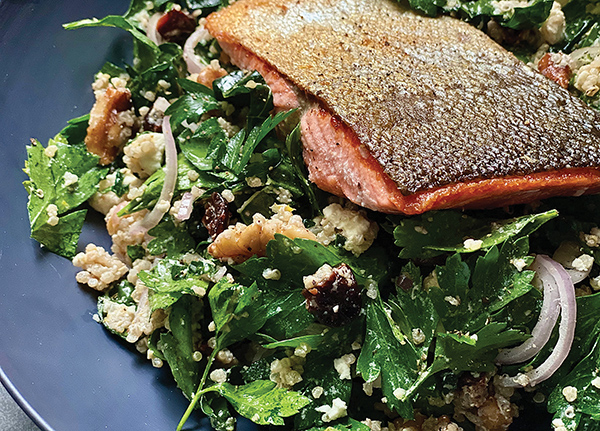
Kale and Quinoa Bowl with Salmon
Recipe courtesy of Alton Brown on behalf of Neuriva
Servings: 4
Kale and Quinoa Bowl:
- 1 bunch lacinato or “dinosaur” kale, stems removed and cut into ribbons (about 4 ounces, stemmed)
- 1 bunch (1 1/2 ounces) flat leaf parsley, stems removed and roughly chopped
- 2 shallots, thinly sliced
- 5 tablespoons extra-virgin olive oil, divided
- 1 lemon, zest and juice only
- 2 large garlic cloves, minced
- 1/2 cup plain, low-fat yogurt
- 4 ounces firm feta cheese, divided
- 1cup (3 1/2 ounces) walnuts, toasted and lightly crushed, divided
- 1 teaspoon kosher salt
- 2 cups cooked white quinoa
- 1/2 cup dried cherries
- freshly ground black pepper
Salmon:
- 2 skin-on salmon fillets (around 1-inch thick and 5 ounces each)
- 1/2 teaspoon kosher salt
- 2 tablespoons light olive oil
- To make kale and quinoa bowls: In large bowl, toss kale, parsley and shallots with 2 tablespoons olive oil; set aside 10 minutes.
- In bowl of food processor, puree remaining olive oil, lemon juice and zest, garlic, yogurt, 2 ounces feta, 1/3 of the walnuts and salt.
- Pour dressing over greens then fold in quinoa, remaining walnuts, cherries and remaining feta.
- Cover and refrigerate at least 1 hour before serving with several grinds of black pepper.
- To make salmon: Wrap fillets in paper towels then heat large cast-iron skillet over medium-high heat 5 minutes.
- When skillet is hot, season fillets with salt. Add oil to skillet and carefully tilt to evenly cover bottom. When oil shimmers, slide fillets in, skin-side down, pressing each fillet firmly down with spatula.
- Reduce heat to medium-low and cook 3 minutes then cover and cook 2 minutes.
- Carefully flip fillets, cover and cook 1 minute, or until fillets reach desired doneness or internal temperature of at least 130 F** on thermometer inserted into centers.
**The United States Department of Agriculture recommends a minimum internal temperature of 145 degrees Fahrenheit. - To serve, separate kale and quinoa mixture into four bowls. Slice each fillet in half and place on top of kale and quinoa.
Content courtesy of Neuriva
Photo courtesy of Getty Images (woman eating at laptop)
Photo courtesy of Getty Images (woman doing a puzzle)
Photo courtesy of Lynne Calamia (Kale and Quinoa Bowl with Salmon)
SOURCE:
Neuriva


Consumer Corner
Cold cities are the most ready for winter, with one exception. See where your city ranks
Cold cities? Every neighborhood has a mix of homeowners who approach seasonal home maintenance differently – there are the people who stay on schedule, and on the other end, the procrastinators. There are the dedicated DIYers, and those who have their favorite maintenance pro saved as a favorite contact in their phone. As it turns out, cities are no different. Some metropolitan areas keep their neighborhoods in tip-top shape, while others are a little more slow-going.

Cold cities are the most ready for winter, with one exception. See where your city ranks
(Sheeka Sanahori) Every neighborhood has a mix of homeowners who approach seasonal home maintenance differently – there are the people who stay on schedule, and on the other end, the procrastinators. There are the dedicated DIYers, and those who have their favorite maintenance pro saved as a favorite contact in their phone. As it turns out, cities are no different. Some metropolitan areas keep their neighborhoods in tip-top shape, while others are a little more slow-going.
New data from home services company Angi, covering fall maintenance activity in August, reveals which U.S. metropolitan areas are the most proactive with fall maintenance. Washington, D.C., tops the ranking with the strongest demand for fall maintenance in the country, followed by Columbus, Ohio, and Milwaukee, Wisconsin. Northern cities dominate the rest of the list.
Cleveland, Ohio, and Albany-Schenectady-Troy, New York, round out the top five. Cold-weather markets dominate the ranking, accounting for eight of the 10 most-prepared metros. Rochester, New York; Charlotte, North Carolina; Chicago; Indianapolis; and Pittsburgh complete the top 10.
Least fall-ready metros
Fewer than 1 in 5 American cities is prepping for fall at an above-average rate. Among the 66 metros that recorded at least 100 fall maintenance service requests during the analysis period, Los Angeles had the lowest level of per-capita activity, followed by Oklahoma City and Riverside, California. California accounts for four of the bottom 10 markets, with Los Angeles, Riverside, San Diego and San Francisco all appearing on the list. These metros historically don’t experience the colder winter climates of the Northeast and Midwest, making fall maintenance less of an imperative.
Grand Rapids, Michigan, stands out as the only clearly cold-weather metro among the 10 least-prepared large metros. The New York City metro, which includes Newark and Jersey City, ranked just outside the 10 least-prepared large metros, coming in at number 11. Other New York state metros, including Syracuse, Rochester and the Albany metro area, were on the most prepared list.
Homeowners are choosing upkeep over upgrades
Sixty-three percent of homeowners who have recently hired a professional completed maintenance work, and 58% completed repairs. Although they may be waiting to do that dream kitchen or bath renovation, they’re focusing for now on the maintenance that keeps their homes in order.
The most common fall maintenance projects focus on outdoor upkeep. Nationally, tree trimming was the most popular, followed by lawn and yard waste cleanup and shrub care.
What homeowners should do now
When tackling a home maintenance list, start at the top of the home by inspecting the roof and gutters. Look for loose or damaged shingles, and make sure gutters are debris-free. It’s also a good idea to ensure downspouts direct water far away from the foundation. Homeowners should inspect these areas from the ground or hire a professional if the work requires climbing or feels unsafe.
Next, check for drafts around the windows and doors. Replacing worn weatherstripping and damaged caulk in the fall can prevent warm air from escaping once the heat comes back on. Homeowners should also inspect their HVAC filters and have the heating system checked before the temperatures drop.
Every home’s maintenance needs will vary, depending on the age and condition of the house and where it’s located. Whether homeowners hire a professional or safely address small issues, making the fixes can prevent larger and more expensive problems later.
The ranking: Metros from most to least prepared
America’s 10 Most Fall-Prepared Metros
1. Washington, D.C.
2. Columbus, Ohio
3. Milwaukee, Wisconsin
4. Cleveland, Ohio
5. Albany-Schenectady-Troy, New York
6. Rochester, New York
7. Charlotte, North Carolina
8. Chicago, Illinois
9. Indianapolis, Indiana
10. Pittsburgh, Pennsylvania
10 Metros With the Most Opportunity to Get Fall-Ready
1. Los Angeles, California
2. Oklahoma City, Oklahoma
3. Riverside, California
4. Miami, Florida
5. San Diego, California
6. Houston, Texas
7. Grand Rapids, Michigan
8. San Francisco, California
9. Austin, Texas
10. Memphis, Tennessee
Methodology
The rankings are based on fall maintenance activity recorded on Angi during August 2026. Projects included yard cleanup, winterization, roofing and gutters, heating systems, water and drainage, outdoor plumbing, fireplaces and chimneys, pest prevention, and snow and storm preparation. U.S. metropolitan areas were ranked by activity per 100,000 residents using 2020 U.S. Census population data. To qualify for the least-prepared ranking, metros were required to have at least five service requests or jobs during the analysis period. The rankings reflect activity on Angi’s platform and are not a complete measure of all home-maintenance activity within each metro. These rankings reflect activity observed on Angi’s platform and should not be interpreted as a complete measure of all home-maintenance behavior within a metro area.
Photo courtesy of Shutterstock
SOURCE:
Angi
Health
Type 2 Diabetes Doesn’t Have to Be Your Future: Medicare Has a Benefit That Can Help
Left unchecked, prediabetes can progress to type 2 diabetes. However, with the right support, prediabetes can often be managed or even reversed. If you have Medicare, you may qualify for a Medicare-covered program that can help you lower your chances of developing type 2 diabetes – at no cost to you.

(Feature Impact) Nearly 1 in 2 people age 65 and older has prediabetes – a condition where blood sugar (glucose) levels run higher than normal. Left unchecked, prediabetes can progress to type 2 diabetes. However, with the right support, prediabetes can often be managed or even reversed. If you have Medicare, you may qualify for a Medicare-covered program that can help you lower your chances of developing type 2 diabetes – at no cost to you.
The Medicare Diabetes Prevention Program is a covered Medicare benefit that gives you practical tools, personalized support, and proven strategies to make healthy lifestyle changes. Learn how to eat better, exercise more, and build healthy habits that stick while guided by a certified coach who helps you every step of the way.
Research shows the program works. People with prediabetes who complete the program result in weight loss, which ultimately leads to reduced risk of type 2 diabetes onset.
What can you expect?
Prevention does not mean you have to make big changes all at once. This program helps you take small, realistic steps that can add up to lasting results. It includes 16 core sessions where you can learn how to reduce your diabetes risk by making healthier meals, moving more, and building healthy habits.
The core sessions are followed by six months of monthly maintenance sessions to help you keep your momentum.

You can choose the class format that works for you
You can enroll in these services from approved Medicare Diabetes Prevention Program suppliers and participate in the way most convenient for you:
- In-Person: Attend sessions in a community location.
- Live-Distance Learning: Join interactive group sessions from home.
- Self-Paced Online: This new option allows you to access online content and learn on your own schedule.
Visit www.medicare.gov/PreventDiabetes to find a class that’s right for you.
Who is eligible?
You may qualify if you are enrolled in Medicare Part B and meet these criteria:
- Have had one of the following test results within the past 12 months:
- Hemoglobin A1c between 5.7% and 6.4%
- Fasting plasma glucose between 110 and 125 mg/dL
- Two-hour plasma glucose between 140 and 199 mg/dL after an oral glucose tolerance test
- Have a body mass index (BMI) of 25 or higher (or 23 or higher if you self-report as Asian descent).
- Have never been diagnosed with type 1 or type 2 diabetes or end-stage renal disease (ESRD).
What does it cost?
If you have Medicare Part B and qualify for the program, you pay nothing to participate. If you are in a Medicare Advantage Plan, you may have to go to an in-network provider to get these services. Contact your plan for more information.
Ready to get started on your healthier future?
Take control of your health on your own terms, schedule, and pace that fits into your life. Check with your doctor to find out if you have prediabetes or are at risk for developing type 2 diabetes. If you’re eligible for the Medicare Diabetes Prevention Program, your doctor can refer you, or you can enroll on your own.
If you’re ready to get started today, find the class that’s right for you at: www.medicare.gov/PreventDiabetes.
Information provided by the U.S. Department of Health and Human Services
Photos courtesy of Shutterstock
SOURCE:
Centers for Medicare & Medicaid Services
health and wellness
The Oral and Cardiovascular Health Connection: 4 Tips to Protect Your Teeth, Gums and Heart
People often think of dentists and doctors as totally separate healthcare professionals: one cares for your teeth and mouth while the other handles the rest of the body. In reality, the different systems in the human body are closely interconnected and oral health is no exception, making dentists a vital part of your healthcare team. Care for your teeth, gums and heart all at once using these tips.

(Feature Impact) People often think of dentists and doctors as totally separate healthcare professionals: one cares for your teeth and mouth while the other handles the rest of the body. In reality, the different systems in the human body are closely interconnected and oral health is no exception, making dentists a vital part of your healthcare team.
Oral health and heart health have a particularly close connection, with inflammation at the core of it. When your gums are inflamed, the resulting bacteria can make their way from your mouth through your bloodstream, potentially contributing to your blood vessels constricting or becoming blocked. This, in turn, may force your heart to work harder and raise your blood pressure, putting you at risk of heart disease and stroke. More than 46% of adults in the U.S. have high blood pressure, and more than 40% of adults age 30 and older are affected by periodontal (gum) disease.
To help address these issues, the American Heart Association’s Healthy Smiles, Healthy Hearts initiative, in collaboration with Delta Dental of California, is encouraging dental teams to take a total-body perspective with their patients. Simple steps like blood pressure screenings during checkups can give a more complete picture of a person’s overall health. If a member of your dental care team pulls out a blood pressure cuff at your next appointment, it’s a good sign.
“The mouth is a gateway to the body and can often reveal more about your total body health than you may think,” said Daniel Croley, D.M.D., chief dental officer at Delta Dental of California and Affiliates. “Oral health professionals have a powerful opportunity to integrate more into their patients’ collective health care team beyond protecting their patients’ teeth By connecting oral health and heart health, this initiative helps dentists identify risks early and guide patients toward care that can improve and even save lives.”
Care for your teeth, gums and heart all at once using these tips from experts at the American Heart Association.
Follow a Brushing and Flossing Schedule
 Good dental health starts with a daily routine. If you don’t want to sheepishly cringe next time the dentist inquires about yours, brush at least twice a day and floss at least once a day to disrupt plaque-forming bacteria. Dentists recommend using toothpaste with fluoride and brushing your teeth and gums thoroughly yet gently, as applying too much pressure can wear away enamel and cause gum recession.
Eat a Healthy Diet and Limit Sugar
Most kids are used to hearing sugar will rot their teeth – and that’s not just a parental scare tactic to get their little hands out of the candy jar. Sugar feeds harmful bacteria in your mouth, producing acid that can cause cavities and gum disease. For a diet your heart and teeth will both appreciate, prioritize vegetables, lean proteins, complex carbohydrates and healthy fats, while limiting added sugars and refined carbohydrates.
Avoid Smoking and Tobacco Products
The connection between smoking and oral disease is well established: smokers face significantly higher risks of developing periodontal disease, losing teeth or being diagnosed with oral cancer. Cigarettes aren’t the only form of tobacco to worry about, either. Vaping, dipping and chewing tobacco can also harm your dental health by drying out your mouth and restricting blood flow to the gums. Since these products are also harmful to heart health, quitting or avoiding them offers plenty of worthwhile benefits. Seek support if you need help to kick the habit.
Communicate with Your Healthcare Team
Since your body’s systems are connected to each other, it’s helpful to talk to your dentist about your blood pressure and to your doctor about your oral health. Start thinking of your dentist as a key member of your integrated healthcare team. Don’t be afraid to share your medical history, discuss the side effects of any medications you’re taking and ask for personalized recommendations on caring for your teeth, gums and overall health.
To learn more about how to improve your oral and cardiovascular health, visit Heart.org/OralHealth.
Photos courtesy of Shutterstock

SOURCE:





