

Lifestyle
Is it COVID-19? Flu? At-home rapid tests could help you and your doctor decide on a treatment plan
At-home rapid tests for COVID-19 and influenza are becoming available, allowing simultaneous diagnosis, which aids timely and effective treatment and improves patient outcomes.


Julie Sullivan, Emory University and Wilbur Lam, Georgia Institute of Technology
A scratchy, sore throat, a relentless fever, a pounding head and a nasty cough – these symptoms all scream upper respiratory illness. But which one?
Many of the viruses that cause upper respiratory infections such as influenza A or B and the virus that causes COVID-19 all employ similar tactics. They target the same areas in your body – primarily the upper and lower airways – and this shared battleground triggers a similar response from your immune system. Overlapping symptoms – fever, cough, fatigue, aches and pains – make it difficult to determine what may be the underlying cause.
Now, at-home rapid tests can simultaneously determine whether someone has COVID-19 or the flu. Thanks in part to the National Institutes of Health’s Rapid Acceleration of Diagnostics, or RADx, program, the Food and Drug Administration has provided emergency use authorization for seven at-home rapid tests that can distinguish between COVID-19, influenza A and influenza B.
Our team in Atlanta – composed of biomedical engineers, clinicians and researchers at Emory University, Children’s Healthcare of Atlanta and Georgia Institute of Technology – is part of the RADx Test Verification Core. We closely collaborate with other institutions and agencies to determine whether and how well COVID-19 and influenza diagnostics work, effectively testing the tests. Our center has worked with almost every COVID and flu diagnostic on the market, and our data helped inform the instructions you might see in many of the home test kits on the market.
While no test is perfect, to now be able to test for certain viruses at home when symptoms begin can help patients and their doctors come up with appropriate care plans sooner.
A new era of at-home tests
Traditionally, identifying the virus causing upper respiratory illness symptoms required going to a clinic or hospital for a trained medical professional to collect a nasopharyngeal sample. This involves inserting a long, fiber-tipped swab that looks like a skinny Q-tip into one of your nostrils and all the way to the back of your nose and throat to collect virus-containing secretions. The sample is then typically sent to a lab for analysis, which could take hours to days for results.
Thanks to the COVID-19 pandemic, the possibility of using over-the-counter tests to diagnose respiratory illnesses at home became a reality. These tests used a much gentler and less invasive nasal swab and could also be done by anyone, anytime and in their own home. However, these tests were designed to diagnose only COVID-19 and could not distinguish between other types of illnesses.
Since then, researchers have developed over-the-counter multiplex tests that can screen for more than one respiratory infection at once. In 2023, Pfizer’s Lucira test became the first at-home diagnostic test for both COVID-19 and influenza to gain emergency use authorization.
What are multiplex rapid tests?
There are two primary forms of at-home COVID-19 and COVID-19/flu combination tests: molecular tests such as PCR that detect genetic material from the virus, and antigen tests – commonly referred to as rapid tests – that detect proteins called antigens from the virus.
The majority of over-the-counter COVID-19 and COVID-19/flu tests on the market are antigen tests. They detect the presence of antigens in your nasal secretions that act as a biological signature for a specific virus. If viral antigens are present, that means you’re likely infected. https://www.youtube.com/embed/s45GMoZaHFE?wmode=transparent&start=0 Respiratory illnesses such as flu, COVID-19 and RSV can be hard to tell apart.
To detect these antigens, rapid tests have paper-like strips coated with specially engineered antibodies that function like a molecular Velcro, sticking only to a specific antigen. Scientists design and manufacture specialized strips to recognize specific viral antigens, like those belonging to influenza A, influenza B or the virus that causes COVID-19.
The antibodies for these viral targets are placed on the strip, and when someone’s nasal sample has viral proteins that are applied to the test strip, a line will appear for that virus in particular.
Advancing rapid antigen tests
Like all technologies, rapid antigen tests have limitations.
Compared with lab-based PCR tests that can detect the presence of small amounts of pathogen by amplifying them, antigen tests are typically less sensitive than PCR and could miss an infection in some cases.
All at-home COVID-19 and COVID-19/flu antigen tests are authorized for repeat use. This means if someone is experiencing symptoms – or has been exposed to someone with COVID-19 but is not experiencing symptoms – and has a negative result for their first test, they should retest 48 hours later.
Another limitation to rapid antigen tests is that currently they are designed to test only for COVID-19, influenza A and influenza B. Currently available over-the-counter tests aren’t able to detect illnesses from pathogens that look like these viruses and cause similar symptoms, such as adenovirus or strep.
Because multiplex texts can detect several different viruses, they can also produce findings that are more complex to interpret than tests for single viruses. This may increase the risk of a patient incorrectly interpreting their results, misreading one infection for another.
Researchers are actively developing even more sophisticated tests that are more sensitive and can simultaneously screen for a wider range of viruses or even bacterial infections. Scientists are also examining the potential of using saliva samples in tests for bacterial or viral infections.
Additionally, scientists are exploring integrating multiplex tests with smartphones for rapid at-home diagnosis and reporting to health care providers. This may increase the accessibility of these tests for people with vision impairment, low dexterity or other challenges with conducting and interpreting at-home tests.
Faster and more accurate diagnoses lead to more targeted and effective treatment plans, potentially reducing unnecessary antibiotic use and improving patient outcomes. The ability to rapidly identify and track outbreaks can also empower public health officials to better mitigate the spread of infectious diseases.
Julie Sullivan, Chief Operating Officer of RADx Tech, Emory University and Wilbur Lam, Chief Innovation Officer, Children’s Healthcare of Atlanta Pediatric Technology Center; Professor of Biomedical Engineering, Georgia Institute of Technology
This article is republished from The Conversation under a Creative Commons license. Read the original article.


(Feature Impact) Every year, approximately 200,000 service men and women transition from military life to corporate America. Finding the right civilian career is a transition, but it’s an opportunity to leverage military leadership and mission-driven talent.
Traditional hiring processes often focus on conventional resumes, but forward-thinking organizations recognize military experience as a competitive advantage in today’s workforce. The resilience, integrity and adaptability of America’s veterans and military families make them uniquely positioned to drive growth and innovation in their communities.
“Veterans bring unmatched discipline, adaptability and a results-driven mindset that directly translates to high-impact corporate careers,” said Drew Matheson, senior director at Capital One’s Commercial Bank and retired U.S. Army infantry officer. “While military experience doesn’t always fit perfectly on a traditional paper resume, employers like Capital One who know how to decode these unique leadership skills are able to unlock an incredible pipeline of proven performers.”
To help transitioning service members successfully navigate this career pivot, military community leaders at Capital One offer these five essential tips for service members entering the civilian workforce: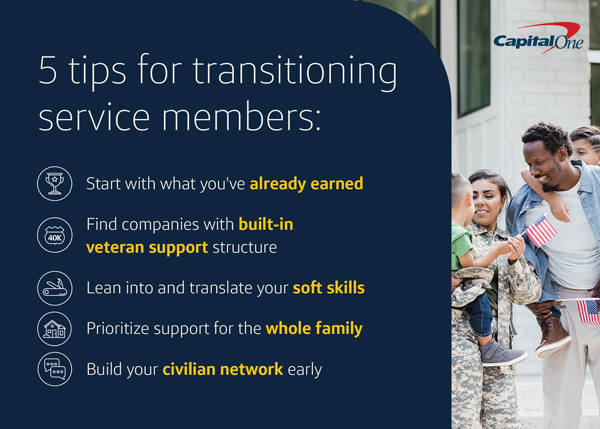
Start With What You’ve Already Earned
Opportunity starts with preparation. Beyond the well-known Post-9/11 GI Bill, which can cover tuition, housing and books, transitioning service members can look into vocational rehab or the SkillBridge program, which allows them to do civilian internships during the last 180 days of service. Many employers also offer internal tuition reimbursement programs. Taking the time to proactively map out these benefits ensures you aren’t leaving valuable opportunities or money on the table.
Find Employers with Veteran Support Structures
With almost half of veterans leaving their first post-military job within a year, according to research published by the Institute for Veterans and Military Families and VetAdvisor, finding the right culture and community is key to a successful transition. Look for employers with active veteran networks and dedicated mentorship.
For example, Capital One’s Salute Business Resource Group serves as a thriving internal community of more than 6,000 members, offering peer support, year-round professional development and mentorship for veterans, reservists and military spouses. Additionally, partner organizations like Hiring Our Heroes provide career workshops, fellowships and job fairs to ensure you’re employment-ready from day one.
Lean Into and Translate Your Soft Skills
Veterans bring a distinct competitive advantage to the applicant pool. You should confidently lean into the cross-functional “soft skills” learned in the line of duty such as risk management, crisis resolution and building trust under high-pressure scenarios.
The trick is translating these capabilities out of military jargon on your resume. Swap military terms like “NCOIC” for “Operations Manager” or “commanded” for “directed.” To make this easier, look for military-friendly employers that employ dedicated military recruiters who specialize in decoding military resumes to align skills with the right roles.
Prioritize Support for the Whole Family
Military service is a family commitment, and the transition out of uniform affects everyone. Military spouses often face unique career hurdles, including frequent relocations and employment gaps. When evaluating employers, look for companies that offer holistic benefits and flexible structures.
For example, Capital One, recognized by “U.S. Veterans Magazine” as a Top Veteran Employer and Top Military Spouse Employer, actively supports military spouses and families through dedicated spouse hiring initiatives and internal support mechanisms. Furthermore, look for organizations that support continued military training and active-duty leave, ensuring military associates never have to choose between their service and their careers.
Build Your Civilian Network Early
In the military, your network is built in. In the civilian world, you have to cultivate it. Long before your terminal leave begins, connect with veterans who work at companies you admire. Reach out for brief, 15-minute informational interviews to learn about their transition journeys rather than simply asking for a job. With more than 70% of civilian jobs filled through networking, according to estimates from Career Horizons, making organic connections early is a powerful tool for getting your foot in the door.
To find additional resources and learn more about how to support the hiring of veterans and military spouses, visit CapitalOneCareers.com/Military.
Photo courtesy of Shutterstock

SOURCE:

Food and Beverage
Beyond Protein: 2 Nutrients Your Plate Might Be Missing
Nutrients: Everyone is talking about protein these days whether watching their weight or managing a disease like type 2 diabetes. However, fiber and healthy fats are nutrients many people are overlooking. One food that makes it easier to invest in your health, according to nutrition experts: avocados.


Beyond Protein: 2 Nutrients Your Plate Might Be Missing
(Feature Impact) Everyone is talking about protein these days whether watching their weight or managing a disease like type 2 diabetes. However, fiber and healthy fats are nutrients many people are overlooking. The latest reports show most Americans already meet or exceed recommendations for protein while nearly all (about 95%) do not eat enough fiber, and many people consume too much saturated fat versus unsaturated fat, according to the 2025 Dietary Guidelines Advisory Committee. Prioritizing ways to get more fiber and healthy fats on your plate could be key to managing weight and type 2 diabetes goals this summer.
One food that makes it easier to invest in your health, according to nutrition experts: avocados.
A growing body of research and materials from Avocados – Love One Today, a science-based resource, suggests fresh avocados offer weight management benefits, help with type 2 diabetes management and are good for blood sugar management.
 According to a study* of more than 27,000 adults published in the journal “Internal Medicine Review,” people who ate just over half of an avocado per day weighed 7.5 pounds less, had smaller waist sizes and tended to have healthier overall eating habits, including higher intakes of fiber and healthy fats, compared to people who didn’t eat avocados. Among the list of benefits, this delicious and healthy fruit uniquely contains fiber and healthy fats in each nutrient-dense bite which slows digestion, helping you feel satisfied and fuller longer which can help you consume fewer calories overall. In fact, if you’re using a GLP-1, avocados are one of the foods to add to your menu to make small meals feel more filling and satisfying while supporting nutrient needs.
Scientists also recently took a second look at the largest study* about avocado consumption to-date involving close to 1,000 adults, per the journal “Current Developments in Nutrition,” and found that consistently eating one avocado every day for six months (no other diet changes required) significantly reduced dietary glycemic load (GL) by nearly 14 points, a metric that evaluates how what you are eating is affecting your blood sugar levels. GL may be an important consideration in the management of chronic diseases like type 2 diabetes. By slowing digestion, fiber and healthy fats also support stable blood sugar levels.
There are many ways to enjoy avocados, including chopped, sliced, mashed, blended, in baked goods or even frozen. Avocados add flavor, variety and nutrition across the day.
Try these recipes for Avocado and Blueberry Chia Pudding, Avocado Breakfast Bowl with Leafy Greens for your next breakfast or snack.
*Remember: Small, consistent food choices can add up over time. Research suggests regularly eating avocados may support weight management and blood sugar targets while providing the fiber and healthy fats that many Americans are overlooking. These studies were supported by the Avocado Nutrition Center. While these findings are encouraging, the studies highlighted show an association, not cause and effect, and thus more research is needed to confirm these findings in other populations.
To explore evidence-based avocado nutrition information, along with practical tips and easy recipes, visit Avocados – Love One Today, a leading resource for avocado nutrition information.
Avocado and Blueberry Chia Pudding
- 1 1/2 cups plain, unsweetened soy milk (or milk of choice)
- 1 ripe, fresh avocado, halved, pitted and peeled
- 3/4 cup frozen blueberries
- 1/2 cup unsweetened vanilla Greek yogurt
- 1 tablespoon maple syrup
- 1/3 cup chia seeds
To Serve:
- 1/3 cup granola
- 1/3 cup fresh blueberries
- 1 kiwi, chopped
- 1/2 fresh, ripe avocado, halved, pitted, peeled and chopped
- In blender, puree soy milk, avocado, blueberries, yogurt and maple syrup until smooth. Pour mixture into storage container or bowl and add chia seeds. Whisk well to combine. Cover with lid or plastic wrap and refrigerate 4 hours or overnight, until thickened.
- To serve, divide into bowls and top with granola, fresh blueberries, kiwi and avocado.
- Notes: Use any milk (dairy or non-dairy) that you prefer in pudding. Use fresh blueberries or conventional frozen blueberries. Other topping options include: nuts, seeds, hemp hearts, sliced banana or strawberries, or nut butter.

Avocado Breakfast Bowl with Leafy Greens
Bowl:
- 1 medium sweet potato, chopped (about 1 3/4 cup)
- nonstick cooking spray
- 1/4 teaspoon smoked paprika
- 1/4 teaspoon garlic powder
- 1/4 teaspoon salt
- 1/2 cup quinoa
- 1 cup water, plus additional for boiling eggs, divided
- 2 eggs
- 2 cups arugula
- 1 ripe, fresh avocado, halved, pitted, peeled and chopped
- 1/4 cup pickled red onions
Avocado Tahini Dressing:
- 1/2 large avocado
- 1/4 cup tahini
- 1 lemon, juice only (2 tablespoons)
- 3/4 cup water
- 1 tablespoon fresh chives
- salt, to taste
- pepper, to taste
- Preheat oven to 400 F. Add chopped sweet potato to baking sheet. Spray with cooking oil then add smoked paprika, garlic powder and salt. Toss to coat in spices. Bake 22-25 minutes, or until tender.
- In medium saucepan, add quinoa and water. Bring to simmer and cover, cooking 12-15 minutes, or until quinoa is tender and fluffy.
- Fill small saucepan with water and bring to boil. Use slotted spoon to lower eggs into water. Cook 8 minutes then transfer eggs to bowl of ice water to cool before peeling.
- To make dressing: In small blender, puree avocado, tahini, lemon juice, water and fresh chives until smooth. Add more water, 1 tablespoon at a time, if needed, to thin until pourable. Season with salt and pepper, to taste.
- Assemble bowls, each with 1/2 sweet potato, 1/2 cup quinoa, 1 egg, 1 cup arugula, 1/2 avocado, 2 tablespoons pickled red onion and 3 tablespoons dressing. Reserve remaining dressing in refrigerator.

Heart-Healthy Frozen Avocado Banana Paleta
- 1 ripe, fresh avocado, halved, pitted, peeled and diced
- 4 cups orange juice
- 2 medium bananas, peeled and sliced
- 1 tablespoon lime juice
- 8 paper cups (5 ounces)
- 8 wooden craft sticks
- In blender, blend avocado, orange juice, bananas and lime juice on high until smooth. Divide into paper cups. Cover cups with aluminum foil. Insert one stick through center of each foil. Freeze 4 hours until firm.

SOURCE:
🍴 What’s your favorite food, recipe, or dining spot? Tell us in the comments! Then subscribe to the STM Daily News newsletter for fresh recipes, restaurant news, food trends, and delicious stories delivered straight to your inbox. Join our growing community of food lovers today!
health and wellness
Zepbound Linked to Lower Healthcare Costs in Adults 55+ With Obesity, Real-World Study Suggests

A new real-world study of adults over age 55 with overweight or obesity found that sustained use of Zepbound (tirzepatide) for weight management was associated with lower healthcare costs over time compared with similar adults who were not treated. Eli Lilly and Company said the findings were driven in part by lower rates of hospital admissions and emergency department visits, and were published in Diabetes, Obesity and Metabolism.
What the study found
According to Lilly, researchers estimated healthcare cost differences over time (excluding the cost of Zepbound itself) using two established analytic methods. Across both approaches, monthly healthcare costs were lower, on average, among older adults who stayed on Zepbound.
Key estimates reported in the release include:
- At six months: costs were up to 15% lower (up to $181 per patient, per month).
- At 12 months: the estimated difference widened to as much as $607 per patient, per month, reflecting up to 38% lower costs than those not treated (estimates varied by model).
In the primary analysis, adults over 55 treated with Zepbound had lower rates of hospital admissions and emergency department visits across every follow-up period, along with numerically higher rates of routine outpatient and office visitsa pattern the company said was consistent with greater engagement in routine care.
Why Medicare is part of the conversation
Lilly said the cost findings may be relevant for older adults, including those in Medicares GLP-1 Bridge program. The company noted that beginning at six months, estimated healthcare savings nearly covered the programs monthly treatment cost of $195 per patient, per month, and by 12 months the estimated savings exceeded the reported monthly treatment cost.
Its important to note the release also emphasizes a limitation: claims data do not capture Zepbounds net price, and the study excluded the cost of Zepbound from total treatment costs. That means the reported differences reflect potential savings elsewhere in care that could offset treatment costs, not the full net cost impact.
Who was included in the analysis
The retrospective observational cohort study used Komodos Healthcare Map, a database of de-identified claims data from more than 330 million individuals enrolled in U.S. healthcare plans. The analysis included 15,843 adults over age 55 (mean age 64.5) with obesity or overweight plus at least one obesity-related complication who initiated Zepbound between November 2023 and September 2025. Each Zepbound user was matched 1:1 with a control participant who met the same eligibility criteria but did not initiate GLP-1 or GIP/GLP-1 receptor agonist medication.
What Zepbound is
Zepbound (tirzepatide) is a dual GIP and GLP-1 receptor agonist indicated for adults with obesity, or some adults with overweight who also have at least one weight-related medical problem, to lose weight and keep it off. Lilly also noted Zepbound is FDA-approved to treat adults with moderate-to-severe obstructive sleep apnea and obesity, and should be used alongside a reduced-calorie diet and increased physical activity.
Safety summary (high level)
The release includes an indications and safety summary with warnings. Among other risks, Lilly notes Zepbound carries a warning about thyroid tumors, including thyroid cancer, and may cause serious side effects such as severe stomach problems, dehydration leading to kidney problems, gallbladder problems, pancreatitis, serious allergic reactions, and low blood sugar (especially when used with certain diabetes medicines). Patients should talk with a healthcare provider about risks and whether the medication is appropriate for them.
Related Links
- Zepbound (official product site): https://zepbound.lilly.com/
- Lilly newsroom: https://www.lilly.com/news
- Journal page (publisher hub): https://dom-pubs.onlinelibrary.wiley.com/journal/14631326
- Medicare (official): https://www.medicare.gov/
- FDA MedWatch (side effect reporting): https://www.fda.gov/medwatch
Source
- PRNewswire / Eli Lilly and Company press release (Aug. 26, 2026): Zepbound linked to lower healthcare costs in adults over age 55 with obesity according to a real-world study
💪 Your health journey starts here! Explore the latest health news, fitness tips, wellness trends, and healthy living advice. Share your thoughts in the comments and subscribe to the STM Daily News newsletter to stay informed and inspired every day.





