News
A boycott campaign fuels tension between Black shoppers and Black-owned brands – evoking the long struggle for ‘consumer citizenship’
Target’s recent decision to end its diversity programs has sparked backlash among Black consumers and entrepreneurs. While some call for a boycott, others caution that it could harm Black businesses more than the retailer.


Timeka N. Tounsel, University of Washington
Some Black consumers may be breaking up with Target this February.
It all started late last month, when the retailer announced that it was ending its diversity, equity and inclusion programs. The move drew widespread rebuke from social justice organizers, including New Birth Missionary Baptist Church Pastor Dr. Jamal Bryant. Although Target said one set of its racial-equity initiatives had already been scheduled to conclude, the timing was notable: The move came just days after the White House called for a federal DEI ban, and as several other companies took similar actions.
Beyond renaming its “supplier diversity” team – now called “supplier engagement” – and ending “diversity-focused surveys,” Target hasn’t said what the change will mean for the many Black entrepreneurs who sell everything from coffee to sunscreen on its shelves. The webpage for the retailer’s Black Beyond Measure initiative, which highlights dozens of Black-founded brands and connects business owners to a program designed to “democratize access to retail education,” remains active.
But Target’s critics, including Minneapolis-based civil rights attorney Nekima Levy Armstrong, view the move as a surrender to the new presidential administration’s attack on equity programs. In a news conference outside Target’s Minnesota headquarters on Jan. 30, 2025, Armstrong called for a nationwide boycott of the store to begin on the first day of Black History Month.
While many social media users posted in support of the boycott, some Black founders whose brands are stocked by Target – and there are dozens of them – have been more conflicted. Tabitha Brown, whose products can be found in various aisles, from books to cooking appliances, asked customers to reconsider boycotting Target. Withholding their dollars, Brown insisted, will hurt Black businesses far more than the corporations that sell their products.
This request for restraint garnered a mixed response on social media. Some Black consumers accused Black business owners of selling out the very racial community that contributed to their success.
So, why would a Black business owner ask consumers to patronize a retailer that signaled it doesn’t care about Black customers? And how did something as mundane as where people buy toilet paper and shampoo become a litmus test for racial consciousness in the first place?
Black consumers and the fight for dignity
The marketplace has long been a battleground where Black Americans have sought to assert their citizenship. Most of the nation’s biggest household brands didn’t begin to take African American consumers seriously until after World War II. Before that shift, advertisements and product packaging were more likely to feature degrading Black caricatures to appeal to white shoppers, than to address Black consumers directly.
This segregated commercial landscape reinforced the belief among some community members that Black people would not be taken seriously as citizens until they were taken seriously as consumers. They would need to vote with their dollars, patronizing only those brands and retailers that respected them.
In my research on marketing campaigns aimed at Black women, I’ve examined how the struggle for consumer citizenship complicated the dynamic between Black entrepreneurs and consumers. On the one hand, businesses have long leveraged Black ownership as a unique selling proposition in and of itself, urging shoppers to view Black brand loyalty as a path to collective racial progress.
Unlike their larger competitors, Black entrepreneurs relied on their racial community to stay afloat. Patronizing African American businesses could therefore be framed as a racial duty. Conversely, as African American advertising pioneers made clear, recognition from big brands was a political victory of sorts because it signaled that Black dollars were just as valuable as anyone else’s. https://www.youtube.com/embed/SAFubUnsl3Y?wmode=transparent&start=0 A short documentary from The Advertising Club of New York featuring iconic ads from African American marketer Tom Burrell.
Competing for Black dollars
Corporate attention to Black consumers ebbs and flows in a cycle that is especially noticeable in the beauty and personal care industry. In seasons of limited competition for African American customers, entrepreneurs typically thrive, even while they struggle to meet the capital demands of a growing brand. Their success, however, beckons larger corporations, which then seek to capitalize on consumer niches they previously ignored.
Two common approaches that mass market brands pursue to compete for Black dollars include acquiring smaller, established Black brands and developing their own niche products. Large corporations deployed both strategies during a period of intense expansion into the beauty market of the 1980s.
Black owners tried to stave off their competition by creating a special emblem that alerted shoppers to their authenticity. Then, as now, social justice organizations, such as Rev. Jesse Jackson’s Operation PUSH, also initiated boycotts and urged Black consumers not to choose “lipstick over liberation.”
Nevertheless, many Black entrepreneurs sold their brands, and by 1986 nearly half of the Black hair care market was no longer Black-owned.
A linked fate
Parsing winners and losers within the world of Black enterprise is as difficult now as it was in earlier periods. African American business owners often possess a cultural consciousness that distinguishes their brands, even when they can’t match the resources of larger competitors. And as they figure out how to survive an uneven playing field, Black entrepreneurs sometimes face accusations of betraying their racial community.
In a market governed by the law of supply and demand, Black consumers benefit from increased competition. Yet, racial loyalty sometimes asks that they eschew these benefits for the sake of keeping Black dollars in Black hands.
Four years ago, when Target launched its Black Beyond Measure funding initiative, it seemed that the retailer had struck a rare balance in supporting Black brands and their customers. In addition to curating a collection of products to lure shoppers, Target used the campaign as an opportunity to position entrepreneurs to flourish well beyond Black History Month.
Now, as Black consumers and business owners weigh varying responses to the retailer’s decision to reverse their commitment to DEI values, one question endures: Do Black dollars matter?
Timeka N. Tounsel, Associate Professor of Black Studies in Communication, University of Washington
This article is republished from The Conversation under a Creative Commons license. Read the original article.

News
Hit Rewind and Rediscover the Magic of ’90s Holiday Nostalgia
The Magic of ’90s Holiday Nostalgia: If you reminisce on the days when the toy catalog was required reading, photos took a week to develop and the only way to reach the North Pole was on a landline, this holiday season may offer an opportunity to take yourself back a few years – or decades.


Hit Rewind and Rediscover the Magic of ’90s Holiday Nostalgia
(Feature Impact) If you reminisce on the days when the toy catalog was required reading, photos took a week to develop and the only way to reach the North Pole was on a landline, this holiday season may offer an opportunity to take yourself back a few years – or decades.
Parents today are looking to recreate the festive memories they grew up with, according to new research from Club Wyndham, the nation’s largest vacation ownership club, in which they ranked the 1990s as the most nostalgic holiday decade. That nostalgia is already shaping how families celebrate as 93% of parents reported they regularly or occasionally recreate elements of their childhood holidays for their own families.
This year, you can take it a step further by traveling back to those beloved ’90s.
Watch this video to see more:
//www.youtube.com/embed/WHqR2p14Bpo
Press rewind with the help of Club Wyndham with its launch of the Holiday Rewind Suite, an immersive stay inspired by Christmas 1999 at Club Wyndham Midtown 45. With assistance from ’90s sitcom icon and spokesperson Jodie Sweetin, travelers are invited to trade streaming and scrolling for VHS movies, board games, disposable cameras and landline calls to Santa.
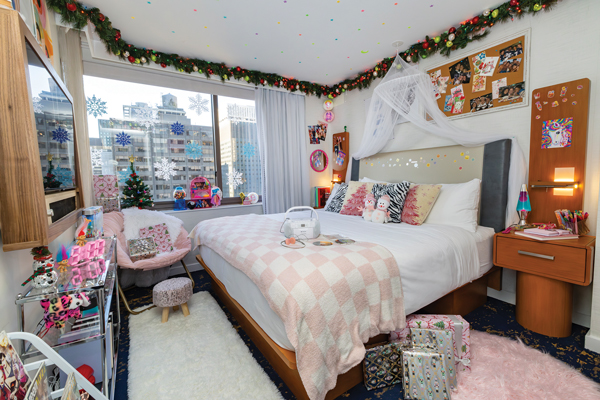 A cozy, colorful living room sits at the heart of the experience featuring wood paneling, retro-patterned wallpaper, festive tinsel, vintage decor and classic holiday trimmings surrounding a twinkling tree. An acrylic landline phone, wall of old-school holiday cards and wish-list-worthy toys from the era adorn the space, while a separate bedroom channels a quintessential late-’90s teen room that’s complete with glow-in-the-dark stars on the ceiling, retro posters, a lava lamp and more.
“Come for the nostalgia, stay for the time together and leave with new memories you’ll keep replaying,” Sweetin said.
The suite is bookable from Nov. 6, 2026-Jan. 4, 2027, and one lucky winner of the Holiday Rewind “Suite-Stakes” will unwrap the ultimate holiday throwback with a complimentary two-night stay from Dec. 18-20, including round-trip economy airfare for two guests.
Book your getaway or enter to win today at ClubWyndham.com/HolidayRewind.
SOURCE:

The Knowledge
Asteroid 1998 KY26: Can Sunlight Explain Its Motion?
Sunlight may explain the unusual motion of asteroid 1998 KY26. A new study casts doubt on the dark comet theory, and Japan has canceled its planned visit.

Last Updated on November 20, 2026 by Daily News Staff

A tiny asteroid about the length of a school bus has been drifting slightly off the path astronomers would predict from gravity alone. The object, known as 1998 KY26, spins once every five minutes and 21 seconds. One of the strongest explanations for its unusual motion comes from a familiar source: sunlight.
In a 2025 study, researchers led by NASA’s Jet Propulsion Laboratory modeled two small forces acting on the roughly 36-foot-wide asteroid. Sunlight exerts pressure when it strikes the surface, and the asteroid gets another tiny push as it radiates heat back into space. When the team accounted for the asteroid’s irregular shape and rapid spin, the model closely matched its observed trajectory.
A newer study published in Icarus casts doubt on another explanation. Astronomers had proposed that escaping water vapor might give KY26 a gentle push without producing a visible tail, making it a candidate for what scientists call a “dark comet.” But temperature simulations found that even the object’s coldest regions would be too warm to hold on to buried water ice over long periods. The findings make long-lived ice a less likely source of the asteroid’s extra acceleration.
A close-up look was planned for 2031, when Japan’s Hayabusa2 spacecraft was due to rendezvous with KY26. On November 17, Japan’s space agency announced that ion-engine trouble had forced a change of plans. The spacecraft is now slated to fly past a different asteroid, 2015 BM510, in April 2028.
Sources
EarthSky, November 20, 2026. Paul Scott Anderson covers the unusual motion of 1998 KY26, the proposed explanations, and the cancellation of Hayabusa2’s planned visit. Mystery space object moves in strange ways- Solar radiation and the orbit. The 2025 study found that sunlight pressure and heat emitted by the asteroid could reproduce its observed trajectory. The Astrophysical Journal Letters
— Radiation Forces and Trajectory of Hayabusa2 Target 1998 KY26
- The new water-ice study. Temperature modeling suggests buried water ice would have difficulty surviving over long periods. Icarus
— Thermally Unfavorable Conditions of Volatile Existence in Near-Earth Asteroid 1998 KY26
- Size and rotation. The team used optical and radar observations to revise the asteroid’s estimated diameter and spin rate. Nature Communications
— 1998 KY26 Is Smaller and Rotating Faster Than Previously Known
- Hayabusa2 mission change. JAXA’s November 17 briefing details the switch from the KY26 rendezvous to a flyby of 2015 BM510. JAXA mission briefing (PDF, Japanese)
· Jiji Press coverage in English
Related reading on STM Daily News
- Large Asteroid 1999 AN10 Will Safely Pass Earth in August 2027
- Asteroid Apophis: An Exciting Encounter with Earth
- Interstellar Visitor 3I/ATLAS Surprises Astronomers With Growing Tail and Strange Chemistry
Transportation
LA Metro’s D Line Extension to Century City Needs $296 Million More as Completion Slips
LA Metro is seeking another $296 million for D Line Extension Section 2 as the project’s substantial-completion forecast shifts from spring to fall 2027. Metro has not announced a replacement date for passenger service to Beverly Hills and Century City.

LOS ANGELES — The next segment of LA Metro’s D Line subway extension is facing a major cost increase and a later construction milestone as the agency works to finish stations serving Beverly Hills and Century City.
Metro staff is asking the agency’s Board of Directors to increase the life-of-project budget for D Line Extension Section 2 by $296 million, from approximately $2.575 billion to $2.871 billion. The proposed increase amounts to about 11.5 percent of the project’s current budget.
According to a Metro Board report, Section 2 was 95 percent complete as of September 2026. However, its unallocated contingency had fallen to approximately $6.7 million, an amount Metro says is insufficient to carry the project through completion.
Contractor settlement and additional construction costs
The requested funding includes a $151 million settlement with design-build contractor Tutor Perini/O&G over a time-related claim. The contractor initially sought more than $200 million, while other claims and notices brought the total potential value of the disputed issues above $357 million.
Metro also identified approximately $75 million in added cost exposure connected to a secondary tunnel liner. Other expenses include additional construction work, real estate costs, extended professional services and restored contingency for remaining risks.
This would be the project’s second major budget increase. The Metro Board approved an additional $134 million in July 2023, after a Federal Transit Administration risk assessment found that the project’s budget was insufficient.
Completion shifts to fall 2027
The negotiated settlement also changes the contractor’s milestone schedule. Metro says the forecast for substantial completion has shifted from spring 2027 to fall 2027.
Metro had previously listed spring 2027 as the start of passenger operations for Section 2. The agency has not announced a revised revenue-service date in the new Board report. Because substantial completion is now forecast for fall 2027, the previous spring opening timetable no longer appears achievable. Testing, safety certification and operating preparations would still be required before riders can use the extension.
Section 2 will extend D Line service about 2.6 miles west from Wilshire/La Cienega, adding the Beverly Drive and Century City stations. It is the middle portion of Metro’s nine-mile Westside subway expansion. Section 1 opened in May 2026, while Section 3 is intended to continue the line to Westwood/UCLA and the Westwood/VA Hospital.
How Metro proposes to cover the increase
Metro staff recommends using $296 million in Measure R transit-capital funds currently programmed for the Division 20 rail-yard program. Proposition A funds would then replace that money for Division 20.
The report says reducing the scope, shortening the segment or relying on additional value engineering is no longer practical because construction is so advanced. Metro warns that without the budget amendment, it would be unable to fund completion according to the current schedule.
The proposal is scheduled for consideration by Metro’s Finance, Budget and Audit Committee on November 19, 2026. The budget amendment will still require Board approval.
The disclosure is consequential for riders because it places both the cost and timing of the Beverly Hills–Century City extension under renewed scrutiny. Although the subway is approaching completion, Metro must now secure hundreds of millions of dollars more and establish a realistic opening timetable for one of the region’s most important transit expansions.