Connect with us

The Bridge

200 years ago, France extorted Haiti in one of history’s greatest heists – and Haitians want reparations

Published

on

Haiti
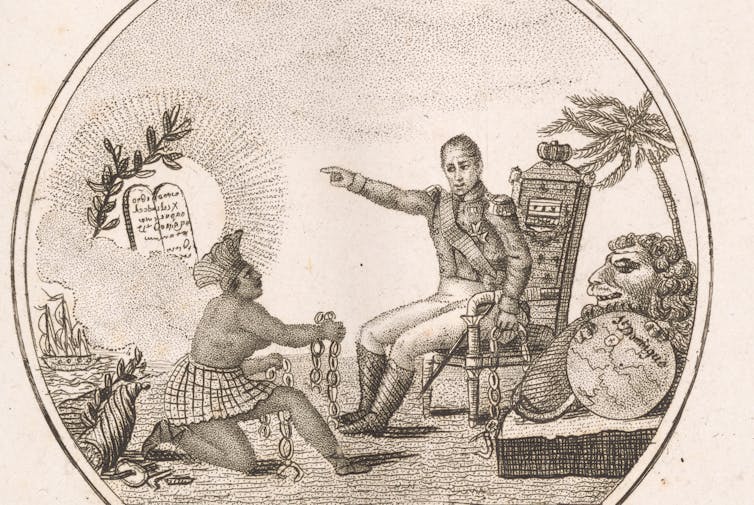
A French propaganda engraving from 1825 depicts King Charles X bestowing freedom on a Black man kneeling before him in chains.
‘S.M. Charles X, le bien-aimé, reconnaissant l’indépendance de St. Domingue,’ 1825, Bibliothèque Nationale de France, Cabinet des Estampes, CC BY-SA

Marlene L. Daut, Yale University

In 2002, Haiti’s former president Jean-Bertrand Aristide argued that France should pay his country US$21 billion.

The reason? In 1825, France extracted a huge indemnity from the young nation, in exchange for recognition of its independence.

April 17, 2025, marks the 200th anniversary of that indemnity agreement. On Jan. 1 of this year, the now-former president of Haiti’s Transitional Presidential Council, Leslie Voltaire, reminded France of this call when he requested that France “repay the debt of independence and reparations for slavery.” In March, tennis star Naomi Osaka, who is of Haitian descent, added her voice to the chorus in a tweet wondering when France would pay Haiti back.

As a scholar of 19th-century Haitian history and culture, I’ve dedicated a significant portion of my research to exploring Haiti’s particularly strong legal case for restitution from France.

The story begins with the Haitian Revolution.

France instituted slavery in the colony of Saint-Domingue on the western third of the island of Hispaniola – today’s Haiti – in the 17th century. In the late 18th century, the enslaved population rebelled and eventually declared independence. In the 19th century, the French demanded compensation for the former enslavers of the Haitian people, rather than the other way around.

Just as the legacy of slavery in the United States has created a gross economic disparity between Black and white Americans, the tax on its freedom that France forced Haiti to pay – referred to as an “indemnity” at the time – severely damaged the newly independent country’s ability to prosper.

The cost of independence

Haiti officially declared its independence from France on Jan. 1, 1804. In October 1806, following the assassination of Haiti’s first head of state, the country was split into two, with Alexandre Pétion ruling in the south and Henry Christophe ruling in the north.

Despite the fact that both Haiti rulers were veterans of the Haitian Revolution, the French had never quite given up on reconquering their former colony.

In 1814, King Louis XVIII, restored as king after the overthrow of Napoléon earlier that year, sent three commissioners to Haiti to assess the willingness of the country’s rulers to surrender. Christophe, crowned king in 1811, remained obstinate in the face of France’s exposed plan to bring back slavery. Threatening war, the most prominent member of Christophe’s cabinet, Baron de Vastey, insisted,“ Our independence will be guaranteed by the tips of our bayonets!”

Advertisement
Get More From A Face Cleanser And Spa-like Massage

In contrast, Pétion, the ruler of the south, was willing to negotiate, hoping that the country might be able to pay France for recognition of its independence.

In 1803, Napoléon had sold Louisiana to the United States for US$15 million. Using this number as his compass, Pétion proposed paying the same amount. Unwilling to compromise with those he viewed as “runaway slaves,” Louis XVIII rejected the offer.

Pétion died suddenly in 1818, but Jean-Pierre Boyer, his successor, kept up the negotiations. Talks, however, continued to stall due to Christophe’s stubborn opposition.

“Any indemnification of the ex-colonists,” Christophe’s government stated, was “inadmissible.”

Once Christophe died in October 1820, Boyer was able to reunify the two sides of the country. However, even with the obstacle of Christophe gone, Boyer repeatedly failed to successfully negotiate France’s recognition of independence. Determined to gain at least suzerainty over the island – which would have made Haiti a protectorate of France – Louis XVIII rebuked the two commissioners Boyer sent to Paris in 1824 to try to negotiate an indemnity in exchange for recognition.

On April 17, 1825, Charles X, brother to Louis XVIII and the new French king, performed a sudden about-face. Charles X issued a decree stating that France would recognize Haitian independence but only at the price of 150 million francs – or nearly twice the 80 million francs the U.S. had paid for the Louisiana territory.

Baron de Mackau, whom Charles X sent to deliver the ordinance, arrived in Haiti in July, accompanied by a squadron of 14 brigs of war carrying more than 500 cannons.

His instructions stated that his “mission” was “not a negotiation.” It was not diplomacy either. It was extortion.

Amid the threat of violent war and a looming economic blockade, on July 11, 1825, Boyer signed the fatal document, which stated, “The present inhabitants of the French part of St. Domingue shall pay … in five equal installments … the sum of 150,000,000 francs, destined to indemnify the former colonists.”

French prosperity built on Haitian poverty

Newspaper articles from the period reveal that the French king knew the Haitian government was hardly capable of making these payments, as the amount was nearly six times Haiti’s total annual revenue. The rest of the world seemed to agree that the agreement was absurd. One British journalist noted that the “enormous price” constituted a “sum which few states in Europe could bear to sacrifice.”

Advertisement
Get More From A Face Cleanser And Spa-like Massage

Forced to borrow 30 million francs from French banks to make the first two payments, it was hardly a surprise to anyone when Haiti defaulted soon thereafter. Still, a subsequent French king sent another expedition in 1838 with 12 warships to force the Haitian president’s hand. The 1838 revision, inaccurately labeled “Traité d’Amitié” – or “Treaty of Friendship” – reduced the outstanding amount owed to 60 million francs, but the Haitian government was once again ordered to take out crushing loans to pay the balance.

It was the Haitian people who suffered the brunt of the consequences of France’s theft. Boyer levied draconian taxes in order to pay back the loans. And while Christophe had been busy developing a national school system during his reign, under Boyer, and all subsequent presidents, such projects had to be put on hold. Moreover, researchers have found that the independence debt and the resulting drain on the Haitian treasury were directly responsible not only for the underfunding of education in 20th-century Haiti, but also for the lack of health care and the country’s inability to develop public infrastructure.

A 2022 analysis by The New York Times, furthermore, revealed that Haitians ended up paying more than 112 million francs over seven decades, or $560 million – estimated between $22 billion and $44 billion in today’s dollars. Recognizing the gravity of this scandal, French economist Thomas Piketty has argued that France should repay at least $28 billion to Haiti in restitution.

A debt that’s both moral and material

Former French presidents, from Jacques Chirac to Nicolas Sarkozy to François Hollande, have a history of punishing, skirting or downplaying Haitian demands for recompense.

In May 2015, when Hollande became only France’s second head of state to visit Haiti, he admitted that his country needed to “settle the debt.” Later, realizing he had unwittingly provided fuel for the legal claims already prepared by attorney Ira Kurzban on behalf of the Haitian people, Hollande clarified that he meant France’s debt was merely “moral.”

To deny that the consequences of slavery were also material is to deny French history itself. France belatedly abolished slavery in 1848 in its remaining colonies of Martinique, Guadeloupe, Réunion and French Guyana, which are still territories of France today. Afterward, the French government demonstrated once again its understanding of slavery’s relationship to economics when it financially compensated the former “owners” of enslaved people.

The resulting racial wealth gap is no metaphor. In metropolitan France, 14.1% of the population lives below the poverty line. In Martinique and Guadeloupe, in contrast, where more than 80% of the population is of African descent, the poverty rates are 38% and 46%, respectively. The poverty rate in Haiti is even more dire at 59%. And whereas the gross domestic product per capita – the best measure of a country’s standard of living – is $44,690 in France, it’s a mere $1,693 in Haiti.

These discrepancies can be viewed as the concrete consequences of stolen labor from generations of Africans and their descendants.

In recent years, French academics have begun to increasingly contribute to the conversation about the longitudinal harms the indemnity brought to Haiti. Yet what effectively amounts to a statement of “no comment” has historically been the only response from France’s current government under President Emmanuel Macron.

On April 17, 2025, the bicentennial of the indemnity ordinance, Macron finally broke his silence. In an official communiqué, Macron acknowledged the “heavy financial indemnity” his country imposed upon Haiti and announced “a joint Franco-Haitian commission responsible for examining our common past and shedding light on all its dimensions.” But he did not address the question of reparations.

Advertisement
Get More From A Face Cleanser And Spa-like Massage

Many Haitians were rightfully not satisfied: the only initiative from France that would really matter, they said, would be one detailing how it plans to provide economic recompense to the Haitian people.

This is an updated version of an article originally published on June 30, 2020.The Conversation

Marlene L. Daut, Professor of French and African American Studies, Yale University

This article is republished from The Conversation under a Creative Commons license. Read the original article.

Continue Reading
Advertisement SodaStream USA, inc

Lifestyle

P.F. Chang’s Partners With Starlight Children’s Foundation for New “Spirit of the Zodiac” Giving Campaign

P.F. Chang’s launches Spirit of the Zodiac, a giving campaign supporting Starlight Children’s Foundation with Bao plush purchases and in-restaurant donations.

Published

on

P.F. Chang’s Launches Spirit of the Zodiac Campaign to Support Starlight Children’s Foundation
P.F. Chang’s and Starlight Children’s Foundation

P.F. Chang’s Launches Spirit of the Zodiac Campaign to Support Starlight Children’s Foundation

P.F. Chang’s is launching a new annual charitable initiative designed to bring comfort to children during hospital stays. The Scottsdale-based restaurant brand announced Spirit of the Zodiac, a giving program inspired by the Chinese zodiac, with its inaugural campaign—Year of the Fire Horse: Spirit of Strength—benefiting Starlight Children’s Foundation.

What the campaign supports

Starlight Children’s Foundation serves more than 800 children’s hospitals nationwide, providing programs such as toy deliveries, hospital gowns, gaming stations, and other experiences intended to help kids feel more comfortable, connected, and supported during medical care.

How guests can participate (Sept. 2–Sept. 30)

From September 2 through September 30, 2026, guests can purchase Bao, a limited-edition horse plushie, for $10 through dine-in transactions at participating P.F. Chang’s restaurants (while supplies last). For each Bao purchased, P.F. Chang’s will donate an identical Bao plushie to Starlight for distribution through its hospital network—up to 20,000 donated plushies.

Guests can also support the campaign by rounding up their checks or making a direct donation in restaurant. The overall effort aims to raise $500,000 to support Starlight’s work with children and families.

Bonus offer for donors

P.F. Chang’s says guests who purchase Bao or make an in-restaurant donation of $10 or more to Starlight will receive an offer for a complimentary appetizer with the purchase of an entrée on a future dine-in visit, valid through October 31, 2026 (restrictions apply; participating locations only).

A story component for families

The campaign also includes a storytelling element: Bao’s journey will be featured in a digital story and an original children’s book by author Jenny Liao and illustrator Adriane Tsai, expected to publish later this month.

What to watch for

P.F. Chang’s and Starlight plan to continue the partnership beyond September, including in-hospital catering and plush deliveries in early October.

For more information, visit www.pfchangs.com/offers/spirit-of-the-zodiac. To learn more about the partnership, visit starlight.org/pfchangs.

💪 Your health journey starts here! Explore the latest health news, fitness tips, wellness trends, and healthy living advice. Share your thoughts in the comments and subscribe to the STM Daily News newsletter to stay informed and inspired every day.

Continue Reading

Community

9/11 Day Awards $3 Million in Grants to Expand Volunteer Opportunities Nationwide Ahead of 25th Anniversary

9/11 Day announced $3 million in grants to nearly 200 groups across 40 states, expanding service projects for the 25th anniversary observance.

Published

on

one world trade center an other skyscrapers in new 2026 01 08 21 59 49 utc
New York City, USA – June 20, 2018: One World Trade Center and other skyscrapers against blue sky in Financial District of Manhattan. Business and technology background

As the United States approaches the 25th anniversary of September 11, 2001, the nonprofit 9/11 Day is putting major resources behind a familiar idea with renewed urgency: remembrance through service. The organization—founded by 9/11 families and leaders and co-led by co-founders David Paine and Jay Winuk—announced $3 million in grants to roughly 200 nonprofits, schools, and community groups across 40 states to expand local volunteer projects tied to this year’s September 11 National Day of Service and Remembrance.

The funding is designed to dramatically increase the number of ways Americans can participate close to home, from food insecurity initiatives to neighborhood cleanups and support programs for veterans and first responders. Together, grant recipients are expected to engage more than 70,000 volunteers nationwide.

A major push toward youth-led service

More than 70% of the grant funding is going to youth organizations and educational institutions, including K–12 schools, universities, and other learning programs. The emphasis reflects a generational reality: millions of students today know 9/11 primarily through textbooks, family stories, and classroom lessons.

“For many students participating in the observance this year, 9/11 is something they’ve only encountered in textbooks or through stories from parents and grandparents,” said Jay Winuk, co-founder and executive vice president of 9/11 Day and a 9/11 family member. “By connecting history with hands-on service, we’re helping young people understand that the legacy of 9/11 isn’t defined only by tragedy. It’s also defined by compassion, resilience and the responsibility we all share to care for one another.”

Youth-focused projects supported by the grants include school-wide days of service, hunger-relief efforts, donation drives, community improvement work, and service-learning initiatives that connect the history of September 11 with practical ways to help others.

UNIITE for Good: turning an anniversary into a nationwide “doing good” moment

The grant program is a cornerstone of 9/11 Day’s nationwide UNIITE for Good campaign, scheduled to officially launch August 24. The campaign aims to transform the 25th anniversary into what organizers describe as America’s largest day of doing good—channeling remembrance into tangible community impact.

The program is administered in collaboration with AmeriCorps, with principal funding provided by AmeriCorps and the Popeyes Foundation. A special emphasis this year is addressing hunger—an issue described in the release as an “ever-growing hunger crisis across the nation.”

Meeting community needs where people live

Grant-funded projects span urban, suburban, and rural communities. Activities include assembling meals for individuals and families facing food insecurity, packing care kits for veterans and first responders, restoring community spaces, and strengthening schools and neighborhoods.

Beyond the service itself, the grants are also intended to help local groups recruit volunteers, purchase supplies, coordinate logistics, and expand the number of service opportunities available in their areas.

“As we mark the 25th anniversary of 9/11, we have a responsibility to preserve not only the memory of that day and those lost and injured, but also the extraordinary way Americans came together in the aftermath of the attacks,” said David Paine, president and co-founder of 9/11 Day. “These community-led projects are helping rekindle that spirit of unity, compassion and service by bringing neighbors together to help solve local challenges.”

AmeriCorps echoed that message, framing service as a way to honor those who responded in the immediate aftermath of the attacks.

Advertisement
Get More From A Face Cleanser And Spa-like Massage

“This year, we invite Americans to carry forward that enduring spirit of unity and service by becoming a hero for someone in need,” said Emily Stock, project manager for Volunteer Initiatives at AmeriCorps, noting that AmeriCorps-funded projects will include food drives, home repairs, neighborhood cleanups, and disaster preparedness activities.

The Popeyes Foundation also highlighted its community-focused mission and its role in supporting local projects.

Why this anniversary matters now

Organizers say the 25th anniversary arrives at a pivotal moment: more than 100 million Americans are now too young to have personal memories of September 11. That makes this milestone one of the last major opportunities to connect those who lived through the day with younger generations learning about it as history.

Examples of grant-supported efforts include:

  • Marshall University, which plans to build on its existing 9/11 Days of Service tradition, including a Memorial Stair Challenge and volunteer projects supporting veterans, first responders, and families in need.
  • Middlebury Elementary School, which will expand hands-on service activities that teach younger students about 9/11 through compassion and community action.
  • University of South Dakota, where students will work alongside community partners to address local needs while learning how service can bridge backgrounds and perspectives.

How to get involved

A full list of 2026 9/11 Day Grant Program recipients is available through 9/11 Day. To learn more about the September 11 National Day of Service and Remembrance—and to find ways to participate—visit 911day.org.

STM Daily News will continue tracking community service initiatives and local observances tied to the 25th anniversary as September approaches

Start Your Morning Informed

Get the STM Morning Brief delivered to your inbox every weekday with breaking news, transportation updates, technology, science, and trending stories.

STM News Brief Ad 2

We don’t spam! Read our privacy policy for more info.

Advertisement
Get More From A Face Cleanser And Spa-like Massage
Continue Reading

STM Blog

Dolly Parton was more than a musical idol – for some fans, she was a spiritual icon

Dolly Parton’s faith, philanthropy and message of love and acceptance made her more than a country music legend—many admirers viewed her as a spiritual icon.

Published

on

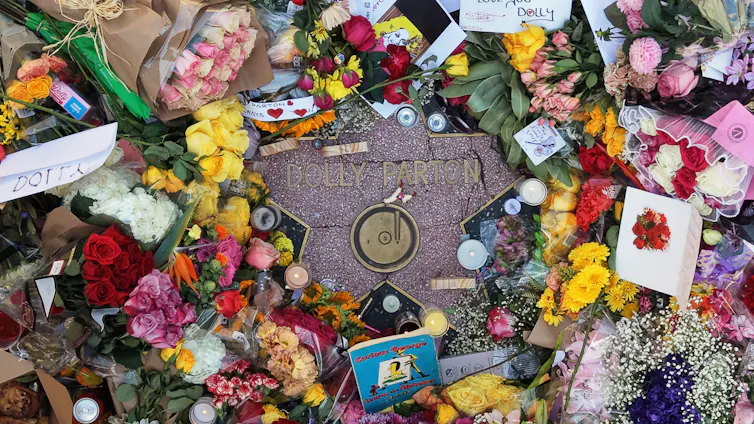
A heap of flowers, notes and photos lie on top of a star-shaped stone that says 'Dolly Parton.'
The legendary artist often spoke about her own evolving faith. AP Photo/Jae C. Hong

Sarah Dees, Iowa State University

As soon as news broke about the death of beloved songwriter Dolly Parton, I began receiving condolence messages from across the country, and around the world.

They came from friends, family and colleagues who knew I’d been working on a biography of the country legend – everyone from a conservative Catholic monk to advocates for queer and trans rights. The list reflects the even more diverse array of fans, people from countless backgrounds, who are mourning her loss.

The main focus of my project is Parton’s own spirituality, starting with her Appalachian upbringing. But it also examines her fandoms, including some people who elevate the singer to an almost sacred status. This was the case before her death – and even more so now.

As a scholar of American religions, I teach my students about practices, texts and beliefs that many of them immediately consider “religious” – for example, a worship service led by a pastor. However, religion is also found far beyond these official times and spaces, including in popular culture. According to scholar America Wolff, fandoms resemble religious groups in the way they focus on a single popular figure who inspires systems of belief, ritual and law.

Singer’s journey

Looking at Parton’s life reveals how a celebrity can incorporate religion into their public persona, without ostracizing admirers from other traditions. She discussed religion in interviews throughout her career, as well as in her 1994 memoir, where she recounted her maternal grandfather, a fundamentalist pastor, preaching hellfire and brimstone.

In 1971, for example, she told journalist Gene Guerrero how religion inspired some of her songs: “My mama used to read us all the Bible stories. I know the Bible pretty well, and I especially loved the stories.” That same year, she released “The Golden Streets of Glory,” the first of her several gospel albums.

‘The Golden Streets of Glory’ was the title track of Parton’s first gospel album.

Six years later, talking with Rolling Stone interviewer Chet Flippo, Parton claimed that she wasn’t a Christian. But “I do believe, I know there is a God and He is still the best friend I got in the world,” she explained. “I talk to Him often, but I’m one of the world’s sinners.”

Later in her life, though, Parton embraced the label “Christian” – albeit in a way that was very much her own. In the memoir “My Life and Other Unfinished Business,” she explained that “Christianity and its symbols are powerful parts of my life.” However, she diverged from socially conservative elements of her grandfather’s faith by embracing makeup and flashy fashion, celebrating her own sexuality, and speaking up for LGBTQ+ rights.

She was never interested in proselytizing. People do not have to embrace Christianity “to be a decent and worthwhile human being,” she wrote. “Spirituality is the most intimate part of a person’s makeup, and it’s strictly up to the individual to choose how to express it.”

‘Gospel of Dolly’

This openness explains part of Parton’s widespread appeal. The popular podcast “Dolly Parton’s America,” produced by journalists Jad Abumrad and Shima Oliaee, was based on the premise that Parton is one of the few public figures to have fans across the political spectrum.

Advertisement
Get More From A Face Cleanser And Spa-like Massage

After her death, President Donald Trump posted a tribute on his social media site, TruthSocial, and ordered that flags be flown at half-staff for a week. At the same time, in the Castro neighborhood of San Francisco – a haven for the queer community – a Pride flag was also flying at half-staff in her honor.

Mourners include Jesuit priest and author James J. Martin, who thanked Parton for “teaching me about the Christian life,” and numerous Christian musicians who looked up to her. “She was the epitome of faith, grace, talent, beauty and humour,” country artist Carrie Underwood wrote. “She had a humble heart for Jesus and made everyone around her feel special.”

A blonde woman in a white suit smiles as she stands on stage, holding a white guitar.
Dolly Parton performs in concert at the Ryman Auditorium in Nashville on July 31, 2015. Wade Payne/Invision/AP

But even non-Christians discussed Parton in sacred terms: a “secular American saint,” as Vox writer Constance Grady designated her in 2021.

Beyond her music, these fans admired her philanthropy, from the Imagination Library program that distributes books to children around the world to her US$1 million donation that helped fund COVID-19 vaccine research. They also highlighted her support for the Black Lives Matter movement and LGBTQ+ rights. “Dolly Parton is beloved because she has devoted her career to standing for love,” Grady wrote.

Even before her death, though, some people idolized her in a saint-like way. In 2011, for example, photographer Alice Hawkins produced a project titled “Dolly Parton is my religon.” Rev. Lindy Vogado, a Presbyterian pastor,likened her to a prophet. “Dolly Parton, through her life and work, inspires us to be better versions of ourselves,” Vogado wrote in 2025. “Just like any good prophet would do.”

In recent years, churches in Illinois, Oklahoma and New York have held services based on “the gospel of Dolly.” I attended the service in New York, which interspersed Parton’s songs with readings from scripture and homilies. Like the other services, the one I attended emphasized Parton’s “teachings”: love, care and acceptance.

Pride celebration inspired by Dolly Parton at Broadway United Church of Christ in New York.

Angels and atheists

Since her death, the religious language has only intensified. Musician Roseanne Cash referred to the singer as a “goddess” on Instagram, and cartoonist Marshall Ramsey portrayed her as an angel. “Listen, I’m fairly well atheist and have been for decades,” Threads user @cartergoesplaces proclaimed, “but Dolly Parton is in heaven with Jesus now. That’s simply a fact, and I’ll hear no arguments, no matter how vast the cosmos…”

Parton had her own personal brand of Christian religiosity, but she encouraged others to find and follow their own paths. I believe this helps to explain the huge outpouring of admiration – from followers of many religious traditions, followers of none, and followers of Dolly herself.

Sarah Dees, Associate Professor of American Religions, Iowa State University

This article is republished from The Conversation under a Creative Commons license. Read the original article.

Advertisement
Get More From A Face Cleanser And Spa-like Massage

📰 Enjoying STM Daily News? Join the conversation!

💬 Leave a comment, share your thoughts, and subscribe to our newsletter for the latest stories, updates, and “News You Can Use This Moment!” delivered to your inbox.

Stay connected with STM Daily News!

Continue Reading

Trending