Connect with us

News

How does the EPA know a pesticide is safe to use in my yard?

Published

on

Last Updated on June 7, 2025 by Rod Washington

EPA
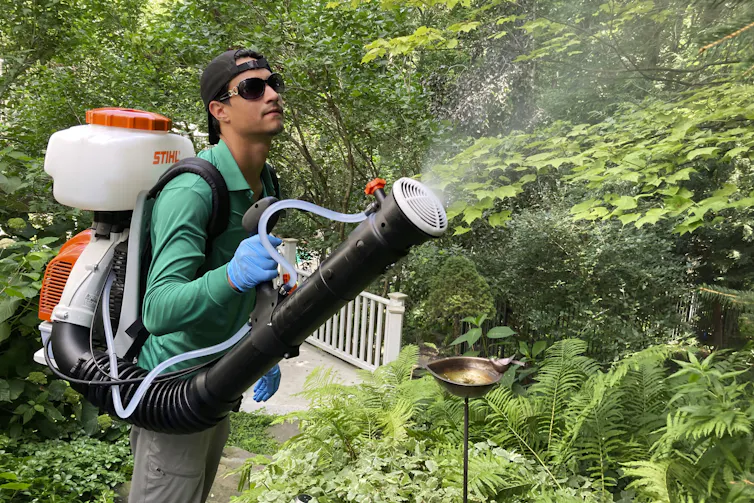
A mosquito-control technician sprays a mixture including insecticides in a yard in Michigan.
AP Photo/John Flesher

Jeffrey Gore, Mississippi State University

Environmental Protection Agency head Lee Zeldin has said he wants the federal agency to accelerate scientific safety evaluations of various chemicals, including pesticides.

The EPA reportedly has more than 500 pending reviews of proposed new pesticides and more than 12,000 overdue reevaluations of pesticides currently in use. The agency is under pressure from the chemical and agricultural industries to catch up, while health and environmental advocates demand it maintain high safety standards.

The review process is careful for a reason – and perhaps the only real method of speeding it up is the one Zeldin has proposed: reassigning staff so there are more people to share the work.

As a faculty member at a land-grant university who has studied the effectiveness of commercial and experimental pesticides in the southern U.S., I have seen how the federal pesticide regulatory process identifies risks to humans and the environment and mitigates them with specific use instructions. Here’s how the process works.

First, what is a pesticide?

The EPA, which regulates pesticides in the U.S., defines a pesticide as any substance or mixture of substances intended to prevent, destroy, repel or mitigate any pest, such as weeds, insects and organisms, that attack plants.

Pesticides are often referred to as toxins when found in food, water bodies or other places where they are not intended. But just because something is detected doesn’t mean it’s harmful to humans or wildlife. Toxicity depends on how much of the substance a person or animal is exposed to, how they are exposed to it – such as breathing it, or getting it on their skin – and for how long.

The Department of Agriculture began regulating pesticides in 1947 with the Federal Insecticide, Fungicide, and Rodenticide Act. Most of the department’s interest was whether a particular pesticide was effective against the target pests.

In 1970, the newly formed EPA took over responsibility for pesticides. It shifted its focus to the safety of consumers, farmworkers and the environment after the Federal Environmental Pesticide Control Act took effect in 1972.

A rack of shelves holds many different containers of various products advertised as pesticides.
A wide range of pesticides are available to consumers for use in their homes and yards.
Jeffrey Greenberg/Universal Images Group via Getty Images

Risk-benefit analysis

Federal law requires the EPA to evaluate both the risks and the benefits of each pesticide – and to revisit that analysis at least every 15 years for every pesticide used in the U.S.

The EPA determines whether the risks to people, animals or the environment are too high for the benefits the pesticide provides and whether any of those risks can be reduced. Sometimes a chemical’s risk can be lessened by recommending mitigation strategies such as wearing protective clothing, reducing environmental spread by barring the use of pesticides near the edges of a property, or decreasing the amount of a pesticide that’s legal to use.

Advertisement
Get More From A Face Cleanser And Spa-like Massage

In its analysis of any given pesticide, the EPA requires a massive amount of data from the manufacturer about what ingredients the pesticide contains and how they work. The agency also reviews scientific research on the pesticide and uses its own scientists and independent experts to evaluate any studies that were submitted by the manufacturer.

The EPA uses all the available data on a pesticide to evaluate the dose that would be toxic to a range of organisms, as well as what residues the pesticide may leave on plants, in the soil and in water. The data is incorporated into computer models that estimate the potential amount of the chemical that may come in contact with humans, animals and the environment. Those models’ results are then combined with toxicity data to determine risk.

The models used by EPA scientists are very conservative. They often use significant overestimates of exposure, which means that when the models determine the risk of a pesticide is below a particular level, they are evaluating the risk posed by far higher quantities of the chemical than will ever actually be used. The risk from the amount actually used, therefore, is even less likely to cause harm.

The EPA also provides opportunities for public comment on a pesticide and uses that information in its evaluations as well.

A tractor moves through a field, spraying mist behind it.
Pesticides are commonly used in commercial agriculture.
Charlie Neibergall/AP

Additional scrutiny

The Endangered Species Act also requires the EPA to evaluate the effects of pesticides on threatened and endangered species.

If a pesticide is found to potentially be dangerous to a protected species or its habitat, the EPA will discuss those findings with the U.S. Fish and Wildlife Service and the National Marine Fisheries Service, which enforce the Endangered Species Act, and determine what to do to ensure the species aren’t harmed.

The law’s requirement to reevaluate each pesticide every 15 years is based on the fact that science evolves and information becomes more precise. New data can shed light on potential risks and benefits, and even lead to pesticides being banned or more closely restricted.

Until recently, for instance, pesticide residues on plants, food and in the environment were measured in parts per million. Newer equipment can measure even smaller amounts, determining parts per billion, which is as precise as identifying one single second in 32 years. Some chemicals can even be measured in parts per trillion, equivalent to one drop of water in 20 Olympic-size swimming pools. That means exposures can be more accurately measured. While some chemicals can be toxic in very small concentrations, most pesticides can be detected at levels that do not pose a biological risk.

Allowing a pesticide to be used

If the EPA determines that a pesticide’s risks outweigh its benefits, then its staff will conduct additional analyses to determine how to mitigate the risks enough to justify using it. If that’s not possible, the EPA will reject the application and not allow the pesticide to be used in the U.S.

If the agency determines that the benefits outweigh the risks, the EPA approves the pesticide for sale and use in the U.S. The law requires the pesticide come with a label providing a strict set of guidelines for how, when and where to use the pesticide.

The guidelines define amounts and timing for applying the pesticide safely, and specific restrictions or protection strategies to control the target pests while eliminating or minimizing harm to the environment, workers and the public.

Advertisement
Get More From A Face Cleanser And Spa-like Massage

The EPA also makes information on pesticides available to the public, so anyone can find out how to use them safely. Using the pesticide without following those directions is a violation of federal law.The Conversation

Jeffrey Gore, Professor of Agricultural Science and Plant Protection, Mississippi State University

This article is republished from The Conversation under a Creative Commons license. Read the original article.

STM Daily News is a vibrant news blog dedicated to sharing the brighter side of human experiences. Emphasizing positive, uplifting stories, the site focuses on delivering inspiring, informative, and well-researched content. With a commitment to accurate, fair, and responsible journalism, STM Daily News aims to foster a community of readers passionate about positive change and engaged in meaningful conversations. Join the movement and explore stories that celebrate the positive impacts shaping our world.

https://stmdailynews.com/

STM Blog

Association of Black Cardiologists to Celebrate Legacy and Leadership at 16th Annual Spirit of the Heart Awards

Published

on

AdobeStock 326809259 scaled
Adobe Stock

The Association of Black Cardiologists (ABC) is bringing its signature celebration of impact back to New York City this fall—spotlighting leaders and organizations working to make cardiovascular care more equitable, more accessible, and more effective. The 16th Annual Spirit of the Heart Awards Program & Fundraiser is set for Saturday, October 3, 2026 (6:00 p.m.–9:00 p.m.) at Cipriani Wall Street in Manhattan.

For ABC, the evening is more than a high-profile awards program. It’s a cornerstone fundraising event that helps power the organization’s year-round work—supporting medical student scholarships, fellowships, education, and programs designed to strengthen the pipeline of diverse clinicians and researchers while improving outcomes in communities that carry a disproportionate burden of heart disease.

1
The official invitation for the ABC 16th Annual Spirit of the Heart Awards Program & Fundraiser, taking place October 3, 2026, at Cipriani Wall Street in New York City.

A fundraising night with long-term stakes

ABC leaders say the Spirit of the Heart Awards is built around a simple idea: celebrating progress while investing in the people who will drive the next wave of change.

Event co-chair Icilma Fergus, MD—Director of the Cardiovascular Disparities Center at Mount Sinai Medical Center and Board Chair of ABC—framed the night as a forward-looking commitment.

“This gathering is about more than one evening of celebration; it is about investing in the future of cardiovascular health for years to come,” Fergus said in the announcement. She added that the support generated through the event helps expand opportunities for aspiring clinicians, researchers, and leaders whose work can transform care and improve lives nationwide.

Honorary Chairperson: Samin K. Sharma, MD

ABC announced Samin K. Sharma, MD as the event’s Honorary Chairperson. Sharma serves as Chief of Clinical Cardiology, Director of the Cardiovascular Clinical Institute, and the Anandi Lal Sharma Professor of Medicine at the Icahn School of Medicine at Mount Sinai.

In the release, ABC highlighted Sharma’s international reputation in interventional cardiology and physician education, noting that he has trained cardiovascular specialists from around the world while advancing the field through research, mentorship, and patient care.

“I am honored to serve as Honorary Chairperson for this important event,” Sharma said. “The Spirit of the Heart Awards Program reflects the power of partnership, philanthropy, and leadership to advance cardiovascular health.”

The Association of Black Cardiologists will host the 16th Annual Spirit of the Heart Awards Oct. 3, 2026 in NYC to honor leaders advancing heart health equity and fund scholarships.
The official invitation schedule for the ABC 16th Annual Spirit of the Heart Awards Program & Fundraiser, taking place October 3, 2026, at Cipriani Wall Street in New York City.

A full weekend of impact, including policy

The awards program is part of a broader weekend of programming. On Friday, October 2, ABC will host its Annual Policy Pulse Summit at Venable LLP in New York City, convening leaders to discuss policy issues shaping the future of cardiovascular health.

What to expect at the Spirit of the Heart Awards

ABC is positioning the evening as both a celebration and a community gathering—bringing together leaders from healthcare, philanthropy, industry, and advocacy.

The event will be co-emceed by:

  • Sandra Bookman, award-winning journalist and anchor of Eyewitness News on ABC7/WABC-TV New York
  • Thomas Cunningham IV, President and Chief Content Officer of BrandCunningham

The program is expected to include:

  • Presentation of the Spirit of the Heart Awards
  • Recognition of medical student scholarship recipients
  • Special guest appearances
  • live auction
  • Musical entertainment

Event co-chair Barbara Hutchinson, MD, PhD, President of Chesapeake Cardiac Care, emphasized the role of sustained collaboration in moving the needle on heart health.

“The Spirit of the Heart Awards Program is a reminder that lasting progress in cardiovascular health is achieved through vision, partnership, and sustained commitment,” Hutchinson said.

How to attend, sponsor, or support

ABC is directing attendees and supporters to its event site for tickets, sponsorship opportunities, and donations:

Advertisement
Get More From A Face Cleanser And Spa-like Massage

About the Association of Black Cardiologists

Founded on the belief that “every heart counts,” the Association of Black Cardiologists works to promote prevention and treatment of cardiovascular disease and to advance health equity by eliminating disparities. ABC’s membership is open to all, regardless of race, ethnicity, or vocation. The organization’s work spans education, advocacy, research, patient and community outreach, and leadership development.

Source and media contact

Media Contact (from the release):

📰 Enjoying STM Daily News? Join the conversation!

💬 Leave a comment, share your thoughts, and subscribe to our newsletter for the latest stories, updates, and “News You Can Use This Moment!” delivered to your inbox.

Stay connected with STM Daily News!

Continue Reading

Food and Beverage

Millions of Eggs Recalled Over Possible Salmonella Risk: What Consumers Need to Know

A major egg recall is affecting nearly 1.6 million dozen eggs sold under several popular brands. Here’s how to determine if your eggs are included and what steps to take if they are.

Published

on

News You Can Use This Moment!

close up shot of brown eggs in a bowl
Photo by Nda Arsa on Pexels.com

Consumers are being urged to check their refrigerators after a major recall involving nearly 1.6 million dozen shell eggs due to the potential presence of Salmonella Enteritidis, a bacterium that can cause serious foodborne illness.

The voluntary recall, announced by Midwest Poultry Services, L.P., affects white shell eggs and brown cage-free eggs produced at two Texas farms and distributed between June 6 and July 3, 2026. According to the U.S. Food and Drug Administration (FDA), the eggs were sold through grocery stores and foodservice distributors in Texas, Louisiana, Oklahoma, Arkansas, Mississippi, and New Mexico.

What Brands Are Included?

The recalled eggs were sold under several familiar brand names, including:

  • Kroger
  • Simple Truth
  • Brookshire’s
  • Country Morning
  • Sunups

Not every carton under these brands is affected. Consumers should look for:

  • Plant Code: P-1950 or 0840962
  • Julian Dates: 157 through 184
  • Best By/Sell By Dates: July 20, 2026, through August 17, 2026

Why the Recall Matters

Salmonella can cause symptoms including:

  • Diarrhea
  • Fever
  • Stomach cramps
  • Nausea
  • Vomiting

Symptoms typically begin 12 to 72 hours after eating contaminated food and usually last four to seven days. While many healthy adults recover without treatment, infections can become severe in young children, older adults, pregnant women, and people with weakened immune systems.

The FDA and the Centers for Disease Control and Prevention (CDC) are investigating a multistate outbreak involving 98 confirmed illnesses across 17 states, resulting in 26 hospitalizations. No deaths have been reported. Investigators say the recalled eggs are linked to part of the outbreak, although they do not account for every reported illness.

What Should You Do?

If you have eggs matching the recalled codes:

  • Do not eat them.
  • Return them to the store for a refund or dispose of them safely.
  • Wash your hands thoroughly after handling the carton.
  • Clean and sanitize any refrigerator shelves, containers, or kitchen surfaces the eggs may have touched.

If you have already eaten the eggs and develop symptoms of Salmonella infection, contact your healthcare provider, especially if symptoms are severe or persist.

Are Arizona Consumers Affected?

The recalled products were officially distributed in six states, and Arizona is not listed among the primary distribution states. However, because food products can move through wholesalers, travelers, or secondary retailers, Arizona consumers who recently purchased eggs while traveling—or who received eggs from family or friends in affected states—should still check the carton codes.

The Bottom Line

Food recalls are an important part of protecting public health. Taking a few moments to inspect the eggs in your refrigerator could help prevent a serious illness. If your carton matches the recalled plant codes and date range, don’t take the risk—return it or throw it away.

STM Daily News will continue to monitor this developing story and provide updates as additional information becomes available.

Related Resources

Continue Reading

Entertainment

The End of an Era: Six Flags Magic Mountain Says Goodbye to an Original Piece of Park History

Published

on

Last Updated on July 21, 2026 by Daily News Staff

For millions of Southern Californians, a visit to Six Flags Magic Mountain meant more than just riding roller coasters. It was a rite of passage—a place where families spent summer vacations, teenagers celebrated graduations, and thrill seekers chased ever-faster rides.

Six Flags Magic Mountain is demolishing the historic Laughing Dragon restaurant, an original 1971 landmark that served generations of Southern California visitors.

Now, one of the last remaining reminders of the park’s opening days is preparing to disappear.

According to KTLA, Los Angeles County has approved demolition permits for the former Laughing Dragon Restaurant, an iconic structure perched atop Samurai Summit that has overlooked Magic Mountain for more than five decades.

Although the building has been vacant since 2008, its demolition marks the end of another chapter in one of California’s most famous amusement parks.

A Restaurant with Deep Roots

When Magic Mountain welcomed its first guests in 1971, the building opened as the elegant Four Winds Steakhouse.

Unlike the quick-service restaurants common in today’s theme parks, Four Winds offered guests a sit-down dining experience high above the park, complete with sweeping views of the surrounding Santa Clarita Valley.

In 1988, after the opening of the park’s suspended roller coaster Ninja, the restaurant was renamed The Laughing Dragon, embracing the area’s Asian-inspired theme.

For years, it became a familiar landmark for guests making the climb to Samurai Summit.

Eventually, changing guest habits and the park’s evolving dining strategy led to the steakhouse’s closure in 2006. The building briefly operated as a Papa John’s Pizza location before closing permanently in 2008.

Since then, it has quietly watched generations of visitors pass by.

Advertisement
Get More From A Face Cleanser And Spa-like Massage

More Than an Empty Building

To younger guests, the vacant structure may have seemed like little more than an abandoned restaurant.

To longtime visitors, however, it represented something much larger.

Magic Mountain has transformed dramatically since its opening more than 50 years ago. Wooden roller coasters gave way to towering steel giants. New technology replaced classic attractions. Entire themed areas evolved with each generation.

Yet the former Laughing Dragon remained—a silent reminder of what the park looked like during its earliest years.

For many fans, it was one of those familiar landmarks that helped connect today’s park with its past.

Samurai Summit Continues to Change

The demolition comes during a period of significant change for the Samurai Summit section of the park.

Nearby, Superman: Escape from Krypton closed in 2024 after decades of launching riders nearly 400 feet into the air. Meanwhile, Tatsu continues to dominate the skyline with one of the world’s most celebrated flying roller coasters.

Construction is also underway on Magic Mountain’s newest attraction—a Vekoma Thrill Glider Roller Coaster, expected to debut in 2027. While the park has not announced what will replace the Laughing Dragon site, many enthusiasts believe the area could become part of future expansion plans.

The Challenge of Preserving Theme Park History

Unlike museums or historic landmarks, amusement parks are constantly reinventing themselves.

Older attractions are removed to make room for larger, faster, and more technologically advanced experiences. Restaurants close as guest preferences change. Buildings that once bustled with activity can quickly become obsolete.

Advertisement
Get More From A Face Cleanser And Spa-like Massage

From a business standpoint, redevelopment makes sense.

But every demolition also removes another tangible connection to the park’s history.

Many Disney attractions have been preserved through photographs, documentaries, and archives. Regional parks like Magic Mountain often receive far less historical attention, making the loss of original structures even more significant for longtime fans.

Looking Ahead

Magic Mountain has not revealed what, if anything, will replace the Laughing Dragon building.

Whether the site becomes part of a new attraction, additional guest amenities, or another expansion remains to be seen.

What is certain is that another piece of the park’s 1971 identity is about to disappear.

For those who grew up visiting Magic Mountain, it’s another reminder that while roller coasters continue to evolve, nostalgia often rides alongside progress.


Did You Know?

  • 🎢 Magic Mountain opened on May 29, 1971.
  • 🥩 The building originally housed the Four Winds Steakhouse.
  • 🐉 It became The Laughing Dragon after Ninja opened in 1988.
  • 🍕 It briefly served as a Papa John’s before closing permanently in 2008.
  • 🏗️ The building sat vacant for nearly 18 years before demolition plans were approved.

STM Daily News Perspective

As someone who grew up in Southern California, I know that Magic Mountain wasn’t just another amusement park—it was part of the Southern California experience. While the biggest headlines usually focus on new roller coasters, it’s often the quieter stories, like the loss of a familiar restaurant overlooking the park, that resonate most with longtime visitors. Places like the Laughing Dragon became part of family traditions, first dates, school trips, and summer vacations. Its demolition is a reminder that every park evolves, but each change also closes another chapter of its history.


Join the Conversation

Have you ever eaten at the Four Winds or the Laughing Dragon? Do you have memories of visiting Magic Mountain in the 1970s, ’80s, ’90s, or early 2000s?

Share your favorite Magic Mountain memories in the comments below, and subscribe to the STM Daily News newsletter for more stories celebrating Southern California history, attractions, and the places that shaped our communities.

Related Links

Advertisement
Get More From A Face Cleanser And Spa-like Massage
Continue Reading

Trending