Connect with us

Community

When grief involves trauma − a social worker explains how to support survivors of the recent floods and other devastating losses

Published

on

support survivors
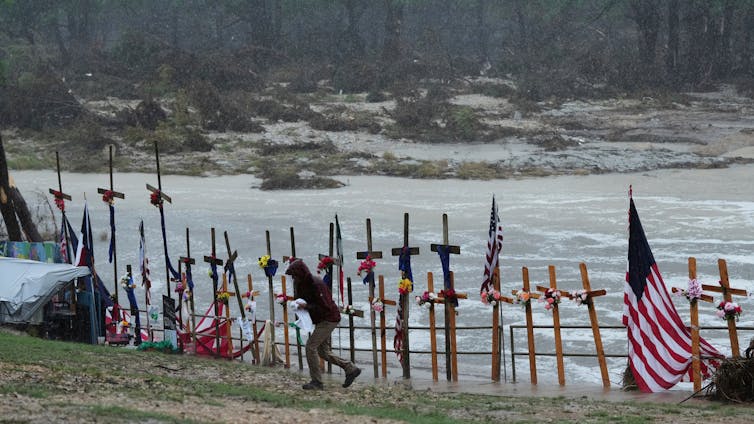
Rain falls over a makeshift memorial for flood victims along the Guadalupe River on July 13, 2025, in Kerrville, Texas.
AP Photo/Eric Gay

Liza Barros-Lane, University of Houston-Downtown

When grief involves trauma − a social worker explains how to support survivors of the recent floods and other devastating losses

The July 4, 2025, floods in Kerr County, Texas, swept away children and entire families, leaving horror in their wake. Days later, flash floods struck Ruidoso, New Mexico, killing three people, including two young children.

These are not just devastating losses. When death is sudden, violent, or when a body is never recovered, grief gets tangled up with trauma.

In these situations, people don’t only grieve the death. They struggle with the terror of how it happened, the unanswered questions and the shock etched into their bodies.

I’m a social work professor, grief researcher and the founder of The Young Widowhood Project, a research initiative aimed at expanding scholarship and public understanding of premature spousal loss.

I was widowed when I was 36. In July 2020, my husband, Brent, went missing after testing a small, flat-bottomed fishing boat called a Jon boat. His body was recovered two days later, but I never saw his remains.

Both my personal loss and professional work have shown me how trauma changes the grieving process and what kind of support actually helps.

To understand how trauma can complicate grief, it’s important to first understand how people typically respond to loss.

Grief isn’t a set of stages

Many people still think of grief through the lens of psychiatrist Dr. Elisabeth Kübler-Ross’ five stages of grief, popularized in the early 1970s: denial, anger, bargaining, depression and acceptance.

But in fact, this model was originally designed for people facing their own deaths, not for mourners. In the absence of accessible grief research in the 1960s, it became a leading framework for understanding the grieving process – even though it wasn’t meant for that.

Despite this misapplication, the stages model has shaped cultural expectations: namely, that grief ends once people reach the “acceptance” stage. But research doesn’t support this idea. Trying to force grief into this model can cause real harm, leaving mourners feeling they’re grieving “wrong.”

Advertisement
Get More From A Face Cleanser And Spa-like Massage

In reality, mourning is often lifelong. Most people go through an acute period of overwhelming pain right after the loss. This is usually followed by integrated grief, where the pain softens but the loss is still part of everyday life, returning in waves.

Although grief is unique to each person and relationship, researchers have found that mourners often strive to a) make sense of the death; b) adjust to a world without their loved one; c) form an ongoing connection with their deceased loved one in new ways; and d) figure out who they are without their loved one.

It’s difficult and at times disorienting work, but most people find ways to carry their grief and keep living.

A grandmother embraces a young woman in front of a wall of flowers.
Julia Mora embraces her granddaughter, Isla Meyer, during a vigil for Texas flood victims on July 11, 2025.
AP Photo/Gerald Herbert

When grief and trauma collide

However, some losses carry an extra layer of pain, confusion and trauma.

Sudden, unexpected, accidental, violent or deeply tragic deaths – like those experienced during the recent floods – can lead to what researchers call traumatic bereavement: grief that is disrupted by the traumatic nature of the death.

People experiencing traumatic bereavement often endure a longer and more intense acute grief period. They may be haunted by disturbing images, nightmares or relentless thoughts about how their loved one died or suffered. Many wrestle with dread, spiritual disorientation and a shattered sense of safety in the world.

Some of these deaths are also considered “ambiguous” – unclear or unconfirmed loss – such as when a body is never recovered or is too damaged to view. Without physical confirmation, mourners often feel stuck in disbelief and helplessness.

This was true in my case. Not seeing my husband’s body left a part of me suspended between knowing and not knowing. I knew he had died but couldn’t fully believe it, no matter how much I lived with the reality of his absence. For a long time, I caught myself repeating these words every morning: “Brent is dead. Brent is dead.”

In many cases, these reactions aren’t short term. Many people affected by traumatic loss remain overwhelmed and sometimes physically and emotionally impaired for years. Symptoms may taper over time, but they rarely disappear entirely.

Supporting mourners

Traumatic bereavement can feel unbearable. Many mourners struggle with intense, long-lasting reactions that can leave them feeling helpless, altered or even unrecognizable to themselves. They may appear withdrawn, forgetful or emotionally drained because their systems are overwhelmed. Coping can look messy or self-destructive, but these are often survival strategies, not conscious choices. I’ve also seen how those same struggles become more survivable when mourners don’t have to carry them alone. If you’re supporting someone through traumatic loss, here are three ways to help.

  • Make space for the horror. Listen without flinching. Acknowledge the full weight of what happened and how terrifying and unjust the loss was. This means saying things like, “This should never have happened,” or “What you went through is beyond words.” It means staying present when the mourner speaks about what haunts them. Let them know they don’t have to carry this alone. You may feel the urge to say something hopeful such as, “At least the body was recovered,” but there is no silver lining in these cases. Instead, say: “There’s nothing I can say to fix this, but I’m not going anywhere.”
  • Help them find others who can understand. Trauma can be isolating. Mourners often feel uniquely overwhelmed or confused. Support groups, peer companions and therapists trained in treating grief and trauma can offer the kind of recognition and validation that even the most devoted friend may not be able to provide.
  • Take care of yourself, too. Being present for someone in deep grief takes energy, especially if you were personally affected by the loss. Stay connected to replenishing people, practices and routines. If you don’t, you may begin to experience trauma, too. Taking care of yourself will help you remain grounded so that you can show up.

I believe supporting someone through traumatic bereavement is one of the most meaningful things you can do. You don’t need perfect words or a plan. What sustains them won’t be advice or solutions, but your simple, powerful act of staying.

Liza Barros-Lane, Assistant Professor of Social Work, University of Houston-Downtown

Advertisement
Get More From A Face Cleanser And Spa-like Massage

This article is republished from The Conversation under a Creative Commons license. Read the original article.

Continue Reading
Advertisement SodaStream USA, inc

Lifestyle

P.F. Chang’s Partners With Starlight Children’s Foundation for New “Spirit of the Zodiac” Giving Campaign

P.F. Chang’s launches Spirit of the Zodiac, a giving campaign supporting Starlight Children’s Foundation with Bao plush purchases and in-restaurant donations.

Published

on

P.F. Chang’s Launches Spirit of the Zodiac Campaign to Support Starlight Children’s Foundation
P.F. Chang’s and Starlight Children’s Foundation

P.F. Chang’s Launches Spirit of the Zodiac Campaign to Support Starlight Children’s Foundation

P.F. Chang’s is launching a new annual charitable initiative designed to bring comfort to children during hospital stays. The Scottsdale-based restaurant brand announced Spirit of the Zodiac, a giving program inspired by the Chinese zodiac, with its inaugural campaign—Year of the Fire Horse: Spirit of Strength—benefiting Starlight Children’s Foundation.

What the campaign supports

Starlight Children’s Foundation serves more than 800 children’s hospitals nationwide, providing programs such as toy deliveries, hospital gowns, gaming stations, and other experiences intended to help kids feel more comfortable, connected, and supported during medical care.

How guests can participate (Sept. 2–Sept. 30)

From September 2 through September 30, 2026, guests can purchase Bao, a limited-edition horse plushie, for $10 through dine-in transactions at participating P.F. Chang’s restaurants (while supplies last). For each Bao purchased, P.F. Chang’s will donate an identical Bao plushie to Starlight for distribution through its hospital network—up to 20,000 donated plushies.

Guests can also support the campaign by rounding up their checks or making a direct donation in restaurant. The overall effort aims to raise $500,000 to support Starlight’s work with children and families.

Bonus offer for donors

P.F. Chang’s says guests who purchase Bao or make an in-restaurant donation of $10 or more to Starlight will receive an offer for a complimentary appetizer with the purchase of an entrée on a future dine-in visit, valid through October 31, 2026 (restrictions apply; participating locations only).

A story component for families

The campaign also includes a storytelling element: Bao’s journey will be featured in a digital story and an original children’s book by author Jenny Liao and illustrator Adriane Tsai, expected to publish later this month.

What to watch for

P.F. Chang’s and Starlight plan to continue the partnership beyond September, including in-hospital catering and plush deliveries in early October.

For more information, visit www.pfchangs.com/offers/spirit-of-the-zodiac. To learn more about the partnership, visit starlight.org/pfchangs.

💪 Your health journey starts here! Explore the latest health news, fitness tips, wellness trends, and healthy living advice. Share your thoughts in the comments and subscribe to the STM Daily News newsletter to stay informed and inspired every day.

Continue Reading

Community

9/11 Day Awards $3 Million in Grants to Expand Volunteer Opportunities Nationwide Ahead of 25th Anniversary

9/11 Day announced $3 million in grants to nearly 200 groups across 40 states, expanding service projects for the 25th anniversary observance.

Published

on

one world trade center an other skyscrapers in new 2026 01 08 21 59 49 utc
New York City, USA – June 20, 2018: One World Trade Center and other skyscrapers against blue sky in Financial District of Manhattan. Business and technology background

As the United States approaches the 25th anniversary of September 11, 2001, the nonprofit 9/11 Day is putting major resources behind a familiar idea with renewed urgency: remembrance through service. The organization—founded by 9/11 families and leaders and co-led by co-founders David Paine and Jay Winuk—announced $3 million in grants to roughly 200 nonprofits, schools, and community groups across 40 states to expand local volunteer projects tied to this year’s September 11 National Day of Service and Remembrance.

The funding is designed to dramatically increase the number of ways Americans can participate close to home, from food insecurity initiatives to neighborhood cleanups and support programs for veterans and first responders. Together, grant recipients are expected to engage more than 70,000 volunteers nationwide.

A major push toward youth-led service

More than 70% of the grant funding is going to youth organizations and educational institutions, including K–12 schools, universities, and other learning programs. The emphasis reflects a generational reality: millions of students today know 9/11 primarily through textbooks, family stories, and classroom lessons.

“For many students participating in the observance this year, 9/11 is something they’ve only encountered in textbooks or through stories from parents and grandparents,” said Jay Winuk, co-founder and executive vice president of 9/11 Day and a 9/11 family member. “By connecting history with hands-on service, we’re helping young people understand that the legacy of 9/11 isn’t defined only by tragedy. It’s also defined by compassion, resilience and the responsibility we all share to care for one another.”

Youth-focused projects supported by the grants include school-wide days of service, hunger-relief efforts, donation drives, community improvement work, and service-learning initiatives that connect the history of September 11 with practical ways to help others.

UNIITE for Good: turning an anniversary into a nationwide “doing good” moment

The grant program is a cornerstone of 9/11 Day’s nationwide UNIITE for Good campaign, scheduled to officially launch August 24. The campaign aims to transform the 25th anniversary into what organizers describe as America’s largest day of doing good—channeling remembrance into tangible community impact.

The program is administered in collaboration with AmeriCorps, with principal funding provided by AmeriCorps and the Popeyes Foundation. A special emphasis this year is addressing hunger—an issue described in the release as an “ever-growing hunger crisis across the nation.”

Meeting community needs where people live

Grant-funded projects span urban, suburban, and rural communities. Activities include assembling meals for individuals and families facing food insecurity, packing care kits for veterans and first responders, restoring community spaces, and strengthening schools and neighborhoods.

Beyond the service itself, the grants are also intended to help local groups recruit volunteers, purchase supplies, coordinate logistics, and expand the number of service opportunities available in their areas.

“As we mark the 25th anniversary of 9/11, we have a responsibility to preserve not only the memory of that day and those lost and injured, but also the extraordinary way Americans came together in the aftermath of the attacks,” said David Paine, president and co-founder of 9/11 Day. “These community-led projects are helping rekindle that spirit of unity, compassion and service by bringing neighbors together to help solve local challenges.”

AmeriCorps echoed that message, framing service as a way to honor those who responded in the immediate aftermath of the attacks.

Advertisement
Get More From A Face Cleanser And Spa-like Massage

“This year, we invite Americans to carry forward that enduring spirit of unity and service by becoming a hero for someone in need,” said Emily Stock, project manager for Volunteer Initiatives at AmeriCorps, noting that AmeriCorps-funded projects will include food drives, home repairs, neighborhood cleanups, and disaster preparedness activities.

The Popeyes Foundation also highlighted its community-focused mission and its role in supporting local projects.

Why this anniversary matters now

Organizers say the 25th anniversary arrives at a pivotal moment: more than 100 million Americans are now too young to have personal memories of September 11. That makes this milestone one of the last major opportunities to connect those who lived through the day with younger generations learning about it as history.

Examples of grant-supported efforts include:

  • Marshall University, which plans to build on its existing 9/11 Days of Service tradition, including a Memorial Stair Challenge and volunteer projects supporting veterans, first responders, and families in need.
  • Middlebury Elementary School, which will expand hands-on service activities that teach younger students about 9/11 through compassion and community action.
  • University of South Dakota, where students will work alongside community partners to address local needs while learning how service can bridge backgrounds and perspectives.

How to get involved

A full list of 2026 9/11 Day Grant Program recipients is available through 9/11 Day. To learn more about the September 11 National Day of Service and Remembrance—and to find ways to participate—visit 911day.org.

STM Daily News will continue tracking community service initiatives and local observances tied to the 25th anniversary as September approaches

Start Your Morning Informed

Get the STM Morning Brief delivered to your inbox every weekday with breaking news, transportation updates, technology, science, and trending stories.

STM News Brief Ad 2

We don’t spam! Read our privacy policy for more info.

Advertisement
Get More From A Face Cleanser And Spa-like Massage
Continue Reading

Community

Kia and its Dealers Expand Community Giving Nationwide

Expand Community Giving Nationwide: Kia announced its fifth annual “Accelerate the Good” dealer match program, which supports St. Jude Children’s Research Hospital. The program also donates to other organizations that make a positive impact in their communities.

Published

on

Kia and its Dealers Expand Community Giving Nationwide

Kia and its Dealers Expand Community Giving Nationwide

(Feature Impact) Families often arrive at St. Jude Children’s Research Hospital with a tough road ahead. Their child has been diagnosed with cancer, and they’re navigating a complex treatment plan. One thing that families don’t have to worry about is how they’ll pay for this upheaval to their lives. In 2026, Kia donated $2 million to St. Jude to help ensure families don’t receive a bill for medical costs, housing or food during treatment.

Watch this video to learn more

https://youtube.com/watch?v=_oAL9vsJbQM%3Fsi%3DqT5nbLCY13pWHOBS%26controls%3D0

Kia announced its fifth annual “Accelerate the Good” dealer match program, which supports St. Jude Children’s Research Hospital. The program also donates to other organizations that make a positive impact in their communities.

Donations from a network of nearly 800 dealers support organizations such as No Kid Hungry, Toys for Tots, Operation Homefront and several other groups dedicated to children’s health, hunger relief, disaster response and veterans’ well-being. Kia employees also lead volunteer efforts to benefit community pantries, beach cleanups and clothing drives.

“The continued success of our ‘Accelerate the Good’ initiative reflects the shared commitment of Kia and our nationwide retailer network to invest in the communities we serve,” said SeungKyu (Sean) Yoon, president and CEO of Kia North America and Kia America. “Together, we are proud to support organizations that deliver lifesaving care, strengthen families, fight hunger and create meaningful opportunities for people across the country.”

Ahead of September’s Childhood Cancer Awareness Month, Kia and its dealers have reached an important milestone: more than $7.7 million donated to St. Jude Children’s Hospital in four years. The donations are part of Kia’s broader community giving initiatives.

To learn more about how Kia is accelerating good in their communities, visit kia.com.

collect?v=1&tid=UA 482330 7&cid=1955551e 1975 5e52 0cdb 8516071094cd&sc=start&t=pageview&dl=http%3A%2F%2Ftrack.familyfeatures track

SOURCE:

Kia

Continue Reading

Trending