

STM Blog
Pharaohs in Dixieland – how 19th-century America reimagined Egypt to justify racism and slavery

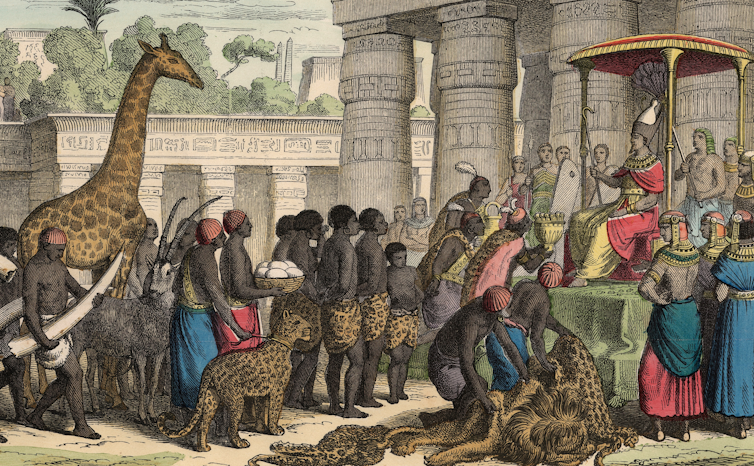
Pharaohs in Dixieland – how 19th-century America reimagined Egypt to justify racism and slavery
Charles Vanthournout, Université de Lorraine
When Napoleon embarked upon a military expedition into Egypt in 1798, he brought with him a team of scholars, scientists and artists. Together, they produced the monumental “Description de l’Égypte,” a massive, multivolume work about Egyptian geography, history and culture.
At the time, the United States was a young nation with big aspirations, and Americans often viewed their country as an heir to the great civilizations of the past. The tales of ancient Egypt that emerged from Napoleon’s travels became a source of fascination to Americans, though in different ways.
In the slaveholding South, ancient Egypt and its pharaohs became a way to justify slavery. For abolitionists and African Americans, biblical Egypt served as a symbol of bondage and liberation.
As a historian, I study how 19th-century Americans – from Southern intellectuals to Black abolitionists – used ancient Egypt to debate questions of race, civilization and national identity. My research traces how a distorted image of ancient Egypt shaped competing visions of freedom and hierarchy in a deeply divided nation.
Egypt inspires the pro-slavery South
In 1819, when lawyer John Overton, military officer James Winchester and future president Andrew Jackson founded a city in Tennessee along the Mississippi River, they christened it Memphis, after the ancient Egyptian capital.
While promoting the new city, Overton declared of the Mississippi River that ran alongside it: “This noble river may, with propriety, be denominated the American Nile.”
“Who can tell that she may not, in time, rival … her ancient namesake, of Egypt in classic elegance and art?” The Arkansas Banner excitedly reported.
In the region’s fertile soil, Chancellor William Harper, a jurist and pro-slavery theorist from South Carolina, saw the promise of an agricultural empire built on slavery, one “capable of being made a far greater Egypt.”
There was a reason pro-slavery businessmen and thinkers were energized by the prospect of an American Egypt: Many Southern planters imagined themselves as guardians of a hierarchical and aristocratic system, one grounded in landownership, tradition and honor. As Alabama newspaper editor William Falconer put it, he and his fellow white Southerners belonged to a “race that had established law, order, and government on earth.”
To them, Egypt represented the archetype of a great hierarchical civilization. Older than Athens or Rome, Egypt conferred a special legitimacy. And just like the pharaohs, the white elites of the South saw themselves as the stewards of a prosperous society sustained by enslaved labor.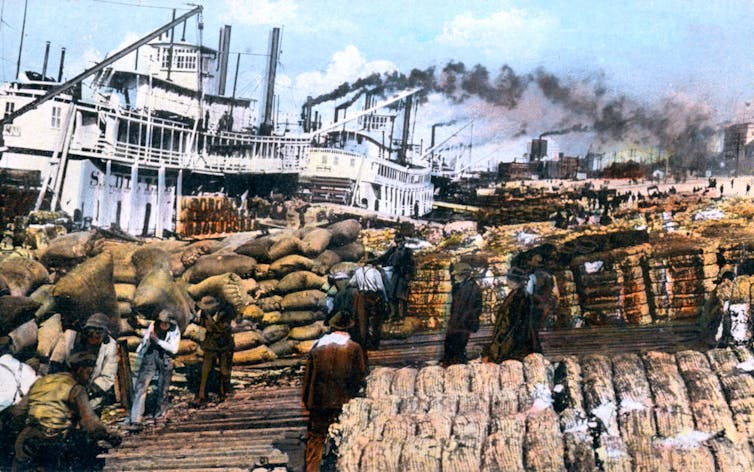
The founders of Memphis named it after the ancient Egyptian capital, and they hoped the Mississippi River that ran alongside it would become an ‘American Nile.’ The Print Collector/Getty Images
Leading pro-slavery thinkers like Virginia social theorist George Fitzhugh, South Carolina lawyer and U.S. Senator Robert Barnwell Rhett and Georgia lawyer and politician Thomas R.R. Cobb all invoked Egypt as an example to follow.
“These [Egyptian] monuments show negro slaves in Egypt at least 1,600 years before Christ,” Cobb wrote in 1858. “That they were the same happy negroes of this day is proven by their being represented in a dance 1,300 years before Christ.”
A distorted view of history
But their view of history didn’t exactly square with reality. Slavery did exist in ancient Egypt, but most slaves had been originally captured as prisoners of war.
The country never developed a system of slavery comparable to that of Greece or Rome, and servitude was neither race-based nor tied to a plantation economy. The mistaken notion that Egypt’s great monuments were built by slaves largely stems from ancient authors and the biblical account of the Hebrews. Later, popular culture – especially Hollywood epics – would continue to advance this misconception.
Nonetheless, 19th-century Southern intellectuals drew on this imagined Egypt to legitimize slavery as an ancient and divinely sanctioned institution.
Even after the Civil War, which ended in 1865, nostalgia for these myths of ancient Egypt endured. In 1877, former Confederate officer Edward Fontaine noted how “Veritable specimens of black, woolyheaded negroes are represented by the old Egyptian artists in chains, as slaves, and even singing and dancing, as we have seen them on Southern plantations in the present century.”
Turning Egypt white
But to claim their place among the world’s great civilizations, Southerners had to reconcile a troubling fact: Egypt was located in Africa, the ancestral land of those enslaved in the U.S.
In response, an intellectual movement called the American School of Ethnology – which promoted the idea that races had separate, unequal origins to justify Black inferiority and slavery – set out to “whiten” Egypt.
In a series of texts and lectures, they portrayed Egypt as a slaveholding civilization dominated by whites. They pointed to Egyptian monuments as proof of the greatness that a slave society could achieve. And they also promoted a scientifically discredited theory called “polygenesis,” which argued that Black people did not descend from the Bible’s Adam, but from some other source.
Richard Colfax, the author of the 1833 pamphlet “Evidence Against the Views of the Abolitionists,” insisted that “the Egyptians were decidedly of the Caucasian variety of men.” Most mummies, he added, “bear not the most distant resemblance to the negro race.”
Physician Samuel George Morton cited “Crania Aegyptiaca,” an 1822 German study of Egyptian skulls, to reinforce this view. Writing in the Charleston Medical Journal in 1851, he explained how the German study had concluded that the skulls mirrored those of Europeans in size and shape. In doing so, it established “the negro his true position as an inferior race.”
Physician Josiah C. Nott, Egyptologist George Gliddon and physician and propagandist John H. Van Evrie formed an effective triumvirate: Through press releases and public lectures featuring the skulls of mummies, they turned Egyptology into a tool of pro-slavery propaganda.
“The Negro question was the one I wished to bring out,” Nott wrote, adding that he “embalmed it in Egyptian ethnography.”
Nott and Gliddon’s 1854 bestseller “Types of Mankind” fused pseudoscience with Egyptology to both “prove” Black inferiority and advance the idea that their beloved African civilization was populated by a white Egyptian elite.
“Negroes were numerous in Egypt,” they write, “but their social position in ancient times was the same that it now is, that of servants and slaves.”
Denouncing America’s pharaohs
This distorted vision of Egypt, however, wasn’t the only one to take hold in the U.S., and abolitionists saw this history through a decidedly different lens.
In the Bible, Egypt occupies a central place, mentioned repeatedly as a land of refuge – notably for Joseph – but also as a nation of idolatry and as the cradle of slavery.
The episode of the Exodus is perhaps the most famous reference. The Hebrews, enslaved under an oppressive pharaoh, are freed by Moses, who leads them to the Promised Land, Canaan. This biblical image of Egypt as a land of bondage deeply shaped 19th-century moral and political debates: For many abolitionists, it represented the ultimate symbol of tyranny and human oppression.
When the Emancipation Proclamation went into effect on Jan. 1, 1863, Black people could be heard singing in front of the White House, “Go down Moses, way down in Egypt Land … Tell Jeff Davis to let my people go.”
Black Americans seized upon this biblical parallel. Confederate President Jefferson Davis was a contemporary pharaoh, with Moses still the prophet of liberation.
African American writers and activists like Phillis Wheatley and Sojourner Truth also invoked Egypt as a tool of emancipation.
“God has implanted in every human heart a principle which we call the love of liberty,” Wheatley wrote in a 1774 letter. “It is impatient with oppression and longs for deliverance; and with the permission of our modern Egyptians, I will assert that this same principle lives in us.”
Yet the South’s infatuation with Egypt shows how antiquity can always be recast to serve the powerful. And it’s a reminder that the past is far from neutral terrain – that there is rarely, if ever, a ceasefire in wars over history and memory.
Charles Vanthournout, Ph.D. Student in Ancient History, Université de Lorraine
This article is republished from The Conversation under a Creative Commons license. Read the original article.
STM Daily News is a multifaceted podcast that explores a wide range of topics, from life and consumer issues to the latest in food and beverage trends. Our discussions dive into the realms of science, covering everything from space and Earth to nature, artificial intelligence, and astronomy. We also celebrate the amateur sports scene, highlighting local athletes and events, including our special segment on senior Pickleball, where we report on the latest happenings in this exciting community. With our diverse content, STM Daily News aims to inform, entertain, and engage listeners, providing a comprehensive look at the issues that matter most in our daily lives. https://stories-this-moment.castos.com/
https://stmdailynews.com/%f0%9f%93%9c-who-created-blogging-a-look-back-at-the-birth-of-the-blog/

Breaking News
Dolly Parton Dies at 80, Leaving Behind an Extraordinary American Legacy
Dolly Parton, the legendary singer, songwriter, actress, entrepreneur and philanthropist, has died at 80. We look back at the remarkable journey that took her from rural Tennessee to becoming one of America’s most beloved cultural icons.

Last Updated on August 25, 2026 by Daily News Staff
Country music legend, songwriter, actress and philanthropist Dolly Parton has died at the age of 80, bringing to a close one of the most remarkable careers in American entertainment.
Dolly Parton Dies at 80
Dolly Parton, whose unmistakable voice, songwriting talent, humor and generosity made her an American cultural icon far beyond the world of country music, died Tuesday, August 25, 2026, in Nashville.
Parton died at Vanderbilt-Ingram Cancer Center following a brief battle with cancer, according to her publicist. She was surrounded by loved ones. The specific type of cancer has not been publicly disclosed.
For millions of fans around the world, the news marks the loss of an entertainer who seemed almost timeless.
From the Tennessee Mountains to Stardom
Born Dolly Rebecca Parton on January 19, 1946, in Sevier County, Tennessee, Parton grew up as one of 12 children in a family with little money.
Those beginnings would become an important part of both her identity and her music.
Rather than distancing herself from her Appalachian upbringing after becoming famous, Parton repeatedly returned to those experiences in her songwriting. Songs such as “Coat of Many Colors” transformed childhood memories into stories about poverty, family, dignity and love.
After moving to Nashville, Parton eventually became a nationally known performer, including through her partnership with Porter Wagoner.
But it was her ability to write songs that helped establish her as one of the defining artists of her generation.
Her catalog would eventually include classics such as “Jolene,” “I Will Always Love You,” “Coat of Many Colors,” “Here You Come Again” and “9 to 5.”
“I Will Always Love You,” originally written and recorded by Parton in the 1970s, would find an entirely new audience when Whitney Houston recorded a soaring version for the 1992 film The Bodyguard.
More Than a Country Singer
Calling Dolly Parton simply a country music star never quite captured the full scope of her career.
She crossed into pop music, television and Hollywood while maintaining her country roots.
Her starring role alongside Jane Fonda and Lily Tomlin in the 1980 comedy 9 to 5 helped turn her into a major movie star. The film’s title song became another Parton classic and an enduring anthem about the frustrations of working life.
Parton later appeared in films including The Best Little Whorehouse in Texas, Steel Magnolias and Straight Talk.
She also became an extraordinarily successful businesswoman.
Her association with Dollywood, the Tennessee theme park bearing her name, helped transform the attraction into one of the state’s best-known tourist destinations while bringing jobs and investment to the region where she grew up.
A Legacy Built Around Giving
Parton’s impact may ultimately be measured by more than records sold, awards won or movies made.
Through the Dolly Parton Imagination Library, founded in 1995, free books have been provided to children from birth to age five.
What began as a literacy program serving children in Parton’s home county in Tennessee grew into an international effort distributing books to children in the United States and several other countries.
Parton also contributed to disaster relief, education and medical research. During the COVID-19 pandemic, she donated $1 million to Vanderbilt University Medical Center research that helped support development of the Moderna COVID-19 vaccine.
Her philanthropy became almost as recognizable as her music.
An Artist Who Crossed Generations
Perhaps one of Parton’s most unusual achievements was her ability to remain relevant without abandoning the personality that made her famous.
Parents who grew up hearing Dolly Parton records introduced her music to their children and grandchildren. Country fans embraced her, but so did rock musicians, pop artists, actors and audiences who might rarely listen to country music.
Her enormous blonde hair, rhinestones and colorful outfits became instantly recognizable, and Parton frequently made herself the punchline of jokes about her appearance before anyone else had the opportunity.
Behind that carefully cultivated public image was a songwriter responsible for thousands of compositions and a businesswoman who maintained considerable control over her work.
Even late in her career, Parton continued exploring new musical territory. Her 2023 album Rockstar featured collaborations with major figures from rock and pop music and demonstrated yet again her ability to move between genres.
Tributes Pour In
News of Parton’s death quickly prompted tributes from across entertainment and public life.
Musicians, actors, friends and admirers remembered not only her extraordinary career but also the kindness and generosity for which she had become known.
The reaction reflects something that made Parton unusual among celebrities of her stature: she became a figure whose appeal extended across generations, regions and many of the cultural divisions of American life.
Her husband, Carl Dean, died in March 2025 at the age of 82. The famously private Dean and Parton had been married for nearly 60 years.
The Music Remains
Dolly Parton’s career is difficult to summarize because it was never confined to one thing.
She was a country singer who became a pop star.
A songwriter who became a movie star.
A girl who grew up poor in the mountains of Tennessee and became a highly successful entrepreneur.
And a celebrity who turned much of her wealth and fame toward helping children she would never meet.
Dolly Parton died at 80, but the songs, stories and institutions she created will continue long after her passing.
For generations of listeners, hearing the opening guitar of “Jolene,” the tenderness of “Coat of Many Colors,” or the unmistakable opening of “9 to 5” will immediately bring her back.
And perhaps that is one of the greatest legacies a songwriter can leave behind.
STM Daily News will publish a more comprehensive look at Dolly Parton’s extraordinary life, career and lasting cultural impact in the coming days.
Sources:
Associated Press — Dolly Parton dies at 80
Reuters — Dolly Parton dies at 80
Related Links:
Official Dolly Parton Website
Dolly Parton’s Imagination Library

The Knowledge
When Did Water Vending Machines Become a Thing?
When did water vending machines appear in America? Explore their history from a 1908 penny water vendor to the refill machines of the 1970s and 1980s.

You’ve probably seen them hundreds of times.
They sit outside supermarkets, convenience stores and shopping centers—or sometimes stand alone in small roadside kiosks. You bring an empty bottle, usually one, three or five gallons, put in some money, push a button and watch purified water pour into your container.
For many people in California, Arizona and other parts of the American West, water vending machines seem like they’ve simply always been there.
But when did we actually start buying water this way?
The answer takes us back more than a century, although the machines we recognize today didn’t really arrive until the 1970s.
The Water Vending Machine’s Surprising Ancestor
The story begins in Boston in 1908 with a man named Lawrence Luellen.
Luellen was working on something that sounds surprisingly modern: a machine that would allow someone to pay a penny and receive a clean drink of water in an individual disposable cup.
At the time, public drinking water was often consumed from a communal cup or metal dipper—a practice that increasingly worried public-health officials because of the potential spread of disease.
Luellen developed a paper drinking cup along with what became known as the Luellen Cup & Water Vendor. The porcelain machine contained water, ice, disposable cups and a place for discarded cups.
For one penny, a customer could get a drink of cold water in a fresh cup.
Historical records at Lafayette College’s Hugh Moore Dixie Cup Company Collection show that Luellen completed work on the vending apparatus in early 1908. His company, the American Water Supply Company of New England, was incorporated on April 4 of that year.
There was just one problem.
The complete water machine was expensive to manufacture.
The company eventually concentrated on selling the disposable cups and cup dispensers instead. Those cups ultimately evolved into one of America’s most recognizable household products—the Dixie Cup.
So although Luellen’s machine wasn’t the five-gallon refill station we know today, the basic idea was already there:
Put money into a machine and receive drinking water.
The Modern Water Vending Machine Arrives
The next major chapter didn’t occur until roughly 65 years later.
According to histories of the water-vending industry, the first practical machines designed to sell purified water in bulk appeared during the mid-1970s.
These were fundamentally different from Luellen’s machine.
Instead of giving customers a cup of water, the new machines treated water—typically municipal tap water—and allowed customers to fill their own reusable containers.
And we have unusually strong evidence that these machines were operating by 1976.
On July 26, 1976, the U.S. Environmental Protection Agency issued a memorandum specifically addressing the regulatory status of water vending machines.
The EPA described machines that filtered and disinfected water with ultraviolet light and then dispensed the treated water into a customer’s own container using a coin-operated mechanism.
In other words, by the summer of 1976, the basic water-refill machine many of us recognize today was already operating in the United States.
Why the 1970s?
The timing wasn’t accidental.
Americans had become increasingly concerned about pollution and drinking-water quality during the 1960s and 1970s.
Congress passed the Safe Drinking Water Act in 1974, establishing a federal framework for protecting public drinking-water supplies. National drinking-water regulations followed during the decade.
Meanwhile, technologies such as filtration, activated carbon treatment, ultraviolet disinfection and eventually reverse osmosis made it practical to build relatively compact systems capable of treating municipal water at the point where it was sold.
The result was a new business opportunity:
Instead of transporting thousands of bottles of water to a store, a vending company could connect a machine to the local water supply, purify that water on site and sell it by the gallon.
Customers supplied the bottle.
California Helps Turn It Into a Business
California became one of the industry’s most important early markets.
One company that would eventually become a major player was founded by Robert G. Miller.
In 1983, Miller established Bottle Water Vending Inc., the predecessor of Glacier Water Services.
The company manufactured water vending machines and placed many of them outside supermarkets. Customers brought their own containers, while participating stores often sold reusable plastic jugs nearby.
The machines treated municipal water using combinations of filtration, reverse osmosis, carbon treatment and ultraviolet sterilization.
The idea caught on quickly.
In 1984, the company expanded from California into Arizona.
Nevada followed in 1986.
By 1987, the company reportedly had nearly 900 water vending machines operating.
Texas and Florida followed in 1988.
The familiar supermarket water-refill station was becoming a significant business.
Then Came the Drive-Up Water Kiosk
Another variation appeared at almost exactly the same time.
In 1984, Lani and Don Dolifka developed what became Watermill Express in Colorado.
Their idea was an automated stand-alone purification kiosk capable of taking municipal water, processing it through multiple purification stages and selling the finished drinking water directly to customers.
Instead of walking into a supermarket, customers could pull up to the kiosk with their bottles.
Later Watermill Express systems were designed to accommodate reusable containers ranging from one to five gallons, using treatment processes including sediment filtration, activated carbon, reverse osmosis, ultraviolet disinfection and ozone treatment.
That basic concept remains familiar today.
Why Five-Gallon Bottles?
The five-gallon container was already well established through traditional bottled-water delivery services.
But refill vending changed the economics.
Instead of purchasing another filled bottle—or waiting for a delivery—a customer could keep the same container and refill it repeatedly.
That eliminated much of the packaging and transportation involved with conventional bottled water.
It also made purified drinking water relatively inexpensive.
Bring the jug.
Buy the water.
Take the same jug home.
Bring it back when it’s empty.
More than four decades later, that’s still essentially how the system works.
So Who Invented the Modern Water Vending Machine?
That’s where the story gets complicated.
There doesn’t appear to be a single universally recognized inventor of the modern bulk purified-water vending machine.
Lawrence Luellen developed an important early coin-operated water vending concept in 1908, but his machine dispensed an individual drink and disposable cup—not gallons of purified water into a customer’s reusable bottle.
The modern bulk-water machine emerged much later, apparently during the mid-1970s, as water-treatment technology and consumer concern about drinking-water quality converged.
By 1976, the EPA was already dealing with the regulatory implications of machines that treated municipal water and sold it through coin-operated dispensers into customers’ own containers.
Entrepreneurs and companies then refined and expanded the idea during the 1980s.
From a Penny Cup to Five Gallons at a Time
The evolution is remarkable.
1908: Put in a penny and receive a cup of cold water.
Mid-1970s: Machines begin treating municipal water and selling purified water in bulk.
1976: The EPA documents coin-operated machines dispensing treated water into customers’ containers.
1983: Bottle Water Vending, the predecessor of Glacier Water Services, begins operations in California.
1984: Glacier’s predecessor expands into Arizona, while Watermill Express develops its automated purification kiosk in Colorado.
Late 1980s and beyond: Water refill machines become increasingly familiar outside supermarkets and at stand-alone locations throughout the United States.
Today, paying a few coins—or tapping a card—and filling a five-gallon jug might seem thoroughly ordinary.
But the machine sitting outside your neighborhood supermarket represents more than a century of evolution in how Americans buy something that once seemed almost unimaginable to sell from a vending machine:
a drink of water.
Sources and Further Reading
U.S. EPA — Status of Water Vending Machines Under Public Law 93-523
Lafayette College — Hugh Moore Dixie Cup Company Collection
U.S. EPA — Safe Water Research Milestones
Glacier Water Services Company History
World Vision — History of Watermill Express
📰 Enjoying STM Daily News? Join the conversation!
💬 Leave a comment, share your thoughts, and subscribe to our newsletter for the latest stories, updates, and “News You Can Use This Moment!” delivered to your inbox.
Stay connected with STM Daily News!
High Speed Rail
Brightline West Construction Advances, But Opening Timeline Shifts Beyond the 2028 Olympics
Construction continues to expand along Interstate 15 as Brightline West moves closer to connecting Southern California and Las Vegas with 200 mph electric trains, though the opening timeline has shifted to late 2029.

The vision of traveling between Southern California and Las Vegas in about two hours by high-speed rail is steadily becoming more tangible as Brightline West expands construction activity along the Interstate 15 corridor.
Since construction officially began in 2025, work has continued to ramp up in both California and Nevada. Motorists traveling I-15 may have noticed increased construction activity, survey crews, utility work, and periodic lane closures as the project moves from planning into full-scale development.
Construction Is Becoming More Visible
Brightline West’s 218-mile all-electric high-speed rail line will connect Rancho Cucamonga, California, with Las Vegas, Nevada, using the median of Interstate 15 for much of the route.
Current work includes:
- Utility relocation
- Geotechnical investigations
- Site preparation
- Early civil construction
- Continued work around future station locations
As construction progresses, travelers should expect additional traffic impacts along portions of I-15 while crews prepare for bridges, guideways, track installation, and station construction.
A New Timeline
One of the biggest developments since construction began is a revised completion schedule.
While Brightline West was once expected to open before the 2028 Los Angeles Olympic Games, current projections now place passenger service in late 2029.
Large infrastructure projects frequently experience schedule adjustments due to inflation, labor availability, permitting, and supply chain challenges. Although the delay means Olympic visitors are unlikely to ride the line, construction continues to move forward.
Four Passenger Stations Planned
The line will include stations at:
- Las Vegas
- Apple Valley
- Hesperia
- Rancho Cucamonga
Passengers traveling from Los Angeles will transfer to Brightline West using Metrolink at Rancho Cucamonga, creating an important connection between Southern California’s commuter rail network and the new high-speed line.
Fast, Electric Travel
When complete, Brightline West trains are expected to operate at speeds approaching 200 mph, reducing travel time between Rancho Cucamonga and Las Vegas to approximately 2 hours and 10 minutes.
The fully electric trains are being manufactured by Siemens and are designed to offer a comfortable alternative to one of America’s busiest highway corridors.
Looking Ahead
The next major milestones will likely include visible bridge construction, elevated guideways, station buildings, track installation, electrical systems, and eventually testing of the first trainsets.
While passengers will have to wait a bit longer than originally hoped, Brightline West remains one of the most ambitious passenger rail projects currently under construction in the United States.
For Southern California, it represents more than a faster trip to Las Vegas—it could signal the beginning of a new era for high-speed passenger rail in the American West.
Have you driven the I-15 corridor recently? Have you seen any Brightline West construction? Share your observations in the comments below, and subscribe to the STM Daily News newsletter for more transportation and infrastructure updates.
Source and Related Links
- Brightline West – Construction:Construction Plan & Current Project Details — breakdown of the Nevada and California construction segments, stations, track/electrification and maintenance facility.
- Brightline West – Construction Advisories:Current Construction Advisories — useful for ongoing field investigations, lane impacts and work-zone updates.
- Brightline West – Project Overview:Official Project Overview — confirms the 218-mile Las Vegas–Rancho Cucamonga route and overall project scope.
- Nevada Department of Transportation:Brightline West High-Speed Rail Project — government source covering the route, stations, $3 billion federal award and construction background.
- Siemens Mobility:American Pioneer 220 Manufacturing Facility — details on the U.S.-built high-speed trainsets and Siemens’ Horseheads, New York manufacturing facility.
- Brightline West – Official Groundbreaking:April 2024 Groundbreaking Announcement — useful background on the project’s infrastructure, bridges, rail, electrification and Buy America commitments.





