

Health
When Vision Changes: 5 Ways to Navigate What Comes Next
Whether sight changes suddenly or gradually, a question often follows: “Now what?” There is no single way to adjust to vision loss, and the questions can change over time. These five starting points can help you identify what matters most now and where to find support.


(Feature Impact) A change in vision can turn ordinary routines into unfamiliar challenges. A favorite book becomes harder to read. Walking through a familiar neighborhood feels different. A family member offers help, but you may not know how to ask for what you need. Whether sight changes suddenly or gradually, a question often follows: “Now what?”
Medical care is essential, but many people encounter a Grand Canyon-sized gap between clinical care and everyday life with vision loss. Questions arise around getting around safely, continuing to do things you love, talking to family about what is changing and more. The answers take more than information; they require practical guidance, emotional support and connection with people who understand.
“The medical conversation rarely has room for what people are actually grappling with: fear, grief and the very practical question of how to keep living the lives they want,” said Johnjoe Farragher, CEO of Hadley, a nonprofit dedicated to helping adults with vision loss. “Those ‘now what?’ moments are where people need a clear place to begin.”
There is no single way to adjust to vision loss, and the questions can change over time. These five starting points can help you identify what matters most now and where to find support.
Take One Step at a Time
You don’t have to solve every challenge at once. Ask your vision care team about your diagnosis and treatment then think about what is most difficult in daily life right now. It could be reading email, moving safely through your home or using your phone. Choose one concern to address first. A small, useful change can make the next step feel more manageable.
 Make Room for the Emotional Side
Vision loss may bring grief, frustration, fear or a change in how you see yourself. Those feelings don’t have to be brushed aside before you can move forward. Share those feelings with someone you trust and seek professional support if you need it. Hearing how others navigated similar changes can help you feel less alone and identify possibilities you may not have imagined.
Find a Trusted Place to Begin
Ask your vision care team about support available in your community. If you’re unsure what to ask for, start with a specific daily challenge on your mind. Offering on-demand guidance, practical tools and opportunities to connect with others living with vision loss, Hadley focuses on life with vision loss beyond the doctor’s office. Its expert-informed guidance and community members address both practical problems and the emotions that come with them, shaped by lived experience. Support is available without cost or waitlists, whether you’re living with vision loss or helping someone you love.
Define Independence on Your Terms
Independence doesn’t have to mean doing everything alone. It may mean finding a new way to do something, choosing a tool that helps or telling family and friends exactly what assistance is useful. Think about a goal that matters to you, whether it’s getting around your home with more confidence or staying involved in a favorite activity, and build from there.
Keep Doing What Matters to You
A change in sight can change how you do things without ending your connection to the people and activities you love. The right adaptations depend on your vision, your interests and your goals.
For instance, when reading gets hard, magnifiers, enlarging fonts, access to free audiobooks and learning braille can make a difference. Passionate home chefs may use tactile or high-contrast labels, well-placed lighting, consistent organization or adaptive tools and techniques to keep cooking with confidence. Assistive technology, low-vision tools and simple adaptations can make everyday routines more accessible and help people stay connected to the activities and relationships that matter most.
When a new “now what?” question comes up, HadleyHelps.org offers a trusted place to start and a path forward.
Photos courtesy of Shutterstock
SOURCE:


Women's Health
Menopause changes your mouth. Most women have no idea.
Menopause changes your mouth: Many women are familiar with the most talked-about symptoms of menopause – hot flashes, disrupted sleep, brain fog and mood swings. Far fewer know that dry mouth and sensitive teeth belong on that list too.

Menopause changes your mouth. Most women have no idea.
(Sheeka Sanahori) Many women are familiar with the most talked-about symptoms of menopause – hot flashes, disrupted sleep, brain fog and mood swings. Far fewer know that dry mouth and sensitive teeth belong on that list too.
There’s a name for it: menopause mouth. According to survey data from Delta Dental Insurance Company, 83% of women 40 and older in menopause aren’t aware of any of its symptoms.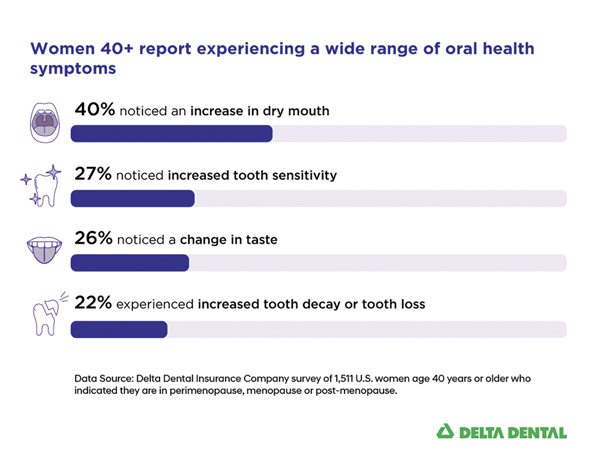
What menopause mouth feels like
Forty percent say they have noticed an increase in dry mouth. Another 27% have noticed more tooth sensitivity in recent months, and 26% say things taste different than they used to. You tell yourself it’s something else. You’re not drinking enough water; you’ve been brushing too hard. Menopause isn’t the first thing that comes to mind.
It adds up. Forty-five percent say oral symptoms associated with menopause, such as tooth pain, dry mouth or gum inflammation, take a toll on their confidence, mood or mental health.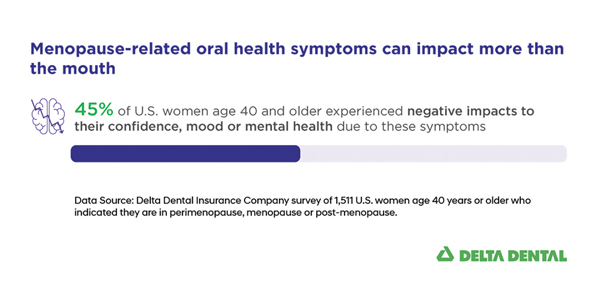
Menopause affects the whole body, mentally and physically. So why is the mouth left out?
Even after learning about this connection, 30% of women say they can’t find information about menopause-related oral health concerns. It isn’t that no one is willing to discuss it.
What makes the conversation hard to start
Three-quarters of dentists say they are comfortable discussing menopause with patients. They just want to know who they’re talking to. Most say they would want more patient history, or to know a patient was in menopause, before raising the subject. Forty-five percent say they would not bring up how menopause affects oral health unless a patient asked.
Dentists also believe that patients are already informed. Ninety-four percent say their patients are at least somewhat aware that menopause can affect oral health. So a patient says nothing about her dry mouth, because it doesn’t seem like a dental problem. The dentist doesn’t bring it up either, assuming someone already has.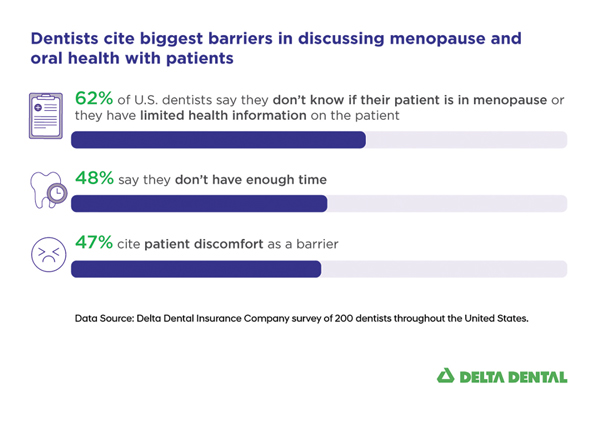
Women are asking for the information
Nearly nine in 10 women say it would help to receive specific instructions during dental visits about managing oral health during menopause. And 69% say they would be more likely to book an appointment if a primary care provider or OB-GYN had told them menopause affects oral health.
No matter who brings it up, the conversation is one worth having. Hormonal changes during menopause can increase the risk of tooth loss or tooth decay, gum disease, receding gumline or loss of jawbone density. Discussing new oral symptoms with a dentist can help women identify potential problems and address them early.
How to start the conversation with your dentist
Your dentist probably doesn’t know you’re in menopause. Start there.
Questions worth asking:
- “Could the changes I’m noticing be related to menopause?”
- “I haven’t had a cavity in 30 years, and now I have two. Could that be tied to hormonal changes?”
- “What can I do about dry mouth?”
- “Are there symptoms I should watch for?”
- “Should I adjust my oral care routine?”
Any one of these questions can get the conversation started.
Methodology
Delta Dental Insurance Company commissioned Atomik Research to conduct two online surveys between June 25 and July 2, 2025.
The first surveyed 200 dentists throughout the United States. The margin of error is +/- 7 percentage points with a 95% confidence level.
The second surveyed 1,511 women ages 40 or older throughout the United States. To qualify, participants had to indicate they are in perimenopause, menopause or post-menopause. Those who were not sure which stage they were in, or who indicated they were not yet in one of the three stages, were excused from participation. The margin of error is +/- 3 percentage points with a 95% confidence level
Atomik Research, part of 4media group, is an independent market research agency.
Photo courtesy of Shutterstock
SOURCE:
Delta Dental Insurance Company
health and wellness
Flu Season Arrives Early: Walgreens Launches 2026-2027 Flu Index as Activity Rises Across the U.S.
The 2026-2027 flu season is tracking four weeks ahead of recent years. Explore Walgreens’ new Flu Index, rising activity, and ways to stay protected.
Last Updated on November 6, 2026 by Daily News Staff
2026-2027 Flu Season: New tracking data suggests influenza activity is running approximately four weeks ahead of recent seasons, with increases reported across western states and Florida.
2026-2027 Flu Season Starts Early as Walgreens Launches New Flu Index
STM Daily News | Health & Wellness
October 30, 2026
Flu season may be getting an early start this year, and a new online tracking tool from Walgreens is giving Americans a closer look at respiratory illness activity in their communities.
On October 21, Walgreens announced the launch of its 2026-2027 Flu Index, an interactive tool that monitors influenza, COVID-19, and other acute respiratory illnesses across the United States.
According to the company’s initial findings, national flu activity is tracking approximately four weeks ahead of recent flu seasons, with increasing activity reported across several western states and Florida.
The early trends serve as a reminder that influenza doesn’t necessarily wait until winter to begin spreading.
Flu Activity Is Increasing Earlier Than Expected
Walgreens reports that its early-season data indicates influenza activity is already increasing in multiple parts of the country.
The company’s findings include:
- Earlier flu activity: National flu activity is tracking approximately four weeks ahead of recent seasons.
- Regional increases: Several western states and Florida are experiencing rising activity.
- More antiviral prescriptions: Walgreens reports dispensing more flu antiviral medications than during the same period in 2025.
- Growing demand for cold and flu products: Sales of cold and flu medications, at-home respiratory illness tests, cough drops, and tea have increased by double-digit percentages compared with last year.
Although these indicators suggest respiratory illness activity is increasing, they do not necessarily mean the current flu season will be more severe than previous seasons.
Increased purchases of cold medications and testing products can reflect changes in consumer behavior as well as illness trends.
The findings come from Walgreens’ pharmacy and retail data and should be considered alongside public health surveillance from the Centers for Disease Control and Prevention (CDC).
What Is the Walgreens Flu Index?
The Walgreens Flu Index is an interactive online platform designed to help consumers understand where respiratory illnesses are circulating and how activity is changing over time.
The tool combines several types of information, including:
- Flu and COVID-19 testing data from Walgreens locations
- Prescription antiviral medication trends
- Over-the-counter cold and flu product purchases
- Geographic patterns in respiratory illness activity
Using these indicators, Walgreens calculates an activity score ranging from 0 to 10.
A score of zero represents the lowest level of activity, while a score of ten represents the highest.
The index provides weekly information for states and territories, along with more than 1,500 counties where sufficient Walgreens data is available.
The map is updated every Monday, allowing users to compare current activity with previous weeks and the prior flu season.
Importantly, Walgreens emphasizes that the index measures relative illness activity, not disease severity. A higher score does not necessarily indicate more hospitalizations, more serious infections, or a greater risk of complications.
The index also does not represent a complete count of influenza cases nationwide.
Explore the interactive map:
https://www.walgreens.com/seasonal/respiratory-illness-index
Why Local Flu Activity Matters
Influenza does not spread evenly across the country.
Some communities may experience increasing cases weeks before others, making local information useful for families, schools, healthcare providers, and individuals who may be at higher risk of complications.
“Flu activity can vary significantly from one community to another, and knowing what’s happening locally can make a real difference,” said Rick Gates, Walgreens’ chief pharmacy and enterprise external affairs officer.
Gates added that the index is intended to help people make informed decisions about prevention, including vaccination before influenza becomes more widespread in their communities.
For residents of states such as Arizona, California, Nevada, and other western states, the reported regional increases make monitoring local respiratory illness trends particularly relevant.
However, the company’s announcement does not establish that every western county is experiencing elevated flu activity. Readers should consult the latest local data for a more accurate picture.
Why Getting a Flu Shot Still Matters
Annual influenza vaccination remains an important tool for reducing the risk of flu illness and serious complications.
Because influenza viruses change over time, flu vaccines are reviewed and updated each season to target strains expected to circulate.
The CDC recommends annual influenza vaccination for most people ages six months and older, with rare exceptions.
Vaccination is especially important for people who face a greater risk of serious complications, including:
- Adults ages 65 and older
- Young children, particularly those younger than five
- Pregnant individuals
- People with chronic conditions such as asthma, diabetes, or heart disease
- People with weakened immune systems
For adults 65 and older, the CDC preferentially recommends certain enhanced influenza vaccines, including higher-dose, recombinant, or adjuvanted options, when available.
Walgreens says its pharmacies offer standard-dose and higher-dose vaccines, along with a new mRNA influenza vaccine at select locations.
Vaccine selection should follow current CDC recommendations, individual eligibility, and guidance from a qualified healthcare professional.
It generally takes about two weeks after vaccination for the body to develop protective antibodies.
Even if influenza is already circulating locally, vaccination can still provide benefits throughout the season.
Practical Ways to Reduce Your Risk of Getting Sick
Vaccination is an important preventive measure, but it is not the only step people can take to reduce the spread of respiratory illnesses.
Public health guidance also encourages several everyday precautions.
Wash your hands regularly. Use soap and water, particularly after touching shared surfaces or being in public places. Alcohol-based hand sanitizer can help when soap and water are unavailable.
Cover coughs and sneezes. Use a tissue or your elbow to reduce the spread of respiratory droplets.
Improve indoor air quality. Opening windows when practical, improving ventilation, and using appropriate air filtration can help reduce exposure to airborne respiratory viruses.
Avoid close contact when sick. Staying home when experiencing respiratory illness symptoms can help protect coworkers, classmates, friends, and family members.
Consider wearing a well-fitting mask. Masks can provide an additional layer of protection, particularly in crowded indoor spaces or around people at higher risk.
Pay attention to symptoms. Fever, coughing, sore throat, fatigue, muscle aches, and congestion can occur with influenza and other respiratory infections.
Because flu and COVID-19 can produce similar symptoms, testing may help determine the cause of an illness.
People at higher risk of complications should contact a healthcare professional promptly if flu symptoms develop. Prescription antiviral medications work best when started early, ideally within the first two days of symptoms, although treatment can still benefit some patients later.
Walgreens Expands Vaccination Access for the 2026–2027 Season
Alongside the launch of its Flu Index, Walgreens announced several efforts to make seasonal vaccinations more convenient.
The company says it is increasing pharmacy staffing, expanding appointment availability, and allowing customers to schedule vaccinations further in advance.
Customers can arrange appointments through several methods:
- Online: https://www.walgreens.com/ScheduleVaccine
- Mobile: Walgreens app
- Text: Send “Flu” to 66879
- Telephone: 1-800-WALGREENS
- Walk-in: Participating Walgreens pharmacies, subject to availability
Walgreens also announced promotional Walgreens Cash rewards for eligible myWalgreens members receiving vaccinations.
Under the limited-time promotion, qualifying members may earn $15 in Walgreens Cash rewards on eligible purchases, along with an additional 10% back on qualifying purchases for a limited period.
Restrictions, exclusions, geographic limitations, and promotional deadlines apply. Customers should review the official terms before participating.
What About COVID-19 and Other Respiratory Illnesses?
Although influenza is the primary focus of the seasonal announcement, the Walgreens Flu Index also tracks COVID-19 and broader acute respiratory illness trends.
This distinction matters because several respiratory viruses can circulate simultaneously during the fall and winter months.
Influenza, COVID-19, respiratory syncytial virus (RSV), and common cold viruses can produce overlapping symptoms, but their potential complications and recommended treatments differ.
Vaccination eligibility and recommendations also vary by disease, age, and individual health circumstances.
Readers should consult current CDC guidance and their healthcare providers when considering flu, COVID-19, or RSV vaccination.
The Bottom Line: Flu Season May Be Early, but Prevention Still Matters
The launch of the 2026–2027 Walgreens Flu Index offers another resource for Americans who want to monitor respiratory illness activity in their communities.
While Walgreens’ early findings suggest influenza activity is increasing sooner than in recent years, it is still too early to determine how severe the overall season will become.
The most important message for consumers is to prepare before respiratory illnesses become widespread.
Staying current with recommended vaccinations, practicing good hygiene, monitoring local illness trends, and seeking medical attention when appropriate can help reduce the risk of serious illness.
With flu activity already rising in some regions, now is a good time for families to review their seasonal health plans.
Related Links for Further Information
Walgreens Resources
- Walgreens Respiratory Illness Index — Interactive map showing respiratory illness activity across the United States.
- Walgreens Vaccination Scheduling — Schedule a flu vaccination or explore available vaccines.
Public Health Resources
- CDC Seasonal Influenza Information — Information about influenza symptoms, prevention, vaccination, and treatment.
- CDC FluView Surveillance — National influenza surveillance and weekly activity reports.
- CDC: Flu and People 65 Years and Older — Guidance for older adults and influenza vaccination.
- CDC Respiratory Illnesses — Prevention information for flu, COVID-19, and RSV.
Source: Walgreen Co., press release, October 21, 2026, Walgreens Launches 2026–2027 Flu Index as Activity Tracks Four Weeks Ahead of Recent Seasons.
Editor’s Note: This article summarizes information from Walgreens’ October 21, 2026, announcement. The reported early-season trends reflect the company’s findings at that time and are not a substitute for current CDC surveillance or medical advice. Readers should consult healthcare professionals about individual vaccination and treatment decisions.
STM Daily News — News You Can Use This Moment!
Health
Caring for the Caregiver: 7 Ways to Support Those Who Care for Others
Caring for the Caregiver:Whether it’s helping an older family member manage appointments and medications, caring for a sick child or coordinating disability services for a loved one, almost everyone will be a caregiver, need a caregiver or both at some point in their lifetime.

Caring for the Caregiver: 7 Ways to Support Those Who Care for Others
(Feature Impact) Caregiving is some of the most important work a person can do, yet it’s often overlooked and undervalued in society. Whether it’s helping an older family member manage appointments and medications, caring for a sick child or coordinating disability services for a loved one, almost everyone will be a caregiver, need a caregiver or both at some point in their lifetime.
In fact, more than 53 million Americans support the health, quality of life and independence of an older adult or family member with a serious illness or disability each year, according to the Administration for Community Living.
Caregiving can be exhausting, stressful and overwhelming at times. In fact, research shows caregivers face real health impacts from physical and emotional strain, according to research published by the National Institutes of Health. Having the right support, however, can improve life for them and those they care for. Consider these practical, accessible ways to support caregivers from the experts at Community Catalyst.
Build a Caregiving Team
Support can begin with reimagining caregiving as a team effort instead of expecting one person to handle every task. Involving other family members, neighbors, local support services and healthcare professionals means many hands and lighter work, whether their help comes in the form of cooking meals, handling transportation or assisting with paperwork.
 Make Time for Your Own Health and Emotions
As a caregiver, you may be tempted to put the needs of others before yours. In fact, many caregivers find themselves scheduling doctors’ appointments for others while skipping their own. Remember your needs are just as important, and you can’t pour from an empty cup. Carve out time for self-care activities like healthy eating, movement, therapy and time with friends. Online support groups and forums can connect you with people who understand, so you feel less isolated.
Look for Respite Care Opportunities
Even if an ill or disabled loved one doesn’t require full-time in-home support, it may be possible to arrange occasional professional respite care. Depending on where you live, Medicaid waivers or local grants could help cover costs – but keep in mind that waitlists can be long, so don’t wait to start exploring these opportunities. For help accessing respite care and other caregiver support, reach out to your state’s “No Wrong Door” center, which can connect you to long-term services and assistance.
Talk to Your Employer
Juggling full-time work and caregiving can be a recipe for burnout, but an understanding employer can make a world of difference. Discuss possibilities like flexible scheduling, remote work, expanded family leave or intermittent leave via the Family and Medical Leave Act, dependent care assistance options and peer support networks.
Get Help Navigating Coverage and Benefits
Between insurance coverage, benefits programs, medical bills and more, the logistics of caregiving can make your head spin. Organizations like Community Catalyst work with local, state and community partners to help caregivers sort through the noise and take actions to improve their families’ lives, like signing up for Medicaid or Medicare.
Through a program funded by the Administration for Community Living, the organization is helping states build systems designed to support caregivers’ health, well-being and financial security. Furthermore, it shares education around family caregiving issues, features the stories of real people who often feel invisible and provides practical, usable guidance for those struggling to navigate insurance and healthcare.
Stay Connected and Organized with Technology
Coordinating care often feels like staying on top of hundreds of details simultaneously. Tools like group chats, video calls, shared calendars, medication apps, remote monitoring devices and telehealth portals can streamline some everyday logistics and keep you in touch with your support network.
Discuss Long-Term Plans Openly
Caregiving is a marathon, not a sprint. Open, honest conversations about the future can help caregivers make more informed decisions, share responsibilities and have greater peace of mind. Discuss medical care, living arrangements, finances, future goals and your loved one’s preferences as you look toward the years ahead.
When caregivers have the support they need, the people they care for – and the communities around them – are stronger. Learn more and find additional caregiver resources at CommunityCatalyst.org.
Photos courtesy of Shutterstock
SOURCE:
Community Catalyst




