Connect with us

Science

If evolution is real, then why isn’t it happening now? An anthropologist explains that humans actually are still evolving

Humans are still evolving! From skin color to lactose tolerance and disease resistance, discover how our bodies keep adapting to changing environments and why evolution is an ongoing process—even in the modern world.

Published

on

Is Human Evolution Still Happening? Why We’re Evolving Right Now
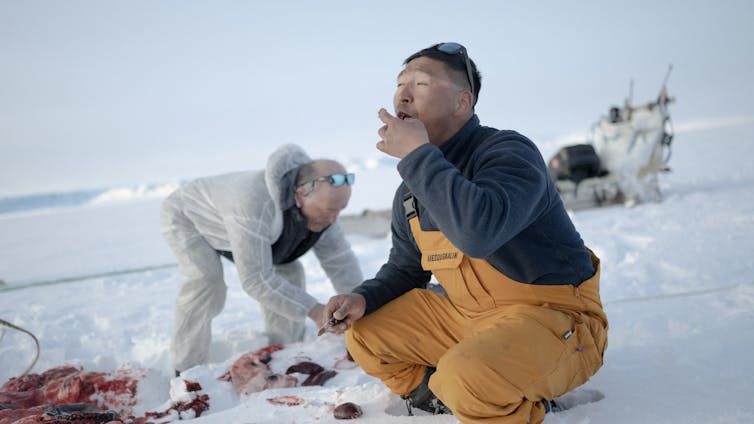
Inuit people such as these Greenlanders have evolved to be able to eat fatty foods with a low risk of getting heart disease.
Olivier Morin/AFP via Getty Images

If evolution is real, then why isn’t it happening now? An anthropologist explains that humans actually are still evolving

Michael A. Little, Binghamton University, State University of New York

Curious Kids is a series for children of all ages. If you have a question you’d like an expert to answer, send it to CuriousKidsUS@theconversation.com.


If evolution is real, then why is it not happening now? – Dee, Memphis, Tennessee


Many people believe that we humans have conquered nature through the wonders of civilization and technology. Some also believe that because we are different from other creatures, we have complete control over our destiny and have no need to evolve. Even though lots of people believe this, it’s not true.

Like other living creatures, humans have been shaped by evolution. Over time, we have developed – and continue to develop – the traits that help us survive and flourish in the environments where we live.

I’m an anthropologist. I study how humans adapt to different environments. Adaptation is an important part of evolution. Adaptations are traits that give someone an advantage in their environment. People with those traits are more likely to survive and pass those traits on to their children. Over many generations, those traits become widespread in the population.

The role of culture

We humans have two hands that help us skillfully use tools and other objects. We are able to walk and run on two legs, which frees our hands for these skilled tasks. And we have large brains that let us reason, create ideas and live successfully with other people in social groups.

All of these traits have helped humans develop culture. Culture includes all of our ideas and beliefs and our abilities to plan and think about the present and the future. It also includes our ability to change our environment, for example by making tools and growing food.

Although we humans have changed our environment in many ways during the past few thousand years, we are still changed by evolution. We have not stopped evolving, but we are evolving right now in different ways than our ancient ancestors. Our environments are often changed by our culture.

We usually think of an environment as the weather, plants and animals in a place. But environments include the foods we eat and the infectious diseases we are exposed to.

A very important part of the environment is the climate and what kinds of conditions we can live in. Our culture helps us change our exposure to the climate. For example, we build houses and put furnaces and air conditioners in them. But culture doesn’t fully protect us from extremes of heat, cold and the sun’s rays.

a man runs after one of several goats in a dry, dusty landscape
The Turkana people in Kenya have evolved to survive with less water than other people, which helps them live in a desert environment.
Tony Karumba/AFP via Getty Images

Here are some examples of how humans have evolved over the past 10,000 years and how we are continuing to evolve today.

The power of the sun’s rays

While the sun’s rays are important for life on our planet, ultraviolet rays can damage human skin. Those of us with pale skin are in danger of serious sunburn and equally dangerous kinds of skin cancer. In contrast, those of us with a lot of skin pigment, called melanin, have some protection against damaging ultraviolet rays from sunshine.

Advertisement
Get More From A Face Cleanser And Spa-like Massage

People in the tropics with dark skin are more likely to thrive under frequent bright sunlight. Yet, when ancient humans moved to cloudy, cooler places, the dark skin was not needed. Dark skin in cloudy places blocked the production of vitamin D in the skin, which is necessary for normal bone growth in children and adults.

The amount of melanin pigment in our skin is controlled by our genes. So in this way, human evolution is driven by the environment – sunny or cloudy – in different parts of the world.

The food that we eat

Ten thousand years ago, our human ancestors began to tame or domesticate animals such as cattle and goats to eat their meat. Then about 2,000 years later, they learned how to milk cows and goats for this rich food. Unfortunately, like most other mammals at that time, human adults back then could not digest milk without feeling ill. Yet a few people were able to digest milk because they had genes that let them do so.

Milk was such an important source of food in these societies that the people who could digest milk were better able to survive and have many children. So the genes that allowed them to digest milk increased in the population until nearly everyone could drink milk as adults.

This process, which occurred and spread thousands of years ago, is an example of what is called cultural and biological co-evolution. It was the cultural practice of milking animals that led to these genetic or biological changes.

Other people, such as the Inuit in Greenland, have genes that enable them to digest fats without suffering from heart diseases. The Turkana people herd livestock in Kenya in a very dry part of Africa. They have a gene that allows them to go for long periods without drinking much water. This practice would cause kidney damage in other people because the kidney regulates water in your body.

These examples show how the remarkable diversity of foods that people eat around the world can affect evolution.

gray scale microscope image of numerous blobs
These bacteria caused a devastating pandemic nearly 700 years ago that led humans to evolve resistance to them.
Image Point FR/NIH/NIAID/BSIP/Universal Images Group via Getty Images

Diseases that threaten us

Like all living creatures, humans have been exposed to many infectious diseases. During the 14th century a deadly disease called the bubonic plague struck and spread rapidly throughout Europe and Asia. It killed about one-third of the population in Europe. Many of those who survived had a specific gene that gave them resistance against the disease. Those people and their descendants were better able to survive epidemics that followed for several centuries.

Some diseases have struck quite recently. COVID-19, for instance, swept the globe in 2020. Vaccinations saved many lives. Some people have a natural resistance to the virus based on their genes. It may be that evolution increases this resistance in the population and helps humans fight future virus epidemics.

As human beings, we are exposed to a variety of changing environments. And so evolution in many human populations continues across generations, including right now.


Hello, curious kids! Do you have a question you’d like an expert to answer? Ask an adult to send your question to CuriousKidsUS@theconversation.com. Please tell us your name, age and the city where you live.

Advertisement
Get More From A Face Cleanser And Spa-like Massage

And since curiosity has no age limit – adults, let us know what you’re wondering, too. We won’t be able to answer every question, but we will do our best.

Michael A. Little, Distinguished Professor Emeritus of Anthropology, Binghamton University, State University of New York

This article is republished from The Conversation under a Creative Commons license. Read the original article.

Sinking Cities: Why Parts of Phoenix—and Much of Urban America—Are Slowly Dropping

Link: https://stmdailynews.com/sinking-cities-why-parts-of-phoenix-and-much-of-urban-america-are-slowly-dropping/

View recent photos

Unlock fun facts & lost history—get The Knowledge in your inbox!

We don’t spam! Read our privacy policy for more info.

Continue Reading
Advertisement Sports Research

The Knowledge

Asteroid 1998 KY26: Can Sunlight Explain Its Motion?

Sunlight may explain the unusual motion of asteroid 1998 KY26. A new study casts doubt on the dark comet theory, and Japan has canceled its planned visit.

Published

on

Last Updated on November 20, 2026 by Daily News Staff

Feature Image Prompt — Asteroid 47186 cP6
Artist’s illustration of asteroid 1998 KY26. Sunlight pressure and heat radiated by the asteroid may explain the small deviations in its orbit.

A tiny asteroid about the length of a school bus has been drifting slightly off the path astronomers would predict from gravity alone. The object, known as 1998 KY26, spins once every five minutes and 21 seconds. One of the strongest explanations for its unusual motion comes from a familiar source: sunlight. 

In a 2025 study, researchers led by NASA’s Jet Propulsion Laboratory modeled two small forces acting on the roughly 36-foot-wide asteroid. Sunlight exerts pressure when it strikes the surface, and the asteroid gets another tiny push as it radiates heat back into space. When the team accounted for the asteroid’s irregular shape and rapid spin, the model closely matched its observed trajectory. 

A newer study published in Icarus casts doubt on another explanation. Astronomers had proposed that escaping water vapor might give KY26 a gentle push without producing a visible tail, making it a candidate for what scientists call a “dark comet.” But temperature simulations found that even the object’s coldest regions would be too warm to hold on to buried water ice over long periods. The findings make long-lived ice a less likely source of the asteroid’s extra acceleration. 

A close-up look was planned for 2031, when Japan’s Hayabusa2 spacecraft was due to rendezvous with KY26. On November 17, Japan’s space agency announced that ion-engine trouble had forced a change of plans. The spacecraft is now slated to fly past a different asteroid, 2015 BM510, in April 2028. 

Sources

Related reading on STM Daily News

https://stmdailynews.com/asteroid-1999-an10-earth-flyby-2027/
Continue Reading

astronomy

Large Asteroid 1999 AN10 Will Safely Pass Earth in August 2027

A large asteroid, 1999 AN10, will safely pass Earth on August 7, 2027, at roughly the Moon’s distance. The flyby could offer binocular views and valuable opportunities for scientific study.

Published

on

Last Updated on November 15, 2026 by Daily News Staff

A close approach near the Moon’s distance could give skywatchers a chance to spot the asteroid with binoculars.

Illustration of asteroid 1999 AN10 passing near Earth against a star-filled background.
Artist’s illustration of asteroid 1999 AN10, which will safely pass Earth on August 7, 2027. Not to scale.

A large asteroid will sweep past Earth on August 7, 2027, offering scientists a valuable research opportunity and skywatchers a potential binocular target. The asteroid, known as 1999 AN10, will safely miss our planet.

How close will asteroid 1999 AN10 come to Earth?

NASA’s Jet Propulsion Laboratory predicts the space rock will pass roughly 242,000 miles (390,000 kilometers) from Earth’s center—about the same distance as the Moon. That is close in astronomical terms, but the predicted flyby poses no impact threat.

Its exact size remains uncertain. JPL estimates a diameter of about 800 meters, or half a mile, while noting considerable uncertainty. Upcoming observations could help researchers better determine its dimensions, shape, and surface features.

Although 1999 AN10 is classified as a potentially hazardous asteroid, that designation describes its orbital proximity and size. It does not mean the asteroid is expected to strike Earth during this encounter.

Can you see the asteroid in August 2027?

For astronomy enthusiasts, the flyby could provide a memorable observing opportunity. JPL predicts the asteroid will reach approximately magnitude 7.5 on the night of August 6–7, making it a possible target for binoculars or small telescopes under suitable conditions. It is expected to be too faint to see with the unaided eye.

Scientists also plan radar observations that could reveal detailed surface features. The encounter offers a chance to learn more about a large near-Earth asteroid as it passes safely through our cosmic neighborhood.

Explore more astronomy and science stories in The Knowledge at STM Daily News.

Sources:

● NASA/JPL, Goldstone Radar Observations Planning: https://echo.jpl.nasa.gov/asteroids/1999an10.2027.goldstone.planning.html

● EarthSky, Mountain-sized asteroid 1999 AN10 to pass close to Earth in 2027: https://earthsky.org/space/mountain-sized-asteroid-1999-an10-pass-close-to-earth-aug-7-2027/

Advertisement
Get More From A Face Cleanser And Spa-like Massage
Continue Reading

Science

October Meteor Showers Give Phoenix Skywatchers a Reason to Look Up

Phoenix skywatchers have several chances to catch October’s meteor showers. Here’s when to watch the Taurids and Orionids—and how moonlight affects the view.

Published

on

Last Updated on October 10, 2026 by Daily News Staff

PHOENIX — October is bringing several opportunities to spot shooting stars over the Valley, with the Draconids reaching their October 8–9 peak and more meteor activity ahead.

The Draconids remain active through October 10, although viewers should expect a light display as the peak passes. Under favorable conditions, the shower typically produces only a handful of meteors per hour. timeanddate.com

Illustration of Orionid meteor shower above Arizona mountains and saguaro cacti, with a sky chart labeling Orion, Betelgeuse, and the shower’s radiant.
An illustrated view of the Orionid meteor shower above the Arizona desert. The shower peaks October 21–22, 2026.

Next, the Southern Taurids have an annual activity peak around October 14. Known for occasional bright fireballs, the shower continues into November. The stronger Orionids peak on the night of October 21 into the morning of October 22, typically producing 10–20 meteors per hour under dark skies. A bright Moon will interfere with this year’s display. American Meteor Society

Phoenix Meteor Showers October 2026: When to Watch

The Orionids originate from debris left by Halley’s Comet. For Phoenix viewers, the best opportunity will be after moonset and before dawn, weather permitting. City lights will further reduce the number visible. amsmeteors.org

NASA recommends finding a viewing area away from streetlights, allowing about 30 minutes for eyes to adjust, and watching a broad stretch of sky. No telescope is needed—just a comfortable chair and patience. NASA Science

ECurious about what’s happening above us? Explore more space stories and science explainers in The Knowledge at STM Daily News.xplore more space, science and everyday

Continue Reading

Trending