

News
Children can be systematic problem-solvers at younger ages than psychologists had thought – new research
Child psychologists: Celeste Kidd’s research challenges long-standing ideas from Jean Piaget about children’s problem-solving abilities. Her findings show that children as young as four can independently utilize algorithmic strategies to solve complex tasks, contradicting the belief that systematic logical thinking develops only after age seven. This insight highlights the importance of nurturing algorithmic thinking in early education.

Last Updated on March 16, 2026 by Daily News Staff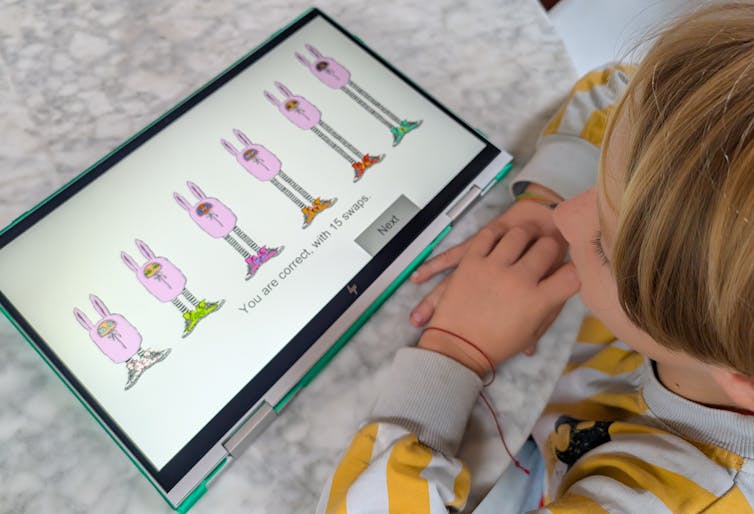
Celeste Kidd, University of California, Berkeley
I’m in a coffee shop when a young child dumps out his mother’s bag in search of fruit snacks. The contents spill onto the table, bench and floor. It’s a chaotic – but functional – solution to the problem.
Children have a penchant for unconventional thinking that, at first glance, can look disordered. This kind of apparently chaotic behavior served as the inspiration for developmental psychologist Jean Piaget’s best-known theory: that children construct their knowledge through experience and must pass through four sequential stages, the first two of which lack the ability to use structured logic.
Piaget remains the GOAT of developmental psychology. He fundamentally and forever changed the world’s view of children by showing that kids do not enter the world with the same conceptual building blocks as adults, but must construct them through experience. No one before or since has amassed such a catalog of quirky child behaviors that researchers even today can replicate within individual children.
While Piaget was certainly correct in observing that children engage in a host of unusual behaviors, my lab recently uncovered evidence that upends some long-standing assumptions about the limits of children’s logical capabilities that originated with his work. Our new paper in the journal Nature Human Behaviour describes how young children are capable of finding systematic solutions to complex problems without any instruction. https://www.youtube.com/embed/Qb4TPj1pxzQ?wmode=transparent&start=0 Jean Piaget describes how children of different ages tackle a sorting task, with varying success.
Putting things in order
Throughout the 1960s, Piaget observed that young children rely on clunky trial-and-error methods rather than systematic strategies when attempting to order objects according to some continuous quantitative dimension, like length. For instance, a 4-year-old child asked to organize sticks from shortest to longest will move them around randomly and usually not achieve the desired final order.
Psychologists have interpreted young children’s inefficient behavior in this kind of ordering task – what we call a seriation task – as an indicator that kids can’t use systematic strategies in problem-solving until at least age 7.
Somewhat counterintuitively, my colleagues and I found that increasing the difficulty and cognitive demands of the seriation task actually prompted young children to discover and use algorithmic solutions to solve it.
Piaget’s classic study asked children to put some visible items like wooden sticks in order by height. Huiwen Alex Yang, a psychology Ph.D. candidate who works on computational models of learning in my lab, cranked up the difficulty for our version of the task. With advice from our collaborator Bill Thompson, Yang designed a computer game that required children to use feedback clues to infer the height order of items hidden behind a wall, .
The game asked children to order bunnylike creatures from shortest to tallest by clicking on their sneakers to swap their places. The creatures only changed places if they were in the wrong order; otherwise they stayed put. Because they could only see the bunnies’ shoes and not their heights, children had to rely on logical inference rather than direct observation to solve the task. Yang tested 123 children between the ages of 4 and 10. https://www.youtube.com/embed/GlsbcE6nOxk?wmode=transparent&start=0 Researcher Huiwen Alex Yang tests 8-year-old Miro on the bunny sorting task. The bunnies are hidden behind a wall with only their sneakers visible. Miro’s selections exemplify use of selection sort, a classic efficient sorting algorithm from computer science. Kidd Lab at UC Berkeley.
Figuring out a strategy
We found that children independently discovered and applied at least two well-known sorting algorithms. These strategies – called selection sort and shaker sort – are typically studied in computer science.
More than half the children we tested demonstrated evidence of structured algorithmic thinking, and at ages as young as 4 years old. While older kids were more likely to use algorithmic strategies, our finding contrasts with Piaget’s belief that children were incapable of this kind of systematic strategizing before 7 years of age. He thought kids needed to reach what he called the concrete operational stage of development first.
Our results suggest that children are actually capable of spontaneous logical strategy discovery much earlier when circumstances require it. In our task, a trial-and-error strategy could not work because the objects to be ordered were not directly observable; children could not rely on perceptual feedback.
Explaining our results requires a more nuanced interpretation of Piaget’s original data. While children may still favor apparently less logical solutions to problems during the first two Piagetian stages, it’s not because they are incapable of doing otherwise if the situation requires it.
A systematic approach to life
Algorithmic thinking is crucial not only in high-level math classes, but also in everyday life. Imagine that you need to bake two dozen cookies, but your go-to recipe yields only one. You could go through all the steps of making the recipe twice, washing the bowl in between, but you’d never do that because you know that would be inefficient. Instead, you’d double the ingredients and perform each step only once. Algorithmic thinking allows you to identify a systematic way of approaching the need for twice as many cookies that improves the efficiency of your baking.
Algorithmic thinking is an important capacity that’s useful to children as they learn to move and operate in the world – and we now know they have access to these abilities far earlier than psychologists had believed.
That children can engage with algorithmic thinking before formal instruction has important implications for STEM – science, technology, engineering and math –education. Caregivers and educators now need to reconsider when and how they give children the opportunity to tackle more abstract problems and concepts. Knowing that children’s minds are ready for structured problems as early as preschool means we can nurture these abilities earlier in support of stronger math and computational skills.
And have some patience next time you encounter children interacting with the world in ways that are perhaps not super convenient. As you pick up your belongings from a café floor, remember that it’s all part of how children construct their knowledge. Those seemingly chaotic kids are on their way to more obviously logical behavior soon.
Celeste Kidd, Professor of Psychology, University of California, Berkeley
This article is republished from The Conversation under a Creative Commons license. Read the original article.
Dive into “The Knowledge,” where curiosity meets clarity. This playlist, in collaboration with STMDailyNews.com, is designed for viewers who value historical accuracy and insightful learning. Our short videos, ranging from 30 seconds to a minute and a half, make complex subjects easy to grasp in no time. Covering everything from historical events to contemporary processes and entertainment, “The Knowledge” bridges the past with the present. In a world where information is abundant yet often misused, our series aims to guide you through the noise, preserving vital knowledge and truths that shape our lives today. Perfect for curious minds eager to discover the ‘why’ and ‘how’ of everything around us. Subscribe and join in as we explore the facts that matter. https://stmdailynews.com/the-knowledge/

Community
‘Give Like a Kid Again’ for Real-World Impact This Halloween
Costumes. Candy. Jack-o-lanterns glowing on porches. Halloween is filled with moments that spark children’s imaginations. This Halloween, children and families can “Give Like a Kid Again,” turning imagination into kindness and helping children around the world.


‘Give Like a Kid Again’ for Real-World Impact This Halloween
(Feature Impact)Costumes. Candy. Jack-o-lanterns glowing on porches. Halloween is filled with moments that spark children’s imaginations.
This Halloween, Trick-or-Treat for UNICEF is inviting children and families to “Give Like a Kid Again,” turning imagination into kindness and helping children around the world. For eight decades,the campaign has shown children that even the smallest act of kindness can travel farther than any front porch and shine brighter than any jack-o-lantern. As the longest-running youth engagement campaign in the United States, it has inspired generations of children to discover that when kids help kids, one Halloween tradition can turn into a lifetime of impact.
What started with just $17 in 1950, when a small group of children filled milk cartons with spare change to help children recovering from World War II, has grown into one of America’s most beloved Halloween traditions, raising nearly $200million to help the organization deliver lifesaving support for children around the world. Today, the iconic orange collection box reminds families that small acts of generosity can create lasting change.
“Each Halloween, Trick-or-Treat for UNICEF reminds us that even the smallest acts of generosity can grow into something extraordinary,” said Shelley Diamond, chief marketing officer, UNICEF USA. “For more than 75 years, this campaign has shown generations of children that you are never too young to make a difference and ‘Give Like a Kid Again’ is about passing that belief on to the next generation.”
Beyond supporting programs in more than 190 countries and territories, donations strengthen the organization’s global humanitarian supply network, delivering emergency essentials like therapeutic food, medicine, blankets and safe water to children impacted by conflict, disasters and disease.
- Be a mermaid and help make waves for clean water. Help provide safe water for a child for a year for $5.
- Be a vampire and help scare away preventable diseases. World Polio Day, just a week before Halloween, provides an opportunity to protect 200 children under age 5 from polio with a $43 donation.
- Be a scientist and help uncover lifesaving answers. Provide 25 malaria diagnostic tests for just $8, helping children receive timely treatment.
- Be a teacher and help children write their next chapter. Provide 1,000 pencils to help children put their ideas, lessons and dreams on paper for $30.
- Be a chef and help cook up a healthier future. Over a two-month period, $10 can treat 15 children by providing 450 packets of micronutrient powder.
- Be an astronaut and help a girl reach for the stars. To helpsix girls feel confident in school, $36 can provide reusable menstrual pads.
- Be a snowman and help bundle up a child against the cold. A donation of $50 could provide a child in an emergency setting with winter clothing, including a jacket, hat, scarf, mittens, socks, winter boots, a warm sweater and warm puffball trousers.
- Be a soccer player (or referee) and help kick off playtime. Provide up to four packages of soccer balls for a child-friendly space for $25 to help kids just be kids again.
This October, everyone can “Give Like a Kid Again” through the iconic orange collection box, online fundraising and family-friendly activities. Visit unicefusa.org/TOT2026 to join the tradition and help make a difference for children around the world.
SOURCE:
UNICEF
📰 Enjoying STM Daily News? Join the conversation!
💬 Leave a comment, share your thoughts, and subscribe to our newsletter for the latest stories, updates, and “News You Can Use This Moment!” delivered to your inbox.
Stay connected with STM Daily News!

Forgotten Genius Fridays
The Tuskegee Airmen: The Red Tails Who Fought Two Wars
The Tuskegee Airmen were far more than the legendary Red Tail fighter pilots. Thousands of pilots, mechanics, instructors and support personnel challenged segregation while helping fight World War II—and their achievements helped change the U.S. military.

A Forgotten Genius Special | STM Daily News
They were training to fight America’s enemies overseas while confronting discrimination in the country they had volunteered to defend. The Red Tails.
They became known as the Tuskegee Airmen.
Their story is often reduced to an image of Black fighter pilots flying red-tailed P-51 Mustangs over Europe during World War II. But the real story was much larger.
The Tuskegee Airmen included pilots, mechanics, instructors, navigators, bombardiers, radio operators, parachute riggers, medical personnel, meteorologists, cooks, clerks, control-tower personnel and many others who helped make military aviation possible.
The National Park Service describes more than 16,000 people as participants in the broader Tuskegee experience.
Together, they helped challenge one of the most persistent prejudices in the American military: the racist assumption that Black Americans lacked the intelligence, discipline or ability required to become successful military aviators.
They proved otherwise.
An Experiment Built on a False Assumption
In January 1941, Secretary of War Henry L. Stimson authorized the formation of a Black pursuit squadron.
The 99th Pursuit Squadron, later redesignated the 99th Fighter Squadron, was activated in March 1941.
Because the American military remained segregated, Black aviators weren’t simply incorporated into existing flying units. A separate training program was established around Tuskegee, Alabama.
Flight training took place at Moton Field, while Tuskegee Army Air Field provided advanced military flight training.
What military officials regarded as an experiment would ultimately help demonstrate that the restrictions placed upon Black aviators had nothing to do with their abilities.
More Than Pilots
The name “Tuskegee Airmen” can be misleading if we imagine only the men sitting inside fighter cockpits.
Aircraft don’t fly because of pilots alone.
They require mechanics.
Fuel crews.
Radio operators.
Meteorologists.
Armorers.
Dispatchers.
Parachute riggers.
Medical personnel.
Instructors.
Navigators.
Engineers.
Control-tower operators.
Administrative personnel.
And many others.
Women were part of the Tuskegee experience as well. According to the National Park Service, women worked as mechanics, control-tower operators, aircraft fuselage technicians, gate guards, secretaries and clerks. Three permanent female parachute riggers helped train hundreds of cadets in the proper packing and maintenance of parachutes.
The Tuskegee story was therefore not simply the story of several hundred pilots.
It was the story of an entire aviation community.
Taking the Fight Overseas
The 99th Fighter Squadron deployed overseas in 1943.
Flying Curtiss P-40 Warhawks, its pilots entered combat in the Mediterranean theater, operating from North Africa and later Sicily and Italy.
The Tuskegee program continued expanding.
Three additional Black fighter squadrons—the 100th, 301st and 302nd—became part of the 332nd Fighter Group.
And the man who would eventually command them had already experienced another form of racial isolation.
His name was Benjamin O. Davis Jr.
The son of America’s first Black Army general had graduated from West Point in 1936 after fellow cadets subjected him to years of deliberate social isolation.
Now Davis was leading Black American fighter pilots into combat.
The Red Tails
The 332nd eventually transitioned to the aircraft that became most closely associated with the Tuskegee Airmen:
The North American P-51 Mustang.
The tails of the group’s aircraft were painted red to identify the unit.
The distinctive markings helped produce one of the most famous nicknames in American military aviation:
The Red Tails.
Operating primarily from Italy, the 332nd escorted heavy bombers deep into enemy territory while also attacking ground targets.
Escort duty was extraordinarily important.
American bombers flying deep into enemy territory were vulnerable to German fighters. Escort pilots had to remain close enough to protect the bombers while simultaneously watching for enemy aircraft.
The Tuskegee Airmen developed an impressive record performing that mission.
The Legend — and the Reality
One claim became particularly famous after the war:
The Tuskegee Airmen never lost a bomber they escorted to enemy fighters.
It is an inspiring story.
It also isn’t completely accurate.
Research by Air Force historian Daniel Haulman using wartime mission reports found that 27 bombers being escorted by the 332nd Fighter Group were shot down by enemy aircraft.
Those losses occurred during seven of the group’s 179 bomber escort missions for the Fifteenth Air Force.
But correcting the legend doesn’t diminish their accomplishment.
In fact, the documented record remains impressive.
Research comparing the 332nd with other P-51 fighter groups in the Fifteenth Air Force found that the Tuskegee Airmen lost substantially fewer escorted bombers to enemy aircraft than the other groups examined.
The truth doesn’t weaken their story.
The truth makes their achievement real.
Fighting Two Wars
The enemy wasn’t confined to the skies over Europe.
Black servicemen returned from missions defending democracy overseas while still confronting segregation at American military installations and throughout American society.
This contradiction became part of the broader Double V campaign during World War II—the call for victory against fascism abroad and racial discrimination at home.
Tuskegee personnel repeatedly challenged discriminatory military policies.
One of the most significant confrontations occurred in 1945 at Freeman Field, Indiana, when Black officers protested restrictions that prevented them from using an officers’ club reserved for white officers.
Their resistance became known as the Freeman Field Mutiny.
The confrontation demonstrated that the Tuskegee story wasn’t simply about proving Black Americans could fly airplanes.
It was also about demanding the rights that should accompany wearing the same uniform.
Changing More Than Aviation
The Tuskegee Airmen didn’t single-handedly desegregate the United States military.
But their performance undermined one of the principal arguments used to justify segregation—that Black servicemen could not perform highly technical or demanding military assignments as effectively as white servicemen.
Three years after the Tuskegee flying program began sending pilots into combat, President Harry S. Truman issued Executive Order 9981 on July 26, 1948, establishing a federal policy of equality of treatment and opportunity in the armed services regardless of race, color, religion or national origin.
Military integration would take additional years to implement.
But the old assumptions had become increasingly difficult to defend.
A Legacy Larger Than the Red Tails
The Tuskegee Airmen eventually became symbols of perseverance, military excellence and the long struggle to expand opportunity within America’s armed forces.
In 2007, the Tuskegee Airmen collectively received the Congressional Gold Medal in recognition of their service.
Yet perhaps the best way to understand their achievement is not through mythology.
They didn’t need a perfect combat record to make history.
They trained in a system created because many officials doubted Black Americans could become military aviators.
They went into combat.
They flew.
They fought.
They protected bomber formations.
They maintained aircraft.
They trained pilots.
And thousands of people behind the scenes made those missions possible.
They demonstrated through performance what segregation had attempted to deny.
And among the men leading them was the son of America’s first Black Army general.
His name was Benjamin O. Davis Jr.
His journey had taken him from isolation at West Point to the cockpit of a military aircraft and command of the 332nd Fighter Group.
But his story was far from finished.
Next Friday on Forgotten Genius Fridays: Benjamin O. Davis Jr. — From West Point Isolation to Four-Star General.
Forgotten Genius Fridays is an STM Daily News series exploring innovators, pioneers and historical figures whose achievements deserve a larger place in our collective memory.
Sources & Related Links
National Park Service — Tuskegee Airmen History & Culture documents the broad definition of the Tuskegee Airmen and the many ground and support occupations involved.
Air Force Historical Support Division — Tuskegee Airmen provides an excellent military chronology of the 99th Fighter Squadron and 332nd Fighter Group.
National Park Service — Tuskegee Airmen National Historic Site is especially useful for Moton Field, training and the Red Tails.
National Park Service — And There Were Women provides material for an often-overlooked part of the story: women who participated in the Tuskegee experience.
Congress authorized a Congressional Gold Medal for the Tuskegee Airmen collectively, recognizing their military record and its role in inspiring reform in the armed forces; the presentation ceremony took place in 2007.
Explore more fascinating stories, videos, and articles on The Knowledge at STM Daily News!
Entertainment
Mattel Adventure Park and VAI Resort: What’s the Latest in Glendale?
Mattel Adventure Park and VAI Resort still have no announced opening date. VAI says construction continues and expects to share more about the park in late 2026.

GLENDALE, Ariz. — The wait continues for Mattel Adventure Park and VAI Resort near State Farm Stadium. Both remain under development, and neither has announced an opening date.
There has, however, been a change in how the park is being described. In August, Axios Phoenix reported that Epic Resort Destinations, the park’s original developer, appears to be out of the Glendale project. Asked about Epic’s involvement, a VAI spokesperson told Axios that VAI is the park’s owner and operator, but did not directly answer whether Epic still has any role. Another VAI spokesperson said the park and resort are now considered part of the same project and that construction continues on both.
VAI also told Axios it is redefining the park’s guest experience and creative vision and expects to share more in the fourth quarter of 2026. That is a promise of a project update, not an opening announcement.
The VAI Resort FAQ currently says it will announce an opening date approximately nine months in advance. Mattel Adventure Park’s Glendale page continues to promote planned attractions, including the Barbie Beach House and two Hot Wheels roller coasters, without listing an opening date.
For families hoping to visit, the practical answer is that there is still no date to put on the calendar. The next meaningful development to watch is VAI’s promised fourth-quarter update: it may clarify the park’s plans, but visitors will need an official opening announcement before they can plan a trip.
Source links: VAI Resort FAQ · Mattel Adventure Park Glendale page · Axios Phoenix’s August report
🎬🍿 Lights, camera, entertainment! From must-see movies and TV to music, celebrities, events, and the latest pop culture buzz, STM Daily News keeps you in the know. 💬 Join the conversation, share your take in the comments, and 📬 subscribe to our newsletter so you never miss the next big story!





