

jobs help wanted
Finding Opportunity in a Tough Market: How Grads Can Build Their Resumes While Job Hunting
Finding a job – even under the best circumstances – is not easy. In this market, recent high school and college grads are having a historically tough time finding work, according to Hiring Lab data. Yet there’s a strategic opportunity both for graduates and employers to help today’s workforce: volunteerism.

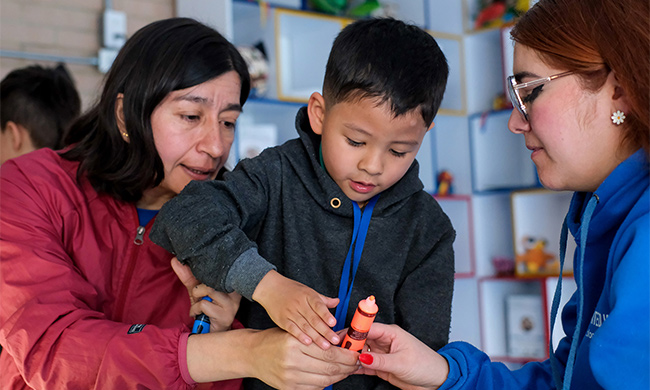
Finding Opportunity in a Tough Market: How Grads Can Build Their Resumes While Job Hunting
(Feature Impact) Finding a job – even under the best circumstances – is not easy. In this market, recent high school and college grads are having a historically tough time finding work, according to Hiring Lab data.
The challenges are amplified as competition for dwindling entry level job openings – fueled in part by AI adoption impacting post-graduate jobs – is intense.
Graduates are submitting countless applications, often without a response. They’re carving time out of their packed schedules for cold calls, interviews and networking. Many are also working jobs in retail or service industries to make ends meet amidst an undeniable affordability crisis.
Yet there’s a strategic opportunity both for graduates and employers to help today’s workforce: volunteerism.
For graduates, it provides hands-on experience to build their resumes, develop professional networks and explore career paths.
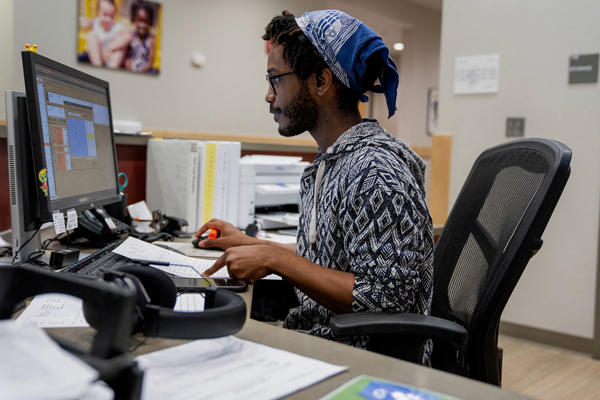 For employers, it acts as an extended interview process, offering opportunities to assess candidates’ skills while boosting company morale, brand reputation and community ties and social responsibility efforts.
Many nonprofits like United Way – as well as businesses, public agencies and other employers – need support in critical areas like communications, event planning, operations, fundraising and technology, which provide hands-on responsibility and skill-building.
“Giving back changes lives but it also opens doors, giving you more opportunities to grow as a person and a professional,” said Rosie Allen-Herring, interim president and CEO of United Way Worldwide. “It is one of life’s greatest joys to volunteer your time to help people in need. However, the benefits don’t stop there, as volunteering also gives you the opportunity to build new skills and form meaningful connections that shape your future.”
For recent graduates, volunteering can:
- Build transferable, real-world skills
Some of the strongest early-career applicants – whether entering the workforce directly from high school or with a college degree – are those who continue building skills, gaining experience and showing initiative after graduation. Employers increasingly value curiosity, adaptability and a willingness to learn skills that volunteering can help build. Volunteer roles also provide real-world transferable skills that AI can’t replicate: communication, leadership, time management, emotional intelligence, teamwork and complex problem-solving. - Deepen and accelerate networking opportunities Meaningful volunteer experiences can place young adults shoulder-to-shoulder with local civic and corporate leaders who have hiring power. According to Gallup research, 55% of youth volunteers find mentors who actively help them reach their career goals.
Volunteering can also create opportunities for established professionals to invest in the next generation – whether through resume reviews, mock interviews, mentorship or professional associations and local networking groups. - Illustrate your “why” Volunteering can help young adults find their passion and purpose. It gives them the space to explore different professional pathways. Aligning volunteer opportunities with career interests allows emerging professionals to test-drive industries and work in environments before committing to a long-term path or even a more structured internship program. For example, high school graduates interested in skilled trades can contribute to community-build projects. Business majors might assist with fundraising strategy. Tech-savvy young adults can support website management. Communications graduates can strengthen social media, writing or content development.
You can start by reaching out to your network of family, friends and colleagues; explore volunteer matching opportunities at your local high school or college career center; or ask local nonprofits directly where they need help most. Another easy place to start is by finding your local United Way, which connects volunteers with meaningful opportunities in communities across the country.
Young adults can also look for short-term or skills-based projects that fit around part-time work or job searching, whether that’s tutoring students, helping with community events, assisting with digital marketing, supporting food banks or volunteering virtually. Even a few hours a week can build valuable experience, grow your network and open doors.
For employers interested in engaging their employees in volunteerism, visit unitedway.org/how-you-can-help/partner-with-us.

SOURCE:
📰 Thanks for reading STM Daily News – your source for News You Can Use This Moment!
We love hearing from our readers. Share your thoughts in the comments section and join the conversation with our growing community. Your feedback helps us create the stories and features that matter most to you.
Don’t miss the latest news, inspiring stories, lifestyle tips, food and drink features, and exclusive updates. Subscribe to the STM Daily News newsletter and get our top stories delivered directly to your inbox.
💬 Leave a comment.
📧 Subscribe to our newsletter.
📢 Share your favorite stories with friends and family.
Stay informed, stay connected, and be part of the STM Daily News community at STMDailyNews.com.


child education
Preparing the Next Generation for Economic Mobility in an AI-Driven World
AI-Driven World: Within only a few years, AI has already changed many things about the world and workforce. Entry-level jobs, particularly the ones relying on routine and predictable tasks, are increasingly disappearing to automation, leaving young people wondering how to launch their careers and futures. To learn what preparing students for the future may look like in practice, consider these tips.

Preparing the Next Generation for Economic Mobility in an AI-Driven World
(Feature Impact) Within only a few years, AI has already changed many things about the world and workforce. Entry-level jobs, particularly the ones relying on routine and predictable tasks, are increasingly disappearing to automation, leaving young people wondering how to launch their careers and futures.
Access to economic mobility – the ability to change your income or wealth – doesn’t just rely on technical knowledge and skills but on leaning into humanity. Being able to think outside the box, collaborate, solve problems and grow as a person can open doors in life and at work. AI may be changing the world, but in change lies opportunity. The students who can adapt quickly are more likely to prosper as the economy continues to reshape itself.
To learn what preparing students for the future may look like in practice, consider these tips from the economic and career experts at Junior Achievement.
Build the Kinds of Skills AI Can’t Replace
Young people facing AI as their competition can get a boost from cultivating the uniquely human skills technology can’t replicate. Educators, parents and other adults in kids’ lives can help them develop increasingly important soft skills like critical thinking, communication, teamwork and leadership, which can translate to many different careers. Hands-on skills can fit into this category as well, like the kinds required in entrepreneurship and the trades.
Provide Real-World Experiences
When young people have the chance to test themselves in a real-world setting, it lets them hone their interests, skills and confidence before the time comes to make major decisions about their futures. As early as elementary school, experiential learning activities like Junior Achievement’s Biztown allow students to operate businesses, work with others, manage finances and solve problems, combining in-class learning with hands-on simulations. As kids grow up, other options can include job shadowing, internships and entrepreneurship experiments – all ways to build durable social and professional skills that can help them succeed.
Teach Foundational Financial Literacy
Earning money is only part of the equation for a healthy financial future; equally important is understanding how to manage it. As kids prepare to earn their first sources of income, make sure they’re also equipped with practical financial skills like budgeting, saving, investing, using credit wisely and planning for future goals. Giving them these tools early helps them make informed decisions about their long-term economic advancement.
Connect Students with Employers and Opportunities
Sometimes, all a student needs to succeed is someone who’s willing to give them a chance. Young people in a position to meet business professionals in (and beyond) their communities may be able to turn those connections into future opportunities. This can happen naturally as they seek real-world experiences through apprenticeships, mentorship programs, career fairs and more.
Programs like Junior Achievement’s 3DE puts students in authentic business challenges, connecting them with educators, business partners and volunteers as they work in teams to complete case experiences. This not only gives young people the opportunity to meet potential employers or mentors, it also lets them demonstrate critical thinking, social skills and real-world competence.
Visit jausa.ja.org for more ideas to help young people gain the confidence and connections needed to achieve economic mobility in a changing world.
Photo courtesy of Shutterstock
SOURCE:
Business and Finance
Handshake Launches Free AI Skills Studio to Help Job Seekers Prepare for an AI-Driven Workplace
Handshake has launched AI Skills Studio, a free project-based learning hub designed to help students and job seekers develop practical AI skills and demonstrate what they can do to prospective employers.

As artificial intelligence becomes a bigger part of everyday work, knowing how to actually use AI tools may become just as important as knowing what they can do.
Career platform Handshake is betting on that shift with the launch of AI Skills Studio, a free learning hub designed to give students and job seekers practical experience using AI through short, hands-on projects.
Handshake’s AI Skills Studio aims to help job seekers build practical, hands-on AI experience as artificial intelligence becomes increasingly important across the workplace. Image: Rod Washington and Firefly.
Announced September 22, AI Skills Studio offers project-based learning “missions” that generally take between 10 and 45 minutes to complete. Instead of focusing primarily on lectures or traditional coursework, participants work directly with AI and technology tools to create something tangible.
Projects can include automated workflows, software, interactive games, data dashboards, portfolios, and tools aimed at preparing users for jobs in areas such as sales and marketing.
The program was developed with a broad group of technology companies and educational partners, including Clay, Figma, Gamma, Google, Lovable, Notion, OpenAI, Replit, Salesforce, Southern New Hampshire University and Vercel.
Turning AI knowledge into something employers can see
One of the more notable aspects of AI Skills Studio is its emphasis on demonstrating skills rather than simply listing them on a résumé.
After completing a mission, learners can add their projects to their Handshake profiles and potentially feature them in the platform’s AI Showcase. Participants also receive verified skill badges intended to provide employers with evidence that they have applied particular AI skills.
That approach reflects a growing challenge for both applicants and businesses: simply saying someone is familiar with artificial intelligence doesn’t necessarily show an employer what that person can accomplish with it.
“Employers know they need people who can work effectively with AI, but a résumé can’t tell you what someone is truly capable of,” Handshake Chief Operating Officer Jon Stull said in announcing the program.
For job seekers, that could make small AI projects increasingly useful as part of a professional portfolio, particularly for people entering the workforce without years of experience.
Students see AI skills becoming increasingly important
Handshake says its own research indicates that many students recognize the importance of AI but don’t necessarily believe their education has kept pace.
According to the company’s 2026 Network Trends Report, 58% of graduating seniors surveyed said they would need a stronger understanding of AI to succeed in the workplace. Only 28%, however, said AI had been meaningfully integrated into their educational programs.
Those figures come from Handshake’s own research, but they highlight a broader issue confronting workers, schools and businesses as generative AI moves rapidly into professional environments.
Julia Stiglitz, Handshake’s Chief Education and Workforce Officer, said people shouldn’t necessarily wait for the technology—or the workplace—to stop changing before beginning to develop AI skills.
“The best thing people can do is start learning and start building,” Stiglitz said.
Learning with tools used in the workplace
Rather than teaching AI only as a theoretical subject, the Studio is designed around tools people could encounter professionally.
OpenAI, for example, is participating with projects involving ChatGPT and Codex. Google is contributing training involving its AI tools and workflows, while other partners bring experience in areas ranging from software development and design to productivity and enterprise technology.
An AI Skills Instructor provides learners with guidance and feedback while they complete projects.
Handshake says connecting those projects directly to a career profile could also give employers another way to evaluate applicants—allowing recruiters to look at what candidates have actually built instead of relying entirely on degrees, résumés or self-reported skills.
AI could change what “experience” means
The development is especially interesting for students, career changers and early-career workers.
Traditionally, gaining experience has often created a familiar problem: employers want applicants with experience, while applicants need employment opportunities to acquire that experience.
Project-based AI training doesn’t eliminate that problem, and completing a short AI exercise isn’t the same as performing a job professionally. But projects can provide another way for someone to demonstrate curiosity, technical familiarity and the ability to apply new tools to a specific task.
As AI becomes embedded in more occupations, portfolios demonstrating how someone uses the technology could become an increasingly useful complement to conventional credentials.
That doesn’t mean everyone needs to become an AI engineer. The more immediate workplace skill may simply be understanding how to use AI effectively within an existing profession—whether that’s marketing, design, software development, sales, research or business operations.
Handshake’s new program is another indication that career preparation is beginning to adjust to that reality.
AI Skills Studio is available free through Handshake’s website and mobile app.
Source: Handshake press release, September 22, 2026. Statistics regarding graduating seniors and AI education are attributed to Handshake’s 2026 Network Trends Report.
Source and Related Links
Handshake — Introducing AI Skills Studio: AI Skills Studio launch and overview — Details the program, project-based missions, participating partners and how completed projects can be displayed to employers.
Handshake — What is AI Skills Studio?: AI Skills Studio Help Center — Official information on how the program works, eligibility, missions and access.
Handshake — Class of 2026 Graduation Report: AI and the Workforce Ahead — Supports the article’s statistics that 58% of graduating seniors say they need stronger AI skills while only 28% say AI has been meaningfully integrated into their academic program. Handshake
Handshake — Workforce Outlook: Class of 2026 in the AI Economy — Additional research on AI adoption, employer demand and attitudes toward AI among graduating students.
Stay informed. Stay curious. From business and technology to lifestyle, entertainment, transportation, science and the stories shaping everyday life, STM Daily News brings you news, insight and useful information that matters.
Discover more stories at STM Daily News: https://stmdailynews.com



(Feature Impact) Every year, approximately 200,000 service men and women transition from military life to corporate America. Finding the right civilian career is a transition, but it’s an opportunity to leverage military leadership and mission-driven talent.
Traditional hiring processes often focus on conventional resumes, but forward-thinking organizations recognize military experience as a competitive advantage in today’s workforce. The resilience, integrity and adaptability of America’s veterans and military families make them uniquely positioned to drive growth and innovation in their communities.
“Veterans bring unmatched discipline, adaptability and a results-driven mindset that directly translates to high-impact corporate careers,” said Drew Matheson, senior director at Capital One’s Commercial Bank and retired U.S. Army infantry officer. “While military experience doesn’t always fit perfectly on a traditional paper resume, employers like Capital One who know how to decode these unique leadership skills are able to unlock an incredible pipeline of proven performers.”
To help transitioning service members successfully navigate this career pivot, military community leaders at Capital One offer these five essential tips for service members entering the civilian workforce: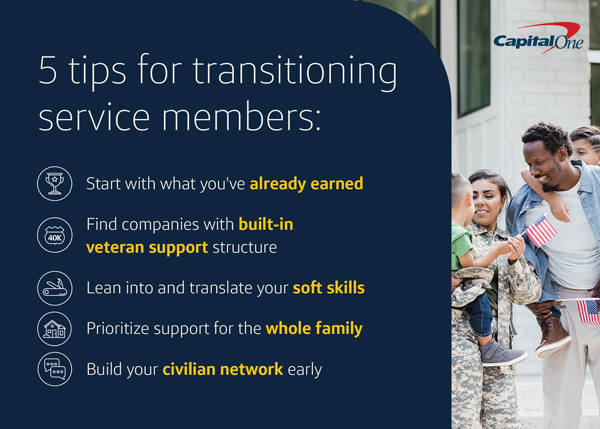
Start With What You’ve Already Earned
Opportunity starts with preparation. Beyond the well-known Post-9/11 GI Bill, which can cover tuition, housing and books, transitioning service members can look into vocational rehab or the SkillBridge program, which allows them to do civilian internships during the last 180 days of service. Many employers also offer internal tuition reimbursement programs. Taking the time to proactively map out these benefits ensures you aren’t leaving valuable opportunities or money on the table.
Find Employers with Veteran Support Structures
With almost half of veterans leaving their first post-military job within a year, according to research published by the Institute for Veterans and Military Families and VetAdvisor, finding the right culture and community is key to a successful transition. Look for employers with active veteran networks and dedicated mentorship.
For example, Capital One’s Salute Business Resource Group serves as a thriving internal community of more than 6,000 members, offering peer support, year-round professional development and mentorship for veterans, reservists and military spouses. Additionally, partner organizations like Hiring Our Heroes provide career workshops, fellowships and job fairs to ensure you’re employment-ready from day one.
Lean Into and Translate Your Soft Skills
Veterans bring a distinct competitive advantage to the applicant pool. You should confidently lean into the cross-functional “soft skills” learned in the line of duty such as risk management, crisis resolution and building trust under high-pressure scenarios.
The trick is translating these capabilities out of military jargon on your resume. Swap military terms like “NCOIC” for “Operations Manager” or “commanded” for “directed.” To make this easier, look for military-friendly employers that employ dedicated military recruiters who specialize in decoding military resumes to align skills with the right roles.
Prioritize Support for the Whole Family
Military service is a family commitment, and the transition out of uniform affects everyone. Military spouses often face unique career hurdles, including frequent relocations and employment gaps. When evaluating employers, look for companies that offer holistic benefits and flexible structures.
For example, Capital One, recognized by “U.S. Veterans Magazine” as a Top Veteran Employer and Top Military Spouse Employer, actively supports military spouses and families through dedicated spouse hiring initiatives and internal support mechanisms. Furthermore, look for organizations that support continued military training and active-duty leave, ensuring military associates never have to choose between their service and their careers.
Build Your Civilian Network Early
In the military, your network is built in. In the civilian world, you have to cultivate it. Long before your terminal leave begins, connect with veterans who work at companies you admire. Reach out for brief, 15-minute informational interviews to learn about their transition journeys rather than simply asking for a job. With more than 70% of civilian jobs filled through networking, according to estimates from Career Horizons, making organic connections early is a powerful tool for getting your foot in the door.
To find additional resources and learn more about how to support the hiring of veterans and military spouses, visit CapitalOneCareers.com/Military.
Photo courtesy of Shutterstock

SOURCE:




