

The Bridge
Large trunks discovered in a basement offer a window into the lives and struggles of early Filipino migrants
Abandoned trunks became time capsules of Little Manila’s Filipino migrant story.

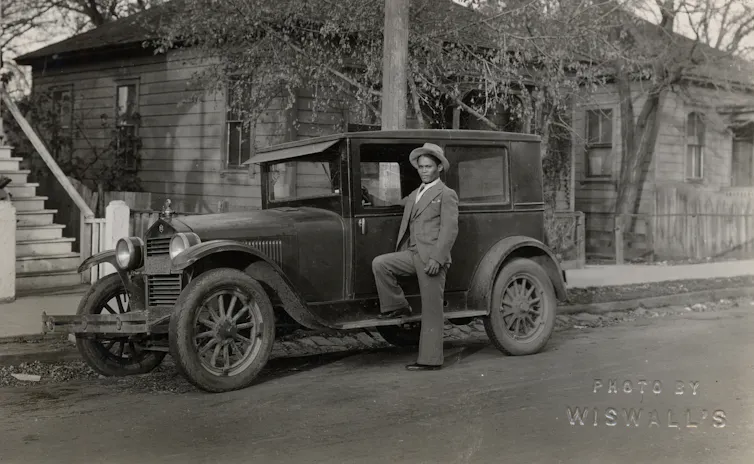
Sam Vong, Smithsonian Institution
In 2005, Antonio Somera, a Filipino American member of the Legionarios del Trabajo, a Masonic fraternal order, stumbled across a trove of mysterious-looking containers while he was cleaning out the basement of the Daguhoy Lodge in Stockton, California.
The containers, which had been abandoned for decades, included more than a dozen steamer trunks – large luggage chests designed for long-distance travel – and a handful of suitcases dating to the 1910s.
They belonged to former Legionarios del Trabajo members who at some point lived in the lodge but had passed away. Fraternal brothers packed their personal belongings to memorialize the deceased and hoped that surviving family members would later reclaim the objects.
These unusual time capsules and their contents tell a largely forgotten history of the men and women who had left the Philippines in the 1910s to work in Hawaii’s sugar industry and later settled in California’s San Joaquin Valley. Affectionately dubbed “Little Manila,” south Stockton became an important hub for one of the largest communities of Filipinos outside the Philippines.
Along with my curatorial assistant, Ethan Johanson, we studied the fascinating objects and photographs found in the trunks to tell the story of this largely forgotten cohort of migrants.
Here are five objects that capture the breadth and depth of life and work in California, Hawaii and other states for Filipino migrants. They’re among those featured in an exhibition created by the Smithsonian Asian Pacific American Center on display at the Smithsonian’s National Museum of American History. Titled, “How Can You Forget Me: Filipino American Stories,” the exhibition explores the making of the Filipino American community in Stockton between the 1910s and 1970s.
1. The steamer trunk
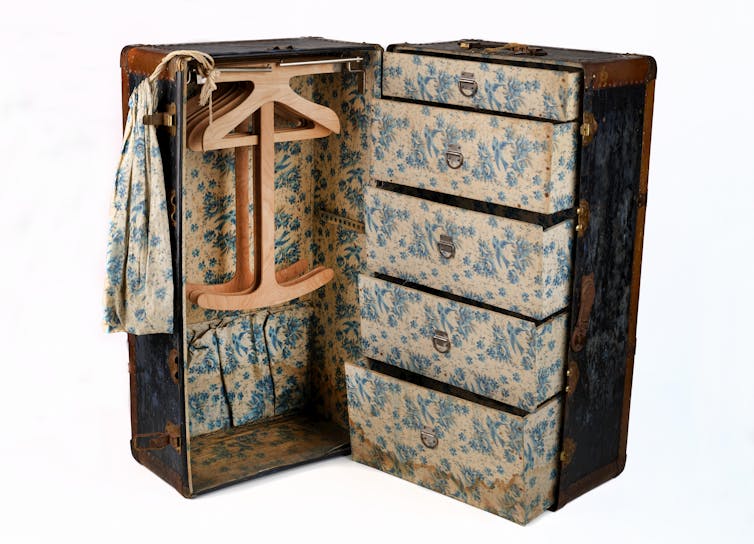
This steamer trunk formerly belonged to Anastacio Atig Omandam, a worker who arrived in Honolulu from the Philippine province Negros Oriental in January 1916.
In his 20s, Omandam embarked on a two- to three-week voyage across the Pacific Ocean, leaving his rural and impoverished hometown to earn money to send home.
Omandam was part of a group of mostly young, single men who were recruited by sugar plantation companies as early as 1906 to work in Hawaii’s booming sugar industry. Between 1906 and 1935, thousands of men – and later women – left their hometowns in the Ilocos and Visayas regions of the Philippines for Hawaii, toiling on plantations alongside other immigrant workers.
After the United States defeated Spain in the 1898 Spanish-American War, the Philippines was under U.S. colonial rule until 1935.
Filipinos living under American rule and in U.S. territories were designated as U.S. nationals, an ambiguous legal status. It allowed Filipinos to migrate relatively freely within U.S. territories, but they lacked constitutional protections and privileges such as citizenship and voting rights.
Omandam’s steamer trunk is emblematic of the trunks discovered by Somera in 2005. Omandam likely bought the trunk secondhand in the Philippines or Hawaii. While the origins of the trunk remain a mystery, it traveled with Omandam from job to job, reflecting the life of a migrant worker continually on the move. Many of these trunks – Omandam’s included – contained handwritten correspondence written in beautiful cursive, photographs, postcards, work tools, garments and pay stubs.
They were, in essence, time capsules of each of these men’s lives.
2. An asparagus knife
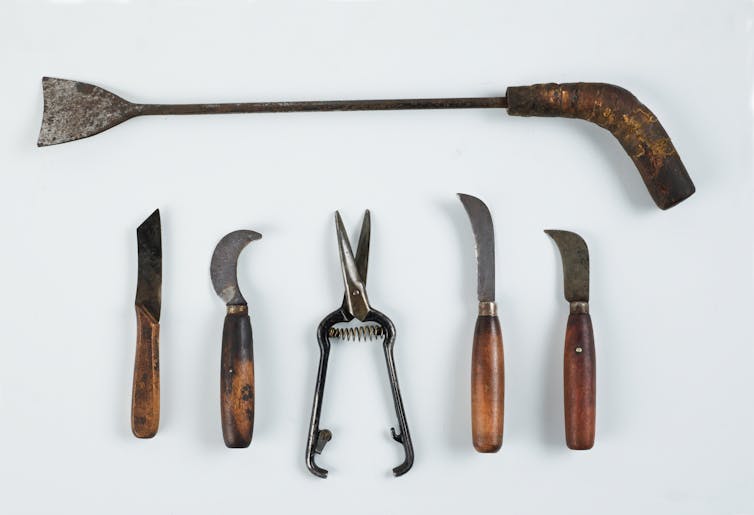
The large, unusual-looking metal instrument found in one trunk is a knife that farmworkers used to harvest asparagus.
During the harvesting season, typically between February and June, workers wielded this knife, using the sharp edge of the forked blade to pierce approximately 6 inches (15 centimeters) below the soil to cut the root of the asparagus.
Harvesting asparagus demanded dexterity and speed. Workers needed to constantly bend over to cut and collect the produce as they moved up and down the rows. This repetitive and backbreaking motion earned Filipino farmworkers the derogatory label “stoop labor.”
After a series of restrictive immigration laws barred Chinese, Japanese and other immigrant groups between the 1870s and 1920s, growers and agribusiness turned to hiring Filipinos and Mexicans to harvest seasonal crops such as lettuce, grapes and asparagus, among others.
When the harvesting season was over, Filipino farmworkers migrated to other West Coast states to harvest apples, hops and grapes. Others went to Alaska to can salmon.
The asparagus knife was found among the containers in the basement, alongside other grafting and pruning knives. These tools – still carrying the soil from which they were tilled – represent the work of the immigrant farmworkers of all backgrounds who helped build California’s agriculture industry, which continues to feed the nation today.
3. Three-piece suits
Three-piece suits were found in nearly all the steamer trunks, along with Stetson hats, bow ties and other fashionable accessories from the 1920s and ’30s.
Despite earning meager wages, most Filipino farmworkers saved their hard-earned money to purchase at least one tailored three-piece suit. Men donned these stylish garments to attend Sunday Mass, dinners and taxi-dance halls – where they could pay a small fee to dance with a professional dancer – or merely to strut their stuff down the streets of Stockton’s Little Manila.
Because Americans often looked down upon agricultural workers as uncultured and illiterate – “little brown monkeys” was a common slur – Filipinos resisted these negative characterizations by presenting themselves like the Hollywood movie stars they saw at the cinema. They understood the power of self-presentation: By embracing popular American styles, they sought to command respect and dignity.
They also wore these suits to pose for fancy photographs that were sent back home to the Philippines as a way to display affluence and social mobility – and to entice their compatriots to join them in the U.S.
Not everyone was enchanted. Some white Americans viewed these slick, handsomely dressed Filipino men as a sexual threat that could “steal” their women.
4. A pageant dress
This sequined dress belonged to Barbara Nambatac, a longtime resident of Livingston, California, who grew up among the “manongs,” a kinship title meaning older brother often used when referring to this early generation of Filipino migrants.
Her Filipino father was a cook who served food to Filipino and Mexican field hands on farms throughout California’s Central Valley, where he later met Nambatac’s Mexican mother.
In the 19th century and into the 20th century, California’s anti-miscegenation laws prohibited whites from marrying outside their race. At the same time, the shared experiences of Mexican and Filipino farmworkers often led to relationships between members of the two migrant groups.
When Barbara was 21, Nambatac’s father, who was a member of the Legionarios del Trabajo in Stockton, saved his modest salary to buy the dress from the Philippines and registered her in a beauty pageant that helped raise funds for the lodge. She ultimately took first place.
In Stockton’s Little Manila, pageants reinforced the importance of women in the community. Since women were discouraged from migrating, there was a gender imbalance in Filipino American communities that persisted for decades.
Filipinas who were able to migrate to the United States were important pillars in Stockton’s Filipino American community and assumed multiple roles. Women labored tirelessly alongside men in the fields, performed domestic work in households, advised young men to save money and go to school, and built and maintained networks that sustained local communities and transpacific ties back home in the Philippines.
Although the gender disparity was stark in Little Manila before the 1960s, the presence of women and girls ensured the survival of Filipino American families.
5. A pillowcase
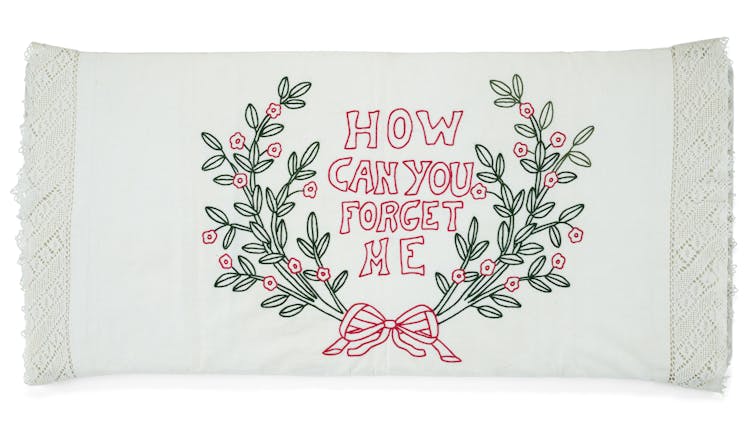
This pillowcase was one of three found in Anastacio Omandam’s steamer trunk.
It’s embroidered with floral patterns and a poignant message – “How Can You Forget Me” – which inspired the exhibition’s title. The pillowcases, along with letters and photographs, evoke the sentimental messages that connected friends, families and lovers separated by a vast ocean.
In the case of Omandam, a loved one from the Philippines likely sent him the pillowcase. The lack of punctuation is interesting: It serves as neither a question nor a declaration, but nonetheless urges Omandam to never let go of his memories of home.
In the same way, I hope the exhibition will implore visitors to never forget this generation of men and women who paved a path for other Filipino immigrants. More than 4.4 million Americans identify as having Filipino ancestry, according to the 2020 U.S. census.
These objects reflect the stories of ordinary people who were resourceful, creative, resilient and filled with hope in the face of discrimination, racism and legal exclusion.
The odds were constantly stacked against them. And yet they persevered – each strike into the soil, each coin saved to save up for a new suit, each lodge meeting and each beauty pageant taking them one step closer to forging a place for themselves in the American story.
Sam Vong, Curator of Asian Pacific American History, Smithsonian Institution
This article is republished from The Conversation under a Creative Commons license. Read the original article.
WATCH MORE • READ MORE • STAY INFORMED
STMDailyNews.com


STM Blog | Commentary | October 14, 2026
The viral allegations involving Texas Roadhouse and the treatment of Black customers raised an understandably disturbing question: Could diners trust that they were being served safely and respectfully?
After reviewing available coverage again on October 14, STM Daily News did not locate new verified evidence establishing that the alleged food tampering occurred. We also did not locate a publicly released final report from the outside firm the company said it hired.
The central distinction remains unchanged: the allegations have not been substantiated in the reporting reviewed, while Texas Roadhouse says its investigation points to a hoax.
What the available reporting says
In August, social media posts alleged that restaurant workers deliberately tampered with food served to Black customers. The claims circulated widely and prompted calls for a boycott. Texas Roadhouse said it had not identified current or former employees connected to the accusations.
In reporting updated August 26, KTXS noted that the viral post did not identify a particular restaurant location and that there was no verified evidence connecting the claims to a Texas Roadhouse employee.
The company told the outlet it had found no credible evidence of food tampering. It also said the original Facebook post had been deleted, some users had retracted posts amplifying the claims, and an outside firm had been engaged to investigate the accusations’ source and motives. These details come from August coverage, rather than a new October announcement.
What remains unresolved publicly
Our latest review did not locate a final outside investigation report that readers could examine. We therefore cannot describe that investigation as complete or independently assess its findings.
The company’s description of the claims as a hoax should continue to be attributed to Texas Roadhouse. Likewise, the allegations should not be repeated as though they describe a confirmed incident.
Not locating a new public report does not establish whether investigative work has continued privately. It means the public information we found does not support a stronger conclusion.
Why careful wording still matters
For Black diners, allegations of racist mistreatment can strike a painful nerve. Everyone deserves to sit down for a meal without worrying that their race could make them a target.
Taking that concern seriously requires credible complaints to be investigated thoroughly. It also requires care before assigning blame to a restaurant, a location, or its workers.
Social media can spread a warning far beyond its original audience before anyone verifies the underlying claim. Once that happens, a correction or clarification may never reach everyone who saw the accusation.
That makes transparency essential. Restaurants should explain what they have investigated and what they can substantiate. Those sharing accusations should be equally willing to share corrections and acknowledge uncertainty.
For now, the responsible position is to keep the evidence and the allegations separate. If new, verifiable findings become public, they should be assessed on their merits.
Join the conversation: What do you look for before trusting a viral warning about a business? Share your thoughts in the comments, and keep the conversation respectful.
Editor’s note: This is an October 14 status review of previously reported allegations. It does not announce a new investigative finding.
Sources
- KTXS: Viral post alleges Texas Roadhouse mistreated Black customers; company responds — Includes the company’s statement and explains the lack of verified evidence connecting the allegations to an employee or location.
- Houston Chronicle: Texas Roadhouse investigates Facebook hoax alleging racist food tampering — Covers the company’s denial and its decision to hire an outside investigative firm.
- MySA: Texas Roadhouse faces social media backlash over viral allegations — Details how the claims spread and the restaurant chain’s response.
Related reading
- Snopes: Posts claim Texas Roadhouse servers contaminated Black customers’ food — Examines the viral allegations.
- Restaurant Business: Texas Roadhouse says post alleging racist practices was a hoax — Restaurant industry coverage of the controversy.
- Texas Roadhouse official website — Company information and customer contact options.


Food Truths
Soul Food Has African Roots—and a Distinct Black American History
Soul food connects African heritage with generations of Black American creativity and community. Here’s why shared roots and a distinct cultural identity both deserve recognition.

Last Updated on October 15, 2026 by Daily News Staff
Shared ancestry connects the African diaspora. It also makes understanding each community’s food traditions worth the effort.
A debate over who can claim soul food raises a question larger than any social media argument: When does a shared cultural inheritance become a distinct tradition?
People across Africa and the African diaspora have foods that evoke home, family, comfort, and belonging. Recognizing that connection is valuable. But using “soul food” as a general description of comforting food is different from identifying the cuisine historically known by that name.
Soul food is a distinctly African American culinary tradition with African roots, shaped by generations of Black life in the United States. Recognizing its American development does not erase Africa. Recognizing Africa should not erase what Black Americans created.
African Roots, American Development
Enslaved Africans arrived with agricultural knowledge, cooking skills, and food traditions. They adapted those traditions to unfamiliar surroundings and unequal access to food, drawing on available ingredients and encounters with Indigenous and European foodways.
Okra, black-eyed peas, and vegetable-centered cooking offer important connections to African traditions. Corn and cornmeal reflect Indigenous American agriculture. These ingredients and influences became part of an evolving food culture rather than remaining unchanged copies of dishes from another continent. [1]
The distinction is between ancestry and development. A cuisine can descend from older traditions and acquire its own identity through the experiences of the people who preserve and transform it.
More Than a Story About Scraps
Slavery and deprivation belong in this history. Enslaved people supplemented restricted food supplies through gardening and other means, and used small amounts of meat to season vegetables. But telling the entire story as “making something out of scraps” understates their knowledge and creativity.
Black food history also includes seafood work, farming, skilled cooking, and enterprise. The Smithsonian’s account of Black foodways, for example, documents African Americans’ extensive involvement in harvesting, processing, and selling oysters. [2]
These were people with expertise. Their contributions deserve recognition as culinary work and cultural creation.
Why the Name Matters
The food traditions are older than the widespread use of the name “soul food.” The term became prominent during the 1960s, amid movements asserting Black identity and cultural pride. Smithsonian histories describe the soul food movement as celebrating foods that mainstream America had often disparaged. [3]
That context gives the name meaning beyond a meal that tastes good or brings comfort.
For some families, a pot of greens or a pan of cornbread carries memories of relatives, church dinners, holidays, and recipes learned by watching someone cook. Calling those foods “soul food” places them within a particular cultural story.
Southern Roots Traveled
Soul food also developed beyond the South. During the Great Migration, Black Americans carried Southern food traditions into new cities and neighborhoods, preserving familiar dishes while adapting their cooking. Smithsonian programming connects that movement directly to soul food’s development. [4]
That helps explain how a cuisine rooted in the South became part of Black community life across the country.
It also makes geography an imperfect test of authenticity. Soul food cooked in London can still be African American soul food. A cuisine’s cultural origins do not change simply because someone prepares it elsewhere.
Shared Heritage Does Not Mean Identical Cultures
Africa is a continent of many food traditions. The diaspora is similarly diverse. African American, Afro-Caribbean, Afro-Latin American, and Black British identities encompass different histories and relationships to food.
Someone may use “soul food” figuratively to describe a cherished family dish. That emotional use is understandable. The difficulty arises when it becomes a historical claim that all Black cuisines are versions of the same named tradition.
Shared ingredients and ancestry establish connections; they do not make distinct cuisines interchangeable.
A useful conversation would ask which dishes are related, what techniques survived, and how different communities adapted them. That approach gives people more history to appreciate.
Respect Through Recognition
Defending soul food’s African American identity need not become an attack on Africans, Caribbean people, or Black Britons. Equally, celebrating connections across the diaspora should include respect for Black Americans’ particular contributions.
Anyone can cook, enjoy, study, and share soul food. Cultural recognition does not require closing the kitchen door. It requires crediting the people and history behind the cuisine.
Soul food’s African roots and African American identity belong in the same sentence. Both deserve to be remembered.
What dish connects you most strongly to your family’s history—and who taught you to make it? Share your story in the comments.
Explore more food stories and culinary traditions in STM Daily News’ Food & Drink section.
Sources and Further Reading
- African and Native American Foodways and Resilience: From 1619 to COVID-19 — Research on food traditions, adaptation, and cultural resilience.
- Black Foodways and Cuisine — National Museum of African American History and Culture.
- African American History Highlights — National Museum of American History, including the soul food movement.
- Cooking Up History — National Museum of American History programming on migration and soul food.
Community
Mariska Hargitay and Purina Team Up to Help Domestic Violence Survivors Keep Their Pets Safe
Mariska Hargitay and Purina are raising awareness about a heartbreaking reality: Many domestic violence survivors delay escaping abuse because they cannot bring their pets. Discover how the Purple Leash Project is helping families and animals find safety together.

Purple Leash Project takes center stage at U.S. Women’s National Team match, raising awareness about a heartbreaking choice facing abuse survivors and their beloved pets.
By STM Daily News | Lifestyle & Pets | October 12, 2026
WASHINGTON, D.C. — For many people, pets are more than companions. They’re family, providing comfort, unconditional love, and emotional support during life’s most difficult moments. But for survivors of domestic violence, the bond with a beloved pet can create an unexpected obstacle when trying to escape an abusive environment.
Actress and longtime domestic violence advocate Mariska Hargitay joined Purina and the U.S. Women’s National Soccer Team on October 10, 2026, to shine a spotlight on this often-overlooked issue.
During the team’s match against Spain at Audi Field in Washington, D.C., Hargitay served as Purina’s Honorary Captain, helping promote the company’s Purple Leash Project, an initiative designed to help domestic violence survivors find safety without leaving their pets behind.
The appearance was part of Domestic Violence Awareness Month, observed every October.


When Escaping Abuse Means Leaving a Pet Behind
For someone experiencing domestic violence, leaving an abusive relationship can be dangerous and emotionally overwhelming. The situation becomes even more complicated when pets are involved.
According to statistics cited by Purina:
- Only 20% of domestic violence shelters allow pets.
- 48% of survivors delay leaving an abusive situation because they cannot take their pets with them.
These figures illustrate a significant barrier to safety.
For survivors whose pets provide emotional stability and companionship, the possibility of abandoning an animal can be devastating. Some may also fear that an abusive partner will harm a pet left behind.
The Purple Leash Project seeks to eliminate that difficult choice by helping domestic violence shelters become more accommodating to animals.
What Is the Purple Leash Project?
The Purple Leash Project is a partnership between Purina and RedRover, a nonprofit organization dedicated to helping animals and strengthening the human-animal bond.
Through grants and financial assistance, the initiative supports domestic violence shelters and social service organizations by funding:
- Renovations that make shelters pet-friendly.
- On-site and off-site housing for survivors’ pets.
- Essential pet supplies and accommodations.
- Necessary veterinary services for animals entering shelter programs.
According to Purina, the initiative has already provided nearly 70 grants totaling more than $2.2 million across over 30 states.
The company has also established a goal of helping provide one million safe nights for survivors and their pets by the end of 2030.
The ultimate objective is simple: Nobody should have to choose between personal safety and protecting a beloved animal.
Mariska Hargitay Brings the Message to the Soccer Field
Hargitay, widely recognized for portraying Olivia Benson on Law & Order: Special Victims Unit, has spent years advocating for survivors of domestic violence and sexual assault.
Her participation in the U.S. Women’s National Team event brought additional visibility to the Purple Leash Project.
During the pre-match ceremonies, Hargitay participated in the ceremonial coin toss alongside Cassidy, a 75-pound Golden Retriever therapy dog, and Cassidy’s handler, Patrice “Pat” Eller.
Cassidy and Eller are part of a Pet Partners therapy team that helps provide comfort to children who may be required to testify in court.
Their presence illustrated the important role animals can play in helping people cope with traumatic experiences.
“Seeing the Purple Leash Project take the field helped turn the stadium into a powerful show of support for survivors and the pets they love,” Hargitay said in a statement released by Purina.
She also emphasized the importance of reducing the stigma surrounding domestic violence and creating more safe spaces where survivors and their pets can recover together.
A Special Soccer Scarf Supporting Survivors and Pets
To encourage fans to participate in the initiative, Purina and U.S. Soccer introduced a limited-edition Courageous & Comfy Soccer Scarf.
The officially licensed scarf is available through the Purple Leash Project’s online store.
According to Purina, 100% of every scarf purchase is donated to RedRover, supporting the effort to help survivors and their pets remain together.
Fans interested in supporting the initiative can visit:
Purple Leash Project Scarf Store
Additional information about the initiative is available at:
Bringing Pets Into the Soccer Experience
Beyond raising awareness for domestic violence survivors, Purina used the event to highlight the relationship between sports fans and their pets.
At Audi Field, the company introduced the Purina Club, a temporary pet-friendly seating area where fans could attend the match with their dogs.
The initiative reflects Purina’s growing involvement in soccer, including collaborations with U.S. Soccer and pet-centered activities associated with the 2026 FIFA World Cup.
While these efforts celebrate the companionship pets bring to everyday life, the Purple Leash Project addresses a more serious reality: For some individuals, the ability to remain with their animals can influence whether they can safely leave an abusive situation.
Why the Human-Animal Bond Matters
Anyone who has experienced the companionship of a dog, cat, or another beloved pet understands how deeply animals can become part of a family.
Pets offer familiarity, routine, comfort, and emotional connection. During times of uncertainty, those relationships can become especially meaningful.
For survivors of domestic violence, maintaining that bond can provide an important source of reassurance while rebuilding their lives.
The Purple Leash Project recognizes that protecting survivors and protecting their animals are often interconnected needs.
“At Purina, we believe survivor safety shouldn’t require sacrifice,” said Nina Leigh Krueger, CEO of Purina, in the company’s announcement.
That philosophy is at the heart of the initiative’s mission to expand access to safe, pet-friendly shelter accommodations.
How You Can Help
Supporting survivors and their pets doesn’t necessarily require a major financial commitment.
Individuals can learn more about the Purple Leash Project, support participating organizations, share information about pet-friendly domestic violence shelters, or contribute to nonprofit programs that help families and animals in crisis.
Organizations such as RedRover also provide resources designed to strengthen the human-animal bond and assist animals during emergencies.
Learn more at RedRover.org.
For anyone currently experiencing domestic violence in the United States, confidential assistance is available through the National Domestic Violence Hotline at 1-800-799-SAFE (7233) or TheHotline.org. If immediate danger exists, call 911.
A Safer Future for Survivors and Their Pets
The partnership between Purina, Mariska Hargitay, RedRover, and U.S. Soccer demonstrates how public awareness campaigns can help bring attention to problems that often remain unseen.
For survivors of domestic violence, the path to safety should not mean having to abandon a loyal companion.
And for the pets who depend on their families, remaining together can mean everything.
By helping shelters accommodate animals, the Purple Leash Project is working toward a future where survivors and their pets can escape dangerous situations, find stability, and begin healing together.
More Lifestyle & Pet Stories From STM Daily News
At STM Daily News, we believe stories about pets are also stories about people, families, communities, and the powerful connections that make life meaningful.
Explore more stories about animal welfare, pet care, family life, and community initiatives in our Lifestyle section at STM Daily News.
Stay informed. Stay connected. Discover stories that matter.
Sources and Additional Resources
- Purina — Purple Leash Project
- RedRover — Animal Welfare and Crisis Support
- National Domestic Violence Hotline
- U.S. Soccer
Source: Nestlé Purina PetCare press release, October 11, 2026. Statistics and grant figures attributed to Purina.





