

News
The Boeing Starliner has returned to Earth without its crew
Boeing’s Starliner returned uncrewed after thruster issues left astronauts on the ISS longer than planned. SpaceX remains a reliable option, challenging Boeing’s standing.

Last Updated on September 7, 2024 by Daily News Staff
– a former astronaut details what that means for NASA, Boeing and the astronauts still up in space
Michael E. Fossum, Texas A&M University
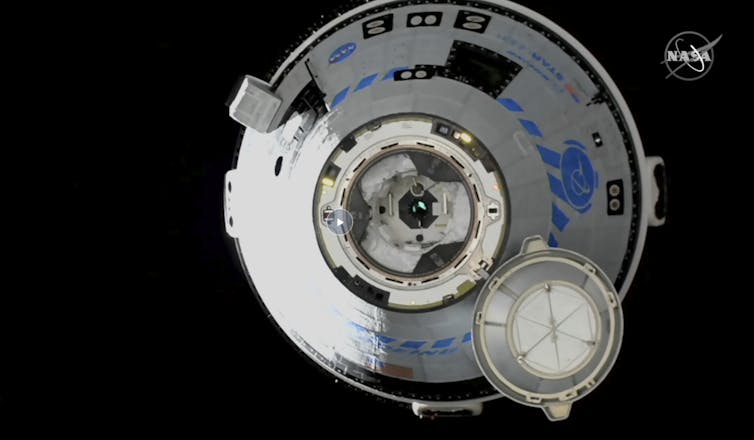
Boeing’s crew transport space capsule, the Starliner, returned to Earth without its two-person crew right after midnight Eastern time on Sept. 7, 2024. Its remotely piloted return marked the end of a fraught test flight to the International Space Station which left two astronauts, Butch Wilmore and Sunita “Suni” Williams, on the station for months longer than intended after thruster failures led NASA to deem the capsule unsafe to pilot back.
Wilmore and Williams will stay on the International Space Station until February 2025, when they’ll return to Earth on a SpaceX Dragon capsule.
The Conversation U.S. asked former commander of the International Space Station Michael Fossum about NASA’s decision to return the craft uncrewed, the future of the Starliner program and its crew’s extended stay at the space station.
What does this decision mean for NASA?
NASA awarded contracts to both Boeing and SpaceX in 2014 to provide crew transport vehicles to the International Space Station via the Commercial Crew Program. At the start of the program, most bets were on Boeing to take the lead, because of its extensive aerospace experience.
However, SpaceX moved very quickly with its new rocket, the Falcon 9, and its cargo ship, Dragon. While they suffered some early failures during testing, they aggressively built, tested and learned from each failure. In 2020, SpaceX successfully launched its first test crew to the International Space Station.
Meanwhile, Boeing struggled through some development setbacks. The outcome of this first test flight is a huge disappointment for Boeing and NASA. But NASA leadership has expressed its support for Boeing, and many experts, including me, believe it remains in the agency’s best interest to have more than one American crew launch system to support continued human space operations.
NASA is also continuing its exchange partnership with Russia. This partnership provides the agency with multiple ways to get crew members to and from the space station.
As space station operations continue, NASA and its partners have enough options to get people to and from the station that they’ll always have the essential crew on the station – even if there are launch disruptions for any one of the capable crewed vehicles. Having Starliner as an option will help with that redundancy.
What does this decision mean for Boeing?
I do think Boeing’s reputation is going to ultimately suffer. The company is going head-to-head with SpaceX. Now, the SpaceX Dragon crew spacecraft has several flights under its belt. It has proven a reliable way to get to and from the space station.
It’s important to remember that this was a test flight for Starliner. Of course, the program managers want each test flight to run perfectly, but you can’t anticipate every potential problem through ground testing. Unsurprisingly, some problems cropped up – you expect them in a test flight.
The space environment is unforgiving. A small problem can become catastrophic in zero gravity. It’s hard to replicate these situations on the ground.
The technology SpaceX and Boeing use is also radically different from the kind of capsule technology used in the early days of the Mercury, Gemini and Apollo programs.
NASA has evolved and made strategic moves to advance its mission over the past two decades. The agency has leaned into its legacy of thinking outside the box. It was an innovative move to break from tradition and leverage commercial competitors to advance the program. NASA gave the companies a set of requirements and left it up to them to figure out how they would meet them.
What does this decision mean for Starliner’s crew?
I know Butch Wilmore and Suni Williams as rock-solid professionals, and I believe their first thoughts are about completing their mission safely. They are both highly experienced astronauts with previous long-duration space station experience. I’m sure they are taking this in stride.
Prior to joining NASA, Williams was a Naval aviator and Wilmore a combat veteran, so these two know how to face risk and accomplish their missions. This kind of unfavorable outcome is always a possibility in a test mission. I am sure they are leaning forward with a positive attitude and using their bonus time in space to advance science, technology and space exploration.
Their families shoulder the bigger impact. They were prepared to welcome the crew home in less than two weeks and now must adjust to unexpectedly being apart for eight months.
Right now, NASA is dealing with a ripple effect, with more astronauts than expected on the space station. More people means more consumables – like food and clothing – required. The space station has supported a large crew for short periods in the past, but with nine crew members on board today, the systems have to work harder to purify recycled drinking water, generate oxygen and remove carbon dioxide from their atmosphere.
Wilmore and Williams are also consuming food, and they didn’t arrive with the clothes and other personal supplies they needed for an eight-month stay, so NASA has already started increasing those deliveries on cargo ships.
What does this decision mean for the future?
Human spaceflight is excruciatingly hard and relentlessly unforgiving. A million things must go right to have a successful mission. It’s impossible to fully understand the performance of systems in a microgravity environment until they’re tested in space.
NASA has had numerous failures and near-misses in the quest to put Americans on the Moon. They lost the Apollo 1 crew in a fire during a preflight test. They launched the first space shuttle in 1981, and dealt with problems throughout that program’s 30-year life, including the terrible losses of Challenger and Columbia.
After having no other U.S. options for over 30 years, three different human spacecraft programs are now underway. In addition to the SpaceX Crew Dragon and the Boeing Starliner, NASA’s Orion spacecraft for the Artemis II mission, is planned to fly four astronauts around the Moon in the next couple of years.
These programs have had setbacks and bumps along the way – and there will be more – but I haven’t been this excited about human spaceflight since I was an 11-year-old cheering for Apollo and dreaming about putting the first human footprints on Mars.
Michael E. Fossum, Vice President, Texas A&M University
This article is republished from The Conversation under a Creative Commons license. Read the original article.
The science section of our news blog STM Daily News provides readers with captivating and up-to-date information on the latest scientific discoveries, breakthroughs, and innovations across various fields. We offer engaging and accessible content, ensuring that readers with different levels of scientific knowledge can stay informed. Whether it’s exploring advancements in medicine, astronomy, technology, or environmental sciences, our science section strives to shed light on the intriguing world of scientific exploration and its profound impact on our daily lives. From thought-provoking articles to informative interviews with experts in the field, STM Daily News Science offers a harmonious blend of factual reporting, analysis, and exploration, making it a go-to source for science enthusiasts and curious minds alike. https://stmdailynews.com/category/science/


The Knowledge
Where Does Federal Money Go? The Biggest Costs Behind the Budget
Where does federal money go? Part two of our National Debt Explained series examines the biggest expenses in the 2025 budget and how spending connects to government borrowing.

Last Updated on October 13, 2026 by Daily News Staff
The Knowledge | National Debt Explained, Part 2
When discussing debt, ask: Who borrowed the money? That question helps distinguish a family’s finances from the federal budget. Our first episode explained why your credit card balance is separate from the national debt. Now comes the next question: What does the federal government spend money on?
Much of it pays for retirement benefits, health coverage, national defense, public services, and interest on previous borrowing.
Social Security was the largest individual program in fiscal year 2025, costing approximately $1.6 trillion. But combine the major health care programs—including Medicare, Medicaid, and health insurance subsidies—and their spending reached about $1.8 trillion, exceeding Social Security alone. cbo.gov
The figures below cover October 1, 2024, through September 30, 2025.Major expense FY 2025 spending What it supports Social Security About $1.6 trillion Retirement, survivor, and disability benefits Medicare, net $988 billion Health coverage for older adults and certain people with disabilities Net interest $970 billion Cost of servicing publicly held federal debt, after subtracting interest income Discretionary defense $893 billion Military personnel, operations, equipment, and research Medicaid $668 billion Federal contribution toward health coverage and care for eligible people
These are selected expenses, not the entire budget. Medicare spending is shown after premiums and other offsetting receipts. The combined health care total already includes Medicare and Medicaid, so it should not be added to those rows. cbo.gov
The government also supports veterans’ health care, transportation, education, housing assistance, courts, law enforcement, scientific research, disaster response, and environmental protection. Nondefense discretionary spending totaled approximately $980 billion in 2025, covering many of these services. Some funding for these areas falls elsewhere in the budget. cbo.gov
Federal spending falls into three broad groups:
- Mandatory spending: Payments governed by existing eligibility rules and benefit formulas, including Social Security and major health programs.
- Discretionary spending: Funding lawmakers control through appropriations legislation, including most defense spending and many public services.
- Net interest: The expense of servicing publicly held federal debt, minus government interest income. cbo.gov
Interest deserves attention because it pays for borrowing already undertaken. In 2025, net interest exceeded discretionary defense spending. Congressional Budget Office
A program’s cost does not automatically translate into an equal increase in national debt. Taxes and other receipts finance much of federal spending. Social Security and Medicare’s hospital insurance program receive dedicated payroll taxes, while Medicare also collects premiums.
In 2025, federal spending totaled approximately $7 trillion, compared with $5.2 trillion in revenue. The roughly $1.8 trillion shortfall was the deficit, requiring borrowing. Understanding national debt therefore means examining both what government spends and what it collects. cbo.gov
Explore more explanations behind the headlines at STM Daily News, home of The Knowledge.
Sources for this episode
- CBO: The Federal Budget in Fiscal Year 2025 — Overview of spending, revenue, deficits, and debt interest.
- CBO: Mandatory Spending in Fiscal Year 2025 — Breakdown of Social Security, Medicare, Medicaid, and other benefit programs.
- CBO: Discretionary Spending in Fiscal Year 2025 — Defense spending and services including transportation, education, and veterans’ health care.
- CBO: Overview of the FY 2025 Budget Infographics — Highlights the largest expenses and broader budget trends.
Related reading
- U.S. Treasury: Understanding the National Debt — What federal debt represents and how borrowing works.
- U.S. Treasury: Understanding the National Deficit — Explains the difference between an annual deficit and accumulated debt.
- U.S. Treasury: Federal Spending — Additional context about where federal money goes.

Daily News
Whose Debt Is the National Debt?
The national debt isn’t Americans’ credit card balances added together. This simple explainer separates federal borrowing from household debt and explains the difference between debt and a deficit.
Last Updated on October 11, 2026 by Daily News Staff
The Knowledge | STM Daily News
When you hear “national debt,” do you picture everyone’s credit card balances added together? The name can create that impression, but the national debt and household debt measure different borrowing.
The U.S. national debt is money the federal government owes. Your personal credit card balance is not included.
Federal debt versus household debt
The Treasury defines national debt as the federal government’s total outstanding borrowing accumulated over the country’s history. Household debt covers borrowing by individuals and families, including mortgages, credit cards, auto loans, and student loans.
|Type of debt |Who borrowed? |Examples |
|————–|————————|————————————————–|
|National debt |Federal government |Outstanding Treasury securities |
|Household debt|Individuals and families|Credit cards, mortgages, auto loans, student loans|
Putting a $500 purchase on your credit card increases your personal balance. It does not add $500 to the national debt.
How does the national debt grow?
When federal spending exceeds tax collections and other revenue, the government runs a budget deficit. Treasury sells securities to borrow money to cover the gap.
Consider a simplified, hypothetical example: the government collects $5 trillion and spends $6 trillion in one year. That leaves a $1 trillion deficit requiring financing.
A deficit measures a shortfall over a period, usually a year. Debt measures outstanding borrowing accumulated over time. Repeated deficits generally increase that debt. Interest on existing borrowing is also a federal expense.
Does paying off your credit card reduce the national debt?
Paying off a card reduces what you owe your lender. It does not directly repay Treasury borrowing. Household debt and government debt can influence the same economy, but they remain separate obligations.
When discussing debt, ask: Who borrowed the money? That one question helps distinguish a family’s finances from the federal budget.
Find more explanations of the ideas behind the headlines at STM Daily News, home of The Knowledge.
Sources
● U.S. Treasury: Understanding the National Debt
● U.S. Treasury: Understanding the National Deficit
● Federal Reserve Bank of New York: Household Debt and Credit Report
Science
October Meteor Showers Give Phoenix Skywatchers a Reason to Look Up
Phoenix skywatchers have several chances to catch October’s meteor showers. Here’s when to watch the Taurids and Orionids—and how moonlight affects the view.
Last Updated on October 10, 2026 by Daily News Staff
PHOENIX — October is bringing several opportunities to spot shooting stars over the Valley, with the Draconids reaching their October 8–9 peak and more meteor activity ahead.
The Draconids remain active through October 10, although viewers should expect a light display as the peak passes. Under favorable conditions, the shower typically produces only a handful of meteors per hour. timeanddate.com

Next, the Southern Taurids have an annual activity peak around October 14. Known for occasional bright fireballs, the shower continues into November. The stronger Orionids peak on the night of October 21 into the morning of October 22, typically producing 10–20 meteors per hour under dark skies. A bright Moon will interfere with this year’s display. American Meteor Society
The Orionids originate from debris left by Halley’s Comet. For Phoenix viewers, the best opportunity will be after moonset and before dawn, weather permitting. City lights will further reduce the number visible. amsmeteors.org
NASA recommends finding a viewing area away from streetlights, allowing about 30 minutes for eyes to adjust, and watching a broad stretch of sky. No telescope is needed—just a comfortable chair and patience. NASA Science
ECurious about what’s happening above us? Explore more space stories and science explainers in The Knowledge at STM Daily News.xplore more space, science and everyday





