

child education
Top 5 Tips for Teaching Kids Modern Money Lessons in the Digital Age
Teaching Kids Modern Money Lessons: Helping kids feel confident about money can start with simple, everyday experiences. Giving kids opportunities to practice earning, saving, spending and making choices with money can help them build skills and confidence, even as more of their financial lives become digital.


Top 5 Tips for Teaching Kids Modern Money Lessons in the Digital Age
(Feature Impact) Helping kids feel confident about money can start with simple, everyday experiences. That can be especially important today, when children may hear different messages about money from parents, friends and financial influencers on social media. Giving kids opportunities to practice earning, saving, spending and making choices with money can help them build skills and confidence, even as more of their financial lives become digital.
Parents don’t need to be financial experts to help children develop healthy money habits. Starting conversations early and giving kids opportunities to practice skills like budgeting, saving and investing can prepare them to make thoughtful financial decisions as they grow. Consider these tips from the experts at Charles Schwab, which provides a full range of brokerage, banking and financial advisory services, to help build kids’ financial knowledge and confidence.
- Start with Hands-On Activities
As children grow, the way parents teach them about money should grow with them. Young kids can start by filling piggy banks or savings jars with coins and cash. As they get older, help them open bank accounts to see how their balances change over time. Introduce budgeting by letting kids make some of their own spending decisions, such as choosing a snack or deciding whether to go to a movie or save for new headphones. Older kids can get involved in family decisions, such as planning a weekend trip within a set budget.
- Encourage Smart Saving and Investing Habits
Learning to save and invest early can help kids see how financial decisions pay off over time. Start with a savings account and show them how compound interest can help their money grow. As kids enter their teen years, look for ways to give them hands-on experience with investing. A teen investing account can give young people a real-world opportunity to research investments, make decisions and learn how to manage money with a parent’s guidance and oversight, helping them better understand risk and reward while building financial skills and confidence.
- Teach Teens About Debt and Credit
Before teens begin using credit themselves, help them understand what borrowing actually costs. A credit card may make a purchase feel easy in the moment, but interest and fees can make that purchase more expensive if the balance isn’t paid off. Talk about the importance of living within their means, how credit scores work and how interest and late fees can cause debt to grow. Real-life examples, such as comparing the cost of paying for something now versus the cost of carrying a balance, can make these lessons easier to understand.
- Introduce Kid-Friendly Digital Tools
For today’s kids, learning about money also means learning how to manage it digitally. When children are old enough to have their own devices or use a parent’s device with supervision, introduce them to age-appropriate banking and budgeting tools. Show them how to check a balance, track spending and follow progress toward a savings goal. These everyday experiences help connect the money lessons they learn at home with the tools they’ll likely use as adults.
- Keep Talking About Money
Building financial confidence doesn’t happen through one conversation. Make money an ongoing, age-appropriate topic by asking kids what they think about spending and saving, and what short- and long-term goals matter to them. Invite them to ask questions and, when appropriate, include them in everyday household money decisions. Giving kids a safe place to learn and make choices (and sometimes mistakes) can help them become more comfortable managing money.
Learn more modern strategies for teaching kids and teens financial literacy at SchwabMoneywise.com.

Photo courtesy of Shutterstock
SOURCE:
📰 Enjoying STM Daily News? Join the conversation!
💬 Leave a comment, share your thoughts, and subscribe to our newsletter for the latest stories, updates, and “News You Can Use This Moment!” delivered to your inbox.
Stay connected with STM Daily News!


Lifestyle
Beyond the Piggy Bank: How to Build Your Child’s Financial Future
Your Child’s Financial Future: When money is tight, saving for the future can feel out of reach. Rent, groceries and bills come first, but building something for your kids doesn’t have to start with your paycheck. For millions of families, there’s already money waiting.

Beyond the Piggy Bank: How to Build Your Child’s Financial Future
(Feature Impact) When money is tight, saving for the future can feel out of reach. Rent, groceries and bills come first, but building something for your kids doesn’t have to start with your paycheck. For millions of families, there’s already money waiting.
Michael and Susan Dell put $250 into the 530A (Trump) Accounts of 25 million children across the United States. Children born between 2016-2024 who live in eligible ZIP codes received the money. Families didn’t have to apply, and they don’t have to pay anything back.
“Every American child now has their own investment account,” said Matt Lira, executive director at Invest America, a nonprofit that helps families understand investing. “It’s in your child’s name, it’s built to grow and it’s theirs from the very start. That’s a real stake in America’s future. Claiming it takes a few minutes, and your child begins life as an owner.”
U.S. children under 18 with valid Social Security numbers already have accounts in their names, and any money in it is invested so it can grow over time. You just need to claim it. Download the official app, available on iOS or Android, or go to the official website then sign in as a parent or guardian to access your child’s account. You can choose to add money if you want, but it’s not required. Claiming the account also lets friends, family, employers and others contribute.
“Parents and grandparents, please claim your child’s account,” said Susan Dell, co-founder of the Michael & Susan Dell Foundation. “These accounts are ready. They’re waiting for you, and they have money in them. Claim your child’s account and start adding money to their account and preparing a wonderful future for them.”
Money Lessons That Don’t Cost a Thing

Claiming the account is the first step. Helping your child understand it is the next. When kids know they own something that can grow, money lessons stop feeling abstract. These everyday habits can help them make the most of it:
- Let them see how you make choices. You probably already compare prices, stretch a grocery budget and decide what can wait. Talk through those choices out loud. When kids hear why you picked the store brand or skipped something this week, they can learn how to tell needs from wants.
- Give them a little to manage. Birthday money, a few dollars for chores or earnings from mowing lawns or babysitting are all chances to practice. Let kids decide how much to spend and how much to save then talk about how it went.
- Explain saving vs. investing. Saving is putting money aside for something you want soon, like a bike. Investing is letting money grow over many years. For example, 530A (Trump) Accounts are a real-life example of investing that kids can check a few times a month to see how money grows.
- Talk about what they dream of.Ask your kids what they want someday, like a car, college, a trade, their own business or a home. Knowing they have money saved or invested can help them dream bigger, because those goals start to feel possible instead of out of reach.
Small Amounts Still Count
If you’re ever able to add something to an investment account, even a few dollars now and then, it has years to grow. Relatives can help, too. A small amount on a birthday or holiday adds up over a childhood. However, if adding money isn’t possible right now, that’s OK.
“In America, small beginnings can become extraordinary things,” Michael Dell said. “When we invest in children’s futures, we invest in America’s future. We are so excited to see what they build.”
Claim your child’s account today through the official app or at TrumpAccounts.gov.
Common Questions About 530A (Trump) Accounts
What is a 530A (Trump) Account?
It’s a free investment account for U.S. children under 18 powered by the U.S. Treasury. It’s in your child’s name. The money in the account is invested in hundreds of America’s biggest companies at once, so it has the chance to grow over time without you having to pick anything. The account also has tax benefits. The money can grow for years without being taxed along the way, which helps it grow faster.
Does my child have one?
U.S. children under 18 with valid Social Security numbers were signed up automatically, and nearly 70 million children already have accounts. You just need to claim your child’s account to track its value over time and help it grow. You just need to claim your child’s account to track its value over time and help it grow.
How do I claim it?
Download the official app on your smartphone or visit the official website. You’ll confirm some information and claim the account. It only takes a few minutes, and it’s free.
Do I have to put money in?
No. Adding money is always possible, but claiming an account allows other people to contribute, even if you don’t.
Can other people add money?
Yes. Parents, grandparents, other family members, friends and even employers can add money. The total limit is $5,000 per child per year. Other government or charity programs may add money in the future, too.
How were children chosen for the $250 from Michael and Susan Dell?
Families did not apply, and children were not picked one by one. The foundation started with the lowest-income ZIP codes, based on U.S. Census data, and kept adding ZIP codes until it reached 25 million children. Learn more about eligibility at investamerica.org/dell.
My ZIP code wasn’t included. Does my child still have an account?
All U.S. children with a Social Security number have an account. The ZIP codes only decided who got the extra $250.
When can my child use the money?
At 18, your child can decide what to do with it. They can keep it growing for retirement or use it for things like school or buying a first home.
Photos courtesy of Shutterstock
SOURCE:
Michael and Susan Dell Foundation

Entertainment
Bring History to Life with Experiences That Feel Real
Bring History to Life: Reading books and watching documentaries can be good ways to learn about history, but there’s something particularly meaningful about immersive experiences that allow you to step inside the stories that shaped the world.
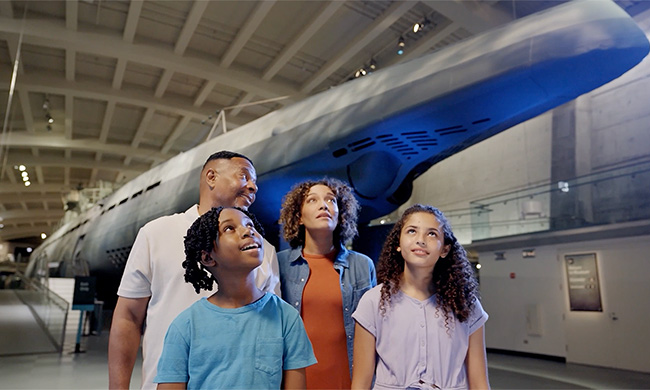
Bring History to Life with Experiences That Feel Real
(Feature Impact) Reading books and watching documentaries can be good ways to learn about history, but there’s something particularly meaningful about immersive experiences that allow you to step inside the stories that shaped the world.
During a visit to the U-505 Submarine exhibit at the Griffin Museum of Science and Industry (Griffin MSI), guests can literally step inside a historic German U-boat captured during World War II. In 1944, the U.S. Navy underwent a top-secret mission to disarm and take over one of the German submarines that wreaked havoc on the high seas, attacking not just military vessels but merchant ships and supply ships as well.
Watch this video to see more:
“The mission was a dangerous one, as U-boat captains were under strict orders to sink their own subs if they were in danger of capture,” said Dr. Voula Saridakis, head curator at Griffin MSI, “but the U.S. Navy managed to take over the vessel and keep it afloat long enough to reach American shores. There, they studied it to gather German military secrets and other intelligence items, like the codebreaking Enigma Machine now on display at Griffin MSI.”
As you tour the submarine, you’ll experience firsthand what life was really like on board. Climb through the hatch, picture yourself bunking for the night in the cramped sleeping quarters, take a turn trying to maneuver the submarine while dodging torpedoes and imagine the bravery of the American soldiers who risked themselves on a perilous mission to capture the vessel and help turn the tide of the war.
There are many important lessons to glean from history, and they’re often easier to understand when presented in a tangible way. Planning visits to museum exhibits and historical sites allows you to stand where others have stood, see what they’ve seen and connect your human experience with theirs. Parents, children, educators, students and people of all ages can find something to inspire them in these stories.
Learn more about bringing history and science to life at GriffinMSI.org.
SOURCE:
Griffin Museum of Science and Industry
child education
Preparing the Next Generation for Economic Mobility in an AI-Driven World
AI-Driven World: Within only a few years, AI has already changed many things about the world and workforce. Entry-level jobs, particularly the ones relying on routine and predictable tasks, are increasingly disappearing to automation, leaving young people wondering how to launch their careers and futures. To learn what preparing students for the future may look like in practice, consider these tips.

Preparing the Next Generation for Economic Mobility in an AI-Driven World
(Feature Impact) Within only a few years, AI has already changed many things about the world and workforce. Entry-level jobs, particularly the ones relying on routine and predictable tasks, are increasingly disappearing to automation, leaving young people wondering how to launch their careers and futures.
Access to economic mobility – the ability to change your income or wealth – doesn’t just rely on technical knowledge and skills but on leaning into humanity. Being able to think outside the box, collaborate, solve problems and grow as a person can open doors in life and at work. AI may be changing the world, but in change lies opportunity. The students who can adapt quickly are more likely to prosper as the economy continues to reshape itself.
To learn what preparing students for the future may look like in practice, consider these tips from the economic and career experts at Junior Achievement.
Build the Kinds of Skills AI Can’t Replace
Young people facing AI as their competition can get a boost from cultivating the uniquely human skills technology can’t replicate. Educators, parents and other adults in kids’ lives can help them develop increasingly important soft skills like critical thinking, communication, teamwork and leadership, which can translate to many different careers. Hands-on skills can fit into this category as well, like the kinds required in entrepreneurship and the trades.
Provide Real-World Experiences
When young people have the chance to test themselves in a real-world setting, it lets them hone their interests, skills and confidence before the time comes to make major decisions about their futures. As early as elementary school, experiential learning activities like Junior Achievement’s Biztown allow students to operate businesses, work with others, manage finances and solve problems, combining in-class learning with hands-on simulations. As kids grow up, other options can include job shadowing, internships and entrepreneurship experiments – all ways to build durable social and professional skills that can help them succeed.
Teach Foundational Financial Literacy
Earning money is only part of the equation for a healthy financial future; equally important is understanding how to manage it. As kids prepare to earn their first sources of income, make sure they’re also equipped with practical financial skills like budgeting, saving, investing, using credit wisely and planning for future goals. Giving them these tools early helps them make informed decisions about their long-term economic advancement.
Connect Students with Employers and Opportunities
Sometimes, all a student needs to succeed is someone who’s willing to give them a chance. Young people in a position to meet business professionals in (and beyond) their communities may be able to turn those connections into future opportunities. This can happen naturally as they seek real-world experiences through apprenticeships, mentorship programs, career fairs and more.
Programs like Junior Achievement’s 3DE puts students in authentic business challenges, connecting them with educators, business partners and volunteers as they work in teams to complete case experiences. This not only gives young people the opportunity to meet potential employers or mentors, it also lets them demonstrate critical thinking, social skills and real-world competence.
Visit jausa.ja.org for more ideas to help young people gain the confidence and connections needed to achieve economic mobility in a changing world.
Photo courtesy of Shutterstock
SOURCE:




