Women's Health
5 Menopause Symptoms That May Feel Harder to Manage This Winter
Menopause Symptoms : As the days grow colder, daily routines naturally shift. For women going through perimenopause or menopause, those shifts can make symptoms such as hot flashes and dry eyes more noticeable. Here are five common menopause symptoms and tips that may help when temperatures drop.

5 Menopause Symptoms That May Feel Harder to Manage This Winter
(Feature Impact) There’s plenty to look forward to in winter, from gathering with loved ones to playing in fresh snow and settling in with a mug of hot chocolate. As the days grow colder, daily routines naturally shift. A walk around the neighborhood means reaching for a heavier coat, and more evenings are spent indoors with the heat on. For women going through perimenopause or menopause, those shifts can make symptoms such as hot flashes and dry eyes more noticeable.
Dry eyes are easy to chalk up to the cold or the heat running indoors. The menopause connection is less familiar. In fact, 79% of women recognize hot flashes as a symptom of menopause, but only 14% recognize dry eyes as a menopause-related symptom, according to the 2026 Bausch + Lomb (Peri)Menopausal Survey.1
“When eyes start to feel dry or gritty in winter, it’s natural to blame the cold wind or the heat running indoors,” said Neda Gioia, OD, CNS, FMCP, FOWNS, founder of Integrative Vision. “Those conditions can make dry eyes feel worse, but hormonal changes during perimenopause and menopause can play a role, too. If the discomfort keeps coming back or starts to interfere with things like reading or driving, an eye doctor can help determine what’s contributing to the symptoms and discuss management options, including daily approaches women can incorporate into their routines.”
Here are five common menopause symptoms and tips that may help when temperatures drop.
Hot Flashes
Hot flashes can be jarring against frigid temperatures. A sudden spike in body temperature can feel stifling, especially when you’re bundled up.
Dress in layers of thin, breathable fabric so you can shed one quickly when you feel a hot flash coming on. An instant ice pack or handheld fan in your bag can also offer fast relief.
Dry Eyes
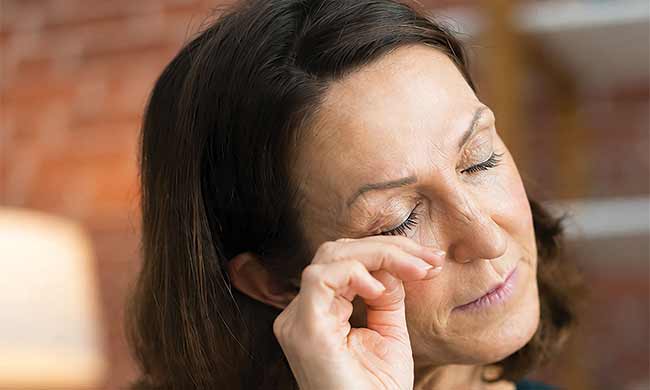
For women who experience dry eyes during perimenopause or menopause, cold, windy weather and dry indoor heat can make the discomfort worse. Among peri-, menopausal and post-menopausal women who experienced dry eyes, respondents reported difficulty reading (58%), difficulty using screens (53%), difficulty driving (26%) and reduced productivity (17%), underscoring the often-overlooked impact dry eyes can have on everyday life.1
Nutritional support can be an important part of a daily routine for dry eyes. Consider Blink® NutriTears® a doctor-recommended, clinically proven once-daily soft gel supplement that targets the key root causes of dry eyes, supports healthy tear production and provides lasting, continuous relief, based on a clinical study.*§† Taken once daily, it can easily fit into an everyday wellness routine, including during the winter months when dry eye symptoms may feel more noticeable.
As part of a comprehensive dry eye routine, the supplement can also be paired with eye drops such as Blink® Triple Care Preservative Free lubricant eye drops, which address tear evaporation, one of the leading causes of dry eyes, and provide instant and long-lasting symptom relief.
Mood Changes
When it’s already dark by the end of the workday, an evening walk can be one of the first things to fall off the schedule, but small changes to your routine can make a difference. Shifting that walk to the morning or lunchtime can make it easier to fit movement into the day to help boost endorphins and relieve stress.
Sleep Disturbances
Although nights are longer, hormonal shifts and night sweats can make good sleep hard to come by. Breathable sleepwear and lighter blankets make it easier to adjust during the night. Keeping the bedroom cool and avoiding caffeine close to bedtime can also help.
Joint Aches
Estrogen decreases during menopause, which can lead to painful inflammation in the joints. Cold can worsen joint pain too, making it difficult to enjoy normal outdoor activities.
Staying active indoors helps keep joints moving. Gentle stretching, yoga or laps at an indoor pool are low-impact options, and a warm bath or heating pad can ease stiffness at the end of the day.
A few adjustments to everyday routines can make winter more comfortable. For women experiencing dry eyes, nutritional support can be part of a comprehensive management approach. To learn more, visit JustBlink.com.*These statements have not been evaluated by the Food and Drug Administration. This product is not intended to diagnose, treat, cure or prevent any disease.
12026 Bausch & Lomb (Peri)Menopause Survey via Suzy, n=402; Women ages 30–80+ who are perimenopausal, menopausal, or post-menopausal
§Based on a clinical study
†When used as directed
Photo courtesy of Shutterstock
SOURCE:
Bausch + Lomb


Women's Health
Menopause changes your mouth. Most women have no idea.
Menopause changes your mouth: Many women are familiar with the most talked-about symptoms of menopause – hot flashes, disrupted sleep, brain fog and mood swings. Far fewer know that dry mouth and sensitive teeth belong on that list too.
Menopause changes your mouth. Most women have no idea.
(Sheeka Sanahori) Many women are familiar with the most talked-about symptoms of menopause – hot flashes, disrupted sleep, brain fog and mood swings. Far fewer know that dry mouth and sensitive teeth belong on that list too.
There’s a name for it: menopause mouth. According to survey data from Delta Dental Insurance Company, 83% of women 40 and older in menopause aren’t aware of any of its symptoms.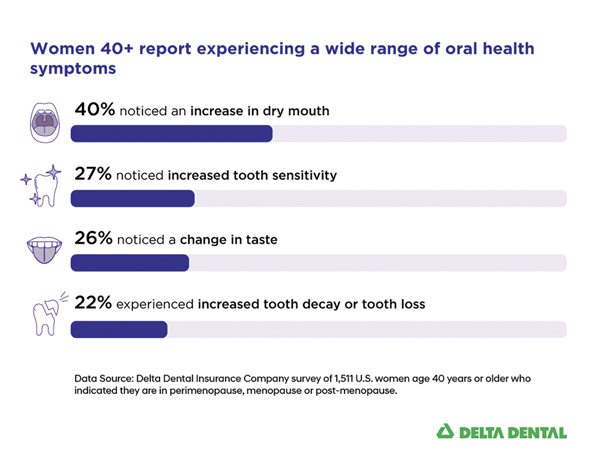
What menopause mouth feels like
Forty percent say they have noticed an increase in dry mouth. Another 27% have noticed more tooth sensitivity in recent months, and 26% say things taste different than they used to. You tell yourself it’s something else. You’re not drinking enough water; you’ve been brushing too hard. Menopause isn’t the first thing that comes to mind.
It adds up. Forty-five percent say oral symptoms associated with menopause, such as tooth pain, dry mouth or gum inflammation, take a toll on their confidence, mood or mental health.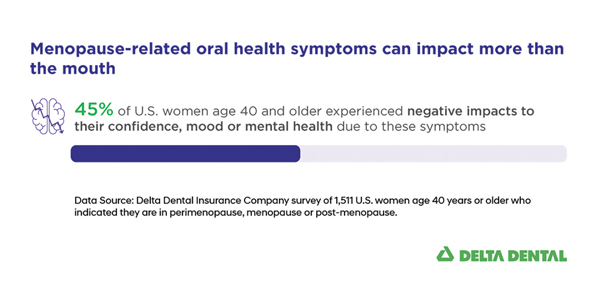
Menopause affects the whole body, mentally and physically. So why is the mouth left out?
Even after learning about this connection, 30% of women say they can’t find information about menopause-related oral health concerns. It isn’t that no one is willing to discuss it.
What makes the conversation hard to start
Three-quarters of dentists say they are comfortable discussing menopause with patients. They just want to know who they’re talking to. Most say they would want more patient history, or to know a patient was in menopause, before raising the subject. Forty-five percent say they would not bring up how menopause affects oral health unless a patient asked.
Dentists also believe that patients are already informed. Ninety-four percent say their patients are at least somewhat aware that menopause can affect oral health. So a patient says nothing about her dry mouth, because it doesn’t seem like a dental problem. The dentist doesn’t bring it up either, assuming someone already has.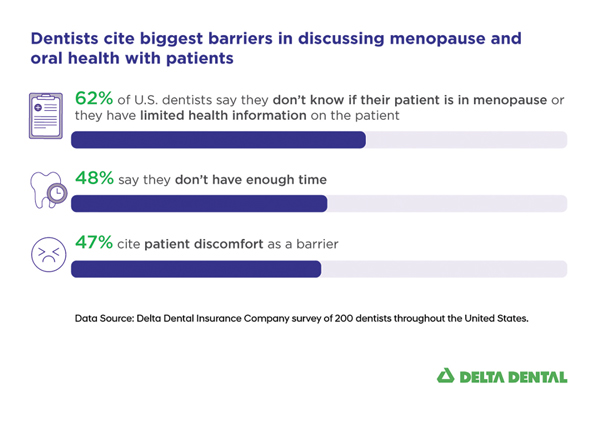
Women are asking for the information
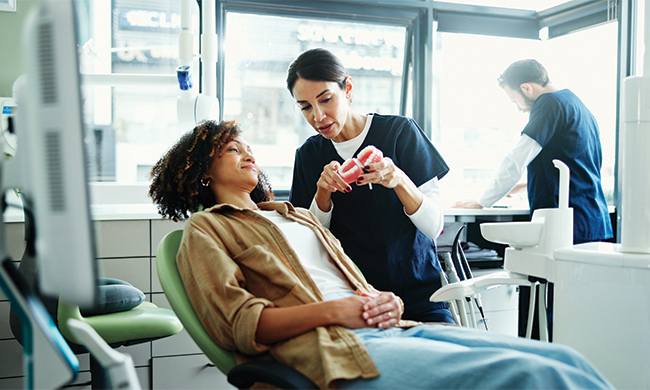
Nearly nine in 10 women say it would help to receive specific instructions during dental visits about managing oral health during menopause. And 69% say they would be more likely to book an appointment if a primary care provider or OB-GYN had told them menopause affects oral health.
No matter who brings it up, the conversation is one worth having. Hormonal changes during menopause can increase the risk of tooth loss or tooth decay, gum disease, receding gumline or loss of jawbone density. Discussing new oral symptoms with a dentist can help women identify potential problems and address them early.
How to start the conversation with your dentist
Your dentist probably doesn’t know you’re in menopause. Start there.
Questions worth asking:
- “Could the changes I’m noticing be related to menopause?”
- “I haven’t had a cavity in 30 years, and now I have two. Could that be tied to hormonal changes?”
- “What can I do about dry mouth?”
- “Are there symptoms I should watch for?”
- “Should I adjust my oral care routine?”
Any one of these questions can get the conversation started.
Methodology
Delta Dental Insurance Company commissioned Atomik Research to conduct two online surveys between June 25 and July 2, 2025.
The first surveyed 200 dentists throughout the United States. The margin of error is +/- 7 percentage points with a 95% confidence level.
The second surveyed 1,511 women ages 40 or older throughout the United States. To qualify, participants had to indicate they are in perimenopause, menopause or post-menopause. Those who were not sure which stage they were in, or who indicated they were not yet in one of the three stages, were excused from participation. The margin of error is +/- 3 percentage points with a 95% confidence level
Atomik Research, part of 4media group, is an independent market research agency.
Photo courtesy of Shutterstock
SOURCE:
Delta Dental Insurance Company

(Feature Impact) Menopause is a phase of life every woman knows will come eventually yet few are truly prepared for. Beyond stereotypical symptoms like hot flashes and mood swings, the other realities of menopause can be mysterious, taking women by surprise when their experiences differ from expectations.
Rather than being a single event, menopause involves a gradual transition that happens as estrogen production changes – meaning symptoms can appear and evolve unpredictably. According to a survey commissioned by the National Menopause Foundation, 63% of U.S. women ages 35-54 experienced symptoms they believed may be related to perimenopause or menopause, yet nearly half (49%) said they weren’t prepared for the changes beforehand.
When women and their loved ones understand what they’re facing, they can approach this time with patience and compassion, which can make a real difference to the 71% of women who wished the people in their lives understood more about perimenopause or menopause. Consider these five facts to help fill in the menopause knowledge gap.
Perimenopause Can Start Years Before Menopause
The physiological transition to menopause can happen up to 10 years before a woman’s final menstrual period, although the average length of perimenopause is about four years. Symptoms may quietly begin in a woman’s 30s, 40s or 50s, and what might look like an isolated problem at first – like brain fog, a night of insomnia or an irregular monthly cycle – could be connected to broader hormonal changes.
Menopause Is More Than Just “Hot Flashes”
Since more than half of women surveyed were already aware of menopause symptoms like hot flashes, mood changes, anxiety and fatigue, these may not take them by surprise. Little-known symptoms are a different story – the majority of respondents didn’t anticipate menopausal issues like rage, inner-ear itching or reduced joint mobility. According to the National Menopause Foundation, women may also experience sleep disturbances, sweating, changes in libido, vaginal dryness, incontinence, weight changes and more.
Every woman’s experience is unique, so these symptoms could present in different combinations and intensities during menopausal years or may not appear at all.
Talking About Menopause Can Be Difficult
Even as women go through these physical and emotional shifts, many struggle to open up about their experiences. In fact, women rank menopause symptoms (17%) more difficult to discuss than hot-button topics like political views (13%), weight (13%) and religious beliefs (10%).
However, suffering in silence can lead to feelings of isolation, relationship misunderstandings and hesitation to seek help, which is why 66% of women said the lack of open discussion about menopause makes the experience worse.
Menopause Isn’t All Bad News
Although this season of life comes with challenges, there are joys to embrace as well. Women navigating midlife can come out the other side with more resilience, emotional awareness and a stronger sense of self. In fact, 44% of women surveyed said their outlook on life became more positive since their transition.
What Loved Ones Can Actually Do
Menopause is a highly individual experience, but that doesn’t mean women have to navigate it alone. Support from partners, families and friends can lift women up during difficult moments, and it can be as simple as taking the time to ask questions, listen and learn about how menopause is affecting their lives. With 30% of women in the U.S. labor force – approximately 15-16 million – in the age range corresponding to menopausal transition (ages 45-60), workplaces can also take steps to become more menopause friendly.
For more resources to help understand symptoms and discuss the transition with loved ones, visit nationalmenopausefoundation.org.
Photo courtesy of Shutterstock

SOURCE:
(Feature Impact) Menopause is a phase of life every woman knows will come eventually yet few are truly prepared for. Beyond stereotypical symptoms like hot flashes and mood swings, the other realities of menopause can be mysterious, taking women by surprise when their experiences differ from expectations.
Rather than being a single event, menopause involves a gradual transition that happens as estrogen production changes – meaning symptoms can appear and evolve unpredictably. According to a survey commissioned by the National Menopause Foundation, 63% of U.S. women ages 35-54 experienced symptoms they believed may be related to perimenopause or menopause, yet nearly half (49%) said they weren’t prepared for the changes beforehand.
When women and their loved ones understand what they’re facing, they can approach this time with patience and compassion, which can make a real difference to the 71% of women who wished the people in their lives understood more about perimenopause or menopause. Consider these five facts to help fill in the menopause knowledge gap.
Perimenopause Can Start Years Before Menopause
The physiological transition to menopause can happen up to 10 years before a woman’s final menstrual period, although the average length of perimenopause is about four years. Symptoms may quietly begin in a woman’s 30s, 40s or 50s, and what might look like an isolated problem at first – like brain fog, a night of insomnia or an irregular monthly cycle – could be connected to broader hormonal changes.
Menopause Is More Than Just “Hot Flashes”
Since more than half of women surveyed were already aware of menopause symptoms like hot flashes, mood changes, anxiety and fatigue, these may not take them by surprise. Little-known symptoms are a different story – the majority of respondents didn’t anticipate menopausal issues like rage, inner-ear itching or reduced joint mobility. According to the National Menopause Foundation, women may also experience sleep disturbances, sweating, changes in libido, vaginal dryness, incontinence, weight changes and more.
Every woman’s experience is unique, so these symptoms could present in different combinations and intensities during menopausal years or may not appear at all.
Talking About Menopause Can Be Difficult
Even as women go through these physical and emotional shifts, many struggle to open up about their experiences. In fact, women rank menopause symptoms (17%) more difficult to discuss than hot-button topics like political views (13%), weight (13%) and religious beliefs (10%).
However, suffering in silence can lead to feelings of isolation, relationship misunderstandings and hesitation to seek help, which is why 66% of women said the lack of open discussion about menopause makes the experience worse.
Menopause Isn’t All Bad News
Although this season of life comes with challenges, there are joys to embrace as well. Women navigating midlife can come out the other side with more resilience, emotional awareness and a stronger sense of self. In fact, 44% of women surveyed said their outlook on life became more positive since their transition.
What Loved Ones Can Actually Do
Menopause is a highly individual experience, but that doesn’t mean women have to navigate it alone. Support from partners, families and friends can lift women up during difficult moments, and it can be as simple as taking the time to ask questions, listen and learn about how menopause is affecting their lives. With 30% of women in the U.S. labor force – approximately 15-16 million – in the age range corresponding to menopausal transition (ages 45-60), workplaces can also take steps to become more menopause friendly.
For more resources to help understand symptoms and discuss the transition with loved ones, visit nationalmenopausefoundation.org.
Photo courtesy of Shutterstock
SOURCE: