The Bridge
Federal judge rules that Louisiana shalt not require public schools to post the Ten Commandments

Charles J. Russo, University of Dayton
Do the Ten Commandments have a valid place in U.S. classrooms? Louisiana’s Legislature and governor insist the answer is “yes.” But on Nov. 12, 2024, a federal judge said “no.”
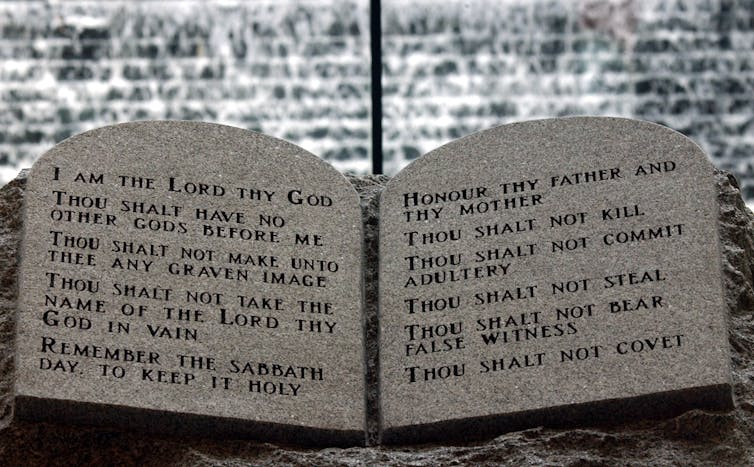
U.S. District Judge John W. deGravelles blocked the state’s controversial House Bill 71, which Gov. Jeff Landry had signed into law on June 19, 2024. The measure would have required all schools that receive public funding to post a specific version of the commandments, similar to the King James translation of the Bible used in many, but not all, Protestant churches. It is not the same version used by Catholics or Jews.
Officials were also supposed to post a context statement highlighting the role of the Ten Commandments in American history and could display the Pilgrims’ Mayflower Compact, the Declaration of Independence and the Northwest Ordinance of 1787, a federal enactment to settle the frontier – and the earliest congressional document encouraging the creation of schools.
The law’s defenders argued that its purpose was not only religious, but historical. Judge deGravelles, though, firmly rejected that argument, striking down HB 71 as “unconstitutional on its face and in all applications.” The law had an “overtly religious” purpose, he wrote, in violation of the First Amendment, according to which “Congress shall make no law respecting an establishment of religion, or prohibiting the free exercise thereof.”
Regardless of the Ten Commandments’ impact on civil law, there was a clear religious intent behind Louisiana’s law. During debate over its passage, for example, the bill’s author, state Rep. Dodie Horton said, “I’m not concerned with an atheist. I’m not concerned with a Muslim. I’m concerned with our children looking and seeing what God’s law is.”
Louisiana Attorney General Liz Murrill has said she intends to appeal the judge’s ruling.
As someone who teaches and researches law around religion and education, with an eye toward defending religious freedom, I believe this is an important test case at a time when the Supreme Court’s thinking on religion and public education is becoming more religion-friendly – perhaps the most it has ever been.
How SCOTUS has ruled before
Litigation over the Ten Commandments is not new. More than 40 years ago, in Stone v. Graham, the Supreme Court rejected a Kentucky statute that mandated displays of the Ten Commandments in classrooms.
The court reasoned that the underlying law violated the First Amendment’s establishment clause – “Congress shall make no law respecting an establishment of religion” – because the mandate lacked a secular purpose.
The justices were not persuaded by a small notation on posters that described the Ten Commandments as the “fundamental legal code of Western Civilization and the Common Law of the United States.”
Twenty-five years later, the Supreme Court again took up cases challenging public displays of the Ten Commandments, although not in schools. This time, the justices reached mixed results.
The first arose in Kentucky where officials had erected a county courthouse display of texts including the Ten Commandments, the Magna Carta, the Declaration of Independence and a biblical citation. In a 2005 ruling in McCreary County, Kentucky v. American Civil Liberties Union of Kentucky the five-member majority agreed that the display of the Ten Commandments violated the establishment clause, largely because it lacked a secular legislative purpose.
On the same day, though, the Supreme Court reached the opposite result in Van Orden v. Perry, a case from Texas. The court upheld the constitutionality of a display of the Ten Commandments on the grounds of the state capitol as one of 17 monuments and 21 historical markers commemorating Texas’ history.
Unlike the fairly new display in Kentucky, the one in Texas, which had existed since the early 1960s, was erected using private funds. The court permitted the Ten Commandments to remain because, despite their religious significance, the Texas monument was a more passive display, not posted on the courthouse door.
Louisiana’s law
Louisiana’s law would have required public school officials to display framed copies of the Ten Commandments in all public school classrooms. Posters were supposed to be at least 11-by-14 inches and printed with a large, easily readable font. The legislation would have allowed, but did not require, officials to use state funds to purchase these posters. Displays could also be received as donations or purchased with gifted funds.
The bill’s author, Horton, previously sponsored Louisiana’s law mandating that “In God We Trust” be posted in public school classrooms.
In defending the Ten Commandments proposal, Horton said it honors the country’s origins.
“The Ten Commandments are the basis of all laws in Louisiana,” she told fellow lawmakers, “and given all the junk our children are exposed to in classrooms today, it’s imperative that we put the Ten Commandments back in a prominent position.”
Justifying the bill, Horton pointed to Kennedy v. Bremerton School District, a 2022 Supreme Court decision. Here, the justices held that educational officials could not prevent a football coach from praying on the field at the end of games because he engaged in personal religious observance protected by the First Amendment.
“The landscape has changed,” she said.
New frontier
Indeed it has.
For decades, the Supreme Court used a three-part measure called the Lemon v. Kurtzman test to assess whether a government action violated the establishment clause. Under this test, when a government action or policy intersects with religion, it had to meet three criteria. A policy had to have a secular legislative purpose; its principal or primary effect could neither advance nor inhibit religion; and it could not result in excessive entanglement between state and religious officials.
Another test the Supreme Court sometimes applied, stemming from Lynch v. Donnelly in 1984, invalidated governmental actions appearing to endorse religion.
The majority of the current court, though, abandoned both the Lemon and endorsement tests in Kennedy v. Bremerton. Writing for the court, Justice Neil Gorsuch ruled that “the Establishment Clause must be interpreted by ‘reference to historical practices and understandings.’” He added that the court “long ago abandoned Lemon and its endorsement test offshoot.”
What that new historical practices and understandings standard means remains to be seen.
More than 80 years ago, in West Virginia State Board of Education v. Barnette the Supreme Court decided in a 6-3 opinion that students cannot be compelled to salute the American flag, which includes reciting the words “under God” in the Pledge of Allegiance, if doing so goes against their religious beliefs. While H.B. 71 does not require students to recite the Ten Commandments, they would be constantly exposed to its presence in their classrooms, reducing them to what the judge described as a “captive audience” – violating their parents’ rights to the free exercise of religion.
In 1962’s Engel v. Vitale, the Supreme Court’s first case on prayer in public schools, the majority observed that “the Founders of our Constitution [recognized] that religion is too personal, too sacred, too holy,” to permit civil authorities to impose particular beliefs. I see no reason to abandon that view.
This is an updated version of an article originally published on June 4, 2024.
Charles J. Russo, Joseph Panzer Chair in Education and Research Professor of Law, University of Dayton
This article is republished from The Conversation under a Creative Commons license. Read the original article.
STM Daily News is a vibrant news blog dedicated to sharing the brighter side of human experiences. Emphasizing positive, uplifting stories, the site delivers inspiring, informative, and well-researched content. With a commitment to accurate, fair, and responsible journalism, STM Daily News aims to foster a community of readers passionate about positive change and engaged in meaningful conversations. Join the movement and explore stories that celebrate the positive impacts shaping our world.


Sports
More Than a Game: Young Athletes Show the Power of Giving Back
More Than a Game for Young Athletes: Becoming a community difference-maker doesn’t require years of experience. In fact, two young soccer players received recognition for superstar service in their communities and are being celebrated for making a difference beyond the field.

More Than a Game: Young Athletes Show the Power of Giving Back
(Feature Impact) Becoming a community difference-maker doesn’t require years of experience. In fact, some of the youngest in hometowns around the country are finding ways to give back, support their neighbors and inspire others to do the same. All it takes is a creative idea, a willingness to lend a hand and the determination to turn good intentions into action.
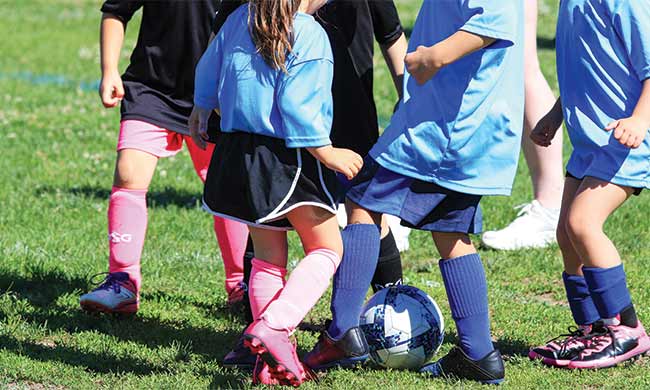
Two young soccer players received recognition for superstar service in their communities through the first CVS Home Team Heroes contest, a nationwide initiative celebrating youth athletes who made a difference beyond the field.
Caroline, 9, and Zoe, 12, were selected as grand prize winners. Each will receive a $25,000 grant for their nonprofit soccer organization, a block party for their team and a spot on limited-edition packaging for select Well Market snacks, expected to arrive on select CVS Pharmacy shelves in spring 2027, while supplies last.
Seattle Reign and U.S. Women’s National Team defender Jordyn Bugg surprised the winners via video.
“Getting to tell Caroline and Zoe they’re CVS Home Team Heroes was one of the best moments of my year,” Bugg said. “I started on a local field with coaches and teammates who believed in me, and it’s really special to see these two show up for the players and communities around them.”
Echoing that sentiment, Croix Bethune, Kansas City Current midfielder, celebrated the winners and the impact they’re making in their communities.
“Caroline and Zoe show what being a true team player is all about,” Bethune said. “I’m honored to be part of sharing their stories and can’t wait to see what the future holds for them.”
Rebuilding a Community with Creativity
When two hurricanes devastated The Center of Anna Maria Island, where Caroline plays youth soccer, she and her older brother, Parker, found a creative way to help their community recover. The siblings launched Print Wizards to sell 3D-printed toys to raise money, and their efforts have generated more than $6,000 to help repair damaged fields and establish an all-girls soccer and flag football team.
For Caroline, soccer is a place to build camaraderie, confidence and leadership skills alongside her teammates. The $25,000 grant will help the center continue rebuilding, support local families affected by the hurricanes and expand youth sports programming so more children can play.
“As Caroline’s parents, we’re so proud to see her enthusiasm for her all-girls flag football and soccer team and her business, Print Wizards, recognized,” said Brooke and Mike Svoboda. “At 9 years old, she’s discovering how her ideas can bring people together, and this support means so much to her and our family. It encourages her to keep dreaming big and making a difference in her community.”
Inspiring Others Through Leadership
Zoe, born with progressive hearing loss, regularly meets with newly diagnosed deaf and hard-of-hearing infants and their families, helping ease parents’ concerns about their children’s futures and serving as a role model for younger children. She hopes to inspire other deaf and hard-of-hearing soccer players by one day playing for the U.S. Women’s Deaf National Team.
Her club team, Tudela Fútbol Club Los Angeles, will use the $25,000 grant to help make soccer more accessible by bridging gender and opportunity gaps and challenging the typical pay-to-play youth sports model.
“Discovering the U.S. Women’s Deaf National Team gave Zoe something she had been missing: the chance to see herself reflected in the athletes she admired,” said Angie Winslow, Zoe’s mother. “Through USA Deaf Soccer, she found the confidence to embrace who she is. When she arrived at her first Tudela FC tryout, someone greeted her in sign language – a simple gesture that showed her she belonged. We’re incredibly proud to see Zoe now extending that same spirit of inclusion to younger athletes and grateful that CVS is celebrating the power of a game that truly belongs to everyone.”
Learn more about the initiative by visiting cvs.com/content/soccer/home-team-heroes.
Photo courtesy of Shutterstock
SOURCE:
CVS

Community
4 Ways to Preserve Veterans’ Stories for Future Generations
Family stories, photographs, letters and memories all have a place in the broader story of humanity, but if they aren’t recorded and preserved, they can fade over time. Consider these ways to help the veterans in your life preserve their stories and leave their mark on history. Preserve Veterans’ Stories for Future Generations
4 Ways to Preserve Veterans’ Stories for Future Generations
(Feature Impact) History is built from stories and memories, which is why it’s important to listen to the people who were there as the world changed. Family stories, photographs, letters and memories all have a place in the broader story of humanity, but if they aren’t recorded and preserved, they can fade over time.
Because more than 70 years have passed since the Korean War ended, opportunities to hear firsthand accounts from earlier conflicts grow fewer as time passes. Veterans and their families may be able to help record stories and lessons from “The Forgotten War” that might otherwise be lost.
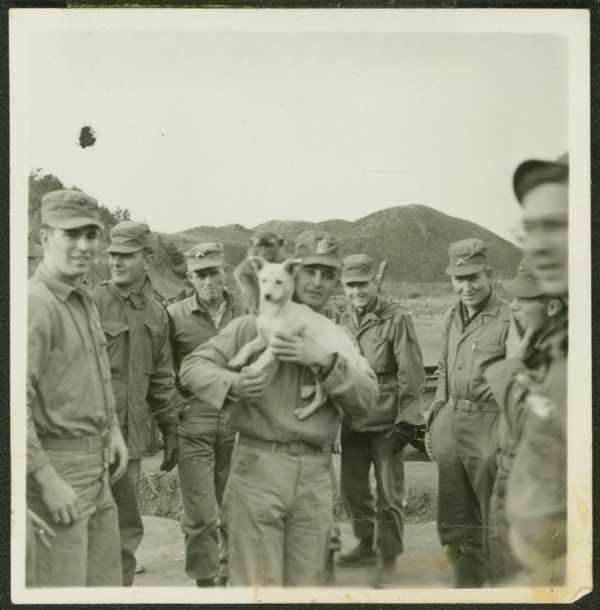
You don’t need to be a historian to help preserve your loved ones’ memories and experiences. Programs like the Library of Congress Veterans History Project are dedicated to collecting stories from people like Private First Class Robert Lawrence Barber, who wrote regular letters home to his mother while serving in Korea. They paint a harrowing picture of combat, exhaustion, cold, fatigue and the stark realities of war that should never be forgotten. Experiences away from combat can be equally revealing, from daily routines and friendships to unexpected challenges.
Consider these ways to help the veterans in your life preserve their stories and leave their mark on history.
Start the Conversation Now
When it comes to recording memories, time is of the essence, especially for those who served in Korea. Decades may have passed, but each day makes a difference. Sit down with your loved one and gently start the conversation. You don’t have to get the entire backstory at once, but you can begin asking questions about their military experience and give them time to gather their thoughts.
 Record Their Story
How a story is told can add dimension to the story itself. An audio or video recording preserves your loved one’s voice, expressions and emotions along with their words, giving your family memories to look back on for generations. Choose a quiet, comfortable space and test the equipment before recording.
Consider Preserving the Story Beyond Your Family
Family stories are most meaningful to those who know and love the storyteller, but they also matter to the world. Sharing veterans’ stories – including difficulties and ordinary moments – offers others a firsthand view of military life. Libraries and oral history archives may be able to preserve qualifying material for a wider audience.
“We want all stories, not just those from the foxhole or the battlefronts, but from all veterans who served the United States in uniform,” said Monica Mohindra, director of the Veterans History Project. “What did they hear? What did they see? What did it mean to them?”
If you have oral history interviews, and/or original photographs, letters or other records, consider contributing them to be archived and made accessible to future generations. Staff members are available to help you curate and select physical materials to contribute to the nation’s library.
Give Old Photos and Letters Context
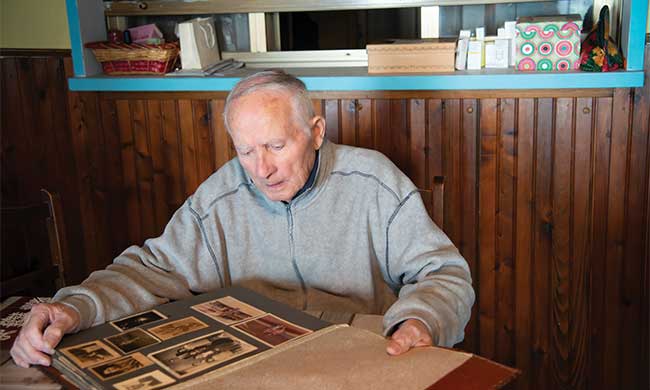
Brush the dust off those old photo albums, scrapbooks and memory boxes because they may contain tangible pieces of history. A photograph, letter or piece of memorabilia could be what a veteran needs to bring fuzzy memories back into focus – whether it’s seeing the face of an old comrade or reading a letter written home. That gives you the opportunity to hear new stories and fill in context.
Learn more, discover veterans’ histories and find instructions for contributing veterans’ stories at loc.gov/vets.
Photo courtesy of Shutterstock (man looking at photo album)
Photo courtesy of the Library of Congress (group of soldiers)
SOURCE:
Library of Congress Veterans History Project
Community
5 Meaningful Ways to Make a Difference This Holiday Season
Make a Difference This Holiday Season: Hunger relief is often top of mind during the holidays, and there are many ways to make a meaningful difference. Consider these ideas.
5 Meaningful Ways to Make a Difference This Holiday Season
(Feature Impact) The holiday season brings people together and often inspires them to think about how they can support others. Yet for many families, this time of year can bring added pressure as they balance the cost of food and other everyday essentials.
According to Feeding America’s latest Map the Meal Gap study, published in 2026, nearly 48 million people in the United States, including 14 million children, experience food insecurity.
Hunger relief is often top of mind during the holidays, and there are many ways to make a meaningful difference. Each year, Charles Schwab employees come together through Season of Giving to support local nonprofits and help make the holidays brighter for those in need.
Consider these ideas from Charles Schwab Foundation, a nonprofit dedicated to advancing financial literacy and strengthening communities.
Give What’s Needed Most
When giving to a local food bank, pantry or other nonprofit, start by finding out what the organization needs most. Many organizations share lists of priority items, while monetary donations can give them flexibility to direct resources where they will have the greatest impact. A little planning can help make every contribution count.
Turn Giving Into a Group Activity
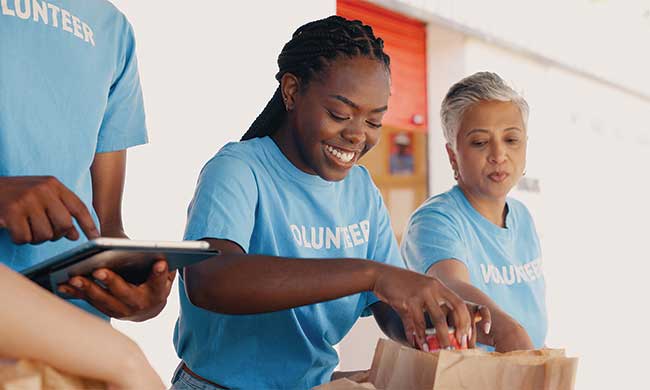
Invite family, friends, neighbors or coworkers to get involved with you. Organizing a donation drive, packing meals or volunteering together can multiply the impact while creating a meaningful way to connect during the holiday season.
Share Your Time and Talents
There are many ways to contribute beyond making a donation. Consider volunteering your time or putting your skills to use for an organization that could benefit from them. From sorting donations and packing meals to helping with special events or administrative projects, your time and expertise can make a meaningful impact.
Support Organizations in Your Own Community
The holidays are an opportunity to learn more about the organizations serving your neighbors every day. Look for local nonprofits addressing needs that matter to you, whether that is hunger, housing, education or another community priority. Supporting organizations close to home can help strengthen the networks people rely on throughout the year.
Keep Giving Beyond the Holidays
The spirit of giving doesn’t have to end when the holiday season is over. Consider turning a one-time contribution into an ongoing commitment, whether by volunteering periodically, making recurring donations or continuing to support an organization with a mission that resonates with you.
Learn more about the work being done to advance financial literacy and strengthen communities at schwabmoneywise.com/foundation.
Photo courtesy of Shutterstock

SOURCE: