News
NASA to Explore Two Landing Options for Returning Samples from Mars
NASA is pursuing a dual-approach for its Mars Sample Return Program to enhance innovation, reduce costs, and study Martian samples by 2026, aiming to unlock the planet’s mysteries and explore potential life.

WASHINGTON, Jan. 7, 2025 /PRNewswire/ — To maximize chances of successfully bringing the first Martian rock and sediment samples to Earth for the benefit of humanity, NASA announced Tuesday a new approach to its Mars Sample Return Program. The agency will simultaneously pursue two landing architectures, or strategic plans, during formulation, encouraging competition and innovation, as well as cost and schedule savings.
NASA plans to later select a single path forward for the program, which aims to better understand the mysteries of the universe, and to help determine whether the Red Planet ever hosted life. NASA is expected to confirm the program – and its design – in the second half of 2026.
“Pursuing two potential paths forward will ensure that NASA is able bring these samples back from Mars with significant cost and schedule saving compared to the previous plan,” said NASA Administrator Bill Nelson. “These samples have the potential to change the way we understand Mars, our universe, and – ultimately – ourselves. I’d like to thank the team at NASA and the strategic review team, led by Dr. Maria Zuber, for their work.”
In September 2024, the agency accepted 11 studies from the NASA community and industry on how best to return Martian samples to Earth. A Mars Sample Return Strategic Review team was charged with assessing the studies and then recommending a primary architecture for the campaign, including associated cost and schedule estimates.
“NASA’s rovers are enduring Mars’ harsh environment to collect ground-breaking science samples,” said Nicky Fox, who leads NASA’s Science Mission Directorate. “We want to bring those back as quickly as possible to study them in state-of-the-art facilities. Mars Sample Return will allow scientists to understand the planet’s geological history and the evolution of climate on this barren planet where life may have existed in the past and shed light on the early solar system before life began here on Earth. This will also prepare us to safely send the first human explorers to Mars.”
During formulation, NASA will proceed with exploring and evaluating two distinct means of landing the payload platform on Mars. The first option will leverage previously flown entry, descent, and landing system designs, namely the sky crane method, demonstrated with the Curiosity and Perseverance missions. The second option will capitalize on using new commercial capabilities to deliver the lander payload to the surface of Mars.
For both potential options, the mission’s landed platform will carry a smaller version of the Mars Ascent Vehicle. The platform’s solar panels will be replaced with a radioisotope power system that can provide power and heat through the dust storm season at Mars, allowing for reduced complexity.
The orbiting sample container will hold 30 of the sample tubes containing samples the Perseverance lander has been collecting from the surface of Mars. A redesign of the sample loading system on the lander, which will place the samples into the orbiting sample container, simplifies the backward planetary protection implementation by eliminating the accumulation of dust on the outside of the sample container.
Both mission options rely on a capture, containment and return system aboard ESA’s (European Space Agency’s) Earth Return Orbiter to capture the orbiting sample container in Mars orbit. ESA is evaluating NASA’s plan.
For more information on NASA’s exploration of Mars, visit:
Source: NASA
The science section of our news blog STM Daily News provides readers with captivating and up-to-date information on the latest scientific discoveries, breakthroughs, and innovations across various fields. We offer engaging and accessible content, ensuring that readers with different levels of scientific knowledge can stay informed. Whether it’s exploring advancements in medicine, astronomy, technology, or environmental sciences, our science section strives to shed light on the intriguing world of scientific exploration and its profound impact on our daily lives. From thought-provoking articles to informative interviews with experts in the field, STM Daily News Science offers a harmonious blend of factual reporting, analysis, and exploration, making it a go-to source for science enthusiasts and curious minds alike. https://stmdailynews.com/category/science/


News
Hit Rewind and Rediscover the Magic of ’90s Holiday Nostalgia
The Magic of ’90s Holiday Nostalgia: If you reminisce on the days when the toy catalog was required reading, photos took a week to develop and the only way to reach the North Pole was on a landline, this holiday season may offer an opportunity to take yourself back a few years – or decades.

Hit Rewind and Rediscover the Magic of ’90s Holiday Nostalgia
(Feature Impact) If you reminisce on the days when the toy catalog was required reading, photos took a week to develop and the only way to reach the North Pole was on a landline, this holiday season may offer an opportunity to take yourself back a few years – or decades.
Parents today are looking to recreate the festive memories they grew up with, according to new research from Club Wyndham, the nation’s largest vacation ownership club, in which they ranked the 1990s as the most nostalgic holiday decade. That nostalgia is already shaping how families celebrate as 93% of parents reported they regularly or occasionally recreate elements of their childhood holidays for their own families.
This year, you can take it a step further by traveling back to those beloved ’90s.
Watch this video to see more:
//www.youtube.com/embed/WHqR2p14Bpo
Press rewind with the help of Club Wyndham with its launch of the Holiday Rewind Suite, an immersive stay inspired by Christmas 1999 at Club Wyndham Midtown 45. With assistance from ’90s sitcom icon and spokesperson Jodie Sweetin, travelers are invited to trade streaming and scrolling for VHS movies, board games, disposable cameras and landline calls to Santa.
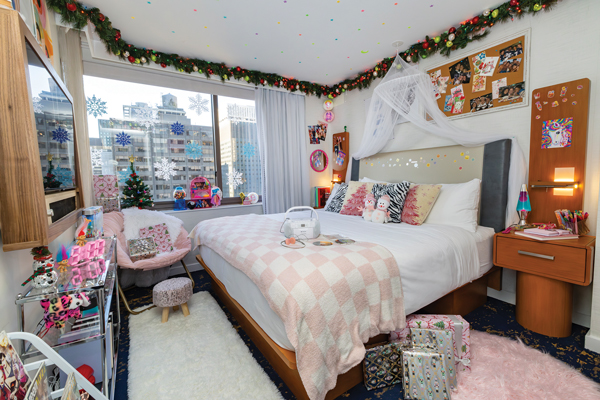 A cozy, colorful living room sits at the heart of the experience featuring wood paneling, retro-patterned wallpaper, festive tinsel, vintage decor and classic holiday trimmings surrounding a twinkling tree. An acrylic landline phone, wall of old-school holiday cards and wish-list-worthy toys from the era adorn the space, while a separate bedroom channels a quintessential late-’90s teen room that’s complete with glow-in-the-dark stars on the ceiling, retro posters, a lava lamp and more.
“Come for the nostalgia, stay for the time together and leave with new memories you’ll keep replaying,” Sweetin said.
The suite is bookable from Nov. 6, 2026-Jan. 4, 2027, and one lucky winner of the Holiday Rewind “Suite-Stakes” will unwrap the ultimate holiday throwback with a complimentary two-night stay from Dec. 18-20, including round-trip economy airfare for two guests.
Book your getaway or enter to win today at ClubWyndham.com/HolidayRewind.
SOURCE:

The Knowledge
Asteroid 1998 KY26: Can Sunlight Explain Its Motion?
Sunlight may explain the unusual motion of asteroid 1998 KY26. A new study casts doubt on the dark comet theory, and Japan has canceled its planned visit.

Last Updated on November 20, 2026 by Daily News Staff

A tiny asteroid about the length of a school bus has been drifting slightly off the path astronomers would predict from gravity alone. The object, known as 1998 KY26, spins once every five minutes and 21 seconds. One of the strongest explanations for its unusual motion comes from a familiar source: sunlight.
In a 2025 study, researchers led by NASA’s Jet Propulsion Laboratory modeled two small forces acting on the roughly 36-foot-wide asteroid. Sunlight exerts pressure when it strikes the surface, and the asteroid gets another tiny push as it radiates heat back into space. When the team accounted for the asteroid’s irregular shape and rapid spin, the model closely matched its observed trajectory.
A newer study published in Icarus casts doubt on another explanation. Astronomers had proposed that escaping water vapor might give KY26 a gentle push without producing a visible tail, making it a candidate for what scientists call a “dark comet.” But temperature simulations found that even the object’s coldest regions would be too warm to hold on to buried water ice over long periods. The findings make long-lived ice a less likely source of the asteroid’s extra acceleration.
A close-up look was planned for 2031, when Japan’s Hayabusa2 spacecraft was due to rendezvous with KY26. On November 17, Japan’s space agency announced that ion-engine trouble had forced a change of plans. The spacecraft is now slated to fly past a different asteroid, 2015 BM510, in April 2028.
Sources
EarthSky, November 20, 2026. Paul Scott Anderson covers the unusual motion of 1998 KY26, the proposed explanations, and the cancellation of Hayabusa2’s planned visit. Mystery space object moves in strange ways- Solar radiation and the orbit. The 2025 study found that sunlight pressure and heat emitted by the asteroid could reproduce its observed trajectory. The Astrophysical Journal Letters
— Radiation Forces and Trajectory of Hayabusa2 Target 1998 KY26
- The new water-ice study. Temperature modeling suggests buried water ice would have difficulty surviving over long periods. Icarus
— Thermally Unfavorable Conditions of Volatile Existence in Near-Earth Asteroid 1998 KY26
- Size and rotation. The team used optical and radar observations to revise the asteroid’s estimated diameter and spin rate. Nature Communications
— 1998 KY26 Is Smaller and Rotating Faster Than Previously Known
- Hayabusa2 mission change. JAXA’s November 17 briefing details the switch from the KY26 rendezvous to a flyby of 2015 BM510. JAXA mission briefing (PDF, Japanese)
· Jiji Press coverage in English
Related reading on STM Daily News
- Large Asteroid 1999 AN10 Will Safely Pass Earth in August 2027
- Asteroid Apophis: An Exciting Encounter with Earth
- Interstellar Visitor 3I/ATLAS Surprises Astronomers With Growing Tail and Strange Chemistry
Transportation
LA Metro’s D Line Extension to Century City Needs $296 Million More as Completion Slips
LA Metro is seeking another $296 million for D Line Extension Section 2 as the project’s substantial-completion forecast shifts from spring to fall 2027. Metro has not announced a replacement date for passenger service to Beverly Hills and Century City.

LOS ANGELES — The next segment of LA Metro’s D Line subway extension is facing a major cost increase and a later construction milestone as the agency works to finish stations serving Beverly Hills and Century City.
Metro staff is asking the agency’s Board of Directors to increase the life-of-project budget for D Line Extension Section 2 by $296 million, from approximately $2.575 billion to $2.871 billion. The proposed increase amounts to about 11.5 percent of the project’s current budget.
According to a Metro Board report, Section 2 was 95 percent complete as of September 2026. However, its unallocated contingency had fallen to approximately $6.7 million, an amount Metro says is insufficient to carry the project through completion.
Contractor settlement and additional construction costs
The requested funding includes a $151 million settlement with design-build contractor Tutor Perini/O&G over a time-related claim. The contractor initially sought more than $200 million, while other claims and notices brought the total potential value of the disputed issues above $357 million.
Metro also identified approximately $75 million in added cost exposure connected to a secondary tunnel liner. Other expenses include additional construction work, real estate costs, extended professional services and restored contingency for remaining risks.
This would be the project’s second major budget increase. The Metro Board approved an additional $134 million in July 2023, after a Federal Transit Administration risk assessment found that the project’s budget was insufficient.
Completion shifts to fall 2027
The negotiated settlement also changes the contractor’s milestone schedule. Metro says the forecast for substantial completion has shifted from spring 2027 to fall 2027.
Metro had previously listed spring 2027 as the start of passenger operations for Section 2. The agency has not announced a revised revenue-service date in the new Board report. Because substantial completion is now forecast for fall 2027, the previous spring opening timetable no longer appears achievable. Testing, safety certification and operating preparations would still be required before riders can use the extension.
Section 2 will extend D Line service about 2.6 miles west from Wilshire/La Cienega, adding the Beverly Drive and Century City stations. It is the middle portion of Metro’s nine-mile Westside subway expansion. Section 1 opened in May 2026, while Section 3 is intended to continue the line to Westwood/UCLA and the Westwood/VA Hospital.
How Metro proposes to cover the increase
Metro staff recommends using $296 million in Measure R transit-capital funds currently programmed for the Division 20 rail-yard program. Proposition A funds would then replace that money for Division 20.
The report says reducing the scope, shortening the segment or relying on additional value engineering is no longer practical because construction is so advanced. Metro warns that without the budget amendment, it would be unable to fund completion according to the current schedule.
The proposal is scheduled for consideration by Metro’s Finance, Budget and Audit Committee on November 19, 2026. The budget amendment will still require Board approval.
The disclosure is consequential for riders because it places both the cost and timing of the Beverly Hills–Century City extension under renewed scrutiny. Although the subway is approaching completion, Metro must now secure hundreds of millions of dollars more and establish a realistic opening timetable for one of the region’s most important transit expansions.