Connect with us

STM Blog

Jimmy Swaggart’s rise and fall shaped the landscape of American televangelism

Published

on

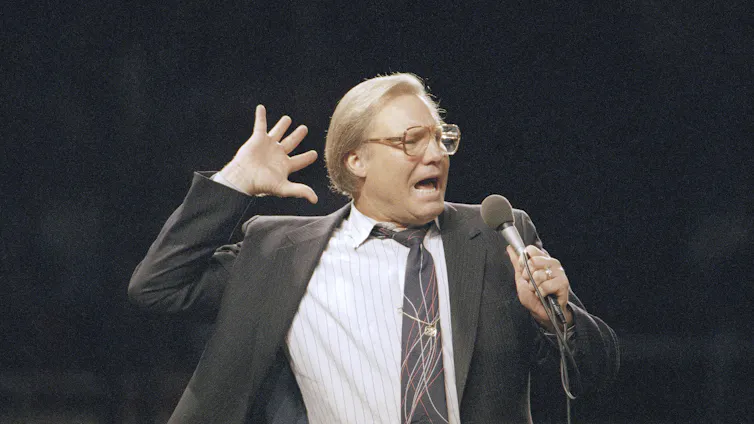
Jimmy Swaggart
Rev. Jimmy Swaggart preaches at the Los Angeles Memorial Sports Arena on March 29, 1987.
AP Photo/Mark Avery, file

Diane Winston, USC Annenberg School for Communication and Journalism

Jimmy Swaggart’s rise and fall shaped the landscape of American televangelism

Jimmy Swaggart, one of the most popular and enduring of the 1980s televangelists, died on July 1, 2025, but his legacy lives.

Along with Jerry Falwell and Pat Robertson, he drew an audience in the millions, amassed a personal fortune and introduced a new generation of Americans to a potent mix of religion and politics.

Swaggart was an old-time evangelist whose focus was “saving souls.” But he also preached on conservative social issues, warning followers about the evils of abortion, homosexuality and godless communism.

Swaggart also denounced what he called “false cults,” including Catholicism, Judaism and Mormonism. In fact, his denunciations of other religions, as well as his attacks on rival preachers, made him a more polarizing figure than his politicized brethren.

As a reporter, I covered Swaggart in the 1980s. Now, as a scholar of American religion, I argue that while Swaggart did not build institutions like Falwell’s Moral Majority or Robertson’s 700 Club, he helped to spread right-wing positions on social issues, such as sexual orientation and abortion, and to shape the image of televangelists in popular culture.

Swaggart’s cousins

Born into a hardscrabble life in a small Louisiana town, Swaggart grew up alongside his cousins Jerry Lee Lewis, the future rockabilly pioneer, and future country singer Mickey Gilley.

All three loved music and singing. They polished their playing on an uncle’s piano and sneaked into African American nightclubs to hear the jazz and blues forbidden by their parents.

A man playing the piano in front of a huge crowd.
Jimmy Swaggart delivering a sermon at the Flora Blanca Stadium in El Salvador.
Cindy Karp/Getty Images

While Gilley and Lewis turned their musical talent into recording and performing careers, Swaggart felt called to the ministry. He dropped out of high school, married at 17, began preaching at 20 and was ordained at 26.

He was licensed by the Assemblies of God, a Pentecostal denomination that believes the Holy Spirit endows believers with spiritual gifts that include speaking in tongues and faith healing.

The glory years

Pentecostals were nicknamed Holy Rollers because of their tendency to shake, quake and roll on the floor when feeling the Holy Spirit. Their preachers excelled at rousing audiences’ ardor, and Swaggart commanded the stage better than most. He paced, pounced and poured forth sweat while begging listeners to turn from sin and accept Jesus.

Starting small, he drew crowds while preaching on a flatbed trailer throughout the South. His following grew, and in 1969 he opened the Family Worship Center in Baton Rouge.

Advertisement
Get More From A Face Cleanser And Spa-like Massage
A man holding a briefcase in one hand stands next to a sign on a wall that says, 'Jimmy Swaggart Evangelistic Association.'
Evangelist Jimmy Swaggart leaves his office complex in Baton Rouge, La., on Jan. 7, 1977.
AP Photo

At capacity, the church held 10,000 worshippers, who represented a broad swath of America: young girls and grannies, white and Black, bankers and farmers. His sermons began calmly but built to a fever pitch. CBS newsman Dan Rather once called him the “country’s greatest speaker.”

During services, Swaggart also sang and played piano. In 1982, Newsweek magazine noted his musical chops, naming him the “King of Honky Tonk Heaven.” His music crossed gospel, country and honky-tonk – songs with a strong rhythmic beat – and he sold 17 million albums over his lifetime.

By 1975, Swaggart’s on-stage charisma powered the launch of a television ministry that would reach millions within a decade. Viewers were captivated by his soulful tunes and fire-and-brimstone sermons. At its height, Swaggart’s show was televised in 140 countries, including Peru, the Philippines and South Africa.

His ministry also became the largest mail-order business in Louisiana, selling books, tapes, T-shirts and biblical memorabilia. Thanks to the US$150 million raised annually from donations and sales, Swaggart lived in an opulent mansion, possessed a private jet previously owned by the Rockefellers, sported a yellow gold vintage Rolex and drove a Jaguar.

The downfall

Swaggart disliked competition and had a history of humiliating rival preachers. Wary of the Rev. Marvin Gorman, a Pentecostal minister whose church also was in Louisiana, Swaggart accused the man of adultery. Gorman admitted his infidelity and was defrocked.

Gorman had heard rumors about Swaggart’s own indiscretions, and he and his son decided to tail the famed evangelist. In 1988, they caught Swaggart at a motel with a prostitute, and Gorman reported the incident to Swaggart’s denomination. He also gave news outlets photos of Swaggart and the prostitute. In a tearful, televised apology, Swaggart pleaded for a second chance.

While his fans were willing, the Assemblies of God had conditions: Swaggart received the standard two-year suspension for sexual immorality. Defying the ruling, Swaggart went back to work after three months, and the denomination defrocked him.

A woman lying curled up on carpeted steps with her head in her arms.
A parishioner overcome with grief lies on steps to the altar after Jimmy Swaggart’s confession of sexual indiscretions.
Thomas S. England/Getty Images

Swaggart might have succeeded as an independent minister, but in 1991 the police stopped his car for driving on the wrong side of the road. Inside they found the preacher with a prostitute. This time, Swaggart did not ask for forgiveness. Instead, he informed his congregation, “The Lord told me it’s flat none of your business.”

Afterward, Swaggart never regained his former standing. His mail-order business dried up, donations fell, and attendance at services cratered. But up until his death, he kept on, in his own words, as an “old-fashioned, Holy Ghost-filled, shouting, weeping, soul-winning, Gospel-preaching preacher.”

Swaggart’s legacy

Swaggart, like other 1980s televangelists, brought right-wing politics into American homes. But unlike Jerry Falwell and Pat Robertson, Swaggart was less interested in winning elections than saving souls. In fact, when Robertson considered a presidential run in 1988, Swaggart initially tried to dissuade him – then changed his mind and supported him.

Swaggart’s calls for a return to conservative Christian norms live on – not just in Sunday sermons but also in today’s world of tradwives, abortion restrictions and calls to repeal gay marriage. His music lives on, too. The day before he died, the Southern Gospel Music Association Hall of Fame inducted him as a member.

But his legacy also survives in popular culture. In recent years, both reality television and scripted series have starred preachers shaped in the image of Swaggart and his peers. Most exaggerate his worst characteristics for shock and comedic effect.

Advertisement
Get More From A Face Cleanser And Spa-like Massage

Preachers of L.A.,” a 2013 reality show that profiled six Los Angeles pastors, featured blinged-out ministers whose sermons mixed hip-hop with the Bible. The fictional “Greenleaf” followed the scandals of an extended family’s Memphis megachurch, while “The Righteous Gemstones,” a dark spoof of Southern preachers, turned a family ministry into a site for sex, murder and moneymaking.

But these imitations can’t match the reality. Swaggart was a larger-than-life minister whose story – from small-town wannabe to disgraced pastor, to preaching to those who would listen – had it all: sex, politics, music and religion.

For those who want a taste of the real thing, The King of Honky Tonk Heaven lives on. You can see his old services and Bible studies streaming daily on his network.The Conversation

Diane Winston, Professor and Knight Center Chair in Media & Religion, USC Annenberg School for Communication and Journalism

This article is republished from The Conversation under a Creative Commons license. Read the original article.

Continue Reading
Advertisement SodaStream USA, inc

The Knowledge

When Did Water Vending Machines Become a Thing?

When did water vending machines appear in America? Explore their history from a 1908 penny water vendor to the refill machines of the 1970s and 1980s.

Published

on

When did water vending machines appear in America? Explore their history from a 1908 penny water vendor to the refill machines of the 1970s and 1980s.
Image Credit: Adobe Firefly

You’ve probably seen them hundreds of times.

They sit outside supermarkets, convenience stores and shopping centers—or sometimes stand alone in small roadside kiosks. You bring an empty bottle, usually one, three or five gallons, put in some money, push a button and watch purified water pour into your container.

For many people in California, Arizona and other parts of the American West, water vending machines seem like they’ve simply always been there.

But when did we actually start buying water this way?

The answer takes us back more than a century, although the machines we recognize today didn’t really arrive until the 1970s.

The Water Vending Machine’s Surprising Ancestor

The story begins in Boston in 1908 with a man named Lawrence Luellen.

Luellen was working on something that sounds surprisingly modern: a machine that would allow someone to pay a penny and receive a clean drink of water in an individual disposable cup.

At the time, public drinking water was often consumed from a communal cup or metal dipper—a practice that increasingly worried public-health officials because of the potential spread of disease.

Luellen developed a paper drinking cup along with what became known as the Luellen Cup & Water Vendor. The porcelain machine contained water, ice, disposable cups and a place for discarded cups.

For one penny, a customer could get a drink of cold water in a fresh cup.

Historical records at Lafayette College’s Hugh Moore Dixie Cup Company Collection show that Luellen completed work on the vending apparatus in early 1908. His company, the American Water Supply Company of New England, was incorporated on April 4 of that year.

Advertisement
Get More From A Face Cleanser And Spa-like Massage

There was just one problem.

The complete water machine was expensive to manufacture.

The company eventually concentrated on selling the disposable cups and cup dispensers instead. Those cups ultimately evolved into one of America’s most recognizable household products—the Dixie Cup.

So although Luellen’s machine wasn’t the five-gallon refill station we know today, the basic idea was already there:

Put money into a machine and receive drinking water.

The Modern Water Vending Machine Arrives

The next major chapter didn’t occur until roughly 65 years later.

According to histories of the water-vending industry, the first practical machines designed to sell purified water in bulk appeared during the mid-1970s.

These were fundamentally different from Luellen’s machine.

Instead of giving customers a cup of water, the new machines treated water—typically municipal tap water—and allowed customers to fill their own reusable containers.

And we have unusually strong evidence that these machines were operating by 1976.

Advertisement
Get More From A Face Cleanser And Spa-like Massage

On July 26, 1976, the U.S. Environmental Protection Agency issued a memorandum specifically addressing the regulatory status of water vending machines.

The EPA described machines that filtered and disinfected water with ultraviolet light and then dispensed the treated water into a customer’s own container using a coin-operated mechanism.

In other words, by the summer of 1976, the basic water-refill machine many of us recognize today was already operating in the United States.

Why the 1970s?

The timing wasn’t accidental.

Americans had become increasingly concerned about pollution and drinking-water quality during the 1960s and 1970s.

Congress passed the Safe Drinking Water Act in 1974, establishing a federal framework for protecting public drinking-water supplies. National drinking-water regulations followed during the decade.

Meanwhile, technologies such as filtration, activated carbon treatment, ultraviolet disinfection and eventually reverse osmosis made it practical to build relatively compact systems capable of treating municipal water at the point where it was sold.

The result was a new business opportunity:

Instead of transporting thousands of bottles of water to a store, a vending company could connect a machine to the local water supply, purify that water on site and sell it by the gallon.

Customers supplied the bottle.

Advertisement
Get More From A Face Cleanser And Spa-like Massage

California Helps Turn It Into a Business

California became one of the industry’s most important early markets.

One company that would eventually become a major player was founded by Robert G. Miller.

In 1983, Miller established Bottle Water Vending Inc., the predecessor of Glacier Water Services.

The company manufactured water vending machines and placed many of them outside supermarkets. Customers brought their own containers, while participating stores often sold reusable plastic jugs nearby.

The machines treated municipal water using combinations of filtration, reverse osmosis, carbon treatment and ultraviolet sterilization.

The idea caught on quickly.

In 1984, the company expanded from California into Arizona.

Nevada followed in 1986.

By 1987, the company reportedly had nearly 900 water vending machines operating.

Texas and Florida followed in 1988.

Advertisement
Get More From A Face Cleanser And Spa-like Massage

The familiar supermarket water-refill station was becoming a significant business.

Then Came the Drive-Up Water Kiosk

Another variation appeared at almost exactly the same time.

In 1984, Lani and Don Dolifka developed what became Watermill Express in Colorado.

Their idea was an automated stand-alone purification kiosk capable of taking municipal water, processing it through multiple purification stages and selling the finished drinking water directly to customers.

Instead of walking into a supermarket, customers could pull up to the kiosk with their bottles.

Later Watermill Express systems were designed to accommodate reusable containers ranging from one to five gallons, using treatment processes including sediment filtration, activated carbon, reverse osmosis, ultraviolet disinfection and ozone treatment.

That basic concept remains familiar today.

Why Five-Gallon Bottles?

The five-gallon container was already well established through traditional bottled-water delivery services.

But refill vending changed the economics.

Instead of purchasing another filled bottle—or waiting for a delivery—a customer could keep the same container and refill it repeatedly.

Advertisement
Get More From A Face Cleanser And Spa-like Massage

That eliminated much of the packaging and transportation involved with conventional bottled water.

It also made purified drinking water relatively inexpensive.

Bring the jug.

Buy the water.

Take the same jug home.

Bring it back when it’s empty.

More than four decades later, that’s still essentially how the system works.

So Who Invented the Modern Water Vending Machine?

That’s where the story gets complicated.

There doesn’t appear to be a single universally recognized inventor of the modern bulk purified-water vending machine.

Lawrence Luellen developed an important early coin-operated water vending concept in 1908, but his machine dispensed an individual drink and disposable cup—not gallons of purified water into a customer’s reusable bottle.

Advertisement
Get More From A Face Cleanser And Spa-like Massage

The modern bulk-water machine emerged much later, apparently during the mid-1970s, as water-treatment technology and consumer concern about drinking-water quality converged.

By 1976, the EPA was already dealing with the regulatory implications of machines that treated municipal water and sold it through coin-operated dispensers into customers’ own containers.

Entrepreneurs and companies then refined and expanded the idea during the 1980s.

From a Penny Cup to Five Gallons at a Time

The evolution is remarkable.

1908: Put in a penny and receive a cup of cold water.

Mid-1970s: Machines begin treating municipal water and selling purified water in bulk.

1976: The EPA documents coin-operated machines dispensing treated water into customers’ containers.

1983: Bottle Water Vending, the predecessor of Glacier Water Services, begins operations in California.

1984: Glacier’s predecessor expands into Arizona, while Watermill Express develops its automated purification kiosk in Colorado.

Late 1980s and beyond: Water refill machines become increasingly familiar outside supermarkets and at stand-alone locations throughout the United States.

Advertisement
Get More From A Face Cleanser And Spa-like Massage

Today, paying a few coins—or tapping a card—and filling a five-gallon jug might seem thoroughly ordinary.

But the machine sitting outside your neighborhood supermarket represents more than a century of evolution in how Americans buy something that once seemed almost unimaginable to sell from a vending machine:

a drink of water.

Sources and Further Reading

U.S. EPA — Status of Water Vending Machines Under Public Law 93-523

Lafayette College — Hugh Moore Dixie Cup Company Collection

U.S. EPA — Safe Water Research Milestones

Glacier Water Services Company History

World Vision — History of Watermill Express

📰 Enjoying STM Daily News? Join the conversation!

💬 Leave a comment, share your thoughts, and subscribe to our newsletter for the latest stories, updates, and “News You Can Use This Moment!” delivered to your inbox.

Advertisement
Get More From A Face Cleanser And Spa-like Massage

Stay connected with STM Daily News!

Continue Reading

High Speed Rail

Brightline West Construction Advances, But Opening Timeline Shifts Beyond the 2028 Olympics

Construction continues to expand along Interstate 15 as Brightline West moves closer to connecting Southern California and Las Vegas with 200 mph electric trains, though the opening timeline has shifted to late 2029.

Published

on

Construction continues to expand along Interstate 15 as Brightline West moves closer to connecting Southern California and Las Vegas with 200 mph electric trains, though the opening timeline has shifted to late 2029.
Image Credit: Brightline West

The vision of traveling between Southern California and Las Vegas in about two hours by high-speed rail is steadily becoming more tangible as Brightline West expands construction activity along the Interstate 15 corridor.

Since construction officially began in 2025, work has continued to ramp up in both California and Nevada. Motorists traveling I-15 may have noticed increased construction activity, survey crews, utility work, and periodic lane closures as the project moves from planning into full-scale development.

Construction Is Becoming More Visible

Brightline West’s 218-mile all-electric high-speed rail line will connect Rancho Cucamonga, California, with Las Vegas, Nevada, using the median of Interstate 15 for much of the route.

Current work includes:

  • Utility relocation
  • Geotechnical investigations
  • Site preparation
  • Early civil construction
  • Continued work around future station locations

As construction progresses, travelers should expect additional traffic impacts along portions of I-15 while crews prepare for bridges, guideways, track installation, and station construction.

A New Timeline

One of the biggest developments since construction began is a revised completion schedule.

While Brightline West was once expected to open before the 2028 Los Angeles Olympic Games, current projections now place passenger service in late 2029.

Large infrastructure projects frequently experience schedule adjustments due to inflation, labor availability, permitting, and supply chain challenges. Although the delay means Olympic visitors are unlikely to ride the line, construction continues to move forward.

Four Passenger Stations Planned

The line will include stations at:

  • Las Vegas
  • Apple Valley
  • Hesperia
  • Rancho Cucamonga

Passengers traveling from Los Angeles will transfer to Brightline West using Metrolink at Rancho Cucamonga, creating an important connection between Southern California’s commuter rail network and the new high-speed line.

Fast, Electric Travel

When complete, Brightline West trains are expected to operate at speeds approaching 200 mph, reducing travel time between Rancho Cucamonga and Las Vegas to approximately 2 hours and 10 minutes.

The fully electric trains are being manufactured by Siemens and are designed to offer a comfortable alternative to one of America’s busiest highway corridors.

Looking Ahead

The next major milestones will likely include visible bridge construction, elevated guideways, station buildings, track installation, electrical systems, and eventually testing of the first trainsets.

Advertisement
Get More From A Face Cleanser And Spa-like Massage

While passengers will have to wait a bit longer than originally hoped, Brightline West remains one of the most ambitious passenger rail projects currently under construction in the United States.

For Southern California, it represents more than a faster trip to Las Vegas—it could signal the beginning of a new era for high-speed passenger rail in the American West.

Have you driven the I-15 corridor recently? Have you seen any Brightline West construction? Share your observations in the comments below, and subscribe to the STM Daily News newsletter for more transportation and infrastructure updates.

Source and Related Links

Continue Reading

The Knowledge

Exploring the Best Neighborhoods in Downtown Los Angeles

From the Arts District and Little Tokyo to the Historic Core and Bunker Hill, discover the best neighborhoods in Downtown Los Angeles and what makes each one worth exploring.

Published

on

Last Updated on August 5, 2026 by Daily News Staff

Best Neighborhoods in Downtown Los Angeles

The Best Neighborhoods in Downtown Los Angeles 

Downtown Los Angeles has undergone one of the most remarkable transformations of any urban center in the United States. Once known primarily as the city’s business district, DTLA has evolved into a vibrant collection of neighborhoods, each offering its own unique character, history, dining, entertainment, and cultural experiences.

Whether you’re a first-time visitor, a longtime Angeleno, or planning your next weekend adventure, these are some of Downtown LA’s must-visit neighborhoods.

Arts District: Where Creativity Comes to Life

The Arts District has become one of the city’s most exciting destinations. Former warehouses have been transformed into lofts, art galleries, coffee shops, breweries, and award-winning restaurants.

Visitors can spend hours exploring colorful murals, browsing independent boutiques, and discovering public art around nearly every corner. It’s a neighborhood that celebrates creativity while preserving its industrial roots.

Perfect for: Art lovers, photographers, foodies, and nightlife.

Historic Core: A Walk Through Old Los Angeles

The Historic Core showcases Downtown LA’s architectural heritage. Along Broadway and surrounding streets, beautifully restored theaters, historic hotels, and early 20th-century buildings tell the story of a booming city during Hollywood’s Golden Age.

Highlights include the iconic Bradbury Building, Grand Central Market, and numerous rooftop restaurants overlooking the skyline.

Perfect for: History buffs and architecture enthusiasts.

South Park: Entertainment Central

South Park is home to some of Los Angeles’ biggest attractions, including LA Live and Crypto.com Arena. The neighborhood has added thousands of apartments, new restaurants, hotels, and entertainment venues over the past two decades.

Advertisement
Get More From A Face Cleanser And Spa-like Massage

Whether you’re attending a Lakers game, a concert, or simply enjoying dinner before an event, South Park offers something for everyone.

Perfect for: Sports fans, concerts, and nightlife.

The Best Neighborhoods in Downtown Los Angeles

Little Tokyo: A Cultural Treasure

One of only a handful of historic Japantowns remaining in the United States, Little Tokyo offers authentic Japanese cuisine, specialty shops, cultural events, museums, and peaceful gardens.

From fresh sushi and ramen to Japanese bakeries and tea houses, visitors can experience generations of cultural heritage in just a few city blocks.

Perfect for: Families, food lovers, and cultural exploration.

Bunker Hill: Downtown’s Cultural Heart

Bunker Hill combines modern architecture with world-class arts and culture. Home to Walt Disney Concert Hall, The Broad, the Museum of Contemporary Art, and Grand Park, this neighborhood is ideal for visitors looking to experience Downtown’s artistic side.

Its dramatic skyline and public spaces also make it one of the most photographed areas in Los Angeles.

Perfect for: Museum lovers and architecture fans.

Financial District: The Skyline of Los Angeles

Glass skyscrapers, luxury hotels, and bustling sidewalks define the Financial District. While it remains the city’s business center during the workweek, the neighborhood also offers excellent dining, rooftop lounges, and convenient access to other parts of Downtown.

Chinatown: Tradition Meets Modern LA

Los Angeles’ Chinatown blends rich history with a growing collection of contemporary restaurants, galleries, and community events. Visitors can enjoy traditional cuisine alongside modern culinary experiences while exploring one of the city’s oldest cultural neighborhoods.

Advertisement
Get More From A Face Cleanser And Spa-like Massage

Fashion District: A Shopper’s Paradise

Covering more than 100 city blocks, the Fashion District is one of the largest garment centers in the country. Whether you’re searching for fabrics, clothing, accessories, or bargains at Santee Alley, this neighborhood attracts shoppers from across Southern California.

A Downtown That Continues to Evolve

Downtown Los Angeles isn’t just one destination—it’s a collection of neighborhoods that reflect the city’s diversity, creativity, and resilience. From historic landmarks and world-class museums to vibrant street art and internationally inspired cuisine, DTLA offers something new around nearly every corner.

Whether you’re planning a day trip or an extended visit, exploring these neighborhoods is one of the best ways to experience the energy and history of Los Angeles.

Related External Links

📰 Enjoying STM Daily News? Join the conversation!

💬 Leave a comment, share your thoughts, and subscribe to our newsletter for the latest stories, updates, and “News You Can Use This Moment!” delivered to your inbox.

Stay connected with STM Daily News!

Continue Reading

Trending


