Connect with us

News

The new NextGen Acela trains promise faster travel and more seats – but arrive as US rail faces an uncertain future

Published

on

Last Updated on September 2, 2025 by Daily News Staff

file 20250521 56 xktk2d.jpg?ixlib=rb 4.1
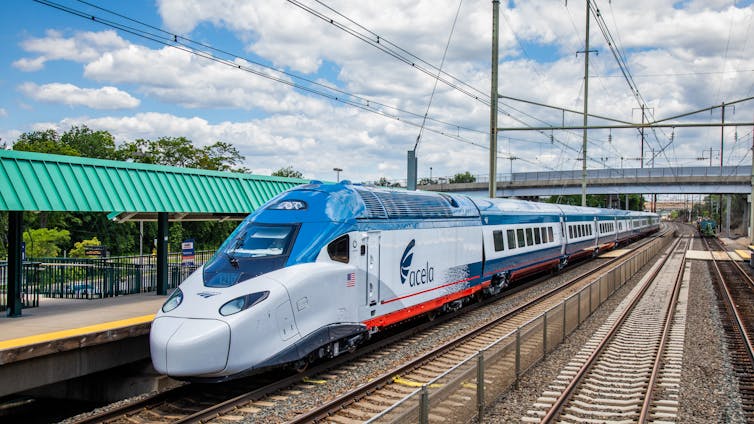
The new Acela trains are scheduled to start running on the Northeast Corridor soon.
Courtesy of Amtrak

David Alff, University at Buffalo

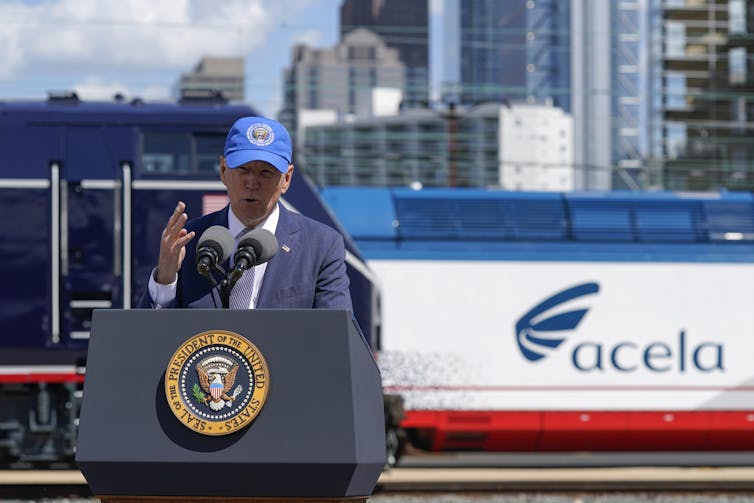
When former President Joe Biden unveiled his US$1.9 trillion infrastructure plan in 2021, he found the perfect place to go public: Philadelphia’s 30th Street Station rail yard.

Over the din of crackling wires and grumbling engines, the president made his case for revitalizing the country’s roads, ports, airports and rail lines.

Behind Biden sat rows of gleaming Amtrak trains. Among them was a prototype of NextGen Acela, a sleek machine engineered to deliver the fastest passenger service in American history.

On Aug. 28, 2025, NextGen will finally hit the rails, after years of delays.

As the author of a book on the Northeast Corridor, the rail line that connects Boston, New York, Philadelphia and Washington, I know this new train cannot come soon enough for many seaboard riders, even though it launches at a time of diminished political will for passenger rail.
Interior of modern train with seats with red headrests
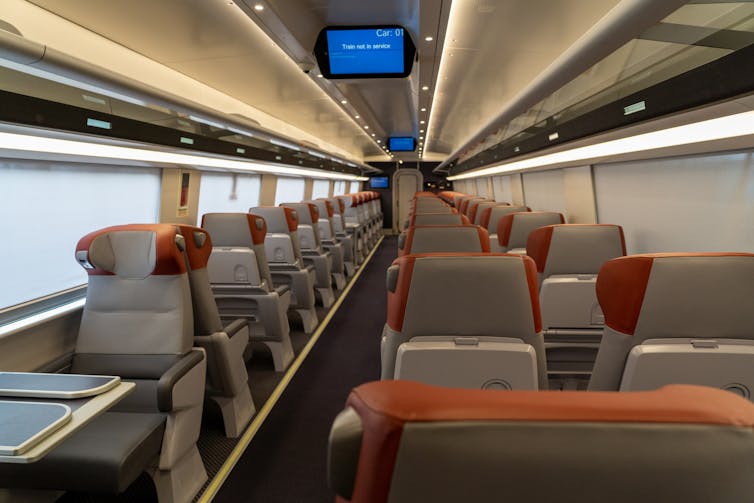
Red headrests distinguish first-class cars from business class on the NextGen Acela trains.
Courtesy of Amtrak

Rail renaissance under fire

The French-designed, American-manufactured NextGen arrives years late due to mechanical defects and failed simulation tests mandated by the Federal Railroad Administration. The new Acela will begin whisking passengers along the corridor after a chaotic year that saw downed wires, busted circuit breakers and brushfires disrupt Amtrak operations.

Gone is Amtrak’s White House champion, railfan-in-chief Biden, replaced by Donald Trump, whose one-time adviser, Elon Musk, called Amtrak a “sad situation,” and who proposed replacing the government-owned carrier with private competitors.
Man in suit and blue baseball cap speaks behind a lectern in front of a train with an urban skyline in the background
Former President Joe Biden delivers remarks at an Amtrak 50th anniversary event in Philadelphia in 2021.
AP Photo/Patrick Semansky

Amtrak CEO Stephen Gardner resigned in March 2025, and, in May, Amtrak cut 450 employee positions.

NextGen Acela promises an American rail renaissance in a moment when federally sponsored trains are fighting for their lives, as Biden’s infrastructure ambitions fall to an administration bent on cutting government costs.

These contradictions, however, are nothing new.

Not-so-fast trains

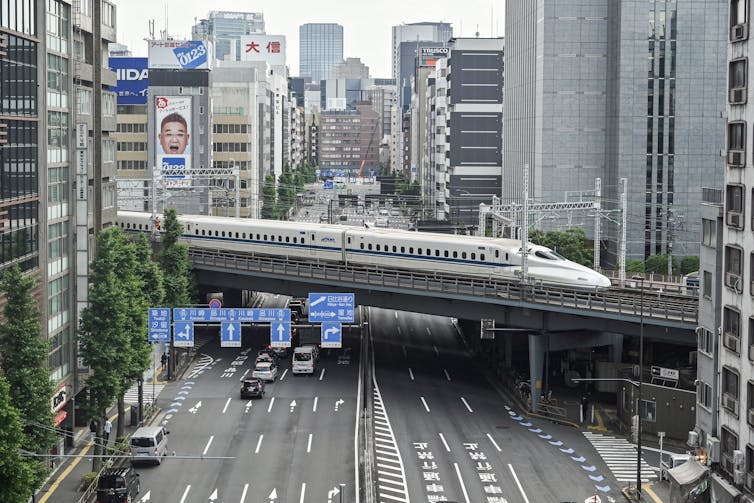
America’s love-hate relationship with fast trains stretches back to October 1964, when Japanese National Railways opened its Shinkansen high-speed line between Tokyo and Osaka.

Advertisement
Get More From A Face Cleanser And Spa-like Massage

Japan’s iconic 130-mph bullet train entranced audiences, many of whom saw footage of the new service during televised coverage of the Tokyo Olympics.
High-speed bullet train crosses bridge between skyscrapers
A Shinkansen high-speed bullet train passes through Tokyo.
Richard A. Brooks/AFP via Getty Images

Americans wanted their own bullet train but were reluctant to pay the massive infrastructural costs of a Shinkansen system. When Congress passed the High-Speed Ground Transportation Act of 1965, it prioritized the development of trains over the reconstruction of tracks, power systems and maintenance facilities.

The resulting services underperformed.

On Dec. 20, 1967, a gas turbine train manufactured by United Aircraft topped 170 mph while testing in New Jersey. But when the so-called TurboTrain entered service, it managed an average pace of just 63 mph on the weaving track between New York and Boston.

The electric-powered Metroliner, which began service in 1969, boasted similar potential but rarely held triple-digit speeds in service and broke down so often that its carrier, the Penn Central Railroad, struggled to keep the trains running between New York and Washington.

Historians usually regard these high-speed forays as resounding failures.

But riders loved them.

Technical flaws aside, both the TurboTrain and Metroliner were a hit with northeastern riders, so much so that Amtrak retained the Metroliner brand until 2006, long after it had retired the ‘60s-era trains.

Reflecting in 1999, rail journalist Don Phillips expressed disbelief “that those dogs were actually popular with the riding public.”

The birth of Acela

Amtrak opened a new era of high-speed rail in 2000 when it launched Acela Express.

Derived from France’s acclaimed TGV design, Acela carries passengers at speeds up to 150 mph on the Northeast Corridor.

Advertisement
Get More From A Face Cleanser And Spa-like Massage

Like the Metroliner before it, Acela suffered from design problems and mechanical faults, including cracked yaw dampers and brake discs, which temporarily sidelined the trains.

Rail writer Joseph Vranich described Acela as both “Amtrak’s crown jewel” and a “remarkable fiasco.”

And yet riders flocked to the service. Acela became one of Amtrak’s most popular and lucrative trains – so attractive that it lured business travelers off regional airlines.

When Acela entered service in 2000, Amtrak trains claimed just 37% of air-rail traffic between New York and Washington. By 2021, it had 83%. Between New York and Boston, that figure jumped from 20% to 75%.
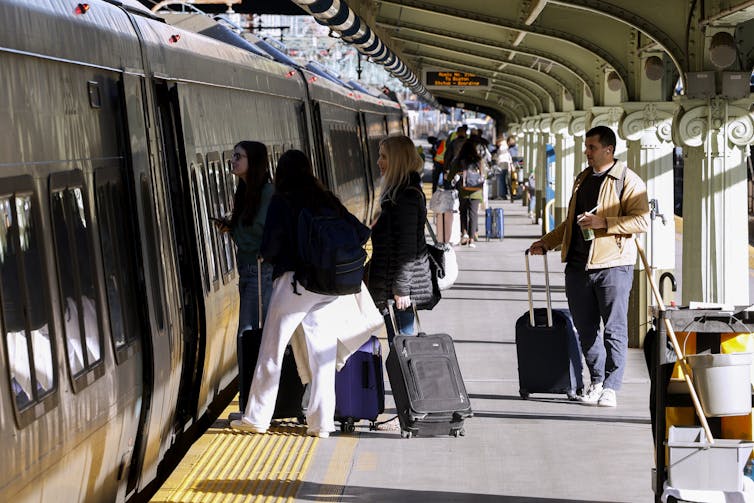
Passengers stand on platform waiting to board a train
Acela trains are popular and lucrative for Amtrak, in part because they draw so many business travelers.
Anna Moneymaker via Getty Images

Acela 2.0

Now, NextGen Acela takes up the fraught legacy of American high-speed rail. What can we expect of the new train?

NextGen is faster than the original Acela but will not set any world speed records. Its top velocity of 160 mph falls short of global benchmarks set by China’s Fuxing, which hits 217 mph, and Japan’s newest Shinkansens, which reach 200 mph.

With better tracks and signals, NextGen could conceivably ramp up to 186 mph, though such speeds won’t be possible anytime soon.

For now, NextGen will make do with an imperfect corridor. The train’s lightweight design means faster acceleration and lower energy consumption. An enhanced dynamic tilting system will let carriages lean into curves on the corridor’s twisting track, so they lose less speed on turns. The original Acela also tilted, but not as much.
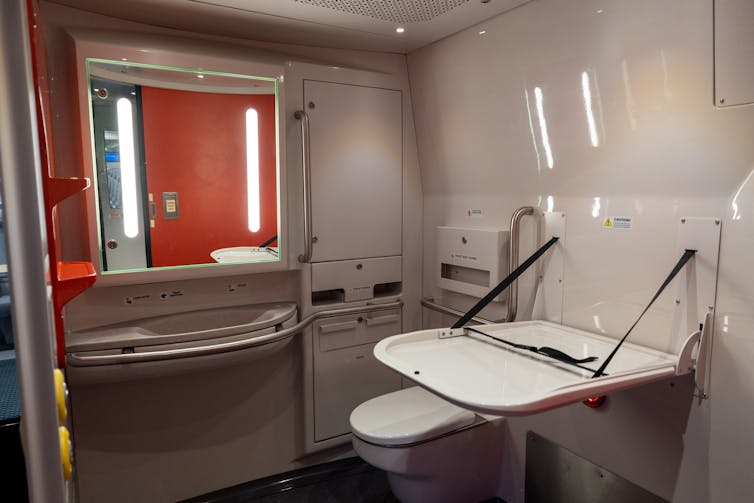
Modern white-and-red bathroom with changing table open
The NextGen Acela bathrooms are more spacious and have more touchless features than the previous design.
Courtesy of Amtrak

The upgraded onboard experience includes winged headrests, seat-side USB ports and 5G Wi-Fi. More importantly, each NextGen train can seat 82 more passengers than its predecessor. When Amtrak’s full fleet of 28 NextGens enters service, sending the first-generation trains into retirement, Acela service capacity will have increased by 4,728 seats.

This figure may be the train’s greatest achievement in a congested region at a time when Amtrak is posting record ridership.

The effects of the Northeast’s post-pandemic passenger surge are nowhere more visible than the Philadelphia rail yard where Biden spoke four years ago. Amtrak is constructing a new maintenance shop beside the Schuylkill River that will service NextGen trains and cement Philly’s role in the railroad’s addition of a million annual seats to its non-Acela corridor trains. Powered by conventional electric locomotives, these slower, cheaper “Regionals” accounted for 77% of corridor ridership in 2024 and will continue to carry the bulk of northeastern passengers.

Meanwhile, a quarter-mile south of the maintenance shop, America’s third-busiest passenger hub, 30th Street Station, is receiving a generational overhaul with a new food court, exterior plaza, shops and underground access to rapid transit.

Advertisement
Get More From A Face Cleanser And Spa-like Massage

These projects demonstrate the economic power of fast, frequent trains in Philly and throughout trackside communities of the Northeast. America’s embattled but resilient high-speed rail tradition may never be the world’s best, but even incremental improvements, like NextGen, cannot help but transform the places they serve.

For Amtrak’s corridor region, the stakes have never been higher.

Read more of our stories about Philadelphia.

David Alff, Associate Professor of English, University at Buffalo

This article is republished from The Conversation under a Creative Commons license. Read the original article.

Dive into “The Knowledge,” where curiosity meets clarity. This playlist, in collaboration with STMDailyNews.com, is designed for viewers who value historical accuracy and insightful learning. Our short videos, ranging from 30 seconds to a minute and a half, make complex subjects easy to grasp in no time. Covering everything from historical events to contemporary processes and entertainment, “The Knowledge” bridges the past with the present. In a world where information is abundant yet often misused, our series aims to guide you through the noise, preserving vital knowledge and truths that shape our lives today. Perfect for curious minds eager to discover the ‘why’ and ‘how’ of everything around us. Subscribe and join in as we explore the facts that matter.  https://stmdailynews.com/the-knowledge/

Continue Reading
Advertisement SodaStream USA, inc

Daily News

Major Construction Begins on Metro’s East San Fernando Valley Light Rail Line

LA Metro has moved the East San Fernando Valley Light Rail Transit Project into major construction. The 6.7-mile Van Nuys Boulevard line will add 11 stations, connect with the G Line and regional rail services, and is now targeted for completion in early 2032.

Published

on

After years of utility relocation and planning, LA Metro is moving into major construction on a new rail line along Van Nuys Boulevard. The milestone also comes with a revised early-2032 completion target.

Major construction is beginning on LA Metro’s 6.7-mile East San Fernando Valley light-rail line, which is targeted for completion in early 2032.
AI rendering depicting East San Fernando Valley LRT construction in the center of Van Nuys Boulevard. By: Daily News Staff

LA Metro has officially marked the beginning of major construction on the East San Fernando Valley Light Rail Transit Project, moving one of the region’s most important rail projects from preparatory work into full-scale construction.

Metro held a groundbreaking ceremony on October 19, 2026, for the 6.7-mile line, which will run along Van Nuys Boulevard from the G Line busway north to San Fernando Road in Pacoima. The project will add 11 light-rail stations serving Van Nuys, Panorama City, Arleta and Pacoima.

https://stmdailynews.com/la-metro-locks-in-vermont-brt-funding-as-world-cup-results-point-toward-2028/

This was not the project’s first groundbreaking. Metro held an earlier ceremony in December 2022 when crews began relocating utility infrastructure. The new milestone is more consequential for riders: the major-construction phase covers the guideway, stations, traction-power substations, rail systems and a maintenance and storage facility.

From utility work to a new rail corridor

The project has spent several years in utility relocation, property acquisition, design and other early work. Metro’s current construction timeline shows major work continuing from 2026 through 2032, with phased traffic changes and K-rail installations expected along Van Nuys Boulevard.

When completed, trains are expected to operate every seven to 10 minutes during peak periods. The line will connect directly with the G Line and provide access to the Van Nuys Metrolink and Amtrak station. It is also expected to become an important transfer point for the future Sepulveda Transit Corridor and a planned Metrolink station in Pacoima.

The corridor already has a substantial transit market. Metro reported that bus Lines 233 and 761, which serve Van Nuys Boulevard, recorded nearly 20,000 boardings in September 2026. The agency also says approximately 19 percent of households in the project area lack access to a car, compared with about 8 percent countywide.

Those figures help explain why this project matters beyond its construction footprint. It is intended to give residents in some of the Valley’s most transit-dependent communities more reliable access to jobs, schools, healthcare and the wider regional transit network.

The opening target has moved to 2032

Metro’s current project page lists an estimated completion date of early 2032. That is later than the 2031 opening forecast the agency publicized when it celebrated an $893-million federal grant in September 2024. Earlier plans were more optimistic still: when utility work began in 2022, Metro said the first segment could open between 2028 and 2030.

The project’s financial scale has also grown clearer. In May 2026, the Metro Board established a life-of-project budget of approximately $3.999 billion and authorized the next phase of its progressive design-build contract with San Fernando Transit Constructors, a joint venture of Skanska and Stacy and Witbeck.

That authorization increased the construction contract’s value to roughly $2.431 billion. Funding for the larger project combines federal, state and local sources, including revenue from Los Angeles County’s Measure M transportation sales tax.

Rail returns to Van Nuys Boulevard

The East San Fernando Valley line will restore passenger rail to Van Nuys Boulevard for the first time since Pacific Electric ended streetcar service there in 1952. It will also become the first major new Metro rail project in the San Fernando Valley since the subway reached North Hollywood in 2000.

Advertisement
Get More From A Face Cleanser And Spa-like Massage

The historical parallel is significant. Van Nuys Boulevard once developed around electric railway service before the region shifted heavily toward automobiles and buses. Metro is now rebuilding rail in the same broad corridor, but as part of a modern network designed to connect local riders with bus rapid transit, regional rail and future high-capacity projects.

The current project ends in Pacoima. Metro continues to study a separate 2.5-mile northern extension that would reach the Sylmar/San Fernando Metrolink station. That extension is not included in the segment now entering major construction.

For riders, the October groundbreaking does not mean trains are imminent. Several years of disruptive and technically complex work remain, and the schedule has already moved beyond earlier forecasts. Still, it represents a tangible transition: the East San Fernando Valley line is no longer primarily a planning exercise or utility-relocation program. Metro has begun building the infrastructure that will carry trains.

That makes this a major step in Los Angeles County’s long effort to restore frequent rail transit to communities that lost it generations ago—and another chapter in The Long Track Back.

Primary sources

This article is part of The Long Track Back, STM Daily News’ continuing coverage of how Los Angeles is rebuilding and expanding a passenger-rail network after decades of automobile-centered grow

Continue Reading

City

Santa Monica Pier Sign Heads to Las Vegas for Historic Restoration

Published

on

For generations, the Santa Monica Pier sign has marked the start of a day at the beach. Now, the familiar blue neon landmark is preparing for a journey of its own.

Santa Monica Pier sign is heading to Las Vegas for restoration during bridge replacement. Find out why it’s leaving and when it will return.
A harbor entrance sign of in Santa Monica Pier California

Santa Monica scheduled removal of the 1941 sign for October 20–22, with shipment to Las Vegas anticipated October 26. The timetable is subject to change, according to the city’s October 19 announcement.

The temporary removal accompanies replacement of the aging bridge connecting Ocean Avenue to the pier. It also creates an opportunity to preserve the historic sign.

https://stmdailynews.com/la-metro-locks-in-vermont-brt-funding-as-world-cup-results-point-toward-2028/

YESCO will restore it at its Las Vegas facility. The company’s experience includes work on the “Welcome to Fabulous Las Vegas” sign.

Crews will repair neon tubing, treat rust, repaint components and address structural needs while retaining historic features. The sign will remain in secure storage during bridge construction.

Once the project is finished, it will return above the new bridge at a slightly greater height for visibility and vehicle clearance. The city’s latest announcement targets project completion by 2028, ahead of the Los Angeles Olympics and Paralympics.

Meanwhile, visitors can photograph a lighted, half-scale replica near Pier Burger.

For anyone who associates that glowing arch with Southern California memories, its absence will be noticeable. The restoration is intended to ensure future generations can make memories beneath it, too.

Source: City of Santa Monica — October 19, 2026 announcement

Related Links

Follow more Southern California stories at STM Daily News.

Continue Reading

Automotive

Slate Truck Gets Real: First Experience Center Opens Ahead of Planned Deliveries

Slate Auto’s first permanent Experience Center gives consumers an up-close look at its customizable electric truck ahead of planned customer deliveries.

Published

on

Slate Auto’s new Chicago location gives prospective buyers a permanent place to see the minimalist electric pickup, explore customization options and learn about demo opportunities—but it is not yet proof that customer deliveries have begun.

CHICAGO — October 20, 2026 — The Slate Truck is moving out of computer renderings and temporary roadshow stops and into a permanent retail setting. Slate Auto opened its first Experience Center on October 15 at 1053 W. Grand Avenue in Chicago, giving consumers a year-round location to get an up-close look at the company’s highly anticipated electric pickup.

Slate Auto’s first permanent Experience Center gives consumers an up-close look at its customizable electric truck ahead of planned customer deliveries.

The Near West Side facility occupies a former Tesla location and includes showroom, retail and garage space, along with electric-vehicle charging infrastructure. For Slate, the opening represents an important step in turning strong online interest into a more tangible buying experience as the startup works toward launching its first vehicle.

Visitors can examine the truck’s compact dimensions, deliberately simple cabin and accessory-driven design in person. The center also showcases Slate’s personalization strategy, including exterior wraps, add-on accessories and digital design tools intended to let owners configure the truck around their needs.

https://stmdailynews.com/jeep-goes-back-to-1945-with-the-2027-wrangler-jl-2a/

Slate has also promoted demonstration opportunities connected with the location, although availability may be limited or appointment-based as the company continues to prepare its fleet. Early media access included passenger rides rather than unrestricted customer test drives, so prospective visitors should confirm current availability before making a special trip.

Why the Chicago opening matters

Until now, most consumers have encountered the Slate Truck through online reservations, media coverage or temporary appearances. A permanent showroom gives buyers a chance to judge details that are difficult to evaluate on a screen, including seating position, bed access, cabin materials and the overall size of the vehicle.

That is especially important for a product built around an unconventional value proposition. Slate is promoting a basic two-seat, two-door electric truck with manual crank windows and no factory-installed infotainment screen or stereo. The company’s strategy is to keep the starting price low and let buyers add features later through accessories and conversion kits.

The physical location also gives Slate a place to explain that approach directly. Rather than presenting the truck as an unfinished vehicle, the company can demonstrate how its modular accessories, wraps and planned SUV-style conversion components are meant to expand the vehicle’s usefulness over time.

Chicago is a logical first market for that effort. The city offers access to a large Midwestern customer base and is within the broader region of Slate’s planned manufacturing operation in Warsaw, Indiana. Reusing a former Tesla store also gives the startup a space already suited to displaying and servicing electric vehicles.

The roadshow continues beyond Chicago

The Experience Center is opening as Slate expands its public demonstration schedule. The company’s events calendar lists a Boston-area demo ride event from October 21 through October 25 at The Shops at Chestnut Hill, followed by an appearance at RADwood in Alameda, California, on October 24 and a New Jersey demo ride event in Freehold from October 28 through October 31.

Slate also lists future stops in Washington, D.C., Raleigh, Atlanta, Miami and Orlando. Together, the permanent Chicago center and the traveling events suggest the company is moving into a broader customer-education phase ahead of planned deliveries.

What has—and has not—changed

The showroom opening does not change Slate’s headline pricing or range claims. The truck is still advertised with a base price of $24,950 before taxes, registration and destination charges. With the currently listed $1,450 destination fee, the entry price would be approximately $26,400 before other costs or optional equipment.

Advertisement
Get More From A Face Cleanser And Spa-like Massage

Slate also continues to advertise an estimated range of up to 205 miles. That figure remains an estimate rather than a final EPA-certified rating.

Most importantly, Slate has not publicly confirmed that regular customer production has started or that the first retail deliveries have occurred. Limited deliveries have been reported as possible before the end of December 2026, while many reservation holders may receive later delivery windows in 2027. The Chicago opening is therefore a commercialization milestone, not a manufacturing milestone.

For customers and industry observers, the next major signals will be the start of production at the Warsaw factory, final specifications and EPA range ratings, and confirmed handoffs to paying buyers.

The bottom line

Slate Auto now has a permanent place where consumers can see and evaluate its unusually simple electric truck. That makes the product feel more real and gives the company a platform to explain a customization-heavy business model that may be unfamiliar to traditional truck buyers.

Still, the biggest questions remain unanswered. Opening a showroom demonstrates progress in marketing and customer engagement; producing vehicles at scale, holding the promised price and delivering a 205-mile truck to reservation holders will determine whether Slate can convert enthusiasm into a viable automotive business.

Sources and more information

Category: Consumer Corner / Automotive

Continue Reading

Trending

