

Family
5 Tips to Pull Off Holiday Hosting
With stay-at-home holidays a thing of the past for many families, they’re now busy preparing for full-blown celebrations. The return of traditional festivities brings seemingly never-ending to-do lists and pressure to be the perfect host.

Last Updated on December 17, 2025 by Daily News Staff
(Family Features) With stay-at-home holidays a thing of the past for many families, they’re now busy preparing for full-blown celebrations. The return of traditional festivities brings seemingly never-ending to-do lists and pressure to be the perfect host.
From mastering a mouthwatering menu and donning your home with decadent decor to ensuring guests enjoy the evening to the fullest, hosting duties bring plenty of responsibilities. This year, though, you can avoid those anxious feelings with some preparation ahead of the big day.
To help pull off a sensational seasonal soiree, consider these tips from the entertaining experts at Sun-Maid to make the holidays brighter and more manageable so you can navigate the stresses of hosting.
Invite Others to Share Favorite Traditions
Especially with stay-at-home holidays in recent years, some friends and family members may have developed their own special traditions from new recipes and foods to seasonal games and activities. Inviting your guests to bring or share something that represents their favorite part of the holidays can help everyone feel welcome.
Take Time for Yourself
Remember to make time for yourself so you can enjoy the fruits of your labor right alongside guests. The busyness of this time of year can add stress but reflecting on the true meaning of the season and reveling in your favorite parts of the holidays can help you avoid feeling overwhelmed.
Add New Ingredients to Your Menu
While pairing this year’s turkey or ham with the classics provides comfort and calls to mind holiday memories of the past, cooking with new ingredients and adding fresh recipes to the menu can put a fun spin on the season and maybe even create your own traditions to carry forward.
For example, baking with an option like Sun-Maid Raisins provides a whole fruit option with zero grams of added sugars per 1/4-cup serving. They’re an easy, better-for-you substitution to reduce overall sugar intake without compromising flavor or texture when compared with dried cranberries, which contain 27 grams of added sugars per 1/4-cup serving. The natural sugars of raisins make them a versatile, useful addition to a wide variety of holiday-worthy dishes.
Hop On Hot Food Trends
One of this year’s most popular trends in the kitchen is food boards, a fun and easy way to elevate flavor while incorporating favorites like cured meats, cold cuts, cheese slices and cubes, dips, nuts and more. Plus, you can keep your board balanced with nutritious items like vegetables and fruit, such as raisins, which provide sweet flavor without the added sugars.
A Time for Truce
Gathering for the holidays is about coming together with loved ones, family, friends and neighbors – and pulling it off means catering to everyone’s needs and wants. It’s a time for compromises and truces. To help add a little extra spark this year, try incorporating a theme to the party or coordinate fun activities and games that can be enjoyed by all. For example, holiday-themed charades, a seasonal “name that tune” game and gift exchanges all give guests ways to get in on the excitement.
To find more holiday entertaining inspiration and recipe ideas, visit SunMaid.com/PullOffTheHolidays .
Photos courtesy of Getty Images
SOURCE:
Sun-Maid Raisins


Consumer Corner
Cold cities are the most ready for winter, with one exception. See where your city ranks
Cold cities? Every neighborhood has a mix of homeowners who approach seasonal home maintenance differently – there are the people who stay on schedule, and on the other end, the procrastinators. There are the dedicated DIYers, and those who have their favorite maintenance pro saved as a favorite contact in their phone. As it turns out, cities are no different. Some metropolitan areas keep their neighborhoods in tip-top shape, while others are a little more slow-going.

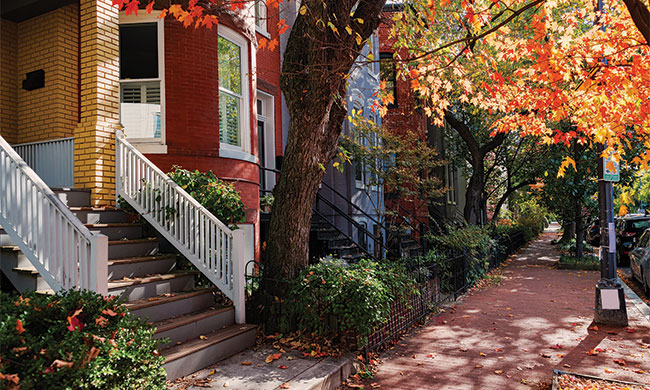
Cold cities are the most ready for winter, with one exception. See where your city ranks
(Sheeka Sanahori) Every neighborhood has a mix of homeowners who approach seasonal home maintenance differently – there are the people who stay on schedule, and on the other end, the procrastinators. There are the dedicated DIYers, and those who have their favorite maintenance pro saved as a favorite contact in their phone. As it turns out, cities are no different. Some metropolitan areas keep their neighborhoods in tip-top shape, while others are a little more slow-going.
New data from home services company Angi, covering fall maintenance activity in August, reveals which U.S. metropolitan areas are the most proactive with fall maintenance. Washington, D.C., tops the ranking with the strongest demand for fall maintenance in the country, followed by Columbus, Ohio, and Milwaukee, Wisconsin. Northern cities dominate the rest of the list.
Cleveland, Ohio, and Albany-Schenectady-Troy, New York, round out the top five. Cold-weather markets dominate the ranking, accounting for eight of the 10 most-prepared metros. Rochester, New York; Charlotte, North Carolina; Chicago; Indianapolis; and Pittsburgh complete the top 10.
Least fall-ready metros
Fewer than 1 in 5 American cities is prepping for fall at an above-average rate. Among the 66 metros that recorded at least 100 fall maintenance service requests during the analysis period, Los Angeles had the lowest level of per-capita activity, followed by Oklahoma City and Riverside, California. California accounts for four of the bottom 10 markets, with Los Angeles, Riverside, San Diego and San Francisco all appearing on the list. These metros historically don’t experience the colder winter climates of the Northeast and Midwest, making fall maintenance less of an imperative.
Grand Rapids, Michigan, stands out as the only clearly cold-weather metro among the 10 least-prepared large metros. The New York City metro, which includes Newark and Jersey City, ranked just outside the 10 least-prepared large metros, coming in at number 11. Other New York state metros, including Syracuse, Rochester and the Albany metro area, were on the most prepared list.
Homeowners are choosing upkeep over upgrades
Sixty-three percent of homeowners who have recently hired a professional completed maintenance work, and 58% completed repairs. Although they may be waiting to do that dream kitchen or bath renovation, they’re focusing for now on the maintenance that keeps their homes in order.
The most common fall maintenance projects focus on outdoor upkeep. Nationally, tree trimming was the most popular, followed by lawn and yard waste cleanup and shrub care.
What homeowners should do now
When tackling a home maintenance list, start at the top of the home by inspecting the roof and gutters. Look for loose or damaged shingles, and make sure gutters are debris-free. It’s also a good idea to ensure downspouts direct water far away from the foundation. Homeowners should inspect these areas from the ground or hire a professional if the work requires climbing or feels unsafe.
Next, check for drafts around the windows and doors. Replacing worn weatherstripping and damaged caulk in the fall can prevent warm air from escaping once the heat comes back on. Homeowners should also inspect their HVAC filters and have the heating system checked before the temperatures drop.
Every home’s maintenance needs will vary, depending on the age and condition of the house and where it’s located. Whether homeowners hire a professional or safely address small issues, making the fixes can prevent larger and more expensive problems later.
The ranking: Metros from most to least prepared
America’s 10 Most Fall-Prepared Metros
1. Washington, D.C.
2. Columbus, Ohio
3. Milwaukee, Wisconsin
4. Cleveland, Ohio
5. Albany-Schenectady-Troy, New York
6. Rochester, New York
7. Charlotte, North Carolina
8. Chicago, Illinois
9. Indianapolis, Indiana
10. Pittsburgh, Pennsylvania
10 Metros With the Most Opportunity to Get Fall-Ready
1. Los Angeles, California
2. Oklahoma City, Oklahoma
3. Riverside, California
4. Miami, Florida
5. San Diego, California
6. Houston, Texas
7. Grand Rapids, Michigan
8. San Francisco, California
9. Austin, Texas
10. Memphis, Tennessee
Methodology
The rankings are based on fall maintenance activity recorded on Angi during August 2026. Projects included yard cleanup, winterization, roofing and gutters, heating systems, water and drainage, outdoor plumbing, fireplaces and chimneys, pest prevention, and snow and storm preparation. U.S. metropolitan areas were ranked by activity per 100,000 residents using 2020 U.S. Census population data. To qualify for the least-prepared ranking, metros were required to have at least five service requests or jobs during the analysis period. The rankings reflect activity on Angi’s platform and are not a complete measure of all home-maintenance activity within each metro. These rankings reflect activity observed on Angi’s platform and should not be interpreted as a complete measure of all home-maintenance behavior within a metro area.
Photo courtesy of Shutterstock
SOURCE:
Angi

child education
Where Curiosity Builds Trade Skills: 5 Ways to Help Kids Discover the Skilled Trades
Help Kids Discover the Skilled Trades: Parents, educators and mentors can encourage young people to broaden their horizons as they plan their futures and build awareness around careers in the skilled trades with these tips.

Where Curiosity Builds Trade Skills: 5 Ways to Help Kids Discover the Skilled Trades
(Feature Impact) Most students hear questions about what they want to be when they grow up. By the time their middle and high school years arrive, they’re often starting to consider their answers more in depth. Conversations with adults can help shape their awareness of and interest in various career paths, including skilled trades.
When they’re provided with opportunities to learn, build, experiment and solve problems, young people can discover whether their talents and passions are a good fit for a career in the trades. Programs likePath to Pro Skills Explorers, launched by The Home Depot in partnership with Scouting America and Boys & Girls Clubs of America, provide free, accessible ways to introduce students to options like the plumbing, construction and electrical fields, as well as content on leadership and soft skills.
Parents, educators and mentors can encourage young people to broaden their horizons as they plan their futures and build awareness around careers in the skilled trades with these tips.
Start Career Conversations Early
Choosing a career path doesn’t have to be one intimidating, life-changing moment. Parents and mentors can normalize career conversations by starting them early and keeping things casual. Opening the dialogue sparks curiosity about the activities kids enjoy and allows them to start connecting those interests to potential career paths. To get started, set kids up with access to online programs, videos and introductory courses so they can explore a variety of possibilities.
 Turn Curiosity Into Hands-On Learning
For many students, learning by doing is the most satisfying way to test, improve and build skills. Instead of only reading textbooks or listening to instructors, offer them the chance to follow a plan, work with different materials, troubleshoot problems and build something tangible. Young people considering hands-on careers need hands-on practice to develop confidence and adaptability. Take the first step by researching online resources and local opportunities for classes, job shadowing or even apprenticeships.
Recognize the Skills Kids Are Already Building
Skilled trades aren’t just about knowing which wires to connect or what tool to reach for. They also rely on a variety of soft skills like communication, patience, critical thinking, time management, attention to detail and more. When kids demonstrate these traits, point them out and encourage them. Take opportunities to let them experiment with hands-on projects, whether they want to try building a treehouse, repairing a bike or tinkering with technology.
Expand Views of Career Pathways and Success
The road to success is more like an intersection. Let young people know there are many pathways to fulfilling careers and futures, and while the traditional college-to-career plan can still be a viable option, it isn’t the only one. Skilled trades offer competitive salaries, job security and the opportunity to learn hands-on skills that will always be in demand. Even in a world where technology is rapidly changing many career fields, it takes skilled workers to replace roofs, repair electrical systems, fix sewer lines and lead disaster recovery efforts.
Find Programs That Make Skilled Trades Exploration Accessible
There is a gap between labor supply and demand in the trades, and it’s only widening as older generations approach retirement age. Programs like The Home Depot’s Skills Explorers are designed to empower young people to step into these roles by providing a mix of online resources and hands-on activities to explore viable career paths. As a key part of a commitment by The Home Depot and The Home Depot Foundation to deliver 15 million introductions to the skilled trades by 2032, the program offers an accessible, no-cost curriculum for youth education groups to learn what it’s like to work in these important fields.
“For years, The Home Depot and The Home Depot Foundation’s Path to Pro program have helped separating military, career changers and others build pathways to the trades,” said Michael Rowe, executive vice president of Pro for The Home Depot. “We know that closing the skilled labor gap starts much earlier. We need more young people to see what’s possible and understand the lucrative opportunities these careers provide.”
Visit pathtopro.com/skills-explorers to access the free curriculum and discover how to bring hands-on skilled trade exploration to students.
SOURCE:
🔧 Curiosity today can become a skill for tomorrow. Giving kids opportunities to build, fix, create, and explore trades at an early age can turn natural curiosity into confidence, practical skills, and even inspiration for a future career. Whether it’s woodworking, automotive repair, cooking, electronics, or construction, hands-on learning shows kids that there’s more than one path to success. Visit: https://stmdailynews.com/lifestyle/
financial wellness
Life insurance is on the to-do list. Right under cleaning out the garage.
No matter how you define “adulting,” getting life insurance tends to be one part of the to-do list that keeps getting set on a procrastination loop. New survey data backs that up: there are plenty of other tasks adults would rather focus on first.

(Sheeka Sanahori) Being an adult comes with a never-ending list of responsibilities: Cook dinner. Scrub the bathroom. File taxes. The tasks grow even longer when sharing a household with a partner, building a family, or taking care of others. No matter how you define “adulting,” getting life insurance tends to be one part of the to-do list that keeps getting set on a procrastination loop.
New survey data backs that up: there are plenty of other tasks adults would rather focus on first.
The Adulting Task Americans Keep Avoiding
According to the 2026 Life Happens Life Insurance Survey, a financial literacy nonprofit organization, 39% of U.S. adults would rather clean out their email inbox than figure out their life insurance needs. Another 31% would rather clean out the garage or basement. One in five U.S. adults would be willing to sit on hold with customer service for three hours before life insurance planning. Even though many adults have it somewhere on their list, nearly half (46%) say they’ll either deal with it later or not at all.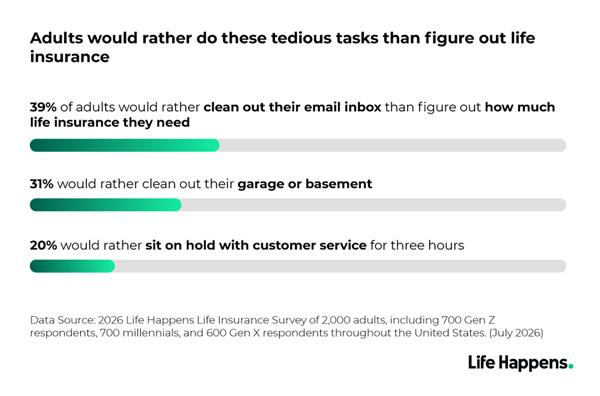
They Know It Matters
Nearly a third of adults have already figured out a life insurance plan, and they feel good about their decision. Others are feeling more conflicted: 14% have a policy, but they’re not sure if they have enough. Another 12% say they either don’t know where to start or they think it’ll be too expensive.
It’s no wonder people are putting it off: Navigating a new-to-them form of financial planning can come with a lot of complicated emotions. Four in 10 feel either overwhelmed, anxious, or some combination of both. Sixteen percent of U.S. adults feel guilty for putting it off, but when the outcome is more procrastination, that feeling lingers.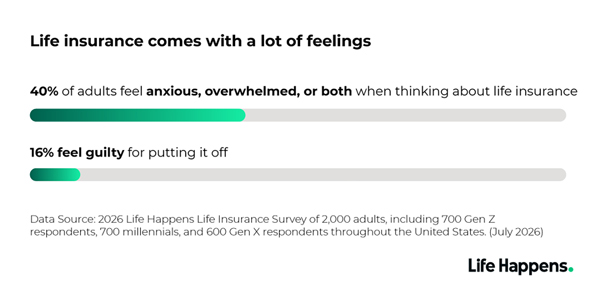
Why Later Keeps Winning
If you’ve ever faced an important decision without having enough information to make an informed choice, you know how stressful it can be. While the generations have different takes on making major decisions with a gut feeling or “pure vibes,” most of the time, people want to feel like they’re making an informed choice. Forty-five percent of U.S. adults say cost concerns, confusion or procrastination are the main reasons they have delayed or would delay looking into life insurance. For more than one in five, the plan is to seriously look at it when they feel more financially stable. For 12%, they say they’ll do it when they’re older.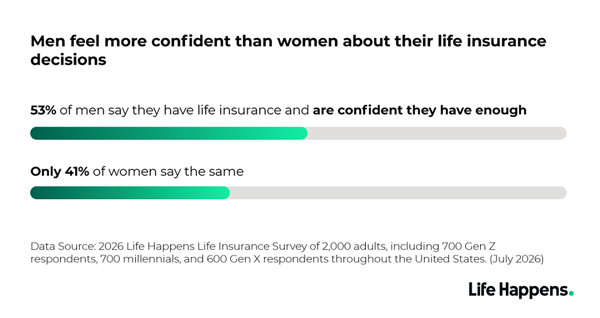
Men tend to feel more confident about their life insurance decisions to date; 53% of men vs. 41% of women feel confident their family would be financially protected.
The First Step Feels Bigger Than It Is
Learning more about life insurance, how it’s priced and how it works could help get many consumers out of their procrastination loop. A quarter of people say they’d make a decision if they learned it was easier to get than they previously thought. Thirty percent would make the purchase if they learned it was more affordable than they believed it to be. Others need an experienced professional to talk to or an online calculator tool to give them guidance.
Methodology: Life Happens commissioned Atomik Research to conduct an online survey of 2,000 adults, including 700 Gen Z respondents, 700 millennials, and 600 Gen X respondents throughout the United States. The margin of error for the overall sample is +/- 2 percentage points and +/- 4 percentage points for each generational sample, with a confidence level of 95 percent. Fieldwork took place between July 14 and July 20, 2026. Atomik Research, part of 4media group, is a creative market research agency.
Photo courtesy of Shutterstock (couple using computer)

SOURCE:





