

STM Blog
Science costs money – research is guided by who funds it and why
Science costs money: Funding is essential for scientific research, shaping its direction and outcomes. Government and private investments drive both basic and applied research, leading to innovation and societal benefits, particularly in health.

Last Updated on October 12, 2025 by Daily News Staff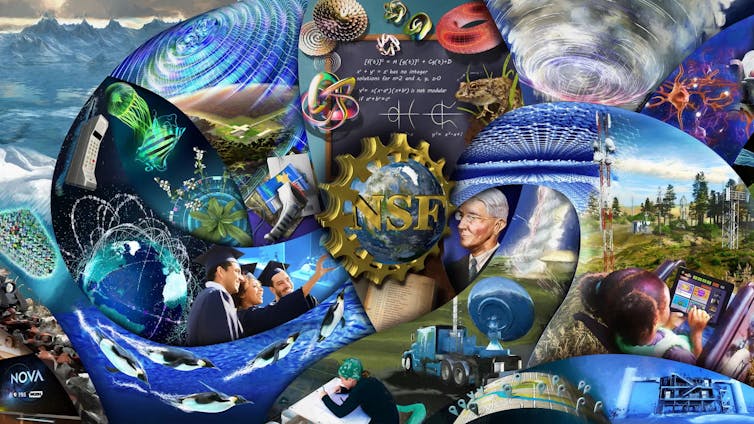
Ryan Summers, University of North Dakota
Science costs money – research is guided by who funds it and why
Scientists have always needed someone to help foot the bill for their work.
In the 19th century, for example, Charles Darwin made an expensive voyage to the southernmost tip of the Americas, visiting many other places en route, including his famous trek through the Galapagos Islands. The fossil evidence Darwin collected over his five-year journey eventually helped him to think about an infinite variety of species, both past and present.
The HMS Beagle and its crew traversed these places while testing clocks and drawing maps for the Royal Navy, and the voyage was funded by the British government. Darwin’s position as a naturalist aboard the ship was unpaid, but, fortunately, his family’s private assets were enough to cover his living expenses while he focused on his scientific work.
Today, government and private funding both remain important for scientific discoveries and translating knowledge into practical applications.
As a professor of science education, one of my goals while preparing future teachers is to introduce them to the characteristics of scientific knowledge and how it is developed. For decades, there has been a strong consensus in my field that educated citizens also need to know about the nature of the scientific enterprise. This includes understanding who pays for science, which can differ depending on the type of research, and why it matters.
Funding for science is more than just the amount of money. To a large extent, the organizations that fund research set the agenda, and different funders have different priorities. It can also be hard to see the downstream benefits of scientific research, but they typically outweigh the upfront costs.
Basic research leads to new knowledge
Basic research, also called fundamental research, involves systematic study aimed at acquiring new knowledge. Scientists often pursue research that falls into this category without specific applications or commercial objectives in mind.
Of course, it costs money to follow where curiosity leads; scientists need funding to pursue questions about the natural and material world.
About 40% of basic research in the U.S. has been federally funded in recent years. The government makes this investment because basic research is the foundation of long-term innovation, economic growth and societal well-being.
Funding for basic research is distributed by the federal government through several agencies and institutes. For more than a century, the U.S. National Institutes of Health have sponsored a breadth of scientific and health research and education programs. Since 1950, the National Science Foundation has advanced basic research and education programs, including the training of the next generation of scientists.
Other federal agencies have complementary missions, such as the Defense Advanced Research Projects Agency, created in response to the Soviet Union’s launch of Sputnik in 1957. DARPA focuses on technological innovations for national security, many of which have become fixtures of civilian life.
Through a competitive review process at these agencies, subject experts vet research proposals and make funding recommendations. The amount of funding available from the NIH, NSF and DARPA varies annually, depending on congressional appropriations. Most of the awarded funds go to universities, research institutions and other health and science organizations that conduct research. The sum of research dollars awarded differs among states.
Applying research
Scientists undertake basic research to generate new knowledge with no specific end goal in mind. Applied research is different in that it aims to find solutions to real-world problems.
Research that investigates specific, practical objectives or improvements with commercial potential is more likely to attract private investors. Companies directly invest in research and development to gain a competitive edge and turn a profit. Private industry is more likely to sink dollars into applied rather than basic research because the potential payoff in the form of a new product or advance is more visible.
From discovery to real-world implementation
As applied research addresses problems, promising findings are moved toward clinical application or mainstream use. This research and development process can lead to tangible benefits for individuals and society.
Federal agencies such as the NIH make substantial investments in the basic and applied science underlying new drugs. Pharmaceutical and biotechnology companies heavily invest in the development of drug candidates. Recent reports have shown that industry has been responsible for 50% or more of the dollars invested in health and biomedical research in recent years. This expenditure includes significant spending to advance clinical trials – the studies that test new medical treatments before they get approved for use.
The NIH funded basic research that contributed to every single drug approved by the U.S. Food and Drug Administration between 2010 and 2016. This includes key work that led to COVID-19 vaccines. The COVID-19 vaccination campaign likely saved the U.S. more than $1 trillion in health care expenses that would have otherwise been incurred and also saved lives.
Initial NSF investments in research was instrumental in capturing images of black holes and exploring deep oceans. Basic research funded by NSF paved the way for everyday conveniences such as smartphones, the Google search engine and artificial intelligence. Other funded projects led to quality of life improvements such as American Sign Language and kidney matching for transplants. Educational programming, such as “Bill Nye the Science Guy” and “The Magic School Bus,” were NSF-backed projects, too.
It matters who pays: Funding shapes science
Funders and financial systems shape the trajectory of research across fields. Institutions advertise funding opportunities based on their current priorities. Changes in the amount of funding available ultimately direct the attention of researchers. Any interruptions to basic research, such as changes to financial supports or institutions, may threaten future discoveries and potential payoffs for years to come.
According to numbers reported by a coalition of research institutions, every dollar that NIH spends on research leads to $2.56 of new economic activity. For the 2024 fiscal year, this means, of the $47.35 billion Congress appropriated for NIH, the $36.94 billion awarded to U.S. researchers fueled $94 billion in activity through employment and the purchase of research-related goods and services.
Economist Pierre Azoulay and colleagues recently imagined an alternative history where NIH was 40% smaller and dispersed less money – a budget akin to current federal proposals. They argued that more than half of the drugs FDA approved since 2000 are tied to NIH-funded research that would have been cut under this scenario. This thought experiment underscores how valuable those basic research dollars are. https://www.youtube.com/embed/xk94il8L820?wmode=transparent&start=1369 ‘Last Week Tonight with John Oliver’ points out some seemingly outlandish basic research that has yielded surprising real-world applications.
Even seemingly out-of-touch or abstract studies may precede discoveries with major impact. Basic research into bee nectar foraging and movement around the colony, recently mentioned on “Last Week Tonight with John Oliver,” led to the development of an algorithm that distributes internet traffic between computer servers, which now powers the multibillion-dollar web-hosting industry. Learning about applications of research with visible societal impacts can help people understand and appreciate the role of funding in the scientific enterprise.
Ryan Summers, Associate Professor of Science Education, University of North Dakota
This article is republished from The Conversation under a Creative Commons license. Read the original article.
STM Daily News is a vibrant news blog dedicated to sharing the brighter side of human experiences. Emphasizing positive, uplifting stories, the site focuses on delivering inspiring, informative, and well-researched content. With a commitment to accurate, fair, and responsible journalism, STM Daily News aims to foster a community of readers passionate about positive change and engaged in meaningful conversations. Join the movement and explore stories that celebrate the positive impacts shaping our world.


unknown
Did Jackie Gleason See Aliens? Inside the Strange Nixon–UFO Legend
Jackie Gleason reportedly told his wife that President Richard Nixon arranged for him to view preserved extraterrestrial bodies at a Florida Air Force base. Here is what we know—and why the remarkable story remains unverified.

The beloved comedian reportedly told his wife that President Richard Nixon arranged for him to view preserved extraterrestrial bodies at a Florida Air Force base. Decades later, the extraordinary story remains fascinating—but unverified.
Jackie Gleason is remembered as “The Great One,” the larger-than-life entertainer who turned bus driver Ralph Kramden into one of television’s most enduring characters on The Honeymooners. Away from the cameras, however, Gleason had another consuming interest: UFOs, psychic phenomena and the possibility of extraterrestrial life.
That interest eventually became the foundation of one of the strangest stories ever associated with an American president and a Hollywood celebrity. According to Gleason’s second wife, Beverly McKittrick, her husband came home late one night in 1973 and claimed that President Richard Nixon had helped him see the preserved bodies of extraterrestrial beings at Homestead Air Force Base in Florida.
Did Jackie Gleason really see aliens?
The honest answer is that we do not know. The allegation is remarkable, but the available evidence never rises above an uncorroborated story attributed to Gleason years after the supposed event.
Gleason’s fascination with UFOs was real
There is little question that Gleason took the UFO subject seriously. He reportedly assembled a substantial personal library devoted to UFOs, the paranormal and related mysteries. His unusual circular home in New York—often nicknamed “The Mothership”—only strengthened his public association with flying saucers, although its distinctive architecture is not evidence of an extraterrestrial encounter.
Gleason also had a genuine social connection with Nixon. The two men shared an interest in golf and spent time together in Florida. That documented friendship is the factual starting point from which the more sensational story grew.
The alleged trip to Homestead Air Force Base
McKittrick said that Gleason returned to their Florida home at about 11:30 one evening looking disturbed. According to her account, he told her that Nixon had arrived without the usual presidential entourage and taken him to Homestead Air Force Base, south of Miami.
Once there, Gleason allegedly entered a secured building where he saw small humanoid bodies preserved inside glass-topped containers. Published versions differ over the number of bodies and some physical details, but they generally describe child-sized beings with oversized heads.
Importantly, McKittrick did not claim to have accompanied the men or witnessed anything at the base. Her account was based entirely on what she said Gleason told her after returning home.
The story became public in 1983, years after the alleged visit and after the couple had divorced. It circulated widely through tabloid reporting, UFO publications and later books, gradually becoming part of UFO folklore.
Why the story remains unverified
No authenticated photograph, visitor record, military document or firsthand statement from Nixon has emerged to confirm the alleged trip. Gleason also never provided investigators with a signed affidavit describing the experience.
UFO researcher Larry Bryant reportedly sought records from Homestead and tried to obtain a statement from Gleason, but those efforts produced no confirming documentation. Gleason’s refusal to address the account publicly has sometimes been portrayed as suspicious, but silence is not proof that an event occurred.
There is another important complication: McKittrick later expressed uncertainty about her former husband’s story.
During telephone interviews conducted by researcher Kenny Young in 2003, she stood by her recollection that Gleason told her he had seen “dead aliens.” She also acknowledged that, as the years passed, she wondered whether he might have invented the explanation because he had been out late. She declined to appear on camera and said the story should be authenticated first.
Her later comments do not establish that the account was false, but they considerably weaken any attempt to treat it as verified history.
Could a president have slipped away unnoticed?
Some versions of the legend emphasize that Nixon supposedly drove to Gleason’s house alone and then entered a military installation without his Secret Service detail. Presidents have occasionally sought privacy or slipped away from tightly managed schedules, but a secret nighttime excursion of this nature would have involved serious security and logistical obstacles.
The claim becomes even more difficult to accept when we consider what Nixon allegedly revealed. If the United States possessed extraterrestrial bodies, granting a comedian personal access to them would have represented an extraordinary breach of national security—with no apparent official purpose and no surviving documentation.
None of that makes the episode logically impossible. It does, however, mean that the story requires exceptionally strong evidence. That evidence has never appeared.
A compelling legend, not a confirmed encounter
The Jackie Gleason story endures because it combines three irresistible ingredients: a famous comedian fascinated by UFOs, a secretive American president and a nighttime visit to a military base containing an alleged government secret.
What can be established is that Gleason was deeply interested in UFOs, knew Nixon and was said by his former wife to have made an extraordinary claim. What cannot be established is that Nixon took him to Homestead Air Force Base or that preserved extraterrestrial bodies were ever stored there.
So, did Jackie Gleason see aliens?
Perhaps he believed that he did—or perhaps he simply told an unforgettable story. Until corroborating evidence emerges, the alleged encounter belongs in the intriguing borderland between celebrity history and American UFO mythology.
Sources and further reading
- The Black Vault: Jackie Gleason and the Pickled Alien
- University of Miami Libraries: The Jackie Gleason Collection
- U.S. Department of Defense: All-domain Anomaly Resolution Office
Step into The Unknown, where STM Daily News explores the strange phenomena, unexplained encounters and enduring mysteries that continue to challenge what we think we know. From UFO sightings and paranormal events to historical mysteries and unusual scientific discoveries, we examine the stories, evidence and competing explanations—without losing our sense of wonder. https://stmdailynews.com/science/unknown/
Community
PenFed Foundation Raises Over $1.2M for Veterans and Military Families at 23rd Annual Military Heroes Golf Classic
The PenFed Foundation says it raised over $1.2 million for veterans and military families at its 23rd annual Military Heroes Golf Classic.

The PenFed Foundation for Military Heroes said it raised more than $1.2 million to support veterans and military families during its 23rd annual Military Heroes Golf Classic, held Monday, Aug. 31, according to a PRNewswire release. The nonprofit, based in the Washington, D.C. region, focuses on helping veterans transition “from service to success” through programs and grants aimed at military-connected communities.
“We are deeply grateful to our partners and supporters whose generosity and dedication make this event—and the Foundation’s work—possible,” said retired Air Force Lt. Gen. Bradford J. “B.J.” Shwedo, president of the PenFed Foundation, in a statement announcing the fundraising total.
At a dinner held the night before the Golf Classic, PenFed Credit Union President/CEO and PenFed Foundation CEO James Schenck recognized Ed Cody for 25 years of service on the foundation’s board of directors. Cody also serves as chairman of the PenFed Credit Union board and was credited with helping guide initiatives including Defender’s Lodge, the Afghan Rescue and Resettlement Program, the Veteran Entrepreneur Program, and grants supporting wounded, ill, and injured service members.
The foundation said it has provided more than $55 million in financial support to veterans, active-duty service members, and military families since it was founded in 2001. It also noted that PenFed Credit Union covers salaries and administrative costs, allowing more donations to go directly to programs.
What to watch for: How the foundation allocates the new $1.2M across its veteran transition and emergency support programs—and whether it announces new grant rounds tied to entrepreneurship and resettlement work.
SOURCE PenFed Foundation
Subscribe to our newsletter STM Morning Brief!
Entertainment
Apple Music Super Bowl LX Halftime Show Starring Bad Bunny Wins 7 Emmys, Sets New Record
Executive produced by Roc Nation and JAY-Z, the show becomes the most-awarded halftime production in Emmy history.
The Apple Music Super Bowl LX Halftime Show starring Bad Bunny took home seven Emmy Awards at the 78th Emmy Awards, making it the most-awarded Super Bowl halftime show in Emmy history, according to Roc Nation. The live spectacle—executive produced by Roc Nation and JAY-Z—won across major production categories, underscoring how the halftime stage has evolved into a full-scale, awards-caliber live television event.
The record-setting wins included Outstanding Variety Special (Live), Outstanding Music Direction, Outstanding Directing for a Variety Special, Outstanding Choreography for Variety or Reality Programming, Outstanding Sound Mixing for a Variety Series or Special, Outstanding Lighting Design/Lighting Direction for a Special, and Outstanding Technical Direction and Camerawork for a Special. Roc Nation also noted the show set a global viewership record, pulling 4.157 billion views in 24 hours across global broadcast, YouTube, and social platforms.
Beyond the trophies and viewership numbers, the halftime show leaned into big-name star power with special guest performers Lady Gaga and Ricky Martin, plus additional appearances from Karol G, Cardi B, Jessica Alba, Pedro Pascal, Young Miko, and others. The sweep signals not just a win for the artists on stage, but for the behind-the-scenes creative teams turning the halftime show into one of the most technically ambitious live productions on television.
What to watch for: With Emmy recognition now firmly in the conversation, expect future halftime shows to push even harder on cinematic staging, choreography, and broadcast innovation—because the bar (and the awards) just got higher.
Source: Roc Nation (PRNewswire), Sept. 6, 2026
Link to original press release: https://prnmedia.prnewswire.com/news-releases/the-apple-music-super-bowl-lx-halftime-starring-bad-bunny–executive-produced-by-roc-nation–jay-z-wins-seven-emmys-302870842.html
📰 Enjoying STM Daily News? Join the conversation!
💬 Leave a comment, share your thoughts, and subscribe to our newsletter for the latest stories, updates, and “News You Can Use This Moment!” delivered to your inbox.
Stay connected with STM Daily News!





