
Connect with us

The Knowledge

Why two tiny mountain peaks became one of the internet’s most famous images

Two tiny mountain peaks: Ever wonder why a mountain icon appears when images won’t load? Discover the fascinating history behind the internet’s most ubiquitous placeholder symbol, from Japanese camera dials to Windows XP’s “Bliss” wallpaper, and why mountains represent mystery in digital life.

Published

on

Why two tiny mountain peaks became one of the internet’s most famous images
The icon has various iterations, but all convey the same meaning: an image should be here.
Christopher Schaberg, CC BY-SA

Why two tiny mountain peaks became one of the internet’s most famous images

Christopher Schaberg, Washington University in St. Louis

It’s happened to you countless times: You’re waiting for a website to load, only to see a box with a little mountain range where an image should be. It’s the placeholder icon for a “missing image.”

But have you ever wondered why this scene came to be universally adopted?

As a scholar of environmental humanities, I pay attention to how symbols of wilderness appear in everyday life.

The little mountain icon – sometimes with a sun or cloud in the background, other times crossed out or broken – has become the standard symbol, across digital platforms, to signal something missing or something to come. It appears in all sorts of contexts, and the more you look for this icon, the more you’ll see it.

You click on it in Microsoft Word or PowerPoint when you want to add a picture. You can purchase an ironic poster of the icon to put on your wall. The other morning, I even noticed a version of it in my Subaru’s infotainment display as a stand-in for a radio station logo.

So why this particular image of the mountain peaks? And where did it come from?

Arriving at the same solution

The placeholder icon can be thought of as a form of semiotic convergence, or when a symbol ends up meaning the same thing in a variety of contexts. For example, the magnifying glass is widely understood as “search,” while the image of a leaf means “eco-friendly.”

It’s also related to something called “convergent design evolution,” or when organisms or cultures – even if they have little or no contact – settle on a similar shape or solution for something.

In evolutionary biology, you can see convergent design evolution in bats, birds and insects, who all utilize wings but developed them in their own ways. Stilt houses emerged in various cultures across the globe as a way to build durable homes along shorelines and riverbanks. More recently, engineers in different parts of the world designed similar airplane fuselages independent of one another.

For whatever reason, the little mountain just worked across platforms to evoke open-ended meanings: Early web developers needed a simple shorthand way to present that something else should or could be there.

Advertisement
Get More From A Face Cleanser And Spa-like Massage

Depending on context, a little mountain might invite a user to insert a picture in a document; it might mean that an image is trying to load, or is being uploaded; or it could mean an image is missing or broken.

Down the rabbit hole on a mountain

But of the millions of possibilities, why a mountain?

In 1994, visual designer Marsh Chamberlain created a graphic featuring three colorful shapes as a stand-in for a missing image or broken link for the web browser Netscape Navigator. The shapes appeared on a piece of paper with a ripped corner. Though the paper with the rip will sometimes now appear with the mountain, it isn’t clear when the square, circle and triangle became a mountain.

A generic camera dial featuring various modes, with the 'landscape mode' – represented by two little mountain peaks – highlighted.
Two little mountain peaks are used to signal ‘landscape mode’ on many SLR cameras.
Althepal/Wikimedia Commons, CC BY

Users on Stack Exchange, a forum for developers, suggest that the mountain peak icon may trace back to the “landscape mode” icon on the dials of Japanese SLR cameras. It’s the feature that sets the aperture to maximize the depth of field so that both the foreground and background are in focus.

The landscape scene mode – visible on many digital cameras in the 1990s – was generically represented by two mountain peaks, with the idea that the camera user would intuitively know to use this setting outdoors.

Another insight emerged from the Stack Exchange discussion: The icon bears a resemblance to the Microsoft XP wallpaper called “Bliss.” If you had a PC in the years after 2001, you probably recall the rolling green hills with blue sky and wispy clouds.

The stock photo was taken by National Geographic photographer Charles O’Rear. It was then purchased by Bill Gates’ digital licensing company Corbis in 1998. The empty hillside in this picture became iconic through its adoption by Windows XP as its default desktop wallpaper image.
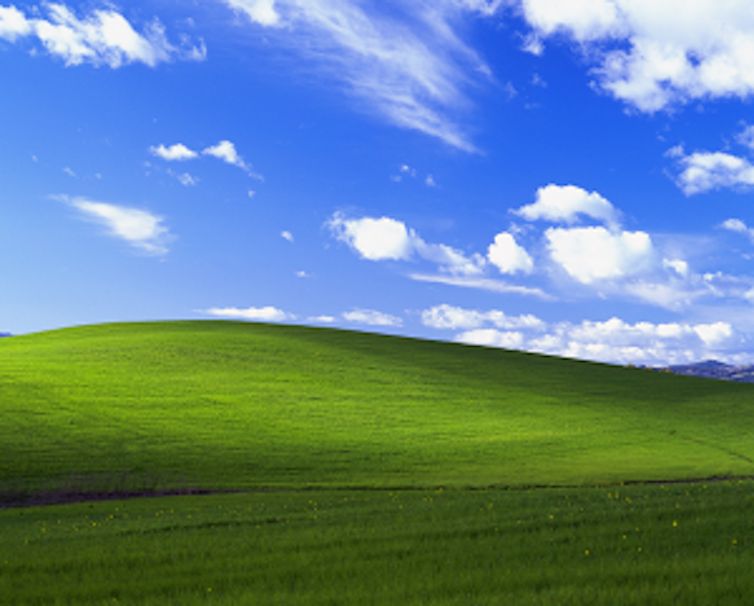
A colorful stock photo of green rolling hills, a blue sky and clouds.
If you used a PC at the turn of the 21st century, you probably encountered ‘Bliss.’
Wikimedia Commons

Mountain riddles

“Bliss” became widely understood as the most generic of generic stock photos, in the same way the placeholder icon became universally understood to mean “missing image.” And I don’t think it’s a coincidence that they both feature mountains or hills and a sky.

Mountains and skies are mysterious and full of possibilities, even if they remain beyond grasp.

Consider Japanese artist Hokusai’s “36 Views of Mount Fuji,” which were his series of paintings from the 1830s – the most famous of which is probably “The Great Wave off Kanagawa,” where a tiny Mount Fuji can be seen in the background. Each painting features the iconic mountain from different perspectives and is full of little details; all possess an ambiance of mystery.

A painting of a large rowboat manned by people on rolling waves with a large mountain in the background.
‘Tago Bay near Ejiri on the Tokaido,’ from Hokusai’s series ‘36 Views of Mount Fuji.’
Heritage Art/Heritage Images via Getty Images

I wouldn’t be surprised if the landscape icon on those Japanese camera dials emerged as a minimalist reference to Mount Fuji, Japan’s highest mountain. From some perspectives, Mount Fuji rises behind a smaller incline. And the Japanese photography company Fujifilm even borrowed the namesake of that mountain for their brand.

The enticing aesthetics of mountains also reminded me of the environmental writer Gary Snyder’s 1965 translation of Han Shan’s “Cold Mountain Poems.” Han Shan – his name literally means “Cold Mountain” – was a Chinese Buddhist poet who lived in the late eighth century. “Shan” translates as “mountain” and is represented by the Chinese character 山, which also resembles a mountain.

Han Shan’s poems, which are little riddles themselves, revel in the bewildering aspects of mountains:

Advertisement
Get More From A Face Cleanser And Spa-like Massage

Cold Mountain is a house
Without beams or walls.
The six doors left and right are open
The hall is a blue sky.
The rooms are all vacant and vague.
The east wall beats on the west wall
At the center nothing.

The mystery is the point

I think mountains serve as a universal representation of something unseen and longed for – whether it’s in a poem or on a sluggish internet browser – because people can see a mountain and wonder what might be there.

The placeholder icon does what mountains have done for millennia, serving as what the environmental philosopher Margret Grebowicz describes as an object of desire. To Grebowicz, mountains exist as places to behold, explore and sometimes conquer.

The placeholder icon’s inherent ambiguity is baked into its form: Mountains are often regarded as distant, foreboding places. At the same time, the little peaks appear in all sorts of mundane computing circumstances. The icon could even be a curious sign of how humans can’t help but be “nature-positive,” even when on computers or phones.

This small icon holds so much, and yet it can also paradoxically mean that there is nothing to see at all.

Viewing it this way, an example of semiotic convergence becomes a tiny allegory for digital life writ large: a wilderness of possibilities, with so much just out of reach.

Christopher Schaberg, Director of Public Scholarship, Washington University in St. Louis

This article is republished from The Conversation under a Creative Commons license. Read the original article.

Dive into “The Knowledge,” where curiosity meets clarity. This playlist, in collaboration with STMDailyNews.com, is designed for viewers who value historical accuracy and insightful learning. Our short videos, ranging from 30 seconds to a minute and a half, make complex subjects easy to grasp in no time. Covering everything from historical events to contemporary processes and entertainment, “The Knowledge” bridges the past with the present. In a world where information is abundant yet often misused, our series aims to guide you through the noise, preserving vital knowledge and truths that shape our lives today. Perfect for curious minds eager to discover the ‘why’ and ‘how’ of everything around us. Subscribe and join in as we explore the facts that matter.  https://stmdailynews.com/the-knowledge/

View recent photos

Unlock fun facts & lost history—get The Knowledge in your inbox!

We don’t spam! Read our privacy policy for more info.

Advertisement
Get More From A Face Cleanser And Spa-like Massage
Continue Reading
Advertisement SodaStream USA, inc

Nature

What in the Heck Is a Sweat Bee? Turns Out, My Wife Wasn’t Making It Up

My wife Rebecca said she thought a sweat bee stung her. I thought she was making it up. Turns out, sweat bees are very real—and their strange name actually makes perfect sense.

Published

on

Firefly Gemini Flash A humorous yet photorealistic editorial image of a tiny metallic green sweat bee perc 453196 1
Sweat Bee on my wife’s arm. Image Credit: Adobe Firefly

It started with a conversation with my wife, Rebecca.

She mentioned that she thought she’d been stung by something called a sweat bee.”

My immediate reaction was basically:

“What in the heck is a sweat bee?”

I’ll admit it. For a moment, I thought she was making the whole thing up. 😂

A sweat bee? Really?

It sounded like one of those names somebody invents when they don’t know what actually stung them.

“It wasn’t a regular bee. It was a… uh… sweat bee!”

So naturally, I asked ChatGPT the same question: What in the heck is a sweat bee?

Well, Rebecca gets this round.

Sweat bees are absolutely real.

Advertisement
Get More From A Face Cleanser And Spa-like Massage

And Yes, They’re Interested in Your Sweat

Sweat bees belong primarily to the Halictidae family, a large group of generally small bees found around the world.

Some are rather ordinary-looking little insects, while others are surprisingly flashy, sporting metallic shades of green, blue, bronze or gold.

But here’s where they earned that wonderfully unfortunate name.

Some sweat bees are attracted to human perspiration.

They’re not after you because they’re angry, and they’re certainly not tiny vampire bees. They’re interested in the salt and minerals in your sweat.

In other words, after you’ve been outside working, gardening, exercising or simply trying to survive a hot summer afternoon, a sweat bee may look at you and think:

“Hey! Free electrolytes!”

Wait…They Can Sting Too?

Unfortunately for Rebecca, there’s another part of her story that checks out.

Female sweat bees can sting.

They’re generally not aggressive and aren’t flying around looking for people to attack. But if one gets trapped against your skin, squeezed or swatted, it may defend itself.

Advertisement
Get More From A Face Cleanser And Spa-like Massage

Their sting is generally considered relatively mild compared with those of many other bees and wasps—but “relatively mild” probably isn’t much consolation when you’re the person who just got stung.

So, Rebecca, I officially withdraw my skepticism.

Mostly.

Don’t Declare War on Them

As annoying as having a tiny bee land on your sweaty arm might be, sweat bees are actually beneficial insects.

They’re important pollinators, visiting wildflowers, garden plants and agricultural crops and carrying pollen from flower to flower.

So if one lands on you, gently brushing or blowing it away is probably a better idea than swatting it against your skin.

And that’s today’s unexpected nature lesson.

Sweat bees are real.

They really are attracted to sweat.

The females really can sting.

Advertisement
Get More From A Face Cleanser And Spa-like Massage

And, perhaps most importantly…

My wife was right.

There. I said it.

I’m sure I’ll never hear the end of this one. 😂

Related Links

📰 Enjoying STM Daily News? Join the conversation!

💬 Leave a comment, share your thoughts, and subscribe to our newsletter for the latest stories, updates, and “News You Can Use This Moment!” delivered to your inbox.

Stay connected with STM Daily News!

Continue Reading

Forgotten Genius Fridays

Forgotten Genius Friday: Marian Croak — The Inventor Behind the Way We Communicate

Marian Croak helped pioneer the technology behind internet calling and text-to-donate fundraising. With more than 200 U.S. patents, her innovations have transformed how millions of people communicate, work, and give.

Published

on

Last Updated on August 7, 2026 by Daily News Staff

Marian Croak, telecommunications pioneer who helped advance Voice over Internet Protocol technology
Marian Croak helped pioneer technologies that transformed voice communication over the internet. Image Credit: Envato

Every day, billions of people make video calls, join virtual meetings, send text-message donations during disasters, and stay connected with loved ones over the internet.

Few realize that one of the pioneers behind these technologies is Marian Croak, an engineer, inventor, and technology leader whose work has fundamentally changed how the world communicates.

Despite holding more than 200 U.S. patents and helping shape modern internet communications, Croak remains largely unknown outside the technology community. That’s exactly why she deserves a place in our Forgotten Genius Fridayseries.

From Engineering to Innovation

Marian Rogers Croak earned a bachelor’s degree from Princeton University before completing a Ph.D. in Social Psychology and Quantitative Analysis at the University of Southern California.

Her unique combination of engineering expertise and an understanding of human behavior would become one of her greatest strengths. Rather than simply building technology, she focused on solving real-world communication problems.

She joined Bell Labs, later becoming part of AT&T, where she spent decades developing new telecommunications technologies.

Helping Create the Internet Calling Revolution

For much of the twentieth century, telephone calls relied on dedicated telephone lines.

Croak helped pioneer technologies that made Voice over Internet Protocol (VoIP) practical, allowing voice conversations to travel over internet networks instead.

Today, VoIP powers countless services, including:

Advertisement
Get More From A Face Cleanser And Spa-like Massage
  • Zoom
  • Microsoft Teams
  • WhatsApp calling
  • FaceTime
  • Internet-based business phone systems
  • Telemedicine appointments

Millions of remote workers, students, families, and businesses depend on technologies that evolved from these innovations.

A Better Way to Help During Disasters

One of Croak’s most visible inventions came from a simple but powerful idea.

What if people could donate to disaster relief simply by sending a text message?

She led the development of systems that made text-to-donate campaigns possible.

Following disasters such as Hurricane Katrina and the devastating 2010 Haiti earthquake, millions of people contributed to relief efforts simply by sending a short text message. The technology helped raise tens of millions of dollars quickly, demonstrating how communication technology could save lives beyond making phone calls.

More Than 200 Patents

Croak has been awarded more than 200 U.S. patents covering internet communications, networking, emergency response systems, and digital collaboration.

Her inventions have influenced everything from enterprise communications to cloud networking and mobile technologies.

Leading Responsible Artificial Intelligence

In 2014, Croak joined Google as a Vice President of Engineering.

Today, she helps lead initiatives focused on Responsible AI and Human-Centered Technology, working to ensure artificial intelligence benefits society while addressing issues of fairness, accessibility, and trust.

Her career reflects an important lesson: innovation is not just about building powerful technology—it is also about building technology responsibly.

Honors and Recognition

Although Marian Croak spent decades working behind the scenes, her achievements have earned growing recognition.

Advertisement
Get More From A Face Cleanser And Spa-like Massage

Among her honors are:

  • National Inventors Hall of Fame inductee
  • National Academy of Engineering member
  • American Academy of Arts and Sciences fellow
  • IEEE Founders Medal recipient

These awards recognize a lifetime devoted to improving how people connect with one another.

Why Marian Croak Matters

Many inventors create products.

Marian Croak created possibilities.

Every internet phone call between grandparents and grandchildren, every virtual doctor’s appointment, every online business meeting, and every text-message donation during a humanitarian crisis reflects technologies she helped make possible.

Her story reminds us that some of history’s greatest innovators work quietly behind the scenes, changing the world without becoming household names.

That’s exactly the kind of legacy Forgotten Genius Friday exists to celebrate.

Related Links

🧠 Discover the remarkable innovators, inventors, and trailblazers who helped shape our world but rarely receive the recognition they deserve. Share your thoughts in the comments and subscribe to the STM Daily News newsletter to catch every new Forgotten Genius Friday feature and more inspiring stories delivered to your inbox.

Continue Reading

The Knowledge

Exploring the Best Neighborhoods in Downtown Los Angeles

From the Arts District and Little Tokyo to the Historic Core and Bunker Hill, discover the best neighborhoods in Downtown Los Angeles and what makes each one worth exploring.

Published

on

Last Updated on August 5, 2026 by Daily News Staff

Best Neighborhoods in Downtown Los Angeles

The Best Neighborhoods in Downtown Los Angeles 

Downtown Los Angeles has undergone one of the most remarkable transformations of any urban center in the United States. Once known primarily as the city’s business district, DTLA has evolved into a vibrant collection of neighborhoods, each offering its own unique character, history, dining, entertainment, and cultural experiences.

Whether you’re a first-time visitor, a longtime Angeleno, or planning your next weekend adventure, these are some of Downtown LA’s must-visit neighborhoods.

Arts District: Where Creativity Comes to Life

The Arts District has become one of the city’s most exciting destinations. Former warehouses have been transformed into lofts, art galleries, coffee shops, breweries, and award-winning restaurants.

Visitors can spend hours exploring colorful murals, browsing independent boutiques, and discovering public art around nearly every corner. It’s a neighborhood that celebrates creativity while preserving its industrial roots.

Perfect for: Art lovers, photographers, foodies, and nightlife.

Historic Core: A Walk Through Old Los Angeles

The Historic Core showcases Downtown LA’s architectural heritage. Along Broadway and surrounding streets, beautifully restored theaters, historic hotels, and early 20th-century buildings tell the story of a booming city during Hollywood’s Golden Age.

Highlights include the iconic Bradbury Building, Grand Central Market, and numerous rooftop restaurants overlooking the skyline.

Perfect for: History buffs and architecture enthusiasts.

South Park: Entertainment Central

South Park is home to some of Los Angeles’ biggest attractions, including LA Live and Crypto.com Arena. The neighborhood has added thousands of apartments, new restaurants, hotels, and entertainment venues over the past two decades.

Advertisement
Get More From A Face Cleanser And Spa-like Massage

Whether you’re attending a Lakers game, a concert, or simply enjoying dinner before an event, South Park offers something for everyone.

Perfect for: Sports fans, concerts, and nightlife.

The Best Neighborhoods in Downtown Los Angeles

Little Tokyo: A Cultural Treasure

One of only a handful of historic Japantowns remaining in the United States, Little Tokyo offers authentic Japanese cuisine, specialty shops, cultural events, museums, and peaceful gardens.

From fresh sushi and ramen to Japanese bakeries and tea houses, visitors can experience generations of cultural heritage in just a few city blocks.

Perfect for: Families, food lovers, and cultural exploration.

Bunker Hill: Downtown’s Cultural Heart

Bunker Hill combines modern architecture with world-class arts and culture. Home to Walt Disney Concert Hall, The Broad, the Museum of Contemporary Art, and Grand Park, this neighborhood is ideal for visitors looking to experience Downtown’s artistic side.

Its dramatic skyline and public spaces also make it one of the most photographed areas in Los Angeles.

Perfect for: Museum lovers and architecture fans.

Financial District: The Skyline of Los Angeles

Glass skyscrapers, luxury hotels, and bustling sidewalks define the Financial District. While it remains the city’s business center during the workweek, the neighborhood also offers excellent dining, rooftop lounges, and convenient access to other parts of Downtown.

Chinatown: Tradition Meets Modern LA

Los Angeles’ Chinatown blends rich history with a growing collection of contemporary restaurants, galleries, and community events. Visitors can enjoy traditional cuisine alongside modern culinary experiences while exploring one of the city’s oldest cultural neighborhoods.

Advertisement
Get More From A Face Cleanser And Spa-like Massage

Fashion District: A Shopper’s Paradise

Covering more than 100 city blocks, the Fashion District is one of the largest garment centers in the country. Whether you’re searching for fabrics, clothing, accessories, or bargains at Santee Alley, this neighborhood attracts shoppers from across Southern California.

A Downtown That Continues to Evolve

Downtown Los Angeles isn’t just one destination—it’s a collection of neighborhoods that reflect the city’s diversity, creativity, and resilience. From historic landmarks and world-class museums to vibrant street art and internationally inspired cuisine, DTLA offers something new around nearly every corner.

Whether you’re planning a day trip or an extended visit, exploring these neighborhoods is one of the best ways to experience the energy and history of Los Angeles.

Related External Links

📰 Enjoying STM Daily News? Join the conversation!

💬 Leave a comment, share your thoughts, and subscribe to our newsletter for the latest stories, updates, and “News You Can Use This Moment!” delivered to your inbox.

Stay connected with STM Daily News!

Continue Reading

Trending


