

The Knowledge
How a 22-year-old George Washington learned how to lead, from a series of mistakes in the Pennsylvania wilderness
This Presidents Day, I’ve been thinking about George Washington − not at his finest hour, but possibly at his worst.

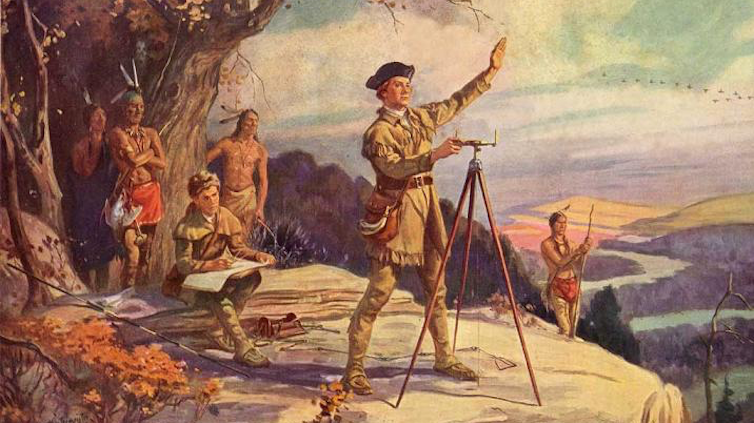
Christopher Magra, University of Tennessee
This Presidents Day, I’ve been thinking about George Washington − not at his finest hour, but possibly at his worst.
In 1754, a 22-year-old Washington marched into the wilderness surrounding Pittsburgh with more ambition than sense. He volunteered to travel to the Ohio Valley on a mission to deliver a letter from Robert Dinwiddie, governor of Virginia, to the commander of French troops in the Ohio territory. This military mission sparked an international war, cost him his first command and taught him lessons that would shape the American Revolution.
As a professor of early American history who has written two books on the American Revolution, I’ve learned that Washington’s time spent in the Fort Duquesne area taught him valuable lessons about frontier warfare, international diplomacy and personal resilience.
The mission to expel the French
In 1753, Dinwiddie decided to expel French fur trappers and military forces from the strategic confluence of three mighty waterways that crisscrossed the interior of the continent: the Allegheny, Monongahela and Ohio rivers. This confluence is where downtown Pittsburgh now stands, but at the time it was wilderness.
King George II authorized Dinwiddie to use force, if necessary, to secure lands that Virginia was claiming as its own.
As a major in the Virginia provincial militia, Washington wanted the assignment to deliver Dinwiddie’s demand that the French retreat. He believe the assignment would secure him a British army commission.
Washington received his marching orders on Oct. 31, 1753. He traveled to Fort Le Boeuf in northwestern Pennsylvania and returned a month later with a polite but firm “no” from the French.
Dinwiddie promoted Washington from major to lieutenant colonel and ordered him to return to the Ohio River Valley in April 1754 with 160 men. Washington quickly learned that French forces of about 500 men had already constructed the formidable Fort Duquesne at the forks of the Ohio. It was at this point that he faced his first major test as a military leader. Instead of falling back to gather more substantial reinforcements, he pushed forward. This decision reflected an aggressive, perhaps naive, brand of leadership characterized by a desire for action over caution.
Washington’s initial confidence was high. He famously wrote to his brother that there was “something charming” in the sound of whistling bullets.
The Jumonville affair and an international crisis
Perhaps the most controversial moment of Washington’s early leadership occurred on May 28, 1754, about 40 miles south of Fort Duquesne. Guided by the Seneca leader Tanacharison – known as the “Half King” – and 12 Seneca warriors, Washington and his detachment of 40 militiamen ambushed a party of 35 French Canadian militiamen led by Ensign Joseph Coulon de Jumonville. The Jumonville affair lasted only 15 minutes, but its repercussions were global.
Ten of the French, including Jumonville, were killed. Washington’s inability to control his Native American allies – the Seneca warriors executed Jumonville – exposed a critical gap in his early leadership. He lacked the ability to manage the volatile intercultural alliances necessary for frontier warfare.
Washington also allowed one enemy soldier to escape to warn Fort Duquesne. This skirmish effectively ignited the French and Indian War, and Washington found himself at the center of a burgeoning international crisis.
Defeat at Fort Necessity
Washington then made the fateful decision to dig in and call for reinforcements instead of retreating in the face of inevitable French retaliation. Reinforcements arrived: 200 Virginia militiamen and 100 British regulars. They brought news from Dinwiddie: congratulations on Washington’s victory and his promotion to colonel.
His inexperience showed in his design of Fort Necessity. He positioned the small, circular palisade in a meadow depression, where surrounding wooded high ground allowed enemy marksmen to fire down with impunity. Worse still, Tanacharison, disillusioned with Washington’s leadership and the British failure to follow through with promised support, had already departed with his warriors weeks earlier. When the French and their Native American allies finally attacked on July 3, heavy rains flooded the shallow trenches, soaking gunpowder and leaving Washington’s men vulnerable inside their poorly designed fortification.
The battle of Fort Necessity was a grueling, daylong engagement in the mud and rain. Approximately 700 French and Native American allies surrounded the combined force of 460 Virginian militiamen and British regulars. Despite being outnumbered and outmaneuvered, Washington maintained order among his demoralized troops. When French commander Louis Coulon de Villiers – Jumonville’s brother – offered a truce, Washington faced the most humbling moment of his young life: the necessity of surrender. His decision to capitulate was a pragmatic act of leadership that prioritized the survival of his men over personal honor.
The surrender also included a stinging lesson in the nuances of diplomacy. Because Washington could not read French, he signed a document that used the word “l’assassinat,” which translates to “assassination,” to describe Jumonville’s death. This inadvertent admission that he had ordered the assassination of a French diplomat became propaganda for the French, teaching Washington the vital importance of optics in international relations.
Lessons that forged a leader
The 1754 campaign ended in a full retreat to Virginia, and Washington resigned his commission shortly thereafter. Yet, this period was essential in transforming Washington from a man seeking personal glory into one who understood the weight of responsibility.
He learned that leadership required more than courage – it demanded understanding of terrain, cultural awareness of allies and enemies, and political acumen. The strategic importance of the Ohio River Valley, a gateway to the continental interior and vast fur-trading networks, made these lessons all the more significant.
Ultimately, the hard lessons Washington learned at the threshold of Fort Duquesne in 1754 provided the foundational experience for his later role as commander in chief of the Continental Army. The decisions he made in Pennsylvania and the Ohio wilderness, including the impulsive attack, the poor choice of defensive ground and the diplomatic oversight, were the very errors he would spend the rest of his military career correcting.
Though he did not capture Fort Duquesne in 1754, the young George Washington left the woods of Pennsylvania with a far more valuable prize: the tempered, resilient spirit of a leader who had learned from his mistakes.
Christopher Magra, Professor of American History, University of Tennessee
This article is republished from The Conversation under a Creative Commons license. Read the original article.
Dive into “The Knowledge,” where curiosity meets clarity. This playlist, in collaboration with STMDailyNews.com, is designed for viewers who value historical accuracy and insightful learning. Our short videos, ranging from 30 seconds to a minute and a half, make complex subjects easy to grasp in no time. Covering everything from historical events to contemporary processes and entertainment, “The Knowledge” bridges the past with the present. In a world where information is abundant yet often misused, our series aims to guide you through the noise, preserving vital knowledge and truths that shape our lives today. Perfect for curious minds eager to discover the ‘why’ and ‘how’ of everything around us. Subscribe and join in as we explore the facts that matter. https://stmdailynews.com/the-knowledge/


The phrase “There’s only one race: human” is simple, hopeful and deeply appealing. It reminds us that beneath differences in skin color, ancestry, nationality and culture, we are members of the same human family.
We share the same basic needs. We want safety, dignity, opportunity, love and a better future for the people we care about. No racial category makes one person more human—or more deserving of respect—than another.
At its best, the phrase rejects the false idea that humanity is divided into separate biological races with different levels of intelligence, character or worth. Those beliefs have been used throughout history to justify slavery, segregation, colonialism and discrimination. Saying that there is only one human race can therefore be a powerful declaration of equality.
But the meaning of the phrase depends on how we use it.
Shared Humanity Does Not Mean Identical Experiences
Although race does not separate people into distinct biological types, racial categories still carry enormous social power. They have shaped laws, neighborhoods, schools, employment, policing, health care and access to wealth. Their consequences do not disappear simply because we say that everyone is human.
That is why “There’s only one race: human” should never become another way of saying, “I don’t see color,” when someone is describing racism or inequality.
Ignoring race does not automatically end racism. In some situations, it can prevent us from recognizing it.
If one group repeatedly encounters barriers that others do not, acknowledging those differences is not an attempt to divide people. It is part of understanding the problem honestly. We cannot repair an injustice that we refuse to see.
Our Differences Are Not the Problem
Human unity does not require sameness. Our cultural identities, traditions, histories and communities are not obstacles that must be erased before we can respect one another.
There is nothing contradictory about celebrating Black history, Latino heritage, Indigenous traditions, Asian American experiences or the many cultures that contribute to our society while also believing in our common humanity.
The problem is not that people have differences. The problem begins when those differences are assigned a hierarchy—when one identity is treated as the standard and another as inferior, threatening or less deserving.
Real unity allows people to bring their complete identities into the room. It does not demand that they leave their histories at the door.
A Statement That Should Lead to Action
If we truly believe there is only one human race, that belief should influence how we treat people. It should lead us to oppose discrimination even when we are not its target. It should make us question stereotypes, listen to experiences different from our own and defend the dignity of people whose backgrounds we may not fully understand.
Shared humanity is more than a comforting slogan. It is a responsibility.
It asks us to recognize that another person’s pain matters, even when it is unfamiliar to us. It reminds us that no community is disposable and that injustice against one group ultimately damages the society we all share.
One Human Family, Many Human Stories
To me, “There’s only one race: human” is most meaningful when it brings two truths together: we are fundamentally equal, and we do not all experience the world in the same way.
We can affirm that there is one human family without pretending racism has disappeared. We can value what connects us without erasing what makes our communities distinct. We can pursue unity while still confronting the inequalities that stand in its way.
Perhaps the fullest version of the message is this:
We are one human family. Our differences deserve respect, our histories deserve acknowledgment, and every person deserves equal dignity.
That is not merely an ideal. It is a standard by which we can judge our choices, our institutions and the kind of world we are building together.
What does the phrase “There’s only one race: human” mean to you? Share your perspective in the comments.
Sources and Related Links
- Universal Declaration of Human Rights — United Nations
Establishes that all people are born free and equal in dignity and rights. - What Are Human Rights? — United Nations Human Rights Office
Explains universal human rights and freedom from discrimination. - Using Population Descriptors in Genetics and Genomics Research — National Academies
Examines why race should not be treated as a substitute for human genetic variation. - AAPA Statement on the Biological Aspects of Race — American Association of Biological Anthropologists
Discusses the scientific evidence concerning race, human biological variation and institutional discrimination. - Race and Ethnicity — American Anthropological Association
An educational examination of race as a social classification and ethnicity as a cultural identity. - Talking About Race — Smithsonian National Museum of African American History and Culture
Resources for understanding racism, racial identity and their effects on society. - Race: Are We So Different? — Smithsonian Institution
Explores race and racism through biological, cultural and historical perspectives.
Stay Informed. Stay Curious.
Get the latest news, thoughtful commentary, inspiring stories and useful information delivered directly to your inbox. Subscribe to the STM Daily News newsletter and never miss the stories that inform, educate and connect our communities.

Forgotten Genius Fridays
Two Black Pioneers Who Helped Change Heart Surgery Forever
Two Black Pioneers Who Helped Change Heart Surgery. Decades apart, Daniel Hale Williams and Vivien Thomas challenged the limits of medicine and helped pave the way toward modern cardiac surgery.

Forgotten Genius Friday: Daniel Hale Williams and Vivien Thomas helped push cardiac surgery from the nearly unthinkable toward modern medicine.

Today, open-heart surgery is performed routinely in hospitals around the world. Surgeons can repair defective valves, bypass blocked arteries and correct complex congenital heart defects using technology that would have seemed almost unimaginable little more than a century ago.
Black Pioneers Who Helped Change Heart Surgery
But the road to modern heart surgery includes two remarkable Black medical pioneers whose contributions came more than 50 years apart: Dr. Daniel Hale Williams and Vivien Thomas.
One demonstrated that surgeons could successfully intervene in injuries involving the heart at a time when such operations were considered extraordinarily dangerous.
The other helped develop an operation that opened a new era of cardiac surgery.
Their stories belong together.
Daniel Hale Williams and the 1893 Operation
In 1893, surgery was dramatically different from what patients experience today.
There were no antibiotics. Blood typing had yet to become standard medical knowledge. Modern blood transfusions, intensive-care units and heart-lung machines did not exist.
Against that backdrop, Dr. Daniel Hale Williams performed an extraordinary operation at Provident Hospital in Chicago.
Williams, born in 1856, was already breaking barriers in American medicine. He founded Provident Hospital and Training School in 1891, creating an institution where Black doctors and nurses could receive training and Black patients could obtain medical treatment at a time when segregation severely restricted their access to many hospitals.
Then came a patient named James Cornish.
Cornish had suffered a serious stab wound to the chest. Williams opened his chest and operated on the structures surrounding the heart, including repairing the pericardium—the protective sac surrounding the heart.
Cornish survived.
The operation became one of the most celebrated moments in the history of American surgery.
Was It Really the First Open-Heart Surgery?
Here is where the history requires some clarification.
Williams is frequently credited with performing the world’s first successful open-heart operation. The U.S. National Library of Medicine, for example, describes his 1893 procedure as the world’s first open-heart surgery.
However, terminology has changed.
Under today’s medical definition, “open-heart surgery” usually refers to an operation performed directly on or inside the heart, frequently with the assistance of cardiopulmonary bypass.
Williams’s operation did not involve opening the chambers of the heart.
For that reason, describing his achievement as one of the earliest successful cardiac operations provides a more precise historical description.
That clarification doesn’t diminish Williams’s accomplishment.
Operating successfully in the chest near the heart in 1893—without antibiotics, modern imaging, sophisticated anesthesia, blood banking or intensive postoperative care—was an extraordinary achievement.
And Williams helped demonstrate something enormously important:
The heart was not necessarily beyond the reach of surgery.
Fifty Years Later: Another Breakthrough
Fast-forward approximately half a century.
Another Black medical pioneer would play a critical role in pushing heart surgery forward.
His name was Vivien Thomas.
Thomas dreamed of becoming a doctor, but the economic devastation of the Great Depression wiped out the money he had saved for medical school.
In 1930, he began working as a laboratory assistant for surgeon Alfred Blalock at Vanderbilt University.
Thomas quickly proved extraordinarily talented at experimental surgery.
When Blalock moved to Johns Hopkins in Baltimore in 1941, Thomas went with him.
There, Thomas would become part of one of the most important developments in the history of cardiac surgery.
The “Blue Baby” Problem
Some children are born with a combination of heart abnormalities called Tetralogy of Fallot.
Because insufficient oxygen reaches their bloodstream, severely affected children can develop a bluish coloration—leading to the historical term “blue baby syndrome.”
At the time, there was little doctors could do for many of these children.
Pediatric cardiologist Dr. Helen Taussig believed a surgical procedure might increase blood flow to the lungs and improve oxygenation.
The challenge was figuring out how to do it.
That’s where Blalock and Thomas entered the story.
Vivien Thomas Builds the Operation
Thomas performed extensive laboratory work developing and perfecting a surgical method that could redirect blood toward the lungs.
Johns Hopkins says Thomas developed and tested the procedure in animals before its first use on a human patient.
His surgical skill became so important that when the first operation was performed, Thomas was present in the operating room guiding Blalock.
On November 29, 1944, the surgical team operated on an 18-month-old child suffering from Tetralogy of Fallot.
The operation successfully increased blood flow to the lungs. Johns Hopkins credits the procedure with eventually saving thousands of children’s lives and helping launch the modern era of cardiac surgery.
It became known for decades as the Blalock-Taussig shunt.
One name was conspicuously missing.
Thomas.
Recognition Comes Decades Later
Despite Thomas’s enormous contribution, racial discrimination shaped both his career and the recognition he received.
Thomas did not have a medical degree and initially worked under classifications and compensation that failed to reflect the sophisticated surgical research he was actually performing.
His role in developing the operation also wasn’t properly credited in the original published account of the procedure. Johns Hopkins itself now describes Thomas as an essential pioneer and notes that he was not given credit when details of the surgery were published in 1945.
Recognition eventually came.
In 1976, Johns Hopkins awarded Thomas an honorary Doctor of Laws degree, and his portrait was placed at the institution.
Even more significantly, Johns Hopkins today incorporates his name into the Blalock-Taussig-Thomas Pediatric and Congenital Heart Center.
History finally added the name that had been missing.
Two Men, Two Eras, One Medical Revolution
Daniel Hale Williams and Vivien Thomas never worked together.
Their breakthroughs happened more than five decades apart.
Their careers were very different.
Williams was a physician, surgeon, hospital founder and medical educator.
Thomas never received the opportunity to become the physician he originally hoped to be, yet became a master surgical technician, researcher and teacher whose skills influenced generations of surgeons.
But their stories intersect in the history of cardiac surgery.
1893 — Daniel Hale Williams demonstrated that extraordinary surgical intervention around the heart could succeed.
1944 — Vivien Thomas helped develop a procedure that demonstrated surgeons could deliberately alter cardiovascular circulation to save children born with serious heart defects.
The 1944 breakthrough was so important that Johns Hopkins describes it as opening the door to today’s heart surgery.
Neither achievement was modern open-heart surgery as we understand it today. The development of cardiopulmonary bypass and the heart-lung machine during the following decade would make operations inside a temporarily stopped heart practical.
But Williams and Thomas helped establish something equally important:
the possibility that surgeons could successfully intervene when the human heart itself was at risk.
Their contributions helped transform cardiac surgery from a medical frontier into one of modern medicine’s most remarkable achievements.
Forgotten Genius Friday
Forgotten Genius Friday celebrates innovators, inventors, scientists and pioneers whose contributions helped shape our modern world but whose names aren’t always as familiar as their accomplishments.
Did you know about Daniel Hale Williams or Vivien Thomas? Join the conversation in the comments, share this story and subscribe to the STM Daily News newsletter for more stories about the people who helped change history.
Source
National Library of Medicine — Daniel Hale Williams, M.D.
Background on Williams, Provident Hospital, and his landmark 1893 cardiac operation.
Daniel Hale Williams — National Library of Medicine
Johns Hopkins Medicine — History of Innovation in Cardiac Surgery
Documents Vivien Thomas’s role in developing the Blue Baby procedure and the historic November 29, 1944 operation. Johns Hopkins describes it as the beginning of a new era in cardiac surgery.
Johns Hopkins Cardiac Surgery Research Lab History
Related External Links
Johns Hopkins — Innovations in Heart Medicine
Explains how Thomas, Alfred Blalock, Helen Taussig and their colleagues developed the Blue Baby operation and how it helped open the door to modern cardiac surgery.
Innovations in Heart Medicine
Johns Hopkins — Vivien Thomas Biography
Especially useful for the Forgotten Genius angle. Johns Hopkins states that Thomas developed and tested the procedure in animals and stood behind Blalock guiding him during the first human operation; Thomas was not credited in the original published report.
Vivien Thomas — Johns Hopkins Medicine
Johns Hopkins — Celebrating a Transformative Medical Milestone
A detailed account of the first Blue Baby operation on 18-month-old Eileen Saxon in 1944 and Thomas’s role in the operating room.
75th Anniversary of the Blue Baby Operation
PubMed — Daniel Hale Williams in Proper Perspective
A useful scholarly source confirming that Williams successfully sutured a pericardial laceration caused by a stab wound in 1893 and that the patient recovered.
Daniel Hale Williams — PubMed
NIH/PMC — Cardiac Surgery: A Century of Progress
Provides broader historical context and notes that Williams’s 1893 operation was among the earliest successful repairs of pericardial wounds, following Henry C. Dalton’s 1891 operation. This is particularly valuable for avoiding the oversimplified claim that Williams indisputably performed history’s first heart operation.
Cardiac Surgery: A Century of Progress
Local Business
Roscoe’s Chicken and Waffles: An L.A. Institution Confronts a Complicated Legacy
Roscoe’s Chicken and Waffles grew from a Harlem-inspired restaurant into a symbol of Black Los Angeles. Fifty years later, lawsuits, bankruptcy, closures and questions about its leadership have complicated the celebrated chain’s legacy.
Last Updated on September 1, 2026 by Daily News Staff
For generations of Southern Californians, Roscoe’s was more than a famous combination of fried chicken and waffles. After 50 years, the restaurant’s cultural importance remains—but lawsuits, bankruptcy, closures and questions about its leadership have complicated the story.
What Happened to Roscoe’s Chicken and Waffles?
For many visitors to Los Angeles, Roscoe’s House of Chicken and Waffles is a destination—one of those famous places they have seen in movies, heard about in songs or watched celebrities visit.
For many of us who grew up in Los Angeles County, however, Roscoe’s occupies a different place in our memories. It was not necessarily our introduction to soul food, nor was chicken and waffles an exotic discovery. Roscoe’s was one among many soul-food restaurants where families ate in South Los Angeles, Inglewood, Compton, Watts and Long Beach.
I ate food from the South L.A. and Inglewood restaurants when I was young, although I was too young to compare the locations. When I returned to Roscoe’s as an adult and ate at the Long Beach location in 2021, I thought the food was good. That experience connected a familiar name from my Southern California childhood with the restaurant Roscoe’s had become decades later.
But the Roscoe’s story today is no longer only about food and nostalgia. It is also about how a Black cultural institution manages its legacy after lawsuits, bankruptcy proceedings, restaurant closures and a public controversy that caused some longtime customers to question who now controls the business—and whether its leadership still understands the community that helped make Roscoe’s famous.
From Harlem inspiration to a West Coast phenomenon
Herbert “Herb” Hudson, a Harlem native and former General Motors foreman, founded Roscoe’s in 1975. Accounts differ on whether the first restaurant was in Hollywood or Long Beach: Roscoe’s official history identifies the company as Hollywood-based, while culinary historian Adrian Miller and several contemporary reports place Hudson’s first location in Long Beach. What is undisputed is that Hudson brought a Harlem-influenced restaurant concept to Southern California and turned it into something distinctly Angeleno.
Hudson drew inspiration from the chicken-and-waffle restaurants and late-night music culture associated with Harlem, particularly Wells Supper Club. Chicken and waffles existed long before either Wells or Roscoe’s, with roots stretching through Pennsylvania Dutch cooking, Southern foodways and the work of Black cooks. Roscoe’s achievement was not inventing the pairing. It was making fried chicken and waffles a recognizable part of Los Angeles dining and eventually a national phenomenon.
In a 1978 advertisement in the Los Angeles Sentinel, Roscoe’s described the dish as “an East Coast specialty with a West Coast atmosphere.” It was an effective summary of Hudson’s idea.
His entertainment connections helped carry the restaurant beyond its neighborhood base. Stevie Wonder, Natalie Cole and comedian Redd Foxx were associated with its early rise, while athletes, actors, musicians and political figures followed. Roscoe’s became a place where local customers, tourists and celebrities could occupy the same dining room.
The restaurant also offered far more than its headline combination. Grits, eggs, greens, macaroni and cheese, red beans and rice, hot-water cornbread and chicken livers helped place Roscoe’s within the larger soul-food tradition. James Beard Award-winning author Adrian Miller’s history of Roscoe’s describes how Hudson used Black media, music connections and neighborhood locations to build the company.
Becoming part of Black Los Angeles
Roscoe’s did not become an institution merely because famous people ate there. Black Los Angeles made it an institution.
Families celebrated there. Musicians stopped in after performances. Local residents brought visiting relatives. Young people grew up knowing the name before national food television began treating chicken and waffles as a culinary discovery.
Roscoe’s also entered popular culture. It was referenced in movies including Jackie Brown, Rush Hour and Soul Plane, appeared in television productions and was mentioned in music. Its yellow-and-red signs became visual shorthand for a particular side of Los Angeles—one connected to Black culture, nightlife and neighborhood life rather than beaches and Hollywood premieres.
President Barack Obama’s 2011 visit to the Pico Boulevard restaurant represented a high point in that cultural journey. Obama ordered three wings and a waffle, and the meal became known as the “Obama’s Special.” A restaurant created by a Black entrepreneur and sustained heavily by Black customers had served the nation’s first Black president.
Roscoe’s fame, however, could sometimes obscure the larger community around it. Los Angeles has long supported many soul-food kitchens, family restaurants and neighborhood establishments. Roscoe’s became the name outsiders recognized, but it was never the whole story of soul food in Southern California.
The discrimination case and bankruptcy
The most consequential legal chapter began with former employee Daniel Beasley, a Black man who sued East Coast Foods, the company managing several Roscoe’s restaurants.
Beasley alleged that Latino managers gave Latino employees preferential schedules and working conditions while treating Black workers unfairly. He also alleged that he was terminated after complaining about discrimination. A jury found in his favor, and the resulting judgment was ultimately reported at approximately $3.2 million.
This was a particularly damaging case for Roscoe’s reputation. The allegations did not come from an outside critic attacking a Black-owned institution. They came from a Black employee accusing the company behind that institution of failing Black workers.
East Coast Foods filed for Chapter 11 bankruptcy protection in 2016. The discrimination judgment was a major factor, but it was not the company’s only financial obligation. Court proceedings described millions of dollars in additional debt.
The restructuring grew complicated. An examiner concluded that East Coast Foods could not meet its fiduciary responsibilities, and a court-appointed trustee effectively led the company for two years. A bankruptcy judge also ordered Hudson to reverse a transfer of the Roscoe’s name and trademark to an affiliated company he controlled, finding the transfer improper under bankruptcy law.
A restructuring plan took effect in September 2018. It promised creditors full payment with interest, secured by company assets and as much as $10 million from Hudson. The restaurants remained open. The U.S. Court of Appeals for the Ninth Circuit later summarized the proceedings and Hudson’s guarantee.
The bankruptcy is important when discussing claims that Roscoe’s “changed hands.” Court supervision, the temporary appointment of a trustee and the emergence of new executives clearly changed how parts of the company were controlled. However, available reporting does not establish a straightforward sale of the entire chain to a new owner.
That distinction matters. Social-media posts frequently describe Roscoe’s as no longer Black-owned, but the company has not publicly provided a clear, current breakdown of its ownership. The most accurate conclusion is that Roscoe’s corporate structure and leadership became more complicated and less transparent—not that a complete sale has been conclusively documented.
A second employee lawsuit
Roscoe’s faced another labor case in January 2024 when former employee Jaime Alejandro Carbajal-Torres filed a proposed class-action lawsuit in Los Angeles Superior Court.
Carbajal-Torres, who said he worked for the company for more than 20 years, alleged unpaid overtime, interrupted or missed meal and rest periods, unpaid vacation wages and unreimbursed work expenses. The complaint sought class-action status, unspecified damages and an injunction against further violations of California labor law.
These are allegations in a civil complaint, not proven findings, and Roscoe’s did not immediately respond to the original request for comment, according to L.A. Taco’s report.
Nevertheless, the filing revived uncomfortable questions about the treatment of the people whose labor sustains a celebrated restaurant brand. For a company whose identity is tied so strongly to community, repeated employee complaints cannot simply be dismissed as a public-relations inconvenience.
Closures, tragedy and public controversy
The last several years have brought additional challenges.
Roscoe’s closed its celebrated Pico Boulevard restaurant in January 2023 after approximately 32 years. The company directed customers to its newer La Brea flagship, which opened in 2021. In June 2024, the Pasadena restaurant closed after 30 years, although the company said it hoped to find an upgraded location in the city. The Los Angeles Times reported that some customers had begun questioning whether rising prices still matched the food’s quality.
The chain was also touched by tragedy in September 2022 when rapper PnB Rock was shot and killed during a robbery at the Manchester Avenue restaurant. That killing was not a business controversy created by Roscoe’s, but it attached another painful chapter to the restaurant’s recent history.
Then, in November 2024, a large inflatable figure of Donald Trump appeared near the Long Beach restaurant. Images spread online, leading some customers to believe Roscoe’s was endorsing Trump and prompting calls for a boycott.
Roscoe’s COO and creative director Diane Vara said the inflatable was connected to a political watch party at an adjacent jazz lounge, not the restaurant itself. According to Eater Los Angeles, the event was hosted by the Los Angeles County Republican Party and URBT News at the neighboring venue.
That explanation did not fully settle the controversy. Vara, who described herself publicly as a partner in Roscoe’s, had also exchanged contentious social-media comments with a food creator who criticized the restaurant and shared a homemade chicken-and-waffle recipe. The tone of the response intensified existing doubts about the company’s ownership, values and relationship with its traditional customers.
For many longtime patrons, the reaction was about more than partisan politics. Roscoe’s had spent decades benefiting from its status as a symbol of Black Los Angeles. Customers therefore expected its leadership to recognize how its actions—or events appearing to be associated with its property—would be understood by that community.
The state of Roscoe’s today
Roscoe’s reached its 50th anniversary in 2025. Its official website currently lists Hollywood, South L.A., Long Beach, Inglewood-LAX, Anaheim, La Brea and Pasadena, although the old Pasadena restaurant closed in 2024 and the company has discussed seeking a replacement site.
There are also signs of continued ambition. Roscoe’s has signed a lease for a space of more than 3,000 square feet at Los Angeles Union Station, according to 2026 reporting, though no firm public opening date had been announced. A Union Station restaurant would place Roscoe’s inside one of Southern California’s most important transportation landmarks as Los Angeles prepares for the 2028 Olympic and Paralympic Games.
This means Roscoe’s is not simply disappearing. It is contracting in some places, repositioning itself in others and attempting to carry a famous name into a new era.
But survival is not the same as renewal.
Roscoe’s still possesses something most restaurants could never purchase: a half-century of cultural memory. It helped popularize chicken and waffles across the country. It provided a gathering place for generations of Angelenos. It became one of the most recognizable Black-founded restaurant brands in America.
That history deserves recognition—but it should not shield the company from scrutiny.
To retain the loyalty of the community that built it, Roscoe’s needs greater clarity about its ownership and leadership, fair treatment of its workers, consistent food and service, and a more thoughtful relationship with longtime customers. Nostalgia can bring people back once. Trust is what keeps them returning.
Roscoe’s remains an L.A. institution. The question now is whether the company managing that institution understands the responsibility that comes with the name.
Editor’s note: This article distinguishes court findings from allegations. Claims in the 2024 labor complaint remain allegations unless proven in court or resolved through an acknowledged settlement. Publicly available reporting does not conclusively establish that the entire Roscoe’s chain was sold or ceased to be Black-owned.
Sources and related reading
- Roscoe’s House of Chicken and Waffles — official history
- The layered legacy of Roscoe’s — Adrian Miller, Resy
- In re East Coast Foods — Ninth Circuit opinion
- Roscoe’s sued by former employee over alleged labor violations — L.A. Taco
- Roscoe’s closes its Pasadena restaurant after three decades — Los Angeles Times
- The controversy surrounding the Trump inflatable near Roscoe’s — Eater Los Angeles





