

Lifestyle
Beyond the Piggy Bank: How to Build Your Child’s Financial Future
Your Child’s Financial Future: When money is tight, saving for the future can feel out of reach. Rent, groceries and bills come first, but building something for your kids doesn’t have to start with your paycheck. For millions of families, there’s already money waiting.


Beyond the Piggy Bank: How to Build Your Child’s Financial Future
(Feature Impact) When money is tight, saving for the future can feel out of reach. Rent, groceries and bills come first, but building something for your kids doesn’t have to start with your paycheck. For millions of families, there’s already money waiting.
Michael and Susan Dell put $250 into the 530A (Trump) Accounts of 25 million children across the United States. Children born between 2016-2024 who live in eligible ZIP codes received the money. Families didn’t have to apply, and they don’t have to pay anything back.
“Every American child now has their own investment account,” said Matt Lira, executive director at Invest America, a nonprofit that helps families understand investing. “It’s in your child’s name, it’s built to grow and it’s theirs from the very start. That’s a real stake in America’s future. Claiming it takes a few minutes, and your child begins life as an owner.”
U.S. children under 18 with valid Social Security numbers already have accounts in their names, and any money in it is invested so it can grow over time. You just need to claim it. Download the official app, available on iOS or Android, or go to the official website then sign in as a parent or guardian to access your child’s account. You can choose to add money if you want, but it’s not required. Claiming the account also lets friends, family, employers and others contribute.
“Parents and grandparents, please claim your child’s account,” said Susan Dell, co-founder of the Michael & Susan Dell Foundation. “These accounts are ready. They’re waiting for you, and they have money in them. Claim your child’s account and start adding money to their account and preparing a wonderful future for them.”
Money Lessons That Don’t Cost a Thing

Claiming the account is the first step. Helping your child understand it is the next. When kids know they own something that can grow, money lessons stop feeling abstract. These everyday habits can help them make the most of it:
- Let them see how you make choices. You probably already compare prices, stretch a grocery budget and decide what can wait. Talk through those choices out loud. When kids hear why you picked the store brand or skipped something this week, they can learn how to tell needs from wants.
- Give them a little to manage. Birthday money, a few dollars for chores or earnings from mowing lawns or babysitting are all chances to practice. Let kids decide how much to spend and how much to save then talk about how it went.
- Explain saving vs. investing. Saving is putting money aside for something you want soon, like a bike. Investing is letting money grow over many years. For example, 530A (Trump) Accounts are a real-life example of investing that kids can check a few times a month to see how money grows.
- Talk about what they dream of.Ask your kids what they want someday, like a car, college, a trade, their own business or a home. Knowing they have money saved or invested can help them dream bigger, because those goals start to feel possible instead of out of reach.
Small Amounts Still Count
If you’re ever able to add something to an investment account, even a few dollars now and then, it has years to grow. Relatives can help, too. A small amount on a birthday or holiday adds up over a childhood. However, if adding money isn’t possible right now, that’s OK.
“In America, small beginnings can become extraordinary things,” Michael Dell said. “When we invest in children’s futures, we invest in America’s future. We are so excited to see what they build.”
Claim your child’s account today through the official app or at TrumpAccounts.gov.
Common Questions About 530A (Trump) Accounts
What is a 530A (Trump) Account?
It’s a free investment account for U.S. children under 18 powered by the U.S. Treasury. It’s in your child’s name. The money in the account is invested in hundreds of America’s biggest companies at once, so it has the chance to grow over time without you having to pick anything. The account also has tax benefits. The money can grow for years without being taxed along the way, which helps it grow faster.
Does my child have one?
U.S. children under 18 with valid Social Security numbers were signed up automatically, and nearly 70 million children already have accounts. You just need to claim your child’s account to track its value over time and help it grow. You just need to claim your child’s account to track its value over time and help it grow.
How do I claim it?
Download the official app on your smartphone or visit the official website. You’ll confirm some information and claim the account. It only takes a few minutes, and it’s free.
Do I have to put money in?
No. Adding money is always possible, but claiming an account allows other people to contribute, even if you don’t.
Can other people add money?
Yes. Parents, grandparents, other family members, friends and even employers can add money. The total limit is $5,000 per child per year. Other government or charity programs may add money in the future, too.
How were children chosen for the $250 from Michael and Susan Dell?
Families did not apply, and children were not picked one by one. The foundation started with the lowest-income ZIP codes, based on U.S. Census data, and kept adding ZIP codes until it reached 25 million children. Learn more about eligibility at investamerica.org/dell.
My ZIP code wasn’t included. Does my child still have an account?
All U.S. children with a Social Security number have an account. The ZIP codes only decided who got the extra $250.
When can my child use the money?
At 18, your child can decide what to do with it. They can keep it growing for retirement or use it for things like school or buying a first home.
Photos courtesy of Shutterstock
SOURCE:
Michael and Susan Dell Foundation


small business
Navigating the American Dream: How Integrated Financial Tools, Credit and Rewards Can Help Small Businesses Succeed
Last Updated on November 9, 2026 by Daily News Staff
(Feature Impact) Owning a small business has been a cornerstone of the “American Dream” for generations. It represents the chance to transform a passion into a livelihood and legacy. However, turning dreams into reality is rarely a smooth or easy process and requires more than ambition alone. Today’s business owners need support and access to tools that enable them to overcome challenges and keep growing.
Recent research conducted by the Capital One Insights Center shows 75% of more than 1,000 surveyed small business owners with more than one employee and annual revenues of up to $20 million are confident about the future, and 69% believe their business is actively primed for growth.
While this optimism is promising, 47% of business owners still said their operations either stayed the same or became less efficient over the past year, citing issues like back-office friction and fragmented financial systems that make it difficult to get a clear picture of the health of their businesses.
If you’re a small business owner eager to grow but not sure how to get there, start with this advice from real small business owners and experts at Capital One.
//www.youtube.com/embed/VX48mqEaSnE
Identify Sources of Friction
Before you can pour effort into growth, you must understand what barriers are holding you back. Take time to look under the hood of your business to identify where time and energy is being lost.
For example, you may be among the 78% of small business owners who feel stressed and uncertain about expense management – think hours spent hunting for receipts, manually entering numbers into software and reconciling accounts. Operational challenges aren’t just a hassle; they also pull attention away from important priorities like serving your customers and planning for growth.
“We were focused on making as many candles as possible, especially during the busy season,” said Katie Roering, co-owner of Fontana Candle Co. “A lot of the back-office tasks like procurement, raw material purchasing, forecasting – all the really important things – were done at 3 a.m., 8 p.m. or on Saturday and Sunday, and there really just was not enough time in the day to get everything done that we needed to. We just knew as we continued to grow, we needed to streamline our processes, build out our team and keep moving forward.”
 Use Integrated Tools to Manage Finances
Instead of balancing 10 different tracking and analysis tools, you can turn to one-stop solutions to improve efficiency. Time gets lost when you’re forced to manually gather and interpret relevant data before you’re able to act. You need a platform that handles the busywork for you.
Integrated, or “all-in-one,” financial tools – like accounting and bookkeeping platforms with automation capabilities or business credit cards featuring built-in analytical tools – allow you to easily stay on top of cash flow and day-to-day operations. For small businesses where every hour and dollar makes a difference, consolidating and automating systems can have an immediate impact. In fact, 51% of survey respondents said integrated tools have already fueled their growth.
Leverage Credit Access and Rewards Wisely
Growth requires capital, so access to credit is a game-changer for many business owners, with 77% describing it as a key factor in achieving business resilience. Having funds accessible when you need them makes your business more capable of weathering storms such as equipment failures and seasonal slowdowns. It also puts the power in your hands to act when an exciting opportunity presents itself, like an inventory flash sale or the chance to advertise in a new market.
Access to credit comes with another advantage: rewards. By using credit cards for your daily business expenses, you can earn cash back, points or travel rewards. Whether you redeem these to cover everyday expenses, book business trips or reinvest in the business, they can act as a bonus source of income. Learn to maximize rewards like the 84% of small business cardholders surveyed so you aren’t leaving money on the table.
To learn more about how small business owners can identify obstacles, employ integrated financial tools and use credit as a tool for growth, read the full report at capitalone.com/about/insights-center.
Photos courtesy of Shutterstock
SOURCE:

Last Updated on November 7, 2026 by Daily News Staff
New hybrid event aims to give grieving audiences meaningful holiday viewing, with films from more than 25 countries and a mission centered on love, loss, and emotional truth.
A new film festival debuting in late 2026 is taking a different approach to holiday entertainment. Grief Fest™: The Grief Film Festival, created by My Grief Angels Inc., is being introduced as what organizers believe is the world’s first film festival dedicated entirely to grief, remembrance, resilience, and healing.
The hybrid festival will run in two segments: November 25–29, 2026, during Thanksgiving week, and December 24, 2026, through January 3, 2027, during Christmas and New Year’s. Top Honors films will be announced on December 31, 2026.
Organizers say the timing is intentional. Research cited in the announcement shows that grief and loneliness are major holiday stressors for many Americans, making the season especially difficult for people coping with loss. In that context, Grief Fest™ is positioning itself as an alternative to the flood of traditional feel-good holiday programming.
The festival is open to short films, features, documentaries, experimental work, AI-generated projects, and VR experiences. It is described as inclusive, non-religious, and LGBTQ+ friendly, with submissions already received from more than 25 countries. All films will be presented in English, either spoken or subtitled.
Grief Fest™ will be available both in person and virtually through Film Festival Plus, making it accessible to audiences worldwide. The launch of GriefFest.com also includes Lumen, a multilingual AI guide designed to help filmmakers and attendees navigate the festival in their preferred language.
Rather than focusing on industry prestige, organizers say the festival is centered on community and emotionally honest storytelling. For audiences who feel unseen during the holidays, Grief Fest™ is aiming to offer something rare on the seasonal screen: recognition.
Source: PR Newswire
Related Reading
- Grief Fest: Official festival site
- My Grief Angels Inc.: About the nonprofit behind the festival
- Film Festival Plus: Virtual access platform
Catch the latest in movies, TV, music, pop culture, and live events in STM Daily News’ Entertainment section.
Women's Health
Menopause changes your mouth. Most women have no idea.
Menopause changes your mouth: Many women are familiar with the most talked-about symptoms of menopause – hot flashes, disrupted sleep, brain fog and mood swings. Far fewer know that dry mouth and sensitive teeth belong on that list too.

Menopause changes your mouth. Most women have no idea.
(Sheeka Sanahori) Many women are familiar with the most talked-about symptoms of menopause – hot flashes, disrupted sleep, brain fog and mood swings. Far fewer know that dry mouth and sensitive teeth belong on that list too.
There’s a name for it: menopause mouth. According to survey data from Delta Dental Insurance Company, 83% of women 40 and older in menopause aren’t aware of any of its symptoms.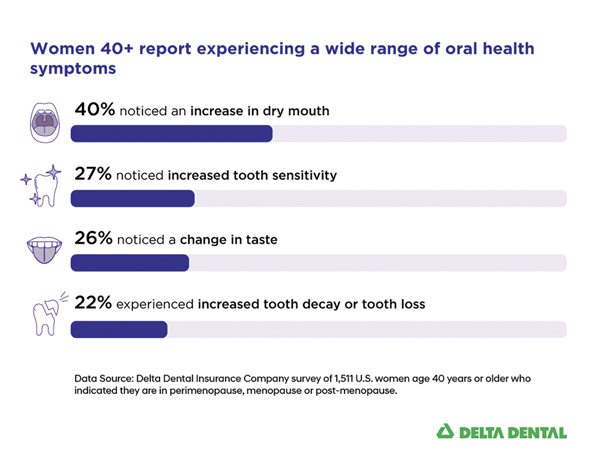
What menopause mouth feels like
Forty percent say they have noticed an increase in dry mouth. Another 27% have noticed more tooth sensitivity in recent months, and 26% say things taste different than they used to. You tell yourself it’s something else. You’re not drinking enough water; you’ve been brushing too hard. Menopause isn’t the first thing that comes to mind.
It adds up. Forty-five percent say oral symptoms associated with menopause, such as tooth pain, dry mouth or gum inflammation, take a toll on their confidence, mood or mental health.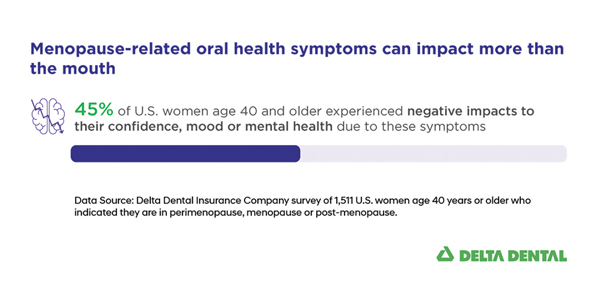
Menopause affects the whole body, mentally and physically. So why is the mouth left out?
Even after learning about this connection, 30% of women say they can’t find information about menopause-related oral health concerns. It isn’t that no one is willing to discuss it.
What makes the conversation hard to start
Three-quarters of dentists say they are comfortable discussing menopause with patients. They just want to know who they’re talking to. Most say they would want more patient history, or to know a patient was in menopause, before raising the subject. Forty-five percent say they would not bring up how menopause affects oral health unless a patient asked.
Dentists also believe that patients are already informed. Ninety-four percent say their patients are at least somewhat aware that menopause can affect oral health. So a patient says nothing about her dry mouth, because it doesn’t seem like a dental problem. The dentist doesn’t bring it up either, assuming someone already has.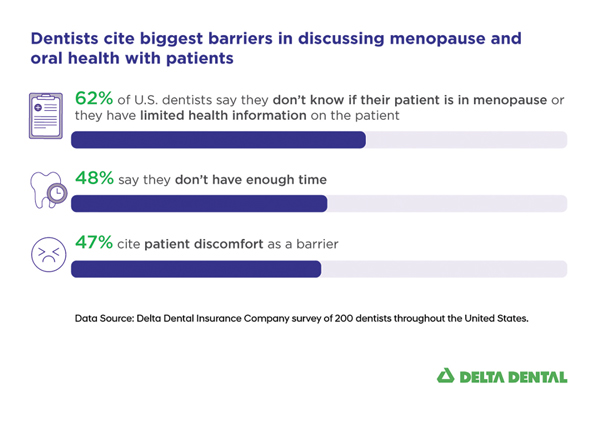
Women are asking for the information
Nearly nine in 10 women say it would help to receive specific instructions during dental visits about managing oral health during menopause. And 69% say they would be more likely to book an appointment if a primary care provider or OB-GYN had told them menopause affects oral health.
No matter who brings it up, the conversation is one worth having. Hormonal changes during menopause can increase the risk of tooth loss or tooth decay, gum disease, receding gumline or loss of jawbone density. Discussing new oral symptoms with a dentist can help women identify potential problems and address them early.
How to start the conversation with your dentist
Your dentist probably doesn’t know you’re in menopause. Start there.
Questions worth asking:
- “Could the changes I’m noticing be related to menopause?”
- “I haven’t had a cavity in 30 years, and now I have two. Could that be tied to hormonal changes?”
- “What can I do about dry mouth?”
- “Are there symptoms I should watch for?”
- “Should I adjust my oral care routine?”
Any one of these questions can get the conversation started.
Methodology
Delta Dental Insurance Company commissioned Atomik Research to conduct two online surveys between June 25 and July 2, 2025.
The first surveyed 200 dentists throughout the United States. The margin of error is +/- 7 percentage points with a 95% confidence level.
The second surveyed 1,511 women ages 40 or older throughout the United States. To qualify, participants had to indicate they are in perimenopause, menopause or post-menopause. Those who were not sure which stage they were in, or who indicated they were not yet in one of the three stages, were excused from participation. The margin of error is +/- 3 percentage points with a 95% confidence level
Atomik Research, part of 4media group, is an independent market research agency.
Photo courtesy of Shutterstock
SOURCE:
Delta Dental Insurance Company




