

News
NASA Coverage Set for Uncrewed Soyuz Undocking, Departure
The uncrewed Roscosmos Soyuz MS-22 spacecraft will undock from the International Space Station on Tuesday, March 28.


Credits: NASA
The uncrewed Roscosmos Soyuz MS-22 spacecraft will undock from the International Space Station on Tuesday, March 28.
The spacecraft will depart the space station’s Rassvet module at 5:57 a.m. EDT, heading for an automated, parachute-assisted landing in Kazakhstan at 7:45 a.m. (5:45 p.m. Kazakhstan time).
NASA will provide coverage of the undocking and departure from the station beginning at 5:30 a.m. on NASA Television, the NASA app, and the agency’s website. Watch the departure coverage online at:
There will be no televised coverage of the deorbit burn or Soyuz landing. The station blog will be updated after the events occur.
NASA astronaut Frank Rubio and Roscosmos cosmonauts Sergey Prokopyev and Dmitri Petelin launched aboard the Soyuz MS-22 in September 2022. Following an external coolant leak detected on the Soyuz MS-22 spacecraft in December, the replacement Soyuz MS-23 was launched to the space station on Thursday, Feb. 23, to return Rubio, Prokopyev, and Petelin later this year.
Learn more about the International Space Station at:
Source: NASA


Community
Kia and its Dealers Expand Community Giving Nationwide
Expand Community Giving Nationwide: Kia announced its fifth annual “Accelerate the Good” dealer match program, which supports St. Jude Children’s Research Hospital. The program also donates to other organizations that make a positive impact in their communities.

Kia and its Dealers Expand Community Giving Nationwide
(Feature Impact) Families often arrive at St. Jude Children’s Research Hospital with a tough road ahead. Their child has been diagnosed with cancer, and they’re navigating a complex treatment plan. One thing that families don’t have to worry about is how they’ll pay for this upheaval to their lives. In 2026, Kia donated $2 million to St. Jude to help ensure families don’t receive a bill for medical costs, housing or food during treatment.
Watch this video to learn more
Kia announced its fifth annual “Accelerate the Good” dealer match program, which supports St. Jude Children’s Research Hospital. The program also donates to other organizations that make a positive impact in their communities.
Donations from a network of nearly 800 dealers support organizations such as No Kid Hungry, Toys for Tots, Operation Homefront and several other groups dedicated to children’s health, hunger relief, disaster response and veterans’ well-being. Kia employees also lead volunteer efforts to benefit community pantries, beach cleanups and clothing drives.
“The continued success of our ‘Accelerate the Good’ initiative reflects the shared commitment of Kia and our nationwide retailer network to invest in the communities we serve,” said SeungKyu (Sean) Yoon, president and CEO of Kia North America and Kia America. “Together, we are proud to support organizations that deliver lifesaving care, strengthen families, fight hunger and create meaningful opportunities for people across the country.”
Ahead of September’s Childhood Cancer Awareness Month, Kia and its dealers have reached an important milestone: more than $7.7 million donated to St. Jude Children’s Hospital in four years. The donations are part of Kia’s broader community giving initiatives.
To learn more about how Kia is accelerating good in their communities, visit kia.com.

SOURCE:
Consumer Corner
3 Practical Ways to Build Financial Confidence
Financial Confidence: Economic uncertainty, fueled by persistent inflation, stagnant wages and a cooling job market, has led many Americans to feel like they’re falling behind, even when they’re doing many of the “right” things financially. This expert guidance can help you be more intentional with the choices you make so your spending reflects your priorities.

Building Financial Confidence
(Feature Impact) Nearly everyone is carrying some level of insecurity about their financial future, even those who are trying to plan ahead. Economic uncertainty, fueled by persistent inflation, stagnant wages and a cooling job market, has led many Americans to feel like they’re falling behind, even when they’re doing many of the “right” things financially.
Though many are paying down debt, saving for retirement and building an emergency fund, they’re still asking, “Am I doing enough?” In fact, only 21% of Americans are financially prepared and assured in their ability to protect their futures, according to Mutual of Omaha’s 2026 Protection Index Survey – a proprietary research study conducted with quantilope – which shows overall financial confidence has declined.
“Many people believe they need to wait until they have more money, more certainty or the perfect plan before taking action,” said Nate Hobson, vice president of sales, Advisor Network at Mutual of Omaha. “But financial confidence is usually built through consistency rather than perfect timing. Even small steps today can make a meaningful difference over time.”
While being financially secure means different things to different people, according to the survey – such as having little or no debt (34%), owning a home (29%), maintaining emergency savings (27%), saving for retirement (26%) or having insurance coverage (26%) – building financial confidence doesn’t have to translate to cutting out everything you enjoy. Instead, this expert guidance can help you be more intentional with the choices you make so your spending reflects your priorities.
Create a Financial Cushion
Whether it’s a car repair, medical bill or temporary loss of income, unexpected expenses happen.
Having even a modest emergency fund can reduce financial stress and reliance on credit cards or loans. If saving several months of expenses feels overwhelming, start with a smaller milestone. Consistency matters more than the starting amount.
 Put Good Financial Habits on Autopilot
One of the easiest ways to make progress is removing the need to make the same decision every month. Consider setting up automatic contributions to savings and retirement accounts, regular investment deposits and automatic bill payments, which can help you build financial security even during busy or uncertain times.
Taking a look at everyday spending habits can also make a difference. The survey showed small, everyday choices add up over time, such as cutting non-essential spending (57%), using rewards programs (54%), comparing prices or switching providers (39%) and following a monthly budget (38%). That could mean bringing your lunch to work instead of grabbing takeout, taking a few extra minutes to compare prices at the grocery store or using rewards to get more value from the purchases you’re already making.
Protect What You’re Building
Saving and investing are important pieces of financial protection, but they’re only part of the equation. Protecting income, loved ones and other financial assets is equally important.
For families, life insurance can provide financial protection during key earning and caregiving years, helping replace income if the unexpected happens. For those focused on covering final expenses, guaranteed whole life insurance can help cover funeral and other end-of-life costs. If you’re approaching or living in retirement, an annuity may provide a reliable stream of income that can complement other retirement resources and reduce uncertainty.
A financial professional can help determine which options best fit your goals and circumstances. To see how much coverage is right for your situation, Mutual of Omaha’s Life Insurance Calculator can provide a personalized estimate based on your income, financial obligations and long-term goals.
For more practical advice to build financial confidence, visit MutualofOmaha.com.
Taking Action with an Extra $1,000
If you unexpectedly received $1,000, your response with the extra cash may reveal your financial priorities and where additional planning could strengthen financial resilience.
Providing a window into Americans’ financial priorities, respondents in Mutual of Omaha’s 2026 Protection Index Report said they would:
- Pay down debt (25%)
- Add it to savings (21%)
- Use it for everyday expenses (14%)
- Invest it (9%)
Photos courtesy of Shutterstock

SOURCE:
💰 Live well and make your money work smarter! Explore the latest lifestyle tips, personal finance insights, saving strategies, and financial wellness stories on STM Daily News. Share your thoughts in the comments and subscribe to our newsletter for fresh ideas delivered straight to your inbox.
financial wellness
Survey: Credit isn’t a backup plan. For millions of Americans, it’s how they buy groceries.
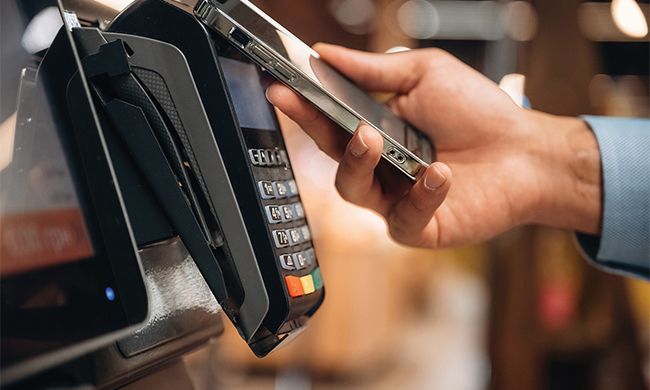
Credit isn’t a backup plan. Credit cards were once reserved for expensive purchases or for added security in buying online. For households managing debt, they have become a way to cover everyday purchases like groceries.
Survey: Credit isn’t a backup plan. For millions of Americans, it’s how they buy groceries.
(Sheeka Sanahori) Sixty-six percent of Americans carrying at least $10,000 in unsecured debt used a credit card to buy groceries in the last year, more than any other essential expense, according to a new survey. Credit cards were once reserved for expensive purchases or for added security in buying online. For households managing debt, they have become a way to cover everyday purchases like groceries.
Accredited Debt Relief, a company specializing in debt relief, commissioned Atomik Research in May 2026 to survey 2,000 U.S. adults with at least $10,000 in unsecured debt. Along with groceries, 47% say they’ve used credit for gas or transportation, 45% for utilities and 33% for rent or housing costs.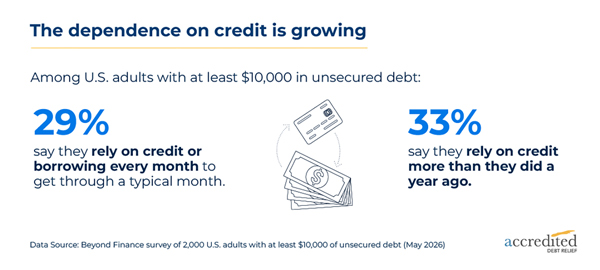
For people struggling with cost-of-living pressures, using unsecured debt can begin as a quick solution to cover household needs for the moment. At first, it’s just milk and eggs. But then an unexpected expense happens: a flat tire, an unusually high electricity bill, a medical cost that was not in the budget. The balance adds up and, according to the survey data, this also creates stress for consumers.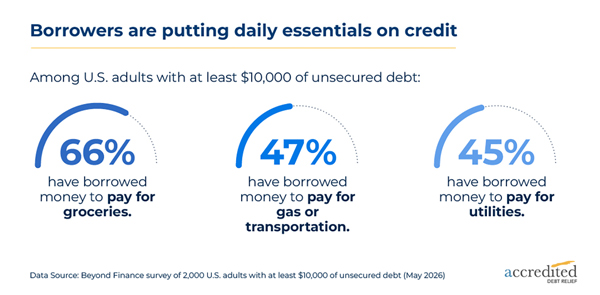
This isn’t discretionary spending. The data reflects a growing reliance on consumer debt to cover basic cost-of-living needs. However, relying on borrowed money without an executable plan for repaying it could mean that one day, the runway for taking care of such expenses runs out.
A significant share of respondents report relying on credit as a routine part of managing their personal finances. This routine could become a long-term debt cycle for many households. Nearly three in ten say that they rely on credit or borrowing to get through a typical month. This reliance appears to be growing, with a third saying they depend on credit more than they did a year ago. For those consumers, what may have once been a stopgap has become an increasingly common and ongoing financial strategy.
The growing debt cycle by unsecured borrowing is taking an emotional toll on these consumers, too. A quarter of respondents are concerned about their financial future and 12% feel a stronger concern that they’re at risk of long-term financial instability.
A lack of savings makes the cycle harder to break. Only 28% of respondents say they can both cover expenses and save. When there is little room between income and expenses, every disruption becomes harder to absorb.
Unexpected expenses, such as medical bills or car repairs, lead 19% of respondents to take on additional debt every time, and 27% most of the time. These are the kinds of costs households are often told to prepare for, but preparation requires room. For many consumers, that room does not exist.
Debt builds over time when credit becomes part of monthly operations. Some of these consumers say they don’t earn enough to make meaningful changes to their current financial situation. Among those surveyed, 45% report that their income is enough to get by but not get ahead. Many report that their financial situation has caused them to put off taking a vacation or begin building savings.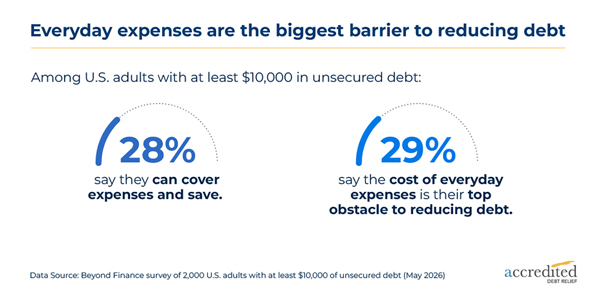
When asked about the biggest barrier to reducing debt, 29% of respondents listed the same obstacle: the cost of everyday expenses. That number connects how debt builds with why it persists.
When everyday expenses become part of ongoing credit card debt, the balance can grow without notice. Even when a consumer gets their next paycheck, if it’s already accounted for, they may not be able to make much progress in paying down their debts. A few recurring costs, spread across months, can become a greater financial weight. The result is debt that builds, because it’s tied to the basic cost of living. It also can create a stressful way to live; more than three in ten people say their current debt situation has affected their mental well-being.
Without meaningful changes, whether through increased income, debt relief or other financial support, these households may continue to rely on consumer debt and unsecured credit as a daily necessity rather than a strategic financial tool or occasional supplement. The risk is that life’s most basic needs become harder to maintain in the long run.
Methodology
Accredited Debt Relief commissioned Atomik Research to conduct an online survey of 2,000 U.S. adults with at least $10,000 in unsecured debt. The margin of error is plus or minus 2 percentage points at a 95 percent confidence level. Fieldwork was conducted between May 11-14, 2026. Atomik Research, part of 4media group, is a creative market research agency.
Photo courtesy of Shutterstock (tap to pay)

SOURCE:
💰 Live well and make your money work smarter! Explore the latest lifestyle tips, personal finance insights, saving strategies, and financial wellness stories on STM Daily News. Share your thoughts in the comments and subscribe to our newsletter for fresh ideas delivered straight to your inbox.





