Connect with us

Science

Fleeting fireflies illuminate Colorado summer nights − and researchers are watching

Published

on

Last Updated on May 25, 2025 by Daily News Staff

fireflies
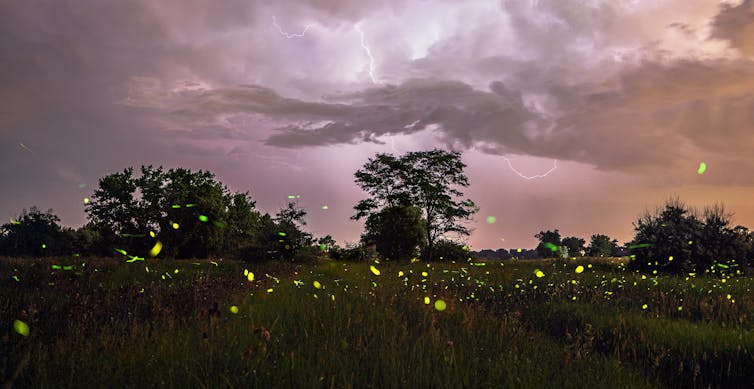
Fireflies in Boulder, Colo., during the summer of 2023.
Radim Schreiber/Firefly Experience, CC BY

Orit Peleg, University of Colorado Boulder and Owen Martin, University of Colorado Boulder

The Colorado June air was thick with summer heat. Mosquitoes rose in clouds around us, testing our resolve while we gathered our cameras and sensors. We walked into the wetland, down the unmarked path until the cattails rose shoulder-high. The sounds of frogs and crickets filled the air as we set up our cameras and waited. Then we spotted them: tiny lights lifting from the grasses, blinking in slow rhythms.

Bioluminescent lampyrid beetles, commonly known as fireflies or lightning bugs, are widespread throughout the Eastern United States but far more scarce west of Kansas.

Even though many are stargazers and hikers, most Colorado residents don’t know that fireflies share their state.

We are an associate professor of computer science and a Ph.D. candidate who are working to shed light on Colorado’s hidden fireflies.

In the past few years, we have observed and filmed elusive bioluminescent fireflies all over Colorado, racing each summer against their brief and unpredictable flashing season.
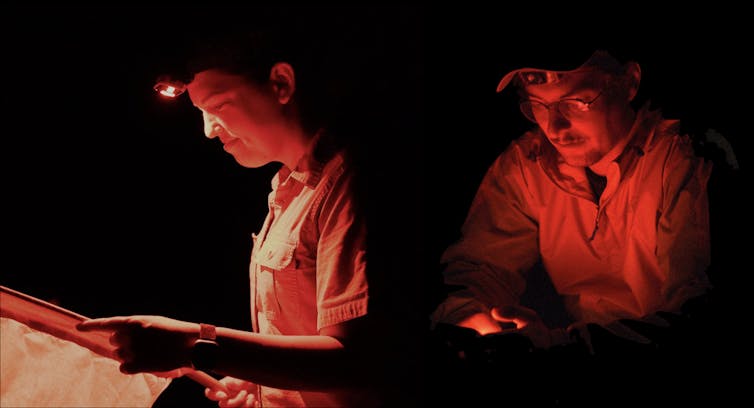
Two people at work in the dark with faces illuminated by red lights.
The authors − Orit, left, and Owen − in the field, taking notes and observing specimens.
Nolan R. Bonnie and Mac Stone

Last year in early June it was too early, we thought, for fireflies in Colorado. For weeks we had been checking weather forecasts, comparing them to previous years, waiting for warmer nights and rising temperatures − the signs that would tell us it’s firefly time.

Then we got a tip. A friend mentioned seeing one or two flashes near their property. The next morning we packed our gear, rearranged our schedules and contacted our volunteer network. The field season began in a literal flash.

As adults, fireflies live and flash for only about two weeks a year − and even then, just for a few hours each night. It’s easy to blink and miss the entire season. The next generation overwinters underground as larvae, emerging as adults the following year, though development may take up to two years in arid climates. Making the most of that narrow window is one of the many reasons we rely on volunteers who help us spot the first flashes and record observations across Colorado.

Western fireflies face unique environmental challenges

Our work joins a growing chorus of scientific observation focused on western fireflies, which pop up across the arid landscape near temporary wetlands, marshes, drainages, desert rivers and other water sources. Because of the dry landscape, these populations tend to be fragmented, isolated to where the water is and nowhere in between.

This strong tie to small, unstable habitat spells vulnerability for the fireflies. If the water runs out, or their habitats are damaged by water or light pollution, the flashing populations could vanish. Pesticides in water are toxic to firefly larvae and their prey, and artificial light inhibits the flash courtship between males and females, preventing successful reproduction. Many populations and species of fireflies are threatened with extinction in the United States due to these factors.

Advertisement
Get More From A Face Cleanser And Spa-like Massage

Organizations such as our lab at the University of Colorado and the Xerces Society for Inverteberate Conservation are studying the distribution of and direct threats to western firefly populations. Many of the species are either endangered or not yet described.

The fireflies of the Photuris genus along the Front Range, for example, still do not have a species name and appear to be genetically distinct from other Photuris around the country. Preliminary genetic results suggest at least one new species might be found here. The genetic data also suggests at least five different bioluminescent species of fireflies are present in Colorado.

How flash patterns help fireflies (and us) tell species apart

During their short mating season, fireflies use their flash patterns as mating calls.

Males produce a series of flash-on, flash-off events, each with specific durations and pauses. These Morse code-like signals communicate what type and how fit the fireflies are to potential mates in the darkness.

When females detect a suitable male, they respond with their own unique flash pattern.

Our work piggybacks on this evolutionary adaptation. We first recorded populations from around the U.S. using two video cameras, which allowed us to accurately track individual fireflies in three dimensions and separate their flash patterns.

We used the data on the flash behavior from different species to train a neural network that can classify the firefly’s flash pattern with a high degree of accuracy. Our algorithm learns the unique flash patterns from our data and can identify the species of firefly that is present in a video.

This is a powerful tool for firefly conservation efforts. The camera footage can cover more time and ground than field surveys conducted by humans, and our algorithm can more quickly identify species that might be threatened.

Fostering community engagement with citizen science

Based on our success with community science data collection across other states, including Tennessee, South Carolina and Massachusetts, we wanted to apply the same principles to Colorado’s firefly populations. This is a big undertaking: There are dozens of fragmented sites where fireflies are active across Colorado, and more are reported by volunteers every season. Our team of two cannot visit and survey every site during the short firefly season.

In 2023 we put out our first call for volunteers in Colorado. Since that time, 18 community members in Boulder, Fort Collins, Divide and Loveland joined the filming effort. We provide cameras for the volunteers, who bring them to their nearby wetlands and set them up in the fading light.

Advertisement
Get More From A Face Cleanser And Spa-like Massage

Last summer we partnered with local land management agencies in Boulder, Fort Collins and Loveland to host informative community events, where we spoke about firefly biology and conservation to audiences of all ages. On many of those nights, as the flashes began, we heard the excitement build: quiet gasps, hushed enthusiasm and a whisper such as, “Look at that beautiful streak of light!”

Fireflies have an important story to tell, and here in Colorado that story is just beginning. Their brief flashes each summer help us learn about communication, ecology and how these delicate insects respond to an ever-changing world.

If you’d like to help us find and study fireflies in Colorado, you can sign up to join our community science project.The Conversation

Orit Peleg, Associate Professor of Computer Science, University of Colorado Boulder and Owen Martin, Ph.D. Candidate in Computer Science, University of Colorado Boulder

This article is republished from The Conversation under a Creative Commons license. Read the original article.

The science section of our news blog STM Daily News provides readers with captivating and up-to-date information on the latest scientific discoveries, breakthroughs, and innovations across various fields. We offer engaging and accessible content, ensuring that readers with different levels of scientific knowledge can stay informed. Whether it’s exploring advancements in medicine, astronomy, technology, or environmental sciences, our science section strives to shed light on the intriguing world of scientific exploration and its profound impact on our daily lives. From thought-provoking articles to informative interviews with experts in the field, STM Daily News Science offers a harmonious blend of factual reporting, analysis, and exploration, making it a go-to source for science enthusiasts and curious minds alike. https://stmdailynews.com/category/science/

Author

Continue Reading
Advertisement SodaStream USA, inc

Tech

Drones paired with AI could help search‑and‑rescue teams find missing persons faster

AI-powered drones equipped with thermal and infrared imaging are transforming search-and-rescue operations, enabling teams to locate missing persons faster and assess their condition—including signs of injury, consciousness, or life-threatening temperature changes—in real time.

Published

on

Last Updated on May 16, 2026 by Daily News Staff

Drones: An AI system can analyze data from a drone to detect people in a forest – and determine what condition they’re in. Adeel Khalid
An AI system can analyze data from a drone to detect people in a forest – and determine what condition they’re in. Adeel Khalid

Adeel Khalid, Kennesaw State University

A combination of infrared imaging, thermal imaging and color cameras on an uncrewed drone, along with an AI system to interpret the data, can help emergency responders and search-and-rescue teams locate, identify and track people who have gone missing in the wilderness. The experimental system helps responders pinpoint where a missing person is and determine whether they are hurt or even alive.

People who get lost or hurt while exploring nature can become stranded for days. Rescue teams often use drones to look for the person or signs of their whereabouts. The small drone my colleagues and I built at my lab at Kennesaw State University flies autonomously using a grid search pattern. It sends live video and images to a ground station operated by the rescue team.

When the AI system finds a person, it analyzes images to determine whether the individual is upright or lying on the ground. It segments parts of the person’s body, identifying the person’s head and the body’s position. It then zeroes in on the forehead. It extracts forehead temperature readings, pixel by pixel, from the imaging data to estimate forehead temperature. We have two papers detailing these findings accepted for the American Institute of Aeronautics and Astronautics Aviation Forum 2026 conference.

https://cdn.theconversation.com/infographics/1381/8e55acef0075dfeebe10e7de53e7f0cbf5223831/site/index.html

Our AI model then assesses whether the person is conscious or unconscious and identifies abnormal temperatures that could indicate heat stress, hypothermia or other physical complications, or death – all vital information for a search-and-rescue team.

In field trials we have conducted, the system has provided consistent temperature readings of the heads of volunteers from our research team who have walked out into a variety of environments, under different conditions.

https://cdn.theconversation.com/infographics/1380/7fe5f8cf79d68c8907da060b27accb7b2051d60c/site/index.html

Why it matters

It is critical to get accurate and timely information on the whereabouts of a missing person. The likelihood that the person will survive decreases steeply as time passes.

An AI-enhanced drone can make search-and-rescue operations significantly more efficient than sending teams of people out into the environment to search on foot, especially in poor weather conditions or under thick foliage. Rescuers who know whether a person is conscious or unconscious can also better gear up for what they need to do to retrieve the person and administer aid. Our technology could save lives.

Advertisement
Get More From A Face Cleanser And Spa-like Massage

What other research is being done

Search-and-rescue personnel use various kinds of drones, but the machines often lack the ability to positively identify humans, especially under thick foliage, in bad weather or when the person is lying down or unconscious. The AI-based technology we have developed overcomes those challenges.

Better sensors that are very lightweight, that can function at night or in rain, and can see more clearly through thick foliage could further improve our drone and drones used by others. Researchers are devising AI-powered sound recognition for detecting screams for help, advanced thermal imaging for better nighttime vision and autonomous drones that could act as first responders.

Also under development are drones that can carry heavy payloads, such as flotation devices, fly for up to 14 hours or perform real-time mapping of the ground below.

What’s next

One of our next steps is to have multiple drones fly together and autonomously coordinate search-and-rescue operations among themselves. This will allow the technology to cover a much larger area, perhaps hundreds of square miles.

We are also designing a large drone that can carry up to 110 pounds (50 kilograms) of payload and stay aloft for an hour.

The Research Brief is a short take on interesting academic work.

Adeel Khalid, Professor of Industrial & Systems Engineering, Kennesaw State University

This article is republished from The Conversation under a Creative Commons license. Read the original article.

Looking for an entertainment experience that transcends the ordinary? Look no further than STM Daily News Blog’s vibrant Entertainment section. Immerse yourself in the captivating world of indie films, streaming and podcasts, movie reviews, music, expos, venues, and theme and amusement parks. Discover hidden cinematic gems, binge-worthy series and addictive podcasts, gain insights into the latest releases with our movie reviews, explore the latest trends in music, dive into the vibrant atmosphere of expos, and embark on thrilling adventures in breathtaking venues and theme parks. Join us at STM Entertainment and let your entertainment journey begin! https://stmdailynews.com/category/entertainment/

Advertisement
Get More From A Face Cleanser And Spa-like Massage

and let your entertainment journey begin!

Author

View recent photos

Unlock fun facts & lost history—get The Knowledge in your inbox!

We don’t spam! Read our privacy policy for more info.

Continue Reading

News Brief

Earthquake Swarm Shakes Southern California Near Salton Sea

Earthquake Swarm: A swarm of earthquakes near California’s Salton Sea and Brawley area has prompted increased monitoring by seismologists as hundreds of tremors shake the region.

Published

on

Salton Sea earthquake swarm

A swarm of earthquakes has been rattling Southern California near the Salton Sea, drawing attention from residents and seismologists across the region.

Salton Sea earthquake swarm?

The activity is centered near Brawley in Imperial County, an area known for frequent seismic movement due to its location within the Brawley Seismic Zone. According to the U.S. Geological Survey, hundreds of small earthquakes have been recorded over the past several days, with the strongest reaching a magnitude of approximately 4.7.

Residents throughout Imperial Valley, parts of Riverside County, and even portions of Arizona reported feeling shaking from several of the larger quakes. Minor incidents such as falling objects and brief power disruptions were also reported, though no major injuries or widespread structural damage have been confirmed at this time.

The region sits near the southern end of the San Andreas Fault and is considered one of California’s most geologically active areas. Scientists say earthquake swarms are relatively common near the Salton Sea because of the interaction between tectonic fault systems and geothermal activity beneath the surface.

While experts continue to monitor the situation closely, they emphasize that earthquake swarms do not necessarily indicate that a larger earthquake is imminent. However, officials encourage residents to review emergency preparedness plans, secure heavy furniture, and keep emergency supplies ready.

The Salton Sea region has experienced similar seismic swarms in the past, making it an important area of study for earthquake researchers and emergency management agencies.

For continued updates on this developing story and other regional news, visit STM Daily News.

Related External Links

Stay informed with the latest breaking news, trending stories, and real-time updates from around the world on STM Daily News. Visit our Stories This Moment page for continuously updated coverage on major events, technology, transportation, science, entertainment, and more.

Authors

  • Daily News Staff
  • Rod Washington

    Rod: A creative force, blending words, images, and flavors. Blogger, writer, filmmaker, and photographer. Cooking enthusiast with a sci-fi vision. Passionate about his upcoming series and dedicated to TNC Network. Partnered with Rebecca Washington for a shared journey of love and art.

    View all posts
Continue Reading

home improvement

Simple Ways to Make At-Home Recycling More Effective

To create a more eco-friendly household, consider these practical tips to help you reduce waste, stay organized and make at-home recycling part of your everyday routine.

Published

on

Last Updated on May 12, 2026 by Daily News Staff

17862 Recycling detail intro

Simple Ways to Make At-Home Recycling More Effective

(Feature Impact) Recycling is a simple way households can reduce waste and help protect natural resources. While many communities offer curbside recycling programs, some people still wonder if they’re doing it correctly or if they’re missing opportunities to recycle more.

To create a more eco-friendly household, consider these practical tips to help you reduce waste, stay organized and make recycling part of your everyday routine.

Know What Your Local Program Accepts

Recycling rules vary depending on your city or waste management provider. Most curbside programs include items like cardboard, paper, aluminum cans and plastics, but others – such as glass – may require drop-off recycling. Review your community guidelines so recyclables don’t accidentally end up in the regular trash.

Create a Simple Sorting System

Set up clearly labeled bins – separated for paper, plastics and metals – in a high-traffic area like the kitchen, garage or laundry room.

Rinse Before You Recycle

Food residue can contaminate other recyclables and may cause entire batches of materials to be rejected during the recycling process. Quickly rinsing yogurt cups, jars or soup cans of leftover residue helps keep recycling streams clean and more likely to be processed properly.

Break Down Boxes

Cardboard boxes are among the most commonly recycled household materials. Flattening boxes before placing them in the recycling bin saves space and allows collection trucks to hold more.

Compost Food Scraps

Not everything belongs in the recycling bin, particularly food waste. Composting fruit peels, vegetable scraps, coffee grounds and eggshells is an easy way to reduce the amount of trash your household produces. Finished compost can be used in gardens, flower beds or houseplants, turning kitchen waste into a valuable resource.

Find more ideas for making recycling a natural part of your household routine at eLivingtoday.com.

Photo courtesy of Shutterstock

Advertisement
Get More From A Face Cleanser And Spa-like Massage
    collect?v=1&tid=UA 482330 7&cid=1955551e 1975 5e52 0cdb 8516071094cd&sc=start&t=pageview&dl=http%3A%2F%2Ftrack.familyfeatures
track

SOURCE:

eLivingtoday.com

Welcome to the Consumer Corner section of STM Daily News, your ultimate destination for savvy shopping and informed decision-making! Dive into a treasure trove of insights and reviews covering everything from the hottest toys that spark joy in your little ones to the latest electronic gadgets that simplify your life. Explore our comprehensive guides on stylish home furnishings, discover smart tips for buying a home or enhancing your living space with creative improvement ideas, and get the lowdown on the best cars through our detailed auto reviews. Whether you’re making a major purchase or simply seeking inspiration, the Consumer Corner is here to empower you every step of the way—unlock the keys to becoming a smarter consumer today!

https://stmdailynews.com/category/consumer-corner

Continue Reading

Trending