

Blog
Glad and Oscar the Grouch Team Up for a Trashy, Toe-Tapping Campaign
Glad teams up with Oscar the Grouch for a playful revival of the “Don’t Get Mad. Get Glad.” campaign, featuring a musical number, limited-edition Oscar-inspired trash bags, and a fresh take on making trash day fun for all ages.

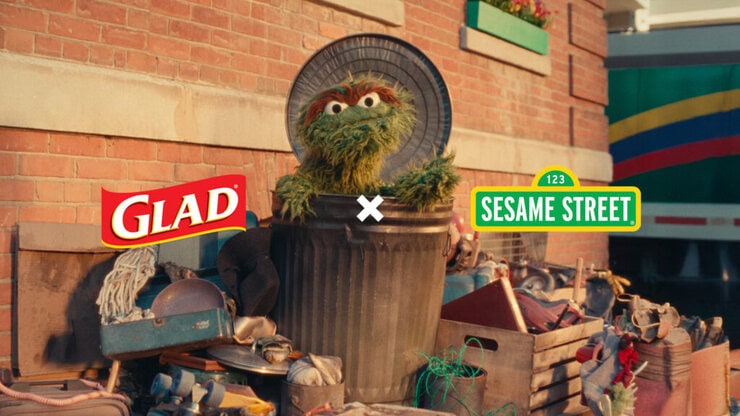
Glad revives its most popular, decades-long, star-studded ad campaign, “Don’t Get Mad. Get Glad.”
A Classic Campaign Gets a Grouchy Remix
Why Oscar? Why Now?
Nostalgia Meets New Audiences
Limited-Edition Oscar Goodies and Where to Find Them
Where to Watch
-

- Glad revives its most popular, decades-long, star-studded ad campaign, “Don’t Get Mad. Get Glad.”
-

- Glad revives its most popular, decades-long, star-studded ad campaign, “Don’t Get Mad. Get Glad.”
Bringing the Campaign Home: Phoenix Community Clean-Up
- “Phoenix, let’s get grouchy about litter and Glad about clean streets! Join our community clean-up and share your photos with #GladToCleanPHX.”
- “Spotted: Oscar the Grouch in Phoenix! Grab your Glad bags, clean up your neighborhood, and tag #OscarLovesTrash for a chance to be featured.”
- “Spring cleaning in Phoenix just got a lot more fun—thanks to Glad and Oscar! Who’s joining our next clean-up day? #GladToCleanPHX”
About the Brands
- Glad Products Company
- Sesame Workshop
- PRNewswire
- Press release via Glad, Dec 2, 2025 (based on IRI data, last 52 weeks ending 10/26/2025)
High Demand Marks “Veggies for Veterans” Event Amid SNAP Delays

STM Blog | Commentary | October 14, 2026
The viral allegations involving Texas Roadhouse and the treatment of Black customers raised an understandably disturbing question: Could diners trust that they were being served safely and respectfully?
After reviewing available coverage again on October 14, STM Daily News did not locate new verified evidence establishing that the alleged food tampering occurred. We also did not locate a publicly released final report from the outside firm the company said it hired.
The central distinction remains unchanged: the allegations have not been substantiated in the reporting reviewed, while Texas Roadhouse says its investigation points to a hoax.
What the available reporting says
In August, social media posts alleged that restaurant workers deliberately tampered with food served to Black customers. The claims circulated widely and prompted calls for a boycott. Texas Roadhouse said it had not identified current or former employees connected to the accusations.
In reporting updated August 26, KTXS noted that the viral post did not identify a particular restaurant location and that there was no verified evidence connecting the claims to a Texas Roadhouse employee.
The company told the outlet it had found no credible evidence of food tampering. It also said the original Facebook post had been deleted, some users had retracted posts amplifying the claims, and an outside firm had been engaged to investigate the accusations’ source and motives. These details come from August coverage, rather than a new October announcement.
What remains unresolved publicly
Our latest review did not locate a final outside investigation report that readers could examine. We therefore cannot describe that investigation as complete or independently assess its findings.
The company’s description of the claims as a hoax should continue to be attributed to Texas Roadhouse. Likewise, the allegations should not be repeated as though they describe a confirmed incident.
Not locating a new public report does not establish whether investigative work has continued privately. It means the public information we found does not support a stronger conclusion.
Why careful wording still matters
For Black diners, allegations of racist mistreatment can strike a painful nerve. Everyone deserves to sit down for a meal without worrying that their race could make them a target.
Taking that concern seriously requires credible complaints to be investigated thoroughly. It also requires care before assigning blame to a restaurant, a location, or its workers.
Social media can spread a warning far beyond its original audience before anyone verifies the underlying claim. Once that happens, a correction or clarification may never reach everyone who saw the accusation.
That makes transparency essential. Restaurants should explain what they have investigated and what they can substantiate. Those sharing accusations should be equally willing to share corrections and acknowledge uncertainty.
For now, the responsible position is to keep the evidence and the allegations separate. If new, verifiable findings become public, they should be assessed on their merits.
Join the conversation: What do you look for before trusting a viral warning about a business? Share your thoughts in the comments, and keep the conversation respectful.
Editor’s note: This is an October 14 status review of previously reported allegations. It does not announce a new investigative finding.
Sources
- KTXS: Viral post alleges Texas Roadhouse mistreated Black customers; company responds — Includes the company’s statement and explains the lack of verified evidence connecting the allegations to an employee or location.
- Houston Chronicle: Texas Roadhouse investigates Facebook hoax alleging racist food tampering — Covers the company’s denial and its decision to hire an outside investigative firm.
- MySA: Texas Roadhouse faces social media backlash over viral allegations — Details how the claims spread and the restaurant chain’s response.
Related reading
- Snopes: Posts claim Texas Roadhouse servers contaminated Black customers’ food — Examines the viral allegations.
- Restaurant Business: Texas Roadhouse says post alleging racist practices was a hoax — Restaurant industry coverage of the controversy.
- Texas Roadhouse official website — Company information and customer contact options.


College Life
Is College Worth It? New U.S. News Rankings Put More Weight on What Graduates Earn
Is college worth it? MIT has taken the No. 1 spot in the 2027 U.S. News Best Colleges rankings, ending Princeton’s 15-year run. But a new Earnings by Major metric could be even more important for families asking whether college is worth the investment.

For millions of students and families, choosing a college increasingly comes down to a basic question: Is college worth it?
The latest U.S. News & World Report Best Colleges rankings are attempting to provide another piece of information to help answer that question.
The 2027 rankings place the Massachusetts Institute of Technology (MIT) at No. 1 among National Universities, ending Princeton University’s 15-year run at the top. But perhaps the bigger story for prospective students isn’t which university occupies the No. 1 position.
It’s a significant change in how U.S. News measures the value of attending college.
For the first time, the rankings include an Earnings by Major factor designed to examine what graduates earn after leaving school — and to compare those earnings with graduates who studied the same subjects elsewhere.
Is College Worth It? U.S. News Looks Beyond Graduation
College has traditionally been promoted as an investment in a person’s future. But as families confront tuition, housing expenses and the possibility of student debt, simply earning a degree may no longer be enough information when deciding where — or whether — to attend.
Students increasingly want to know what happens after graduation.
The new U.S. News Earnings by Major metric examines graduate earnings four years after graduation using data from the U.S. Department of Education’s College Scorecard.
Importantly, the system doesn’t simply compare the average salary of graduates from one university with another.
Instead, earnings are compared within specific academic disciplines.
That distinction matters.
A university graduating large numbers of engineers, computer scientists or students entering other relatively high-paying occupations could otherwise appear to produce stronger financial outcomes simply because of the subjects its students choose to study.
Comparing graduates within similar fields is intended to provide a clearer picture of how graduates from different institutions fare financially.
From Student Debt to Graduate Earnings
The new Earnings by Major metric replaces the Graduate Indebtedness factor previously used by U.S. News.
That represents an important shift in perspective.
Instead of focusing primarily on how much debt students accumulate, the new measure looks at one aspect of what students may receive financially from their education after entering the workforce.
The metric examines employed federal financial aid recipients whose highest degree is a bachelor’s degree.
According to U.S. News, the approach is intended to reduce the influence of family financial advantages and provide a better indication of the economic value institutions may contribute to graduates.
That doesn’t mean earnings alone determine whether a college education is worthwhile.
But for a student potentially investing tens of thousands of dollars — and several years of their life — knowing how graduates in a particular major perform economically can be an important part of the decision.
MIT Takes the No. 1 Spot
Against that changing methodology, MIT moved into the No. 1 position among National Universities in the 2027 rankings.
The top three are:
- Massachusetts Institute of Technology
- Princeton University
- Harvard University
Princeton’s move to second place ends a run at No. 1 that began with the 2012 edition of the rankings.
Among National Liberal Arts Colleges, Williams College remained No. 1, followed by Amherst College at No. 2. Bowdoin College, Claremont McKenna College, Pomona College and Swarthmore College tied for third.
Nearly 1,700 institutions were evaluated in the 2027 edition.
Outcomes Are Becoming a Bigger Part of the Equation
The addition of graduate earnings is part of a broader emphasis on student outcomes in the U.S. News methodology.
U.S. News says outcomes now account for more than half of a school’s total score.
Institutions can be evaluated using as many as 17 weighted measures, including graduation and retention rates, social mobility for lower-income students, post-graduate earnings, faculty resources and academic peer assessments.
The shift reflects a changing conversation surrounding higher education.
For generations, students were often encouraged to focus heavily on getting into the most prestigious college possible. Today’s students may also be asking more practical questions:
How much will it cost?
How much financial aid will I receive?
How much debt might I have when I graduate?
What do graduates in my intended major earn?
And perhaps most importantly:
Will the investment pay off for me?
College Value Isn’t Just About Salary
Graduate earnings can provide useful information, but salary shouldn’t be treated as the sole measurement of the value of higher education.
Different careers have dramatically different compensation structures.
A graduate pursuing teaching, public service, social work, the arts or nonprofit work may earn less than someone entering engineering, finance or technology while still considering their education worthwhile.
There are also benefits of higher education that are difficult to capture in a salary statistic.
That’s why students comparing schools may want to look beyond an institution’s overall ranking and examine factors such as net price after financial aid, scholarships, graduation rates, student debt, internship opportunities, career placement, location and the strength of the program they actually intend to study.
The best-known university isn’t automatically the best financial or educational choice for every student.
Economic Diversity Also Gets Attention
The 2027 rankings also highlight economic diversity among highly ranked institutions.
According to U.S. News, MIT and Princeton rank third and fourth, respectively, among the top 25 National Universities in the percentage of students receiving federal Pell Grants.
Pell Grants generally assist undergraduate students with significant financial need and typically do not have to be repaid.
Among the top 25 National Liberal Arts Colleges, Amherst College ranked highest for economic diversity under the U.S. News measure.
A New Ranking Looks at In-State Value
U.S. News is also placing additional attention on affordability for students considering public universities.
The 2027 edition introduces a Best Value Schools for In-State Students ranking, which evaluates public universities based on academic quality and affordability for residents.
The University of North Carolina at Chapel Hill took the No. 1 position in the inaugural ranking.
That category could be particularly relevant to families deciding whether the prestige associated with attending a private or out-of-state university justifies potentially higher costs compared with attending a public institution in their home state.
The Rankings Look Different This Year
There is another important caveat when comparing the 2027 results with previous years.
Changes to the Carnegie Classification framework resulted in approximately 20% of previously ranked institutions moving into different U.S. News categories.
Because some colleges are now being compared against different groups of institutions, their 2027 rankings may not be directly comparable with previous years.
The changes also expanded eligibility, allowing additional institutions specializing in areas such as engineering, business and health to enter the rankings.
U.S. News also introduced an undergraduate economics specialty ranking while continuing rankings covering areas such as social mobility, innovation, historically Black colleges and universities, artificial intelligence programs, internships, undergraduate research and study-abroad opportunities.
Public Universities, HBCUs and Social Mobility
Among public National Universities, the University of California, Berkeley and UCLA tied for the No. 1 position, followed by the University of Michigan–Ann Arbor.
The top three Historically Black Colleges and Universities were:
- Spelman College
- Howard University
- Tuskegee University
For social mobility among National Universities, Florida International University and the University of California, Riverside tied for No. 1, with Oakland City University ranked third.
These categories illustrate another reason students may want to look deeper than a school’s overall national position. Different rankings can reveal institutions performing particularly well in areas that may matter more to an individual student.
So, Is College Worth It?
There isn’t one answer that applies to every student.
The cost of attending, financial aid, chosen major, career goals, likelihood of graduating and potential debt can dramatically change the financial equation.
A college with a famous name and high national ranking could be a poor financial choice for one student while a less prominent public university with generous financial aid could be an excellent investment for another.
That’s what makes the addition of Earnings by Major noteworthy.
Instead of asking only “Which college ranks highest?”, prospective students now have another reason to ask a much more personal question:
“What am I paying for — and what could I realistically get in return?”
MIT replacing Princeton at No. 1 makes the headline.
But for students and parents trying to decide whether college is worth the cost, the growing emphasis on outcomes, affordability and post-graduation earnings may ultimately be the more important story.
Source: U.S. News & World Report, 2027 Best Colleges rankings, released September 22, 2026.
U.S. News & World Report press release:
MIT Claims No. 1 Spot in U.S. News 2027 Best Colleges Rankings PR Newswire
Stay Informed with STM Daily News
From education and personal finance to technology, lifestyle, transportation and the stories shaping our everyday lives, STM Daily News keeps you informed about what matters — and why it matters. Get more news, useful insights and the latest updates by visiting STM Daily News and subscribe to stay connected to the stories worth knowing.
Forgotten Genius Fridays
Sarah Boone Improved the Ironing Board by Thinking About the Sleeve
Sarah Boone didn’t invent the first ironing board. The New Haven dressmaker patented a clever improvement shaped for pressing sleeves and fitted clothing.

Forgotten Genius | STM Daily News
Try ironing a sleeve on a wide, flat board. The fabric bunches, the seams curve, and pressing one side can leave a crease on the other. For dressmaker Sarah Boone, that everyday frustration presented a problem she could solve.
Working in New Haven, Connecticut, Boone designed an ironing board shaped for sleeves and fitted garments. Her board was narrow enough for a sleeve to slip over it, allowing one side to be pressed without flattening the other. Its curved edges followed the lines of a sleeve’s seams, while its supports helped position the board for different uses.
Boone filed her patent application in 1891. On April 26, 1892, she received U.S. Patent No. 473,653 for her improvement.
Boone did not invent the first ironing board. What she patented was a thoughtful redesign for a particular task. That distinction makes her achievement more interesting: she understood how the tool was used, recognized where it fell short, and changed its shape to make the work easier.
The patent drawing brings her idea to life. Instead of the broad surface most people picture when they hear “ironing board,” Boone’s design looks almost like the part of a garment it was meant to support. It is a practical solution from someone who knew the job firsthand.
That is the heart of Sarah Boone’s story. Invention does not always begin with an entirely new machine. Sometimes it begins when a person doing familiar work asks a better question: What would this tool look like if it truly fit the task?
Boone answered with a design—and secured a place in the history of Black innovation.
References:
Sarah Boone’s Original Ironing Board Patent — U.S. Patent No. 473,653, granted April 26, 1892. Includes her description, construction details, and original drawings.
USPTO: Beyond Baker’s List—Black Innovation Then and Now — Identifies Boone as a New Haven dressmaker who patented an improved ironing board shaped for bodices and sleeves.
USPTO: Found on Baker’s List — Background on Henry Baker’s work documenting Black patent holders, providing historical context for the Forgotten Genius series.
Explore more inventors and innovators in STM Daily News’ Forgotten Genius series.
Sources: U.S. Patent and Trademark Office; Sarah Boone’s original 1892 patent, available through Google Patents.




