Connect with us

STM Blog

The aftermath of floods, hurricanes and other disasters can be hardest on older rural Americans – here’s how families and neighbors can help

Published

on

older rural Americans
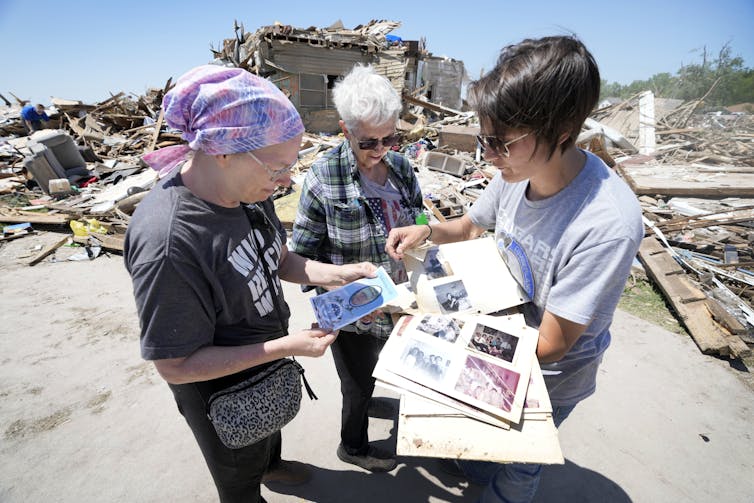
Edith Schaecher, center, and her daughter and granddaughter look at a photo album recovered from her tornado-damaged home in Greenfield, Iowa, in May 2024. AP Photo/Charlie Neibergall
Lori Hunter, University of Colorado Boulder

The aftermath of floods, hurricanes and other disasters can be hardest on older rural Americans – here’s how families and neighbors can help

Hurricanes, tornadoes and other extreme weather do not distinguish between urban and rural boundaries. But when a disaster strikes, there are big differences in how well people are able to respond and recover – and older adults in rural areas are especially vulnerable. If a disaster causes injuries, getting health care can take longer in rural areas. Many rural hospitals have closed, leaving patients traveling longer distances for care. At the same time, rural areas have higher percentages of older adults, a group that is more likely to have chronic health problems that make experiencing natural disasters especially dangerous. Medical treatments, such as dialysis, can be disrupted when power goes out or clinics are damaged, and injuries are more likely around property damaged by flooding or powerful winds. As a sociologist who studies rural issues and directs the Institute of Behavioral Science at the University of Colorado Boulder, I believe that understanding the risks is essential for ensuring healthier lives for older adults. I see many different ways rural communities are helping reduce their vulnerability in disasters.

Disasters disrupt health care, especially in isolated rural regions

According to the U.S. Census Bureau, about 20% of the country’s rural population is age 65 and over, compared with only 16% of urban residents. That’s about 10 million older adults living in rural areas. There are three primary reasons rural America has been aging faster than the rest of the country: Young people have been leaving for college and job opportunities, meaning fewer residents are starting new families. Many older rural residents are choosing to “age in place” where they have strong social ties. And some rural areas are gaining older adults who choose to retire there. An aging population means rural areas tend to have a larger percentage of residents with chronic disease, such as dementia, heart disease, respiratory illness and diabetes. According to research from the National Council on Aging, nearly 95% of adults age 60 and older have at least one chronic condition, while more than 78% have two or more. Rural areas also have higher rates of death from chronic diseases, particularly heart disease. At the same time, health care access in rural areas is rapidly declining. Nearly 200 rural hospitals have closed or stopped providing in-patient care since 2005. Over 700 more — one-third of the nation’s remaining rural hospitals — were considered to be at risk of closing even before the cuts to Medicaid that the president signed in July 2025. Hospital closures have left rural residents traveling about 20 miles farther for common in-patient health care services than they did two decades ago, and even farther for specialist care. Those miles might seem trivial, but in emergencies when roads are damaged or flooded, they can mean losing access to care and treatment. After Hurricane Katrina struck New Orleans in 2005, 44% of patients on dialysis missed at least one treatment session, and almost 17% missed three or more. When Hurricanes Matthew and Florence hit rural Robeson County, North Carolina, in 2016 and 2018, some patients who relied on insulin to manage their blood sugar levels went without insulin for weeks. The county had high rates of poverty and poor health already, and the healthy foods people needed to manage the disease were also hard to find after the storm. Insulin is important for treating diabetes – a chronic disease estimated to affect nearly one-third of adults age 65 and older. But a sufficient supply can be harder to maintain when a disaster knocks out power, because insulin should be kept cool, and medical facilities and drugstores may be harder for patients to reach. Rural residents also often live farther from community centers, schools or other facilities that can serve as cooling centers during heat waves or evacuation centers in times of crisis.

Alzheimer’s disease can make evacuation difficult

Cognitive decline also affects older adults’ ability to manage disasters. Over 11% of Americans age 65 and older – more than 7 million people – have Alzheimer’s disease or related dementia, and the prevalence is higher in rural areas’ older populations compared with urban areas. Caregivers for family members living with dementia may struggle to find time to prepare for disasters. And when disaster strikes, they face unique challenges. Disasters disrupt routines, which can cause agitation for people with Alzheimer’s, and patients may resist evacuation. Living through a disaster can also worsen brain health over the long run. Older adults who lived through the 2011 Great East Japan earthquake and tsunami were found to have greater cognitive decline over the following decade, especially those who lost their homes or jobs, or whose health care routines were disrupted.

Social safety nets are essential

One thing that many rural communities have that helps is a strong social fabric. Those social connections can help reduce older adults’ vulnerability when disasters strike. Following severe flooding in Colorado in 2013, social connections helped older adults navigate the maze of paperwork required for disaster aid, and some even provided personal loans.
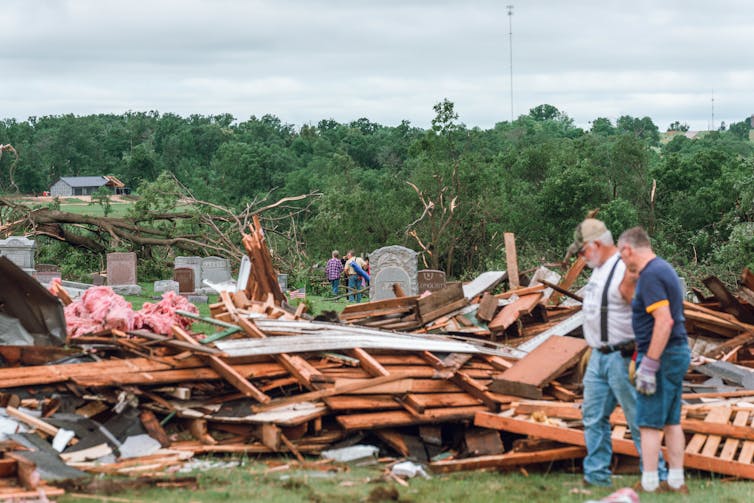
Two older men stand by debris form a storm-damaged church. Another group of people walks in the background.
Community support through churches, like this one whose building was hit by a tornado in rural Argyle, Wis., in 2024, and other groups can help older adults recover from disasters. Ross Harried/NurPhoto via Getty Images
Friends, family and neighbors in rural areas often check in on seniors, particularly those living alone. They can help them develop disaster response plans to ensure older residents have access to medications and medical treatment, and that they have an evacuation plan. Rural communities and local groups can also help build up older adults’ mental and physical health before and after storms by developing educational, social and exercise programs. Better health and social connections can improve resilience, including older adults’ ability to respond to alerts and recover after disasters. Ensuring that everyone in the community has that kind of support is important in rural areas and cities alike as storm and flood risks worsen, particularly for older adults. Lori Hunter, Professor of Sociology, Director of the Institute of Behavioral Science, University of Colorado Boulder This article is republished from The Conversation under a Creative Commons license. Read the original article.

Discover more from Daily News

Subscribe to get the latest posts sent to your email.

Continue Reading
Advertisement Sports Research

The Knowledge

How a 22-year-old George Washington learned how to lead, from a series of mistakes in the Pennsylvania wilderness

This Presidents Day, I’ve been thinking about George Washington − not at his finest hour, but possibly at his worst.

Published

on

How a 22-year-old George Washington learned how to lead, from a series of mistakes in the Pennsylvania wilderness
A young George Washington was thrust into the dense, contested wilderness of the Ohio River Valley as a land surveyor for real estate development companies in Virginia. Henry Hintermeister/Public domain via Wikimedia Commons

Christopher Magra, University of Tennessee

This Presidents Day, I’ve been thinking about George Washington − not at his finest hour, but possibly at his worst.

In 1754, a 22-year-old Washington marched into the wilderness surrounding Pittsburgh with more ambition than sense. He volunteered to travel to the Ohio Valley on a mission to deliver a letter from Robert Dinwiddie, governor of Virginia, to the commander of French troops in the Ohio territory. This military mission sparked an international war, cost him his first command and taught him lessons that would shape the American Revolution.

As a professor of early American history who has written two books on the American Revolution, I’ve learned that Washington’s time spent in the Fort Duquesne area taught him valuable lessons about frontier warfare, international diplomacy and personal resilience.

The mission to expel the French

In 1753, Dinwiddie decided to expel French fur trappers and military forces from the strategic confluence of three mighty waterways that crisscrossed the interior of the continent: the Allegheny, Monongahela and Ohio rivers. This confluence is where downtown Pittsburgh now stands, but at the time it was wilderness.

King George II authorized Dinwiddie to use force, if necessary, to secure lands that Virginia was claiming as its own.

As a major in the Virginia provincial militia, Washington wanted the assignment to deliver Dinwiddie’s demand that the French retreat. He believe the assignment would secure him a British army commission.

Washington received his marching orders on Oct. 31, 1753. He traveled to Fort Le Boeuf in northwestern Pennsylvania and returned a month later with a polite but firm “no” from the French.

A close-up portrait of a young, brunette George Washington.
George Washington held an honorary commission as a major in the British army prior to the French and Indian War. Dea/M. Seemuller/De Agostini collection/Getty Images

Dinwiddie promoted Washington from major to lieutenant colonel and ordered him to return to the Ohio River Valley in April 1754 with 160 men. Washington quickly learned that French forces of about 500 men had already constructed the formidable Fort Duquesne at the forks of the Ohio. It was at this point that he faced his first major test as a military leader. Instead of falling back to gather more substantial reinforcements, he pushed forward. This decision reflected an aggressive, perhaps naive, brand of leadership characterized by a desire for action over caution.

Washington’s initial confidence was high. He famously wrote to his brother that there was “something charming” in the sound of whistling bullets.

The Jumonville affair and an international crisis

Perhaps the most controversial moment of Washington’s early leadership occurred on May 28, 1754, about 40 miles south of Fort Duquesne. Guided by the Seneca leader Tanacharison – known as the “Half King” – and 12 Seneca warriors, Washington and his detachment of 40 militiamen ambushed a party of 35 French Canadian militiamen led by Ensign Joseph Coulon de Jumonville. The Jumonville affair lasted only 15 minutes, but its repercussions were global.

A color illustration showing battle between soldiers in red and blue coats.
The Jumonville affair became the opening battle of the French and Indian War. Interim Archives/Archive Collection/Getty Images

Ten of the French, including Jumonville, were killed. Washington’s inability to control his Native American allies – the Seneca warriors executed Jumonville – exposed a critical gap in his early leadership. He lacked the ability to manage the volatile intercultural alliances necessary for frontier warfare.

Washington also allowed one enemy soldier to escape to warn Fort Duquesne. This skirmish effectively ignited the French and Indian War, and Washington found himself at the center of a burgeoning international crisis.

Advertisement
Get More From A Face Cleanser And Spa-like Massage

Defeat at Fort Necessity

Washington then made the fateful decision to dig in and call for reinforcements instead of retreating in the face of inevitable French retaliation. Reinforcements arrived: 200 Virginia militiamen and 100 British regulars. They brought news from Dinwiddie: congratulations on Washington’s victory and his promotion to colonel.

His inexperience showed in his design of Fort Necessity. He positioned the small, circular palisade in a meadow depression, where surrounding wooded high ground allowed enemy marksmen to fire down with impunity. Worse still, Tanacharison, disillusioned with Washington’s leadership and the British failure to follow through with promised support, had already departed with his warriors weeks earlier. When the French and their Native American allies finally attacked on July 3, heavy rains flooded the shallow trenches, soaking gunpowder and leaving Washington’s men vulnerable inside their poorly designed fortification.

A black and white illustration showing George Washington signing a document.
Washington was outnumbered and outmaneuvered at Fort Necessity. Interim Archives/Archive Collection/Getty Images

The battle of Fort Necessity was a grueling, daylong engagement in the mud and rain. Approximately 700 French and Native American allies surrounded the combined force of 460 Virginian militiamen and British regulars. Despite being outnumbered and outmaneuvered, Washington maintained order among his demoralized troops. When French commander Louis Coulon de Villiers – Jumonville’s brother – offered a truce, Washington faced the most humbling moment of his young life: the necessity of surrender. His decision to capitulate was a pragmatic act of leadership that prioritized the survival of his men over personal honor.

The surrender also included a stinging lesson in the nuances of diplomacy. Because Washington could not read French, he signed a document that used the word “l’assassinat,” which translates to “assassination,” to describe Jumonville’s death. This inadvertent admission that he had ordered the assassination of a French diplomat became propaganda for the French, teaching Washington the vital importance of optics in international relations.

A current photograph of the logs used to construct Fort Necessity as it stands today along the battlefield in Pennsylvania.
A log cabin used to protect the perishable supplies still stands at Fort Necessity today. MyLoupe/Universal Images Group/Getty Images

Lessons that forged a leader

The 1754 campaign ended in a full retreat to Virginia, and Washington resigned his commission shortly thereafter. Yet, this period was essential in transforming Washington from a man seeking personal glory into one who understood the weight of responsibility.

He learned that leadership required more than courage – it demanded understanding of terrain, cultural awareness of allies and enemies, and political acumen. The strategic importance of the Ohio River Valley, a gateway to the continental interior and vast fur-trading networks, made these lessons all the more significant.

Ultimately, the hard lessons Washington learned at the threshold of Fort Duquesne in 1754 provided the foundational experience for his later role as commander in chief of the Continental Army. The decisions he made in Pennsylvania and the Ohio wilderness, including the impulsive attack, the poor choice of defensive ground and the diplomatic oversight, were the very errors he would spend the rest of his military career correcting.

Though he did not capture Fort Duquesne in 1754, the young George Washington left the woods of Pennsylvania with a far more valuable prize: the tempered, resilient spirit of a leader who had learned from his mistakes.

Christopher Magra, Professor of American History, University of Tennessee

This article is republished from The Conversation under a Creative Commons license. Read the original article.

 
Dive into “The Knowledge,” where curiosity meets clarity. This playlist, in collaboration with STMDailyNews.com, is designed for viewers who value historical accuracy and insightful learning. Our short videos, ranging from 30 seconds to a minute and a half, make complex subjects easy to grasp in no time. Covering everything from historical events to contemporary processes and entertainment, “The Knowledge” bridges the past with the present. In a world where information is abundant yet often misused, our series aims to guide you through the noise, preserving vital knowledge and truths that shape our lives today. Perfect for curious minds eager to discover the ‘why’ and ‘how’ of everything around us. Subscribe and join in as we explore the facts that matter.  https://stmdailynews.com/the-knowledge/
 

Advertisement
Get More From A Face Cleanser And Spa-like Massage

Author

View recent photos

Unlock fun facts & lost history—get The Knowledge in your inbox!

We don’t spam! Read our privacy policy for more info.


Discover more from Daily News

Subscribe to get the latest posts sent to your email.

Continue Reading

Urbanism

The Building That Proved Los Angeles Could Go Vertical

Los Angeles once banned skyscrapers, yet City Hall broke the height limit and proved high-rise buildings could be engineered safely in an earthquake zone.

Published

on

Los Angeles once banned skyscrapers, yet City Hall broke the height limit and proved high-rise buildings could be engineered safely in an earthquake zone.
LA City Hall. Image Credit: TNC Network & Envato

How City Hall Quietly Undermined LA’s Own Height Limits

The Knowledge Series | STM Daily News

For more than half a century, Los Angeles enforced one of the strictest building height limits in the United States. Beginning in 1905, most buildings were capped at 150 feet, shaping a city that grew outward rather than upward.

The goal was clear: avoid the congestion, shadows, and fire dangers associated with dense Eastern cities. Los Angeles sold itself as open, sunlit, and horizontal — a place where growth spread across land, not into the sky.

And yet, in 1928, Los Angeles City Hall rose to 454 feet, towering over the city like a contradiction in concrete.

It wasn’t built to spark a commercial skyscraper boom.
But it ended up proving that Los Angeles could safely build one.


A Rule Designed to Prevent a Manhattan-Style City

The original height restriction was rooted in early 20th-century fears:

  • Limited firefighting capabilities
  • Concerns over blocked sunlight and airflow
  • Anxiety about congestion and overcrowding
  • A strong desire not to resemble New York or Chicago

Los Angeles wanted prosperity — just not vertical density.

The height cap reinforced a development model where:

  • Office districts stayed low-rise
  • Growth moved outward
  • Automobiles became essential
  • Downtown never consolidated into a dense core

This philosophy held firm even as other American cities raced upward.


@stmblog

Los Angeles banned skyscrapers for decades — except one. 🏛️ While most buildings were capped at 150 feet, LA City Hall rose three times higher. This wasn’t a loophole — it was power, symbolism, and city planning shaping the skyline we know today. Why was City Hall the exception? And how did this one decision change Los Angeles forever? 📍 Forgotten LA 🧠 The Knowledge Series 📰 STM Daily News LosAngelesHistory LACityHall ForgottenLA UrbanPlanning CityPlanning LASkyline DidYouKnow HistoryTok TheKnowledge STMDailyNews ♬ original sound – STMDailyNews – STMDailyNews


Why City Hall Was Never Meant to Change the Rules

City Hall was intentionally exempt from the height limit because the law applied primarily to private commercial buildings, not civic monuments.

But city leaders were explicit about one thing:
City Hall was not a precedent.

It was designed to:

  • Serve as a symbolic seat of government
  • Stand alone as a civic landmark
  • Represent stability, authority, and modern governance
  • Avoid competing with private office buildings

In effect, Los Angeles wanted a skyline icon — without a skyline.


Innovation Hidden in Plain Sight

What made City Hall truly significant wasn’t just its height — it was how it was built.

Advertisement
Get More From A Face Cleanser And Spa-like Massage

At a time when seismic science was still developing, City Hall incorporated advanced structural ideas for its era:

  • A steel-frame skeleton designed for flexibility
  • Reinforced concrete shear walls for lateral strength
  • A tapered tower to reduce wind and seismic stress
  • Thick structural cores that distributed force instead of resisting it rigidly

These choices weren’t about aesthetics — they were about survival.


The Earthquake That Changed the Conversation

In 1933, the Long Beach earthquake struck Southern California, causing widespread damage and reshaping building codes statewide.

Los Angeles City Hall survived with minimal structural damage.

This moment quietly reshaped the debate:

  • A tall building had endured a major earthquake
  • Structural engineering had proven effective
  • Height alone was no longer the enemy — poor design was

City Hall didn’t just survive — it validated a new approach to vertical construction in seismic regions.


Proof Without Permission

Despite this success, Los Angeles did not rush to repeal its height limits.

Cultural resistance to density remained strong, and developers continued to build outward rather than upward. But the technical argument had already been settled.

City Hall stood as living proof that:

  • High-rise buildings could be engineered safely in Los Angeles
  • Earthquakes were a challenge, not a barrier
  • Fire, structural, and seismic risks could be managed

The height restriction was no longer about safety — it was about philosophy.


The Ironic Legacy

When Los Angeles finally lifted its height limit in 1957, the city did not suddenly erupt into skyscrapers. The habit of building outward was already deeply entrenched.

The result:

  • A skyline that arrived decades late
  • Uneven density across the region
  • Multiple business centers instead of one core
  • Housing and transit challenges baked into the city’s growth pattern

City Hall never triggered a skyscraper boom — but it quietly made one possible.


Why This Still Matters

Today, Los Angeles continues to wrestle with:

Advertisement
Get More From A Face Cleanser And Spa-like Massage
  • Housing shortages
  • Transit-oriented development debates
  • Height and zoning battles near rail corridors
  • Resistance to density in a growing city

These debates didn’t begin recently.

They trace back to a single contradiction: a city that banned tall buildings — while proving they could be built safely all along.

Los Angeles City Hall wasn’t just a monument.
It was a test case — and it passed.

Further Reading & Sources


More from The Knowledge Series on STM Daily News


Discover more from Daily News

Subscribe to get the latest posts sent to your email.

Continue Reading

Community

Local governments provide proof that polarization is not inevitable

Local politics help mitigate national polarization by focusing on concrete issues like infrastructure and community needs rather than divisive symbolic debates. A survey indicates that local officials experience less partisanship, as interpersonal connections foster recognition of shared interests. This suggests that reducing polarization is possible through collaboration and changes in election laws.

Published

on

Ribbon cutting ceremony with mascots present. Local officials get to participate in events such as ribbon cuttings, celebrating projects they may have helped make happen.
Local officials get to participate in events such as ribbon cuttings, celebrating projects they may have helped make happen. NHLI/Eliot J. Schechter via Getty Images

Lauren Hall, Rochester Institute of Technology

When it comes to national politics, Americans are fiercely divided across a range of issues, including gun control, election security and vaccines. It’s not new for Republicans and Democrats to be at odds over issues, but things have reached a point where even the idea of compromising appears to be anathema, making it more difficult to solve thorny problems.

But things are much less heated at the local level. A survey of more than 1,400 local officials by the Carnegie Corporation and CivicPulse found that local governments are “largely insulated from the harshest effects of polarization.” Communities with fewer than 50,000 residents proved especially resilient to partisan dysfunction.

Why this difference? As a political scientist, I believe that lessons from the local level not only open a window onto how polarization works but also the dynamics and tools that can help reduce it.

Problems are more concrete

Local governments deal with concrete issues – sometimes literally, when it comes to paving roads and fixing potholes. In general, cities and counties handle day-to-day functions, such as garbage pickup, running schools and enforcing zoning rules. Addressing tangible needs keeps local leaders’ attention fixed on specific problems that call out for specific solutions, not lengthy ideological debates.

By contrast, a lot of national political conflict in the U.S. involves symbolic issues, such as debates about identity and values on topics such as race, abortion and transgender rights. These battles are often divisive, even more so than purely ideological disagreements, because they can activate tribal differences and prove more resistant to compromise.

Three men site in chairs on a dais in front of a banner reading
When mayors come together, they often find they face common problems in their cities. Gathered here, from left, are Jerry Dyer of Fresno, Calif., John Ewing Jr. of Omaha, Neb., and David Holt of Oklahoma City. AP Photo/Kevin Wolf

Such arguments at the national level, or on social media, can lead to wildly inaccurate stereotypes about people with opposing views. Today’s partisans often perceive their opponents as far more extreme than they actually are, or they may stereotype them – imagining that all Republicans are wealthy, evangelical culture warriors, for instance, or conversely being convinced that all Democrats are radical urban activists. In terms of ideology, the median members of both parties, in fact, look similar.

These kinds of misperceptions can fuel hostility.

Local officials, however, live among the human beings they represent, whose complexity defies caricature. Living and interacting in the same communities leads to greater recognition of shared interests and values, according to the Carnegie/CivicPulse survey.

Meaningful interaction with others, including partisans of the opposing party, reduces prejudice about them. Local government provides a natural space where identities overlap.

People are complicated

In national U.S. politics today, large groups of individuals are divided not only by party but a variety of other factors, including race, religion, geography and social networks. When these differences align with ideology, political disagreement can feel like an existential threat.

Such differences are not always as pronounced at the local level. A neighbor who disagrees about property taxes could be the coach of your child’s soccer team. Your fellow school board member might share your concerns about curriculum but vote differently in presidential elections.

Advertisement
Get More From A Face Cleanser And Spa-like Massage
A large group of reporters surround Minneapolis Mayor Jacob Frey.
Mayors can find themselves caught up in national debates, as did Minneapolis Mayor Jacob Frey over the Trump administration’s immigration enforcement policies in his city. AP Photo/Kevin Wolf

These cross-cutting connections remind us that political opponents are not a monolithic enemy but complex individuals. When people discover they have commonalities outside of politics with others holding opposing views, polarization can decrease significantly.

Finally, most local elections are technically nonpartisan. Keeping party labels off ballots allows voters to judge candidates as individuals and not merely as Republicans or Democrats.

National implications

None of this means local politics are utopian.

Like water, polarization tends to run downhill, from the national level to local contests, particularly in major cities where candidates for mayor and other office are more likely to run as partisans. Local governments also see culture war debates, notably in the area of public school instruction.

Nevertheless, the relative partisan calm of local governance suggests that polarization is not inevitable. It emerges from specific conditions that can be altered.

Polarization might be reduced by creating more opportunities for cross-partisan collaboration around concrete problems. Philanthropists and even states might invest in local journalism that covers pragmatic governance rather than partisan conflict. More cities and counties could adopt changes in election law that would de-emphasize party labels where they add little information for voters.

Aside from structural changes, individual Americans can strive to recognize that their neighbors are not the cardboard cutouts they might imagine when thinking about “the other side.” Instead, Americans can recognize that even political opponents are navigating similar landscapes of community, personal challenges and time constraints, with often similar desires to see their roads paved and their children well educated.

The conditions shaping our interactions matter enormously. If conditions change, perhaps less partisan rancor will be the result.

Lauren Hall, Associate professor of Political Science, Rochester Institute of Technology

This article is republished from The Conversation under a Creative Commons license. Read the original article.

Advertisement
Get More From A Face Cleanser And Spa-like Massage

The Bridge is a section of the STM Daily News Blog meant for diversity, offering real news stories about bona fide community efforts to perpetuate a greater good. The purpose of The Bridge is to connect the divides that separate us, fostering understanding and empathy among different groups. By highlighting positive initiatives and inspirational actions, The Bridge aims to create a sense of unity and shared purpose. This section brings to light stories of individuals and organizations working tirelessly to promote inclusivity, equality, and mutual respect. Through these narratives, readers are encouraged to appreciate the richness of diverse perspectives and to participate actively in building stronger, more cohesive communities.

https://stmdailynews.com/the-bridge


Discover more from Daily News

Subscribe to get the latest posts sent to your email.

Continue Reading

Trending


