

The Knowledge
Artemis II crew brought a human eye and storytelling vision to the photos they took on their mission
Artemis II crew: Artemis II’s astronaut photos show how human perspective and storytelling make space imagery feel authentic—especially in an era of AI-generated visuals.

Christye Sisson, Rochester Institute of Technology
In early April 2026, the Artemis II mission captivated me and millions of people watching from across the world. The crew’s courage, skill and infectious wonder served as tangible proof of human persistence and technological achievement, all against the mysterious backdrop of space.
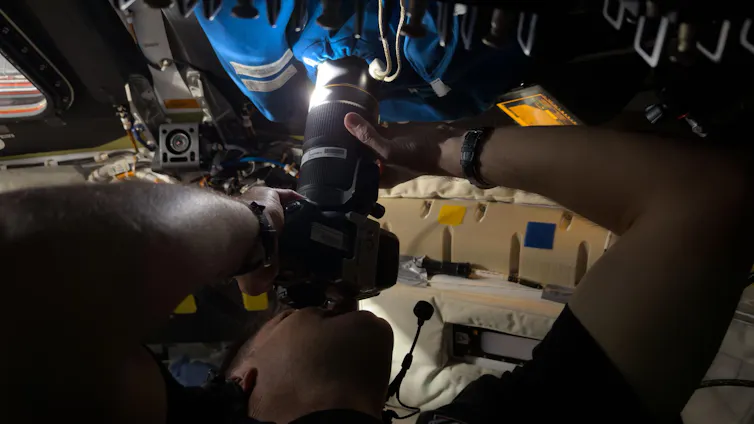
People back on Earth got to witness the mission through remarkable photos of space captured by astronauts. Images created and shared by astronauts underscore how photography builds a powerful, authentic connection that goes beyond what technology alone can capture.
As a photographer and the director of the Rochester Institute of Technology’s School of Photographic Arts and Sciences, I am especially drawn to how these photographs have been at the center of the public’s collective experience of this mission.
In an era when image authenticity is often questioned and with the capabilities of autonomous, AI-driven imaging, NASA’s choice to train astronauts in photography has placed meaning over convenience and prioritized their human perspectives and creativity.
Capturing space from the crew’s perspective
Photography was not originally placed as a high priority in NASA’s Apollo era. The astronauts only took photographs if they had the chance and all their other tasks were complete.
Thanks largely in part to public response to those images from Apollo, including “Earthrise” and the “Blue Marble” being widely credited for helping catalyze the modern environmental movement, NASA shifted its approach to utilize photography to help capture the public’s imagination by training their astronauts in photographic practices.
The Artemis II mission’s photographs have helped cut through the increasing volume of artificially generated images circulating on social media. NASA’s social media releases of the crew’s photographs have garnered thousands of shares and comments.
This excitement could be explained by the novelty of photos from space, but these images also distinguish themselves as products of astronauts experiencing these sights and interpreting them through their photographs. These differences require an important distinction around where technology ends and humanity begins.
Human perspective versus AI tools
Photography has long integrated AI-powered software and data-driven tools in a variety of ways: to process raw images, fill in missing color information, drive precise focus and guide image editing, among others. These modern technological assists help human photographers realize their vision.
Artificial intelligence is also increasingly capable of operating machinery competently and autonomously, from cars to drones and cameras.
And AI can generate convincing, realistic images and videos from nothing more than a text prompt, using readily available tools.
Researchers train AI to mimic patterns informed by millions of sample images, and the algorithm can then either take or create a photograph based on what it predicts would be the most likely version of a successful, believable image.
Human-created photos are rooted in direct observation, intent and lived experience, while AI images – or choices made by AI-driven tools – are not. While both can produce compelling and believable visuals, the human photographs carry emotional power because the photographer is drawing from their experiences and perspective in that moment to tell an authentic story.
Artemis II photographs resonate, not only because they are historic, but because they reflect the deliberate choices and intent of a human being in that specific moment and context. The exposure, camera setting, lens choice and composition are all dictated by the astronaut’s vision, skill, perspective and experience. Each image is unique in comparison with the others. These choices give the images narrative power, anchoring them in human perspective.
Images to tell a story
Photographers choose what to include in the final version of their image to tell a story. In the Artemis II images, this human perspective comes out. In the “Earthset” photo, you see a striking juxtaposition of the Moon’s monochromatic, textured surface in the foreground against a slivered, bright Earth.
The choice to include both in the frame contrasts these objects literally and figuratively, inviting comparison. It creates a narrative where Earth is contrasted against the Moon – life is contrasted against the absence of it.
Another photo shows the nightside of the whole Earth, featuring the Sun’s halo, auroras and city lights. The choice to include the subtle framing of the window of the capsule in the lower left corner reminds the viewer where and how this image was captured: by a human, inside a capsule, hurtling through space. That detail grounds the photograph in the human perspective.
Both photos are reminiscent of Earthrise and the Blue Marble. These past images hold a place in the global collective consciousness, shaped by a shared historical moment.
The Artemis II photographs are anchored in this collective moment of lived human experience, yet also shaped by each astronaut’s viewpoint. The crew’s unique perspectives exemplify photography’s transformative power by inviting viewers to engage emotionally and intellectually with their journey. These photographs share the astronauts’ awe and wonder and affirm the value of human creativity and its ability to connect us in a captured moment.
Christye Sisson, Professor of Photographic Sciences, Rochester Institute of Technology
This article is republished from The Conversation under a Creative Commons license. Read the original article.
Dive into “The Knowledge,” where curiosity meets clarity. This playlist, in collaboration with STMDailyNews.com, is designed for viewers who value historical accuracy and insightful learning. Our short videos, ranging from 30 seconds to a minute and a half, make complex subjects easy to grasp in no time. Covering everything from historical events to contemporary processes and entertainment, “The Knowledge” bridges the past with the present. In a world where information is abundant yet often misused, our series aims to guide you through the noise, preserving vital knowledge and truths that shape our lives today. Perfect for curious minds eager to discover the ‘why’ and ‘how’ of everything around us. Subscribe and join in as we explore the facts that matter. https://stmdailynews.com/the-knowledge/


Forgotten Genius Fridays
Octavia E. Butler: The Black Woman Who Helped Change Science Fiction
Discover how Octavia E. Butler transformed science fiction, explored Black identity, and helped shape Afrofuturism through her groundbreaking novels.

Forgotten Genius Friday | The Knowledge | STM Daily News
Octavia E. Butler: The Woman Who Reimagined the Future
When we think about science fiction, we often picture spaceships, robots, alien civilizations, and futuristic technology. But what happens when science fiction becomes a way to explore racism, inequality, human survival, and the consequences of our choices?
That is exactly what Octavia E. Butler brought to the genre.
Long before Afrofuturism became a widely recognized cultural movement, Butler was creating extraordinary stories that placed Black characters—especially Black women—at the center of imagined futures.
Her work challenged conventional ideas about who could be a hero, whose experiences mattered, and what science fiction could accomplish.
A Young Girl With a Powerful Imagination
Octavia Estelle Butler was born on June 22, 1947, in Pasadena, California.
Raised primarily by her mother and grandmother after her father’s death, Butler grew up shy and found comfort in books and storytelling.
Her mother worked as a domestic employee, and Butler sometimes accompanied her to work. Those experiences exposed her to the racial and economic inequalities that would later influence her fiction.
As a child, Butler loved science fiction, but she noticed something missing: people who looked like her.
Rather than accepting that absence, she began creating stories of her own.
She would eventually become one of the most influential writers in speculative fiction.
Breaking Barriers in Science Fiction
During the 1970s, mainstream American science fiction was largely associated with white male writers and protagonists.
Butler entered that literary world with a different perspective.
Her first published novel, Patternmaster, appeared in 1976. It introduced readers to a world shaped by extraordinary mental abilities, social hierarchies, and struggles for power.
Butler continued developing complex stories that explored humanity’s relationship with authority, identity, biology, and survival.
In 1979, she published one of her best-known novels, Kindred.
The book follows Dana, a Black woman living in 1970s California who is repeatedly transported back to a Maryland plantation before the Civil War.
Through Dana’s experiences, Butler forced readers to confront the brutality of American slavery and its continuing influence on the present.
Rather than treating history as something safely confined to the past, Kindred makes that history immediate and deeply personal.
Imagining the Future—and Warning Us About It
In 1993, Butler published Parable of the Sower, a novel set in a collapsing American society struggling with economic inequality, environmental destruction, violence, and weakened institutions.
Its central character, Lauren Olamina, is a young Black woman who develops a philosophy called Earthseed while searching for a way to survive and build a community.
The novel takes place beginning in 2024, making its imagined future particularly striking to modern readers.
Butler followed it with Parable of the Talents in 1998, continuing her examination of social instability, religious extremism, authoritarianism, and the struggle to create a better future.
Her novels were not literal predictions. They were works of speculative fiction that used recognizable social trends to ask difficult questions about where humanity might be headed.
Octavia Butler and Afrofuturism
Afrofuturism brings together African and African diasporic experiences with science fiction, technology, history, mythology, and imaginative visions of the future.
While artists such as Sun Ra and George Clinton explored cosmic identity through music, performance, and futuristic imagery, Butler used literature to investigate power, history, and humanity’s possible futures.
Her novels frequently placed Black women in situations where they had to navigate extraordinary challenges and reshape the societies around them.
Butler’s work is widely discussed within Afrofuturist scholarship, although her literary contributions also extend beyond any single cultural label.
She demonstrated that Black people did not have to remain secondary characters in someone else’s vision of the future.
They could be the architects of entirely new worlds.
Recognition and a Lasting Legacy
Butler received some of science fiction’s most significant honors, including Hugo and Nebula Awards.
In 1995, she became the first science-fiction writer to receive a MacArthur Fellowship, often called a genius grant.
Her work also included the Xenogenesis trilogy, later collected as Lilith’s Brood, which explored humanity’s encounter with an extraterrestrial species and raised questions about consent, adaptation, identity, and survival.
Butler died on February 24, 2006, at age 58.
Yet her influence has continued to grow.
Her novels are studied in classrooms, discussed by scholars, and embraced by new generations of readers and creators interested in science fiction, social justice, and Afrofuturism.
A Genius Who Made Us Think Differently About Tomorrow
Octavia E. Butler was more than a science-fiction author.
She was a visionary storyteller who understood that imagining the future also meant examining the past and questioning the present.
Her stories asked readers to consider how power operates, how communities survive, and how human beings might change.
And perhaps her greatest contribution was demonstrating that the future belongs in the imagination of everyone.
Why Octavia E. Butler Belongs in Forgotten Genius Friday
At STM Daily News, our Forgotten Genius Friday series celebrates extraordinary individuals whose ideas, innovations, and accomplishments helped shape our world, even if their stories aren’t widely known. Octavia E. Butler fits that mission perfectly. Although she received prestigious literary awards and recognition during her lifetime, her influence extends far beyond science fiction. Like the inventors, scientists, and trailblazers we’ve featured in this series, Butler challenged barriers, defied expectations, and opened doors for future generations. Through her imagination, she helped redefine who could tell stories about humanity’s future—and who could be at the center of those stories. Her inclusion in Forgotten Genius Friday reminds us that genius isn’t limited to laboratories and inventions. Sometimes, it begins with a pen, a powerful imagination, and the courage to envision a different world.
Sources and fact-checking
The Huntington Library holds Butler’s literary archive and confirms the chronology of her major novels, awards, and career. The MacArthur Foundation independently documents her 1995 fellowship.
- Official Octavia E. Butler biography
- The Huntington — Octavia E. Butler Papers
- MacArthur Foundation — Octavia Butler
- The Huntington — Telling My Stories exhibition
For more stories about overlooked innovators, writers, scientists, and visionaries who changed our world, explore The Knowledge and Forgotten Genius Friday at STM Daily News.

Food Truths
Soul Food Has African Roots—and a Distinct Black American History
Soul food connects African heritage with generations of Black American creativity and community. Here’s why shared roots and a distinct cultural identity both deserve recognition.
Last Updated on October 15, 2026 by Daily News Staff
Shared ancestry connects the African diaspora. It also makes understanding each community’s food traditions worth the effort.
A debate over who can claim soul food raises a question larger than any social media argument: When does a shared cultural inheritance become a distinct tradition?
People across Africa and the African diaspora have foods that evoke home, family, comfort, and belonging. Recognizing that connection is valuable. But using “soul food” as a general description of comforting food is different from identifying the cuisine historically known by that name.
Soul food is a distinctly African American culinary tradition with African roots, shaped by generations of Black life in the United States. Recognizing its American development does not erase Africa. Recognizing Africa should not erase what Black Americans created.
African Roots, American Development
Enslaved Africans arrived with agricultural knowledge, cooking skills, and food traditions. They adapted those traditions to unfamiliar surroundings and unequal access to food, drawing on available ingredients and encounters with Indigenous and European foodways.
Okra, black-eyed peas, and vegetable-centered cooking offer important connections to African traditions. Corn and cornmeal reflect Indigenous American agriculture. These ingredients and influences became part of an evolving food culture rather than remaining unchanged copies of dishes from another continent. [1]
The distinction is between ancestry and development. A cuisine can descend from older traditions and acquire its own identity through the experiences of the people who preserve and transform it.
More Than a Story About Scraps
Slavery and deprivation belong in this history. Enslaved people supplemented restricted food supplies through gardening and other means, and used small amounts of meat to season vegetables. But telling the entire story as “making something out of scraps” understates their knowledge and creativity.
Black food history also includes seafood work, farming, skilled cooking, and enterprise. The Smithsonian’s account of Black foodways, for example, documents African Americans’ extensive involvement in harvesting, processing, and selling oysters. [2]
These were people with expertise. Their contributions deserve recognition as culinary work and cultural creation.
Why the Name Matters
The food traditions are older than the widespread use of the name “soul food.” The term became prominent during the 1960s, amid movements asserting Black identity and cultural pride. Smithsonian histories describe the soul food movement as celebrating foods that mainstream America had often disparaged. [3]
That context gives the name meaning beyond a meal that tastes good or brings comfort.
For some families, a pot of greens or a pan of cornbread carries memories of relatives, church dinners, holidays, and recipes learned by watching someone cook. Calling those foods “soul food” places them within a particular cultural story.
Southern Roots Traveled
Soul food also developed beyond the South. During the Great Migration, Black Americans carried Southern food traditions into new cities and neighborhoods, preserving familiar dishes while adapting their cooking. Smithsonian programming connects that movement directly to soul food’s development. [4]
That helps explain how a cuisine rooted in the South became part of Black community life across the country.
It also makes geography an imperfect test of authenticity. Soul food cooked in London can still be African American soul food. A cuisine’s cultural origins do not change simply because someone prepares it elsewhere.
Shared Heritage Does Not Mean Identical Cultures
Africa is a continent of many food traditions. The diaspora is similarly diverse. African American, Afro-Caribbean, Afro-Latin American, and Black British identities encompass different histories and relationships to food.
Someone may use “soul food” figuratively to describe a cherished family dish. That emotional use is understandable. The difficulty arises when it becomes a historical claim that all Black cuisines are versions of the same named tradition.
Shared ingredients and ancestry establish connections; they do not make distinct cuisines interchangeable.
A useful conversation would ask which dishes are related, what techniques survived, and how different communities adapted them. That approach gives people more history to appreciate.
Respect Through Recognition
Defending soul food’s African American identity need not become an attack on Africans, Caribbean people, or Black Britons. Equally, celebrating connections across the diaspora should include respect for Black Americans’ particular contributions.
Anyone can cook, enjoy, study, and share soul food. Cultural recognition does not require closing the kitchen door. It requires crediting the people and history behind the cuisine.
Soul food’s African roots and African American identity belong in the same sentence. Both deserve to be remembered.
What dish connects you most strongly to your family’s history—and who taught you to make it? Share your story in the comments.
Explore more food stories and culinary traditions in STM Daily News’ Food & Drink section.
Sources and Further Reading
- African and Native American Foodways and Resilience: From 1619 to COVID-19 — Research on food traditions, adaptation, and cultural resilience.
- Black Foodways and Cuisine — National Museum of African American History and Culture.
- African American History Highlights — National Museum of American History, including the soul food movement.
- Cooking Up History — National Museum of American History programming on migration and soul food.
The Knowledge
Where Does Federal Money Go? The Biggest Costs Behind the Budget
Where does federal money go? Part two of our National Debt Explained series examines the biggest expenses in the 2025 budget and how spending connects to government borrowing.
Last Updated on October 13, 2026 by Daily News Staff
The Knowledge | National Debt Explained, Part 2
When discussing debt, ask: Who borrowed the money? That question helps distinguish a family’s finances from the federal budget. Our first episode explained why your credit card balance is separate from the national debt. Now comes the next question: What does the federal government spend money on?
Much of it pays for retirement benefits, health coverage, national defense, public services, and interest on previous borrowing.
Social Security was the largest individual program in fiscal year 2025, costing approximately $1.6 trillion. But combine the major health care programs—including Medicare, Medicaid, and health insurance subsidies—and their spending reached about $1.8 trillion, exceeding Social Security alone. cbo.gov
The figures below cover October 1, 2024, through September 30, 2025.Major expense FY 2025 spending What it supports Social Security About $1.6 trillion Retirement, survivor, and disability benefits Medicare, net $988 billion Health coverage for older adults and certain people with disabilities Net interest $970 billion Cost of servicing publicly held federal debt, after subtracting interest income Discretionary defense $893 billion Military personnel, operations, equipment, and research Medicaid $668 billion Federal contribution toward health coverage and care for eligible people
These are selected expenses, not the entire budget. Medicare spending is shown after premiums and other offsetting receipts. The combined health care total already includes Medicare and Medicaid, so it should not be added to those rows. cbo.gov
The government also supports veterans’ health care, transportation, education, housing assistance, courts, law enforcement, scientific research, disaster response, and environmental protection. Nondefense discretionary spending totaled approximately $980 billion in 2025, covering many of these services. Some funding for these areas falls elsewhere in the budget. cbo.gov
Federal spending falls into three broad groups:
- Mandatory spending: Payments governed by existing eligibility rules and benefit formulas, including Social Security and major health programs.
- Discretionary spending: Funding lawmakers control through appropriations legislation, including most defense spending and many public services.
- Net interest: The expense of servicing publicly held federal debt, minus government interest income. cbo.gov
Interest deserves attention because it pays for borrowing already undertaken. In 2025, net interest exceeded discretionary defense spending. Congressional Budget Office
A program’s cost does not automatically translate into an equal increase in national debt. Taxes and other receipts finance much of federal spending. Social Security and Medicare’s hospital insurance program receive dedicated payroll taxes, while Medicare also collects premiums.
In 2025, federal spending totaled approximately $7 trillion, compared with $5.2 trillion in revenue. The roughly $1.8 trillion shortfall was the deficit, requiring borrowing. Understanding national debt therefore means examining both what government spends and what it collects. cbo.gov
Explore more explanations behind the headlines at STM Daily News, home of The Knowledge.
Sources for this episode
- CBO: The Federal Budget in Fiscal Year 2025 — Overview of spending, revenue, deficits, and debt interest.
- CBO: Mandatory Spending in Fiscal Year 2025 — Breakdown of Social Security, Medicare, Medicaid, and other benefit programs.
- CBO: Discretionary Spending in Fiscal Year 2025 — Defense spending and services including transportation, education, and veterans’ health care.
- CBO: Overview of the FY 2025 Budget Infographics — Highlights the largest expenses and broader budget trends.
Related reading
- U.S. Treasury: Understanding the National Debt — What federal debt represents and how borrowing works.
- U.S. Treasury: Understanding the National Deficit — Explains the difference between an annual deficit and accumulated debt.
- U.S. Treasury: Federal Spending — Additional context about where federal money goes.




