art, culture and humanities
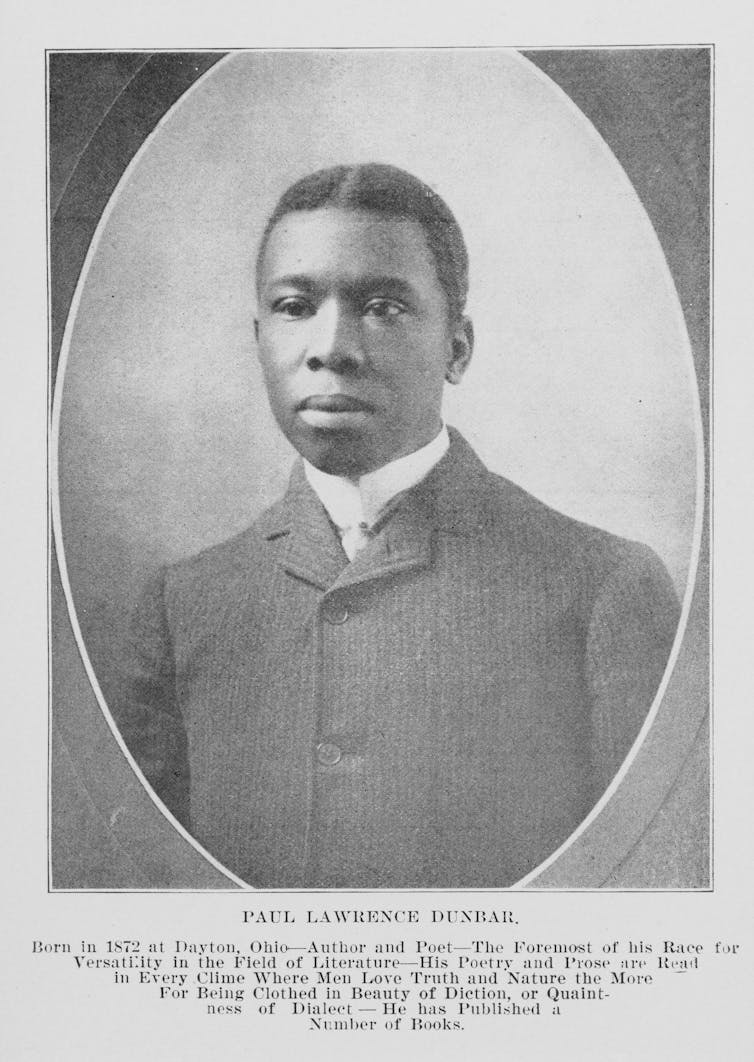
The brief but shining life of Paul Laurence Dunbar, a poet who gave dignity to the Black experience

Minnita Daniel-Cox, University of Dayton
Paul Laurence Dunbar was only 33 years old when he died in 1906.
In his short yet prolific life, Dunbar used folk dialect to give voice and dignity to the experience of Black Americans at the turn of the 20th century. He was the first Black American to make a living as a writer and was seminal in the start of the New Negro Movement and Harlem Renaissance.
Dunbar also penned one of the most iconic phrases in Black literature – “I know why the caged bird sings” – his poem “Sympathy.”
“… When his wing is bruised and his bosom sore, When he beats his bars and he would be free; It is not a carol of joy or glee, But a prayer that he sends from his heart’s deep core, But a plea, that upward to Heaven he flings – I know why the caged bird sings!”
Published in 1899, “Sympathy” inspired acclaimed Black writer and activist Maya Angelou to use Dunbar’s line as the title of her seminal autobiography.
But Dunbar’s artistic legacy is often overlooked. This, despite the fact that his work influenced a number of other great African American literary giants, including Langston Hughes, Nikki Giovanni, James Weldon Johnson, Zora Neale Hurston and Margaret Walker.
In a very real sense, Dunbar is your favorite poet’s favorite poet.
A blooming life of writing
Born on June 27, 1872, to two formerly enslaved people from Kentucky, Dunbar was raised by his mother, and they eventually settled in Dayton, Ohio.
While there, Dunbar attended the integrated Dayton Central High School. An exceptional writer, Dunbar was the only Black student in his class and became editor-in-chief of the high school newspaper as well as a member of the literary and drama clubs and debating society.
He also became friends with a white classmate who, with his brother, would later invent the airplane – Orville Wright.

The two knew each other well.
Their friendship led to business as the Wright brothers, who owned a printing press, were the first to print Dunbar’s writings, including the newspaper Dunbar started and edited, the Dayton Tattler, the first Black newspaper in that city.
After high school, the lives of Dunbar and Wright took different turns.
Unable to find consistent pay for his writing, Dunbar worked a variety of jobs, including as a janitor in one downtown Dayton office building and as an elevator operator in another. Not one to miss a business opportunity, the 20-year-old Dunbar sold his first book of poetry, “Oak and Ivy,” to passengers he met on the elevator.
He found another such job after he moved to Washington, D.C., and worked stacking shelves at the Library of Congress. According to his wife, Alice Dunbar, an accomplished writer in her own right, it was there that her husband began to think about a caged bird.
“… The torrid sun poured its rays down into the courtyard of the library and heated the iron grilling of the book stacks until they were like prison bars in more senses than one,” Dunbar wrote. “The dry dust of the dry books … rasped sharply in his hot throat, and he understood how the bird felt when it beats its wings against its cage.”
Dunbar’s first break came when he was invited to recite his poems at the 1893 Worlds Fair, where he met Frederick Douglass, the famous abolitionist. Impressed, Douglass gave Dunbar a job and called him the “the most promising young colored man in America.”
Dunbar’s second break came three years later. On his 24th birthday, he received a glowing Harper’s Weekly review of his second book of poetry, “Majors and Minors,” from the prominent Ohio-raised literary critic William Dean Howells.
That review came with a mixed blessing. Howells’ praise of Dunbar’s use of dialect limited Dunbar’s ability to sell his other styles of writing.
But that same review helped catapult Dunbar to international acclaim.
His stardom didn’t last long, though.
Diagnosed with tuberculosis in 1900, Dunbar died from complications of the disease on Feb. 9, 1906.
But his work survives.
Dunbar’s musical legacy
In all, Dunbar wrote 600 poems, 12 books of poetry, five novels, four volumes of short stories, essays, hundreds of newspaper articles and lyrics for musicals.
His poetry has been continuously set by composers, from his contemporaries to living composers still living today, including Carrie Jacobs Bond, John Carpenter, Harry Thacker Burleigh, William Bolcom and Zenobia Powell Perry.
Florence Price’s numerous settings of his texts include popular and advertisement music, while William Grant Still’s “Afro-American” symphony features spoken epigraphs of Dunbar poems before each movement.
Dunbar’s legacy in apparent not only in the concert hall, but on the theatrical stage as well.
Dunbar was librettist for an operetta by Samuel Coleridge Taylor, “Dream Lovers,” written specifically for Black singers.
Dunbar’s own extraordinary life became the subject for operas as composers Adolphus Hailstork, Richard Thompson, Steven Allen and Jeff Arwady composed works depicting Dunbar’s legacy.
The collaborations of Dunbar and Will Marion Cook produced the first examples of contemporary musical theater.
Without Paul’s contributions with “In Dahomey” and “Jes Lak White Fo’ks,” in my view there would be no “Hamilton,” the modern Broadway musical written by Lin-Manuel Miranda in 2015.
‘We wear the mask’
Dunbar’s works celebrated all of humanity.
He turned the plantation tradition on its head by using dialect to not only offer critical social commentary, as in his poem “When Malindy Sings,” but also to portray oft-ignored humanity, as in “When Dey ‘Listed Colored Soldiers.”
Dunbar’s works provide historical snapshots into the everyday lives of working-class Black Americans.
None were as poignant as his poem “We Wear the Mask.”
“We wear the mask that grins and lies, It hides our cheeks and shades our eyes, This debt we pay to human guile; With torn and bleeding hearts we smile, And mouth with myriad subtleties.”
Minnita Daniel-Cox, Associate Professor of Music, University of Dayton
This article is republished from The Conversation under a Creative Commons license. Read the original article.

Entertainment
Bring History to Life with Experiences That Feel Real
Bring History to Life: Reading books and watching documentaries can be good ways to learn about history, but there’s something particularly meaningful about immersive experiences that allow you to step inside the stories that shaped the world.


Bring History to Life with Experiences That Feel Real
(Feature Impact) Reading books and watching documentaries can be good ways to learn about history, but there’s something particularly meaningful about immersive experiences that allow you to step inside the stories that shaped the world.
During a visit to the U-505 Submarine exhibit at the Griffin Museum of Science and Industry (Griffin MSI), guests can literally step inside a historic German U-boat captured during World War II. In 1944, the U.S. Navy underwent a top-secret mission to disarm and take over one of the German submarines that wreaked havoc on the high seas, attacking not just military vessels but merchant ships and supply ships as well.
Watch this video to see more:
“The mission was a dangerous one, as U-boat captains were under strict orders to sink their own subs if they were in danger of capture,” said Dr. Voula Saridakis, head curator at Griffin MSI, “but the U.S. Navy managed to take over the vessel and keep it afloat long enough to reach American shores. There, they studied it to gather German military secrets and other intelligence items, like the codebreaking Enigma Machine now on display at Griffin MSI.”
As you tour the submarine, you’ll experience firsthand what life was really like on board. Climb through the hatch, picture yourself bunking for the night in the cramped sleeping quarters, take a turn trying to maneuver the submarine while dodging torpedoes and imagine the bravery of the American soldiers who risked themselves on a perilous mission to capture the vessel and help turn the tide of the war.
There are many important lessons to glean from history, and they’re often easier to understand when presented in a tangible way. Planning visits to museum exhibits and historical sites allows you to stand where others have stood, see what they’ve seen and connect your human experience with theirs. Parents, children, educators, students and people of all ages can find something to inspire them in these stories.
Learn more about bringing history and science to life at GriffinMSI.org.
SOURCE:
Griffin Museum of Science and Industry

Entertainment
‘Project Hail Mary’ demonstrates how intellectual humility can be a guiding force for scientists and astronauts

‘Project Hail Mary’ demonstrates how intellectual humility can be a guiding force for scientists and astronauts
Deana L. Weibel, Grand Valley State University
Early in Phil Lord and Christopher Miller’s science fiction blockbuster “Project Hail Mary,” middle school teacher Ryland Grace, played by Ryan Gosling, is tasked by an international coalition to uncover the biology of a strange microbe known as an “astrophage” that has been absorbing energy from an ever-dimming Sun.
Grace is a molecular biologist by training, but his controversial ideas and overconfident attitude have kept him out of academia. The viewer will see through flashbacks that as he’s matured, he’s developed a vital skill for solving the astrophage crisis: intellectual humility.
I’m an anthropologist who studies astronauts and space professionals to understand what space symbolizes to the people who experience it firsthand. Grace’s character in “Project Hail Mary” developed several of the traits that I’ve observed in the astronauts I’ve interviewed. These characteristics prove essential to success in high-stakes, uncertain situations. Warning: some plot points will be revealed ahead.
‘Project Hail Mary’ follows a middle school science teacher tasked with saving Earth from star-eating microbes.
Grace has been chosen as one of the first to study astrophage because of his Ph.D. dissertation on whether life can exist without water, a hot take in the world of science that, along with his rude response to peer reviewers, has gotten him banned from polite science conferences. The solar microbes eating the Sun seem to live without water, so Grace is the acknowledged expert.
Unfortunately, Grace can’t see into the mysterious, opaque little organisms until a dead one becomes translucent. Finally, Grace can see inside the microbe to study it, and he believes his hypothesis about life not needing water will be proven. However, chemical analysis reveals astrophage is made up of mostly water.
In a moment that undercuts both his expertise and his expectations, Grace is wrong. Crushed, he throws a tantrum, observed by a bemused assembly of international leaders.
What actually matters isn’t that Grace is wrong but what he does next. Only after Grace overcomes his frustration and need to be right is he able to move forward, returning to the problem with curiosity rather than defensiveness and the resolve to learn enough about astrophage to make saving the world a possibility.
Admitting what you don’t know
Perhaps the real hero of the story is not Ryland Grace himself but his intellectual humility. Intellectual humility, the admission of your own limited knowledge and a willingness to learn from others, sometimes seems to be undervalued, particularly by those in leadership positions.
People who are intellectually humble will say things like, “Tell me more,” or “I wish I had thought of that.” They don’t feel threatened when admitting vulnerability.
Some people, however, do feel threatened by the thought of admitting incomplete knowledge or appearing to have limitations. Instead of confessing what they don’t know, they may claim a kind of certainty that goes beyond their true expertise, shutting down further questioning. Intellectual humility, in contrast, encourages someone to remain engaged by highlighting how much they still have to learn.
Being contradicted by the facts can produce diverse reactions. For someone without intellectual humility, not knowing can feel like failure. It can lead to defensiveness, denial or a refusal to engage. With humility, however, not knowing is more interesting than scary. The defensiveness is gone, replaced by curiosity.
When Grace realizes his expectations about astrophage aren’t supported by scientific evidence, he goes from feeling sure to feeling unsure. Reality itself hasn’t changed, but Grace’s sense of reality shifts in an important way. He realizes that there is a great deal he still needs to learn about these microbes, without assumptions blocking new knowledge. His intellectual humility gives him a path forward, a way to reset and take in new information without shutting down.
Intellectual humility as a method
Ryland Grace is willing to learn, and this serves him well throughout the movie. His intellectual humility operates as a method, guiding how he approaches problems step by step.
For instance, once he realizes, to his dismay, that astrophage is made of water, Grace acknowledges this new truth. He doesn’t like it, but he accepts it. Moving forward, he avoids making assumptions about astrophage. Instead, he tests hypotheses using simple tools that have been cobbled together from items available in a big-box store.
His partner in this experiment is Carl, played by Lionel Boyce, who is there as a sort of half-“babysitter,” half-security guard, keeping an eye on Grace but also being irresistibly pulled into his scientific orbit.
Grace’s intellectual humility transforms Carl from a minder into a partner. Even though Carl isn’t a scientist himself, when Grace has to figure out how to make the lab’s astrophage experiment replicate the conditions causing the crisis in our solar system, it is Carl who suggests a solution.
Instead of being bothered that a nonscientist knew better than he did, Grace acknowledges the solution’s value, thanks Carl and uses Carl’s idea to reach a crucial discovery, proving himself to be open to ideas and feedback from others.
When Grace’s experiments struggle, he moves forward without defensiveness and instead displays increasing curiosity. His method of intellectual humility is to admit ignorance, test variables and revise working hypotheses based on new data, staying open to suggestions from others the whole time. To borrow a phrase from a different space story, “this is the way.”
Science fiction to real space exploration
Although “Project Hail Mary” is fictional, the attitude displayed by Ryland Grace is something I have seen in ethnographic interviews with astronauts and other space professionals, including engineers, astronomers and flight surgeons. Ethnography is a method of research, usually done in the long term, that combines interviews and participant observation.
When confronted with the reality of the universe – an enormous starry void we humans are only beginning to understand – scientists and space explorers are often stunned and humbled by the extent of their own ignorance. Although there are, without a doubt, less-than-humble people building rockets or going into space, intellectual humility is often a guiding force among many successful space researchers.

In my book, “The Ultraview Effect,” I trace the way a sense of cosmic awe can provoke feelings of humility and openness, which serve as catalysts for curiosity. This pattern, which I began to notice after an astronaut told me how seeing billions of stars with his own eyes made him realize how little he actually knew, is very similar to what Grace experiences in the movie.
Being open to awe and willing to be humbled by it isn’t weakness but strength. And in his embrace of intellectual humility, Grace lives up to his name.
Deana L. Weibel, Professor of Anthropology, Grand Valley State University
This article is republished from The Conversation under a Creative Commons license. Read the original article.
Looking for an entertainment experience that transcends the ordinary? Look no further than STM Daily News Blog’s vibrant Entertainment section. Immerse yourself in the captivating world of indie films, streaming and podcasts, movie reviews, music, expos, venues, and theme and amusement parks. Discover hidden cinematic gems, binge-worthy series and addictive podcasts, gain insights into the latest releases with our movie reviews, explore the latest trends in music, dive into the vibrant atmosphere of expos, and embark on thrilling adventures in breathtaking venues and theme parks. Join us at STM Entertainment and let your entertainment journey begin! https://stmdailynews.com/category/entertainment/
and let your entertainment journey begin!
Entertainment
Philly theaters unite to stage 3 plays by Pulitzer-winning playwright James Ijames
James Ijames, 2022 Pulitzer Prize winner for “Fat Ham,” is celebrated with a Citywide Pass in Philadelphia, offering access to three of his plays across different theaters. This initiative fosters collaboration among local theaters and showcases Ijames’ unique ability to create nuanced, character-driven narratives that explore complex queer and Black identities.

Bess Rowen, Villanova University
Most theater subscriptions offer a patron access to a single theater’s season. But Philadelphia’s new Citywide James Ijames Pass provides tickets to three James Ijames – pronounced EYE-ms, rhymes with “chimes” – plays at three theaters in Philadelphia. Subscribers will also get one mustard-colored beanie, one of Ijames’ signature accessories.
The full pass, which costs US$130, includes tickets for the Arden Theatre’s “Good Bones,” which premiered Jan. 22 and runs through March 22, the Wilma Theater’s “The Most Spectacularly Lamentable Trial of Miz Martha Washington,” which runs March 17 to April 5, and the Philadelphia Theatre Company’s “Wilderness Generation,” a world premiere that runs April 10 to May 3. There is also a two-show pass for $90 without “Good Bones.”
I’m a theater theorist, historian and practitioner who has written about Ijames’ work before and after his 2022 Pulitzer Prize. I believe this landmark collaboration between three important Philadelphia theaters is a fitting celebration of a multi-hyphenate theater artist who continues to champion his longtime artistic home.
Actor, playwright, director
Ijames, 46, was born in North Carolina and attended Morehouse College in Atlanta, Georgia. He earned his Master of Fine Arts degree at Temple University and stayed in Philadelphia after graduating.
Notably, this playwright’s MFA is in the study of acting. Ijames is also a talented director, and he performed and directed at multiple theaters around Philadelphia before starting to work as a playwright. He was also a tenured professor of theater at Villanova University, where I had the privilege to work with him and watch his creative process before he moved to New York City in 2025 to run the playwriting concentration at Columbia University.
Ijames was already a local celebrity in Philly before winning the Pulitzer Prize for drama for “Fat Ham,” his Hamlet adaptation centered on a queer Black Hamlet named Juicy and the legacy of his father’s barbecue joint. The New York theater scene took notice of him when the National Black Theatre staged “Kill Move Paradise” in 2017. This haunting piece is set in limbo, where unarmed Black men who have been killed by police examine how they have come to this place and how society continues to enable this pattern.
Other Ijames plays include “White,” a satire of the art world that tells the story of a gay white male artist who hires a Black woman actor to pretend to have done his work to see if that makes a difference in how his art is viewed. “TJ Loves Sally 4Ever” sets Thomas Jefferson and Sally Hemings’ relationship on a college campus where “TJ” is a dean and Sally is a student. And “Reverie” is a chamber play, which is an intimate meditation with an earnest and somber tone. In it, the father of a recently deceased Black gay man comes to meet the man he believed was his son’s partner.
Most recently, in 2025, Ijames partnered with the Australian pop singer Sia on a musical called “Saturday Church.” It is a story about reconciling queer community and Christian faith, and relying on the support of family, both biological and chosen.
Charting new dramatic territory
Although his theatrical styles and genres vary, at his core, Ijames writes nuanced, character-driven works that revolve around interpersonal relationships. His plays are playgrounds for performers, particularly due to his ability to write complex queer Black characters.
Influential American playwright Suzan-Lori Parks notes in her 1994 essay “Elements of Style” that the conflict between Black people and white people is the default trope of how Black people have been represented onstage – by almost exclusively white playwrights – for most of U.S. theater history. Parks posits that a way to avoid this centering of white conflict in Black lives comes from new dramatic territory that depicts conflicts between Black people and anything else.
Ijames never sets his Black characters in opposition to white society alone. He also refuses to take up the tropes of LGBTQ identity as incompatible with religion, or the idea that characters can be only gay or straight. Instead, Ijames creates narratives with queer religious people and pansexual men whose identities are not sources of conflict.
The citywide pass
The plays in the citywide pass offer an exciting cross section of what makes Ijames’s work so vibrant.
“Good Bones” is the story of a now-affluent Black woman, Aisha, who moves back to her blue-collar hometown. Aisha might be from this working-class neighborhood, but her elaborate renovations and white-collar sensibilities make her return seem more like gentrification than homecoming, at least as far as her local contractor can see.
“Miz Martha” follows the titular Martha Washington through a fever-dream-inspired trial in her final moments, as enslaved people care for her while knowing her death means their freedom.
And “Wilderness Generation” follows five cousins reunited in the U.S. South after many years apart, ready to talk about the secrets from their pasts.
With theater’s ever-changing and unstable financial landscape, I believe the Citywide James Ijames Pass is an exciting new subscriber model. The collaboration highlights Philadelphia’s theatrical talent and banks on local theaters working together to build audiences instead of treating each other as competition – a new development that could change how regional theater scenes operate.
Bess Rowen, Assistant Professor of Theatre, Villanova University
This article is republished from The Conversation under a Creative Commons license. Read the original article.
Looking for an entertainment experience that transcends the ordinary? Look no further than STM Daily News Blog’s vibrant Entertainment section. Immerse yourself in the captivating world of indie films, streaming and podcasts, movie reviews, music, expos, venues, and theme and amusement parks. Discover hidden cinematic gems, binge-worthy series and addictive podcasts, gain insights into the latest releases with our movie reviews, explore the latest trends in music, dive into the vibrant atmosphere of expos, and embark on thrilling adventures in breathtaking venues and theme parks. Join us at STM Entertainment and let your entertainment journey begin! https://stmdailynews.com/category/entertainment/
and let your entertainment journey begin!