Connect with us

The Knowledge

Pumpkins’ journey from ancient food staple to spicy fall obsession spans thousands of years

Published

on

Last Updated on November 20, 2025 by Daily News Staff

Pumpkin
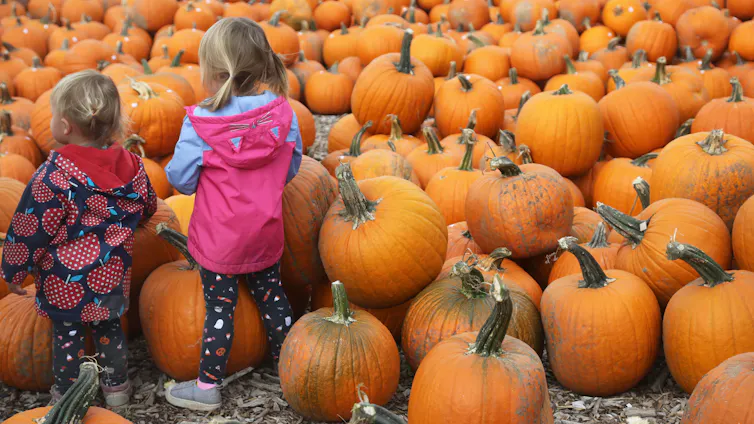
Pumpkin patch excursions have become a fall staple in many U.S. households.
Creative Touch Imaging Ltd./NurPhoto via Getty Images

Pumpkins’ journey from ancient food staple to spicy fall obsession spans thousands of years

Shelley Mitchell, Oklahoma State University

October in much of the U.S. brings cooler weather, vibrant fall colors and, of course, pumpkin-spiced everything. This is peak pumpkin season, with most of the American pumpkin crop harvested in October.

With the pumpkin spice craze fully underway, I find myself thinking more about pumpkins. As an extension specialist working at Oklahoma State University’s botanic garden, I educate the people pouring in to buy pumpkins at our annual sale about the plant’s storied history and its prominence today.

While people often picture pumpkins as bright orange, they actually come in a wide range of colors, including red, yellow, white, blue and even green. They vary in size and texture too: Some are smooth, others warty. They can even be miniature or giant.

The word “pumpkin” comes from the Greek word “peopon,” meaning “large melon.” Botanically, pumpkins are fruits because they contain seeds, and they belong to the squash family, Cucurbitaceae. This family also includes cucumbers, zucchini and gourds. Pumpkins are grown for many purposes: food, seasonal decorating, carving for Halloween and even giant pumpkin contests.
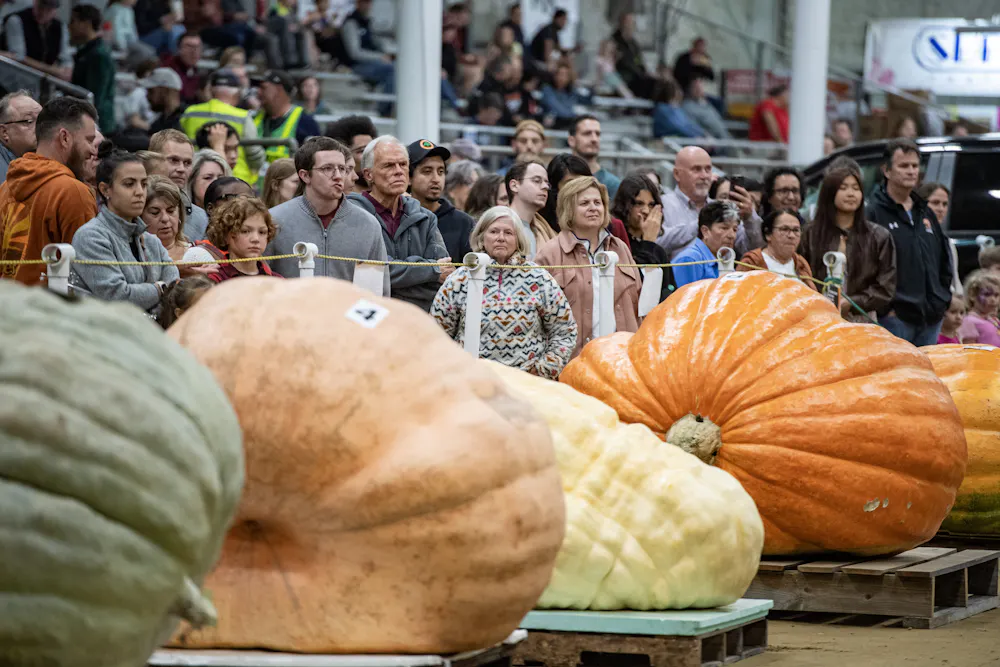
A crowd of people look at five large pumpkins lined up on small platforms
Some pumpkins can be over 1,000 pounds. Pumpkin-growing contests are common at county and state fairs.
Joseph Prezioso/AFP via Getty Images

All 50 states produce some pumpkins, with Illinois harvesting the most. In 2023, Illinois grew 15,400 acres of pumpkins. The next largest amount was grown in Indiana, with about 6,500 acres.

Pumpkin yields vary each year, depending on the varieties grown and the growing conditions in each area. The top six pumpkin-producing states are California, Illinois, Indiana, Michigan, Pennsylvania and Washington.

Early pumpkin history

Pumpkins originated in Central and South America, ending up in North America as Native Americans migrated north and carried the seeds with them. The oldest pumpkin seeds discovered were found in Mexico and date back about 9,000 years.

Pumpkins were grown as a crop even before corn or beans, the other two sisters in a traditional Native American “three sisters” garden. The three sister crops – corn, beans and squash – are planted together, and each has a role in helping the others grow.

Native Americans planted corn in the spring, and once the plants were a few inches tall, they planted beans. The beans vine around the corn as it grows, giving them a natural trellis. Beans also have the ability to take nitrogen from the atmosphere, and with the help of bacteria they convert it into forms that plants can use, such as ammonia, for fertilizer.

After the beans started growing, it was time to plant squash, such as pumpkin. Squash leaves covered the ground, shading the soil and helping keep it moist. The giant leaves also helped reduce the number of weeds that would compete with the corn, bean and squash growth.

Advertisement
Get More From A Face Cleanser And Spa-like Massage

Every part of the pumpkin plant is edible, even the flowers. Some Native American groups would dry pumpkins’ tough outer shells, cut them into strips and weave them into mats.

Pumpkins were introduced to Europe from North America through the Columbian Exchange. Europeans found that the pumpkins grown in the New World were easier to grow and sweeter than the ones in 1600s England or France, likely due to the weather and soil conditions in the Americas.
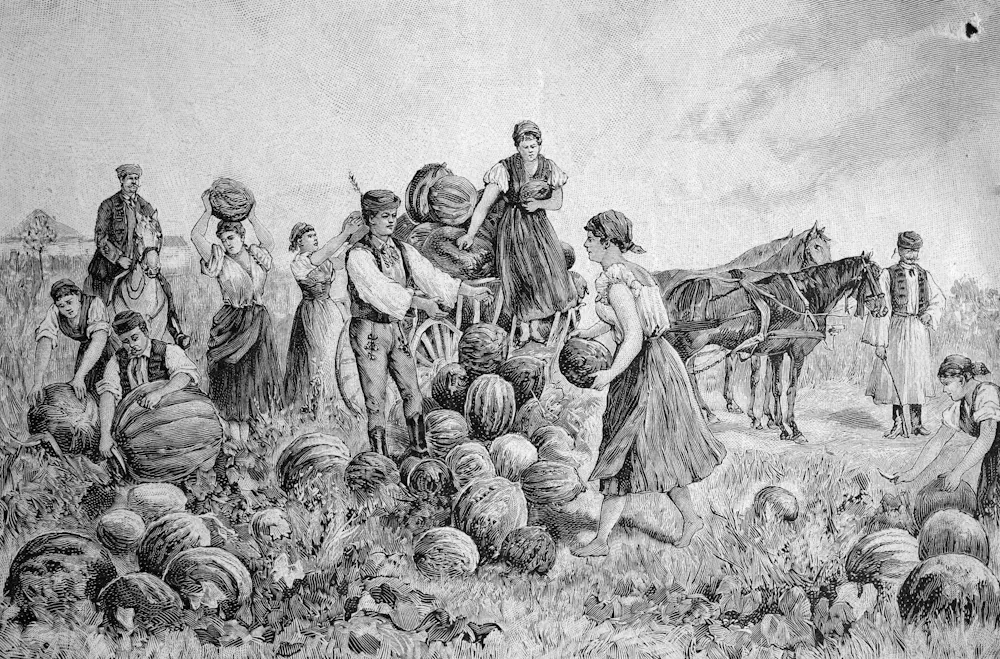
A black and white illustration of a group of people loading pumpkins in a cart.
People have been harvesting pumpkin for centuries. This historical illustration from around 1893 shows the pumpkin harvest in Hungary.
bildagentur-online/uig via Getty Images

Baking American pumpkins

Native Americans introduced early settlers to pumpkins, and the colonists eagerly incorporated them into their diet, even making pies with them.

Early settlers’ pumpkin pies were hollowed-out pumpkins filled with milk, honey and spices, cooked over an open fire or in hot ashes. Others followed English traditions, combining pumpkin and apple with sugar and spices between two crusts.

The custard-style pumpkin pie we know today first appeared in 1796 as part of the first cookbook written and published in the United States, “American Cookery,” by Amelia Simmons. There were actually two pumpkin pie recipes: one used mace, nutmeg and ginger, the other just allspice and ginger.

The pumpkin spice craze

Pumpkin spice as one mixed ingredient was sold beginning in the early 1930s for convenience. The spice mix typically includes a blend of cinnamon, nutmeg, ginger, allspice and cloves.

Pumpkins and pumpkin spice are now synonymous with fall in America. Pumpkin spice flavoring is used in candles, marshmallows, coffees, lotions, yogurts, pretzels, cookies, milk and many other products.

A white mug with a Starbucks logo, filled with foamy coffee and powdered cinnamon on top.
Starbucks’ pumpkin spice latte kicked off the craze thath put this seasonal flavor in high demand.
Beata Zawrzel/NurPhoto via Getty Images

While pumpkin spice is available in one form or another all year long, sales of pumpkin-spiced products increase exponentially in the fall. The pumpkin spice craze is so popular that the start of the pumpkin spice season is a couple of months before the pumpkins themselves are even ready to harvest in October.

Pumpkin excursions

Americans continue to wholeheartedly embrace pumpkins today. Pumpkins in production are typically hand-harvested as soon as they mature, when the skins are hard enough to not be dented when you press it with your thumb.

Children often take field trips to pumpkin patches to pick their own. With the growing popularity of agritourism, many farmers are letting the customers go into the field and pick their own, getting more dollars per pumpkin than farmers could get by selling through the markets. Customer harvesting also reduces labor costs, produces immediate profits and builds community relationships.

In addition, farmers often combine the you-pick experience with other sources of income: corn mazes, hay rides, petting zoos and more. The customers get fresher fruit, enjoy a fun and educational activity and support the local economy.

This year you could get pumpkin spice flavors across the United States by late August, and the industry started promoting pumpkin spice season in July. Because fall has the right conditions for pumpkin picking, the season will keep its hold on pumpkin spice flavor, and consumers will continue to eagerly await its return each year.

Advertisement
Get More From A Face Cleanser And Spa-like Massage

Shelley Mitchell, Senior Extension Specialist, Horticulture and Landscape Architecture, Oklahoma State University

This article is republished from The Conversation under a Creative Commons license. Read the original article.

Dive into “The Knowledge,” where curiosity meets clarity. This playlist, in collaboration with STMDailyNews.com, is designed for viewers who value historical accuracy and insightful learning. Our short videos, ranging from 30 seconds to a minute and a half, make complex subjects easy to grasp in no time. Covering everything from historical events to contemporary processes and entertainment, “The Knowledge” bridges the past with the present. In a world where information is abundant yet often misused, our series aims to guide you through the noise, preserving vital knowledge and truths that shape our lives today. Perfect for curious minds eager to discover the ‘why’ and ‘how’ of everything around us. Subscribe and join in as we explore the facts that matter.  https://stmdailynews.com/the-knowledge/

Continue Reading
Advertisement Sports Research

The Knowledge

Asteroid 1998 KY26: Can Sunlight Explain Its Motion?

Sunlight may explain the unusual motion of asteroid 1998 KY26. A new study casts doubt on the dark comet theory, and Japan has canceled its planned visit.

Published

on

Last Updated on November 20, 2026 by Daily News Staff

Feature Image Prompt — Asteroid 47186 cP6
Artist’s illustration of asteroid 1998 KY26. Sunlight pressure and heat radiated by the asteroid may explain the small deviations in its orbit.

A tiny asteroid about the length of a school bus has been drifting slightly off the path astronomers would predict from gravity alone. The object, known as 1998 KY26, spins once every five minutes and 21 seconds. One of the strongest explanations for its unusual motion comes from a familiar source: sunlight. 

In a 2025 study, researchers led by NASA’s Jet Propulsion Laboratory modeled two small forces acting on the roughly 36-foot-wide asteroid. Sunlight exerts pressure when it strikes the surface, and the asteroid gets another tiny push as it radiates heat back into space. When the team accounted for the asteroid’s irregular shape and rapid spin, the model closely matched its observed trajectory. 

A newer study published in Icarus casts doubt on another explanation. Astronomers had proposed that escaping water vapor might give KY26 a gentle push without producing a visible tail, making it a candidate for what scientists call a “dark comet.” But temperature simulations found that even the object’s coldest regions would be too warm to hold on to buried water ice over long periods. The findings make long-lived ice a less likely source of the asteroid’s extra acceleration. 

A close-up look was planned for 2031, when Japan’s Hayabusa2 spacecraft was due to rendezvous with KY26. On November 17, Japan’s space agency announced that ion-engine trouble had forced a change of plans. The spacecraft is now slated to fly past a different asteroid, 2015 BM510, in April 2028. 

Sources

Related reading on STM Daily News

https://stmdailynews.com/asteroid-1999-an10-earth-flyby-2027/
Continue Reading

Transportation

LA Metro’s D Line Extension to Century City Needs $296 Million More as Completion Slips

LA Metro is seeking another $296 million for D Line Extension Section 2 as the project’s substantial-completion forecast shifts from spring to fall 2027. Metro has not announced a replacement date for passenger service to Beverly Hills and Century City.

Published

on

LA Metro’s D Line Extension to Century City Needs $296 Million More as Completion Slips
AI-generated editorial illustration; not an actual photograph.

LOS ANGELES — The next segment of LA Metro’s D Line subway extension is facing a major cost increase and a later construction milestone as the agency works to finish stations serving Beverly Hills and Century City.

Metro staff is asking the agency’s Board of Directors to increase the life-of-project budget for D Line Extension Section 2 by $296 million, from approximately $2.575 billion to $2.871 billion. The proposed increase amounts to about 11.5 percent of the project’s current budget.

According to a Metro Board report, Section 2 was 95 percent complete as of September 2026. However, its unallocated contingency had fallen to approximately $6.7 million, an amount Metro says is insufficient to carry the project through completion.

https://stmdailynews.com/los-angeles-graffiti-towers-cleaned-up-as-oceanwide-plaza-awaits-next-chapter/

Contractor settlement and additional construction costs

The requested funding includes a $151 million settlement with design-build contractor Tutor Perini/O&G over a time-related claim. The contractor initially sought more than $200 million, while other claims and notices brought the total potential value of the disputed issues above $357 million.

Metro also identified approximately $75 million in added cost exposure connected to a secondary tunnel liner. Other expenses include additional construction work, real estate costs, extended professional services and restored contingency for remaining risks.

This would be the project’s second major budget increase. The Metro Board approved an additional $134 million in July 2023, after a Federal Transit Administration risk assessment found that the project’s budget was insufficient.

Completion shifts to fall 2027

The negotiated settlement also changes the contractor’s milestone schedule. Metro says the forecast for substantial completion has shifted from spring 2027 to fall 2027.

Metro had previously listed spring 2027 as the start of passenger operations for Section 2. The agency has not announced a revised revenue-service date in the new Board report. Because substantial completion is now forecast for fall 2027, the previous spring opening timetable no longer appears achievable. Testing, safety certification and operating preparations would still be required before riders can use the extension.

Section 2 will extend D Line service about 2.6 miles west from Wilshire/La Cienega, adding the Beverly Drive and Century City stations. It is the middle portion of Metro’s nine-mile Westside subway expansion. Section 1 opened in May 2026, while Section 3 is intended to continue the line to Westwood/UCLA and the Westwood/VA Hospital.

How Metro proposes to cover the increase

Metro staff recommends using $296 million in Measure R transit-capital funds currently programmed for the Division 20 rail-yard program. Proposition A funds would then replace that money for Division 20.

The report says reducing the scope, shortening the segment or relying on additional value engineering is no longer practical because construction is so advanced. Metro warns that without the budget amendment, it would be unable to fund completion according to the current schedule.

Advertisement
Get More From A Face Cleanser And Spa-like Massage

The proposal is scheduled for consideration by Metro’s Finance, Budget and Audit Committee on November 19, 2026. The budget amendment will still require Board approval.

The disclosure is consequential for riders because it places both the cost and timing of the Beverly Hills–Century City extension under renewed scrutiny. Although the subway is approaching completion, Metro must now secure hundreds of millions of dollars more and establish a realistic opening timetable for one of the region’s most important transit expansions.

Source

https://stmdailynews.com/review-your-medicare-coverage-options-open-enrollment-is-through-dec-7/
Continue Reading

astronomy

Large Asteroid 1999 AN10 Will Safely Pass Earth in August 2027

A large asteroid, 1999 AN10, will safely pass Earth on August 7, 2027, at roughly the Moon’s distance. The flyby could offer binocular views and valuable opportunities for scientific study.

Published

on

Last Updated on November 15, 2026 by Daily News Staff

A close approach near the Moon’s distance could give skywatchers a chance to spot the asteroid with binoculars.

Illustration of asteroid 1999 AN10 passing near Earth against a star-filled background.
Artist’s illustration of asteroid 1999 AN10, which will safely pass Earth on August 7, 2027. Not to scale.

A large asteroid will sweep past Earth on August 7, 2027, offering scientists a valuable research opportunity and skywatchers a potential binocular target. The asteroid, known as 1999 AN10, will safely miss our planet.

How close will asteroid 1999 AN10 come to Earth?

NASA’s Jet Propulsion Laboratory predicts the space rock will pass roughly 242,000 miles (390,000 kilometers) from Earth’s center—about the same distance as the Moon. That is close in astronomical terms, but the predicted flyby poses no impact threat.

Its exact size remains uncertain. JPL estimates a diameter of about 800 meters, or half a mile, while noting considerable uncertainty. Upcoming observations could help researchers better determine its dimensions, shape, and surface features.

Although 1999 AN10 is classified as a potentially hazardous asteroid, that designation describes its orbital proximity and size. It does not mean the asteroid is expected to strike Earth during this encounter.

Can you see the asteroid in August 2027?

For astronomy enthusiasts, the flyby could provide a memorable observing opportunity. JPL predicts the asteroid will reach approximately magnitude 7.5 on the night of August 6–7, making it a possible target for binoculars or small telescopes under suitable conditions. It is expected to be too faint to see with the unaided eye.

Scientists also plan radar observations that could reveal detailed surface features. The encounter offers a chance to learn more about a large near-Earth asteroid as it passes safely through our cosmic neighborhood.

Explore more astronomy and science stories in The Knowledge at STM Daily News.

Sources:

● NASA/JPL, Goldstone Radar Observations Planning: https://echo.jpl.nasa.gov/asteroids/1999an10.2027.goldstone.planning.html

● EarthSky, Mountain-sized asteroid 1999 AN10 to pass close to Earth in 2027: https://earthsky.org/space/mountain-sized-asteroid-1999-an10-pass-close-to-earth-aug-7-2027/

Advertisement
Get More From A Face Cleanser And Spa-like Massage
Continue Reading

Trending

